“Money’s too tight for your gifts,” my son’s wife texted.
Forty-eight hours later, I saw she’d bought her mom a Surface Pro, iPad, and headphones.
I cancelled their chalet reservation.
That night, my son called: “Mom, what did you do?!”
The text arrived on a Wednesday morning while I was sitting at my kitchen table in Brockville, watching the St. Lawrence River freeze at the edges through the frost on the window glass. I had just wrapped both hands around a mug of Earl Grey when my phone lit up on the placemat beside me. I read it twice.
Rosalind, Carter and I won’t be doing Christmas gifts for you this year. Money has been really strained lately.
No greeting, no softening, just my first name dropped at the front of a sentence that landed like a door closed quietly but firmly in my face.
My son Carter and his wife Yvette had been married for four years. They both worked. Carter as a project manager at an engineering firm in Ottawa, Yvette as a dental hygienist at a busy clinic nearby. They lived in a four-bedroom detached house in a nice part of the West End, drove matching Subarus, and took two holidays a year without fail. The mortgage they carried was entirely manageable. I knew because Carter and I had gone over the numbers when they bought the place, sitting at this very table with his laptop open between us, both of us running figures until we were satisfied he could handle it comfortably. Money being tight was possible, I suppose. Life has a way of humbling everyone, and I tried, genuinely, to extend them that grace.
But something about the bluntness of that text bothered me more than the news itself. The thing that scraped at me was the fact that she had used my first name, not Mom, my first name. As if she were cancelling a dentist appointment.
I set down my mug, typed back, “Don’t worry about it at all. I hope you both have a wonderful Christmas.” I pressed send, turned the phone face down on the table, and went back to watching the river. I managed to stay gracious for exactly forty-eight hours.
I want to be honest about something, because it matters for understanding what came next. I had spent a good portion of that Wednesday telling myself the text was reasonable. I sat with my tea going cold and ran through every charitable explanation I could construct. Perhaps Carter’s firm had slowed down on bonuses this year. Perhaps there had been an unexpected dental bill, an unexpected car repair, the ordinary attrition of a young family’s finances. I had raised two children largely on my own in the years after my husband’s first heart scare, back when his hours were cut and we lived carefully for the better part of two years, counting out grocery money at the kitchen table the way some people count out medication. I remembered what that felt like, the particular shame of having to say no to small things in front of people who didn’t understand why. So I gave Yvette and Carter the benefit of every doubt I had available to me. I told myself that a withheld Christmas gift from a daughter-in-law was not, in the grand accounting of a life, a significant wound. I told myself I was being petty for even noticing how the text was worded.
I did the dishes. I called my sister Jean in Kingston, and we talked for forty minutes about nothing in particular, her knee replacement recovery, a mutual friend’s granddaughter’s wedding, the price of good coffee these days. I did not mention the text. I was, by Wednesday evening, nearly convinced I had already let it go.
On Friday evening, I was sitting in my living room with a glass of red wine and a novel I hadn’t been able to concentrate on for the better part of three chapters. I scrolled through Instagram out of habit. Yvette’s mother, Paulette, kept a very active account. She lived in Mississauga, had strong opinions about everything, her garden, her grandchildren, the correct way to make butter tarts, and she posted constantly. I had followed her out of goodwill in the early days of the marriage, back when I still believed that kind of gesture mattered, back when I was trying so hard to make this new, blended family feel seamless. I remember commenting on her tomato plants once, early on, and she’d written back three paragraphs about heirloom varieties, and I had thought, foolishly, that we were building something.
The new post was a video. In the thumbnail, Paulette was sitting at her kitchen island, surrounded by shopping bags, one hand pressed to her chest in theatrical delight. The caption read, “Spoiled absolutely rotten by my Carter and Yvette, best kids in the world.” I pressed play.
The video was just under a minute long. Paulette turned the bags toward the camera one by one. A Microsoft Surface Pro, still sealed in its box. A pair of Sony noise-cancelling headphones in their case. And then, held up last with maximum effect, an iPad with a keyboard cover already attached. “For my quilting tutorials,” she announced cheerfully to whoever was watching. “Carter researched everything himself. Best son-in-law a woman could ask for.”
I set my wine glass down on the side table very carefully. I did it the way you set something down when your hands have started to shake slightly and you do not want to spill. The items on that screen totaled well over three thousand Canadian dollars. A Surface Pro starts at twelve hundred. The Sony headphones were another four hundred. The iPad with the keyboard cover, nine hundred at least.
I watched the video a second time. Then a third. I found myself pausing it on the frame where Paulette’s face was closest to the camera, her delight so unguarded and so entirely unaware of me, of the text message sitting two days old in my phone, of the particular arithmetic I was now performing against my will.
You do not spend three thousand dollars on your mother’s early Christmas when money is tight. You spend three thousand dollars on her when one family matters and the other is simply background.
I put the phone face down on the couch cushion and sat very still for a moment. Outside, the first real snowfall of the season had started, those big soft flakes that stick to the window and muffle every sound on the street. I watched them come down, and all the small moments came back to me in that quiet. The way Yvette had always used my first name, even after Carter once asked her gently not to, a conversation he’d relayed to me afterward with visible discomfort, as though he’d rather not have had to have it at all. The Christmas two years ago when she booked Paulette a table at a nice restaurant downtown for her birthday but forgot mine entirely, and I found out through Carter, who apologized on her behalf while Yvette scrolled through her phone across the room, not even looking up for the apology. The summer they had asked me to take the grandchildren for two full weeks so the two of them could take Paulette to Portugal. I had done it without a single complaint because I adored those children. I would do it again. But I was starting to understand the arithmetic of how I was valued in this family, and the sum was arriving slowly, piece by piece, the way these things always do, never all at once, never in a way you can point to and say, there, that was the moment.
I thought, too, about smaller things. The way Yvette had once corrected my seasoning on a dish I’d made for Easter, in front of the whole table, with a laugh that was meant to sound playful and didn’t quite land that way. The way she referred to my house, when she thought I wasn’t in earshot, as “Carter’s childhood place,” as though I were simply a fixture that came with the property rather than the woman who had raised him there. None of these things, on their own, would have amounted to much. Strung together on a Friday night with a glass of wine going warm in my hand, they formed a pattern I could no longer pretend not to see.
I got up, walked to my bedroom closet, and took down the large accordion folder from the top shelf. Inside it were the printed confirmations for this year’s Christmas surprise. Every year since my husband passed three years ago, I had used a portion of his life insurance to create a Christmas experience for the whole family. I never announced it in advance. I planned it, paid for it, and surprised everyone when it was done. It had become the thing people looked forward to most. This year, I had outdone myself considerably.
I had rented a chalet in the Laurentians, a proper one just past Sainte-Agathe, with six bedrooms, a stone fireplace large enough to stand in, a cedar sauna, and a view of the ski mountain that had made me exhale slowly when I first saw it on the listing. The five-night rental over Christmas week had cost seven thousand dollars. I had also purchased a full ski pass package for all the adults and booked a private dinner for Christmas Eve at a restaurant in the village that had a three-month wait list.
My daughter Cordelia had been the other person invited. She lived in Hamilton and worked as a high school vice principal. She was steady and warm and had never once in her adult life made me feel like a burden or an afterthought. She was the one I called when I needed to think something through properly, the one who still sent me articles she thought I’d find interesting and called on Sunday mornings just to talk, no agenda, no request attached. She had two teenagers of her own and a partner, James, a quiet, dependable man who had fit into our family so easily it sometimes surprised me to remember he hadn’t always been part of it.
I sat on the edge of the bed with the folder open across my knees and read through the confirmation emails slowly. Carter’s name. Yvette’s name. The guest list for the dinner reservation. I read it all. Then I walked to the desk in the corner, opened my laptop, and logged into the rental portal.
The property manager had given me a direct email at the time of booking because the chalet required a single point of contact for any changes. I wrote him a short note asking to reduce the reservation from six bedrooms to three, to remove two adults from the ski pass package, and to cancel two of the seats at the Christmas Eve dinner. He confirmed the changes within twenty minutes and told me a partial refund, roughly twenty-four hundred dollars, would be processed to my card within the week.
The booking system automatically sent update emails to all registered adult guests whenever a reservation was modified. Yvette’s email address was listed as a secondary contact because she had asked to be included at the time of booking, something she’d specifically requested months earlier, wanting to be able to check availability of amenities herself. She would receive the notification.
I made myself a cup of chamomile tea and went to bed. I did not sleep particularly well. I lay there in the dark going over the conversation I expected would follow, rehearsing lines I suspected I would not actually use, the way you do when you know, somewhere beneath the surface calm, that something significant has just been set into motion.
The call came at 8:43 the next morning. I was still in my housecoat, standing at the kitchen counter spreading marmalade on toast, when Carter’s name lit up my screen. I set the knife down and answered.
“Mom.” His voice was tight in the way it gets when he is trying to stay measured. “What happened with the chalet?”
“What do you mean?” I asked.
“Yvette got an email last night. It says the reservation was modified. Our names aren’t on it anymore. The ski passes are gone.”
“That’s correct,” I said.
A pause. “Did something go wrong with the booking? Did they overbook it or something?”
“No,” I said. “I made the changes myself.”
A longer pause this time. When he spoke again, his voice had shifted, quieter, more careful. “Mom, why?”
“Money’s been strained lately,” I said evenly. “I had to make some adjustments.”
The silence that followed had weight to it.
“That’s — you’ve had the reservation for months. Everything was already paid for. What does money being strained — ”
“I saw Paulette’s Instagram post,” I said. “The Surface Pro, the headphones, the iPad with the keyboard cover. It looks like a beautiful early Christmas for her. I’m glad you were both able to do that.”
He said nothing.
“I received a text on Wednesday,” I continued, “informing me that gifts for me this year had been cancelled due to financial strain. Forty-eight hours later, I watched a video of Paulette unwrapping what appears to be over three thousand dollars in electronics. So I applied the same reasoning to my own budget. Things got tight. I made adjustments.”
I heard him breathing on the other end, the particular sound of someone trying to find footing on ground that has just shifted.
“Mom, Cordelia and I are still going,” I said. “The chalet is smaller now, but we’ll be very comfortable. I hope you have a wonderful Christmas, Carter.”
I heard him exhale. Then Yvette’s voice came through in the background, quick, insistent, the specific sharpness of someone who has just been told something they refuse to accept. “I waited.”
“She wants to talk to you,” Carter said quietly.
“Tell her I’ll speak with her another time,” I replied. “Have a good day, sweetheart.”
I hung up, finished my toast, and washed my plate. I felt something I hadn’t expected. Not satisfaction, not guilt, but a kind of clarity, like a room where the furniture has always been slightly wrong, and someone has finally moved it to where it belongs.
I spent the rest of that morning in an odd, unhurried calm. I watered the few houseplants that survive my indifferent care through the winter. I called Cordelia and told her, briefly, what had happened, and she was quiet for a moment and then said, “Good,” in a tone that suggested she’d been waiting a long time to say it. “You’ve let that go on for years, Mom. I didn’t want to be the one to point it out, but I’m glad somebody finally did the math out loud.”
“You noticed too?”
“Everyone noticed, Mom. You were just the only one still pretending not to.”
That observation sat with me for the rest of the day, uncomfortable in the particular way true things often are. I thought about all the years I had absorbed small slights in the name of keeping the peace, telling myself that grandmothers were supposed to be endlessly flexible, endlessly forgiving, that my job was to smooth things over so the children never felt the friction of the adults around them. I had been so committed to that role that I had not noticed, until a video of electronics on a kitchen island, how thoroughly I had disappeared inside it.
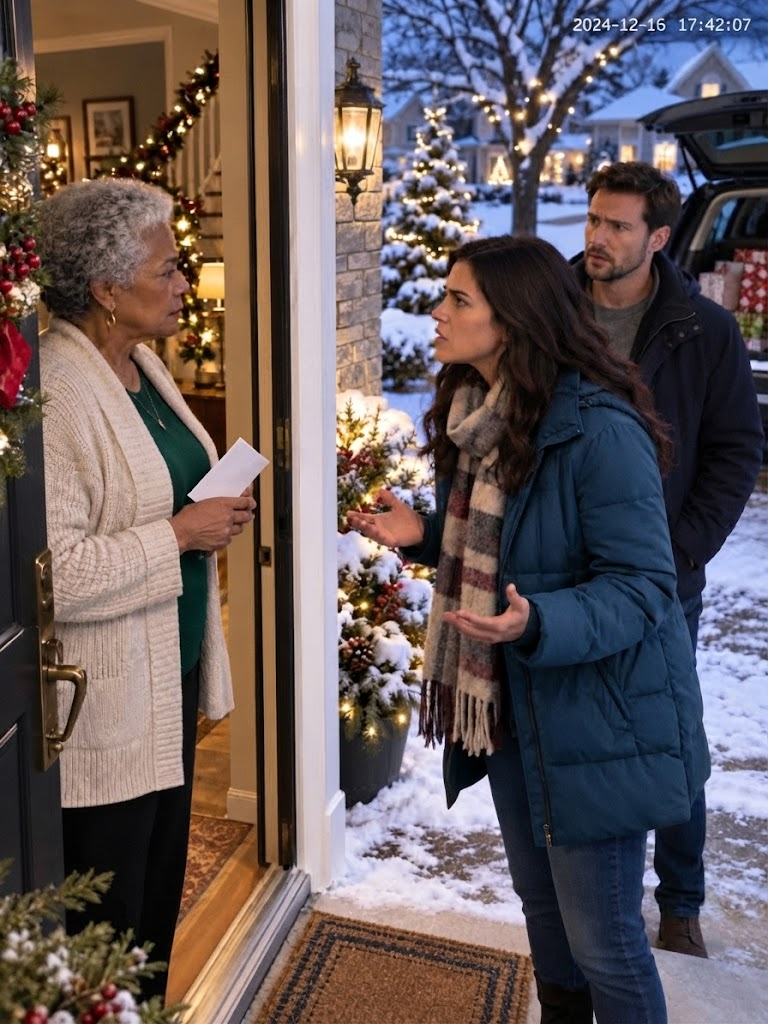
They arrived at my front door that afternoon. I had seen the car from the kitchen window and had not hurried. I opened the door with my reading glasses still on and a dish towel still in my hand, as though they’d interrupted something ordinary, which they had.
Carter looked stricken. Yvette looked ready for a fight. “Rosalind,” she said, stepping forward without greeting me properly, her chin up in the way it gets when she has rehearsed something. “This is completely unreasonable. Those children have been told about the chalet for weeks. Carter’s kids have been drawing pictures of the mountain. You cannot just pull that from them without any warning.”
“I gave the same notice you gave me,” I said pleasantly.
“That is not the same thing,” she said. “A text about a gift is not the same as cancelling a family trip.”
“You’re right,” I agreed. “What I cancelled was considerably more expensive.”
Carter put a hand on her arm. “Mom, can we come in? Can we sit down and talk about this properly?”
I stepped back and let them into the front hall. I did not invite them further into the house. We stood there in the entry, our winter coats still on, the cold still clinging to the fabric of theirs.
“I don’t want an argument,” I said. “So I’ll keep this brief. You sent me a message saying gifts were cancelled because finances were tight. That message arrived two days before I watched a video of Paulette opening thousands of dollars of gifts you had bought for her. I am not angry about the gifts for Paulette. You are absolutely entitled to spend your money how you choose. But you do not get to claim poverty to me on Wednesday and post luxury hauls on Friday. That is not honesty. That is hierarchy.”
Yvette opened her mouth. “I haven’t finished,” I said, and something in my voice, calm, unhurried, stopped her.
“I have absorbed quite a lot over the past four years. The way I am addressed, or not addressed. The birthday that gets overlooked. The two weeks I spent as free child care so you could take Paulette to Europe. I have done all of it without complaint because I love my son and I love those grandchildren. But I am not a resource to be managed. I am a person, and I have decided to behave accordingly.”
Carter’s face had gone very still. He was looking at the floor, at a spot just past my slippers, the way he used to look at the floor as a boy when he knew he was in the wrong but hadn’t yet worked out how to say so.
“One more thing,” I said. I reached into the pocket of my cardigan and held out a folded piece of paper to Yvette. She took it. It was a screenshot from my phone account with Rogers. Four lines listed, mine, Carter’s, Yvette’s, and a spare line they used for the babysitter. I had been paying the bill without fanfare for two years. It ran to around two hundred and twenty dollars a month.
“I’ll be removing the three additional lines at the end of the billing cycle,” I said. “That’s December thirty-first. You’ll want to contact Rogers before then to port the numbers to a new account, so there’s no interruption.”
Yvette’s face shifted. For the first time since she’d stepped onto my porch, something other than indignation crossed it, something closer to alarm.
“And the house key,” I added, holding out my palm. “I gave you both a copy when I had my knee surgery last spring. I’d like it back now. If there’s ever a real emergency, Cordelia has one, and she’s easy to reach.”
Carter stood there for a moment with his hand in his jacket pocket, the key in his palm, as though he was waiting for something to change, for me to relent, to say never mind, keep it, this has all gotten out of hand. Nothing changed. He set it into my hand, the metal still cold from his pocket.
Yvette said nothing. She had gone very quiet, the way people do when they are rapidly recalculating something they had assumed was fixed, running new numbers through an equation they hadn’t realized was still open to revision.
“Drive safely,” I said. “The roads are getting icy.”
I closed the door. I stood in the front hall for a moment afterward, listening to their car pull out of the driveway, and then I went back to the kitchen and finished the dishes I’d left in the sink, my hands steadier than I expected them to be.
The next two weeks were the quietest I had known in years, and I say that as a compliment. Cordelia came by twice to help me pack and organize for the trip. She had heard from Carter. He had called her, hoping she might intervene. She told him, not unkindly but with complete clarity, that she wasn’t going to do that. “You made your bed,” she’d said, which was entirely accurate, and she relayed the conversation to me over tea with a small, satisfied smile that I recognized from her father.
“He actually thought I’d talk you out of it,” she said. “I told him I was looking forward to my room having an actual door this year instead of a pull-out couch.”
“That’s not very diplomatic of you.”
“I wasn’t trying to be diplomatic, Mom. I was trying to be honest. Those are different things, and I think you’ve spent forty years mixing them up on everyone’s behalf but your own.”
I didn’t have an answer for that right away. I thought about it while I packed, folding sweaters into the suitcase on my bed, and I decided, eventually, that she was probably right.
Yvette tried several approaches over those two weeks. The first was a text with a photo of Maisie, their youngest, sitting by the Christmas tree, looking very small and very sad. The caption read, “She keeps asking why she can’t go to the mountain with Grandma.” I looked at that photo for a long moment, at Maisie’s round face, at the way she was hugging her knees to her chest in front of the lit tree. I typed back, “I love Maisie so much. I’ll have her over for a baking afternoon in January, just the two of us. She will have a wonderful Christmas.” I meant every word of it. Whatever had shifted between Yvette and me, it had nothing to do with that little girl, and I was not going to let it.
The second attempt was a Facebook post, one of those vague inspirational quotes about releasing toxic energy and protecting your peace from people who don’t deserve it. I saw it, understood what it was, and muted her account without comment. I did not engage. I had learned, somewhere in the last two weeks, that engaging with that particular kind of performance only feeds it.
The third attempt was Carter calling on a Sunday evening, his voice carrying the specific exhaustion of someone who has been asked to make a phone call he doesn’t entirely believe in. He said they should have handled things differently. He apologized for the text Yvette sent. He did not mention the iPad or the Surface Pro or the Sony headphones. I told him I appreciated him saying so and that I would talk with both of them in January. I kept the call warm and brief.
I was not punishing my son. I was not performing coldness. I simply no longer had the energy to engineer reconciliations I hadn’t caused the need for.
There was a fourth attempt, one I haven’t mentioned, because it was the one that actually troubled me. Paulette herself called, three days before Christmas, her voice bright and performative in a way that made my stomach tighten the moment I picked up.
“Rosalind! I just wanted to say, I’m so sorry if there’s been some kind of misunderstanding between the kids. I had no idea my little gifts would cause such a fuss.”
“There’s no misunderstanding, Paulette. I saw the video. I understand exactly what happened.”
“Well, I just think it’s a shame the grandchildren have to suffer for something between the grown-ups.”
“The grandchildren aren’t suffering,” I said. “They’re going to have a lovely Christmas at home with both their parents and their other grandmother, who, from what I understand, bought them each something from under that tree as well.”
There was a pause on her end, the particular pause of someone who has just realized the conversation is not going to unfold the way they’d planned.
“I don’t think that’s really fair to say,” she said.
“I’m not trying to be fair to you, Paulette. I’m being honest with myself, which is something I should have started doing years ago.”
I ended the call shortly after that, politely but firmly, and I did not feel the particular guilt I expected to feel. I felt, instead, something closer to relief, the specific relief of a door finally closing on a room I’d been standing awkwardly inside for far too long.
On the morning of departure, the temperature in Brockville had dropped to minus nineteen. Cordelia arrived at 6:30 in her Jeep, helped me load the bags without being asked, and handed me a travel mug of coffee before I’d had the chance to go looking for one. Her partner James drove. Cordelia’s two teenagers, Lila and Benji, were in the back seat in various states of blurry excitement, one of them already asleep again before we had reached the highway. We crossed into Quebec as the sun came up properly, turning the fields on either side of the autoroute white and gold. I watched it from the passenger window and felt something I could only describe as uncomplicated.
James, I should say, had a particular talent for making long car rides pass easily. He put on a playlist of old Gordon Lightfoot songs he knew I liked, and somewhere around the second hour, Benji woke up enough to ask what the song was about, and James spent the next twenty minutes explaining the Edmund Fitzgerald to a thirteen-year-old with far more patience than the question probably warranted, and I sat in the passenger seat listening to the two of them and thought, not for the first time, how lucky Cordelia was to have found someone who fit so easily into the rhythm of our family, and how lucky I was, by extension, to have him too.
The chalet was smaller than what I had originally booked, but it was exactly right. Three bedrooms, a long farmhouse table in the kitchen, and a fireplace with stone running all the way to the ceiling. From the back deck, you could see the ski runs lit up through the spruce trees at night, strung with light like a paper lantern. The sauna was tucked off the side entrance and smelled of cedar and woodsmoke and decades of winter.
We arrived in the early afternoon, and there was the particular flurry of unloading a car that always happens at the start of any holiday, bags carried in, beds claimed, the teenagers racing each other up the stairs to see who’d get the room with the window seat. I stood in the main room for a long moment after the chaos settled, looking at the fire James had already started, at Cordelia unpacking groceries in the kitchen, at the snow falling steadily past the big windows, and I felt the particular ache of missing my husband that arrives at unexpected moments, usually when things are good rather than when they’re hard. He would have loved this chalet. He would have been the first one to suggest a card game, the first one up the next morning to shovel the deck before anyone else was awake, just so he could watch the sunrise alone with his coffee before the house woke up around him.
I let myself feel that for a few minutes, standing by the fire, and then I went to help Cordelia with the groceries, because that is what you do with grief after a few years, you let it visit, and then you get up and put the milk in the refrigerator.
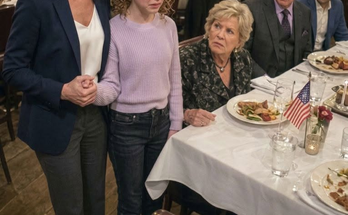
On Christmas Eve, we cooked together, a leg of lamb I had been marinating since that morning, roasted potatoes, green beans, and a tarte au pomme from a bakery in the village that James had driven into town to collect. We ate at the farmhouse table with the fire going and a playlist of old carols playing softly from a speaker on the counter. Cordelia’s teenagers, who I had fully expected to stare at their phones all evening, instead insisted on teaching James and me a card game they had learned at school and laughed loudly when I won three hands in a row.
“Grandma’s a shark,” Lila announced to the table, and I felt absurdly pleased by the title.
I checked my phone once during dinner, briefly. Yvette had posted a photo of their living room back home. The kids on the couch watching television. Paulette settled in the armchair with the new iPad propped on her lap. Nobody looking at anybody else. The caption read, “Quiet Christmas at home this year, making the best of it.” The comments were full of sympathetic responses from her friends. I looked at the photo for about four seconds. Then I placed the phone face down on the table and passed the potato dish to James.
Later that night, after the teenagers had gone up to bed and Cordelia and James had retreated to the sauna with a bottle of wine between them, I sat alone by the dying fire for a while, the house quiet around me, the snow still falling steadily past the windows. I thought about the version of this Christmas I had originally planned, the full chalet, the ski passes, the private dinner in the village, everyone gathered around this same fireplace. I thought about whether I had done the right thing, and I found, sitting there in the quiet, that I believed I had, not because it had been easy, but because it had been honest, and I had spent enough years mistaking exhaustion for peace to finally recognize the difference.
Christmas morning brought the sound of Cordelia’s teenagers on the stairs before it was fully light, and Cordelia’s laughter from the kitchen, and the smell of coffee and the orange buns she had brought from Hamilton and reheated in the oven. We opened presents around the fire. I had found Cordelia a pair of wool-lined gloves she had admired months ago in a shop window, and a framed photograph of her father taken the last summer he was well, standing at a lake with a fish he had just caught and a smile that took up his whole face. She cried a little, the good kind of crying, and held the frame in both hands for a long time without speaking.
For Lila and Benji, I had found a telescope, something their father had mentioned they’d been curious about, and we spent part of the afternoon out on the deck in the cold, all of us bundled in coats, trying to find a clear patch of sky between the clouds, Benji insisting he could see Saturn’s rings even though I suspected, privately, that what he was actually looking at was a slightly blurry smudge of cloud cover. It didn’t matter. The joy on his face was entirely real, and that was enough.
Carter called at noon. I stepped out onto the back deck with my coat pulled around my shoulders and answered. The air was sharp enough to sting the inside of my nose and turn my breath to white cloud.
“Merry Christmas, Mom,” he said. His voice was quieter than usual.
“Merry Christmas, Carter.”
“How’s the chalet?”
“Beautiful,” I said honestly. “We had a wonderful evening last night. Cordelia’s kids are excellent company.”
“Good. I’m glad.” He paused. “It’s been a strange Christmas here,” he said after a moment. “Yvette’s been thinking about the text she sent, about a lot of things.” He paused again. “Paulette hasn’t put the iPad down since she unwrapped it. She didn’t really sit with the kids for the movie last night.”
I didn’t offer any response to that. It wasn’t my place to comment on Paulette’s priorities, and I suspected Carter already knew that observation carried more weight coming from him than it ever would from me.
“Can we come for dinner in January?” he asked. “The four of us, with the kids. I think Yvette wants to have a proper conversation. I think we both do.”
I breathed in the cold air and looked at the spruce trees heavy with snow against a sky the color of pale iron. “Yes,” I said. “Call me after New Year’s and we’ll find a date.”
“Okay.” He sounded relieved, though I had promised nothing beyond a dinner. “Mom, I’m sorry. I should have said that a lot sooner than this.”
“I know,” I said. “We’ll talk in January. Tell Cordelia Merry Christmas from us.”
“I will. Give Maisie a hug from me.”
“I will. We’ll see you soon, sweetheart.”
I went back inside to the warmth and the noise and the smell of the fire, and I stood for a moment in the doorway watching my daughter and her family, Lila and Benji arguing cheerfully over the last orange bun, James laughing at something Cordelia had said, the fire crackling steadily in the hearth, and I thought, this is what it looks like when love doesn’t require an invoice.
The remaining days of the trip passed easily, the way good days tend to blur together afterward into a single warm impression rather than a sequence of distinct memories. We skied, or rather, James and the teenagers skied while Cordelia and I sat in the lodge drinking hot chocolate and watching through the big windows, both of us having long ago decided that our knees had earned the right to retire from that particular sport. We hiked a short trail behind the chalet on the second-to-last morning, the snow crunching underfoot, Benji identifying animal tracks with a confidence that was probably eighty percent invention and twenty percent actual knowledge gleaned from a nature documentary. We used the sauna every evening, the four adults taking turns with the teenagers, the cedar smell settling into my hair in a way that lingered pleasantly for days after we got home.
On our last night, Cordelia and I sat up after everyone else had gone to bed, the two of us sharing the last of the wine, the fire burned down to embers.
“Do you regret it?” she asked. “Pulling back on the chalet?”
I thought about the question seriously before answering, turning my glass slowly in my hand. “No,” I said. “I regret that it took me this long to notice what I was accepting. I don’t regret stopping.”
“I’ve wanted to say something for years,” Cordelia admitted. “About Yvette, I mean. The way she talks to you sometimes. But it felt like it wasn’t my place, and I was scared that if I said something, you’d just tell me I was overreacting, and then I’d feel foolish for even bringing it up.”
“I probably would have told you that,” I admitted. “I was very committed to believing it was fine. It’s easier, in a strange way, to absorb something than to name it. Naming it means you have to decide what to do about it.”
“And now you’ve decided.”
“Now I’ve decided.” I looked at her, at the firelight catching the side of her face, so much like her father’s it still occasionally startled me. “You never made me feel like that. Not once, in your whole life.”
“I had a good example,” she said simply, and reached over to squeeze my hand, and we sat there for a while longer not saying anything else, because nothing else needed to be said.
We drove home on the twenty-eighth, the roads clear, the sun bright and hard against the snow, and I spent the drive thinking less about Carter and Yvette than I expected to. Instead, I found myself thinking about the years ahead, about what I actually wanted them to look like, now that I had finally admitted to myself that I was allowed to want something rather than simply absorb whatever arrangement happened to be offered to me.
January came, and Carter and Yvette did come for dinner, the four of them arriving on a Saturday evening with Maisie clutching a drawing she’d made specially for me, a crayon rendering of what I eventually understood to be the chalet, complete with a stick-figure version of myself standing on the roof for reasons she couldn’t quite explain beyond “that’s where you’d want to be, Grandma, so you could see everything.”
Yvette was quieter than I had ever seen her, which in itself was something. She helped me in the kitchen without being asked, chopping vegetables for the salad while Carter and the children set the table, and partway through, apropos of nothing, she said, “I’ve been thinking about why I used your first name in that text.”
I kept chopping. “Oh?”
“I think I did it because it felt safer than calling you Mom and then having to actually explain myself to someone who deserved an explanation. It’s easier to disappoint a name than a person, if that makes sense.”
I set down my knife and looked at her properly. It was, I thought, the most honest thing she had ever said to me in four years. “It does make sense,” I said. “Thank you for telling me that.”
“I’m not asking you to put the phone lines back,” she added quickly. “Or the chalet thing. I understand why you did what you did. I just wanted you to know I’ve thought about it. A lot.”
“I appreciate that, Yvette.”
She used the word Mom for the first time in four years later that evening, over dessert, not loudly, just there, folded into a sentence about the recipe, asking whether Mom’s apple crisp recipe was the same one Carter’s grandmother used to make. I noticed, and I did not make a production of it.
We talked for three hours that night, long after the children had gone to watch a movie in the other room. Some things were said that needed saying. I did not pretend the past had not happened, but I also did not carry it into the room like a weapon. We found, without using the word agreement, that things would be different going forward. Yvette would call Maisie’s room “Grandma’s room” when we visited, not “the guest room.” Birthdays, mine included, would be remembered with the same care as anyone else’s. And the phrase money is tight would never again be used as a door closed in my face while it was flung wide open for someone else.
Whether they will stay different, I can’t say. That is not something I can control. What I can control is this: I am no longer waiting with held breath, hoping to be chosen by the people I have already chosen. I spend my Sundays now the way I spend them best, with Cordelia on the phone, with Maisie’s crayon drawing taped to my refrigerator door, with the quiet, steady understanding that love, the real kind, the kind that survives a bad Christmas and comes out the other side more honest than it went in, was never something I needed to buy. It only ever needed me to stop apologizing for expecting it.