I asked her to roll up his sleeve. When I saw the bruises, I didn’t scream. I pulled out my phone and started recording everything. But the worst thing was hidden inside my wife’s bedroom.
PART 1
“Your daughter doesn’t deserve a seat at this table. Let her eat standing up. She should be grateful she’s allowed to live here at all.”
Those were the first words I heard when I unexpectedly came home three days early.
My name is Gabriel Torres, and I’d been driving a freight route to Monterrey when the shipment was suddenly canceled. Instead of spending three unnecessary days away, I decided to surprise my family.
It was almost eleven at night when I reached our house in a quiet neighborhood of León.
Something immediately felt wrong.
The entire house was dark.
No television.
No music.
Not even the kitchen light.
Then I heard something coming from the laundry room.
I followed the sound.
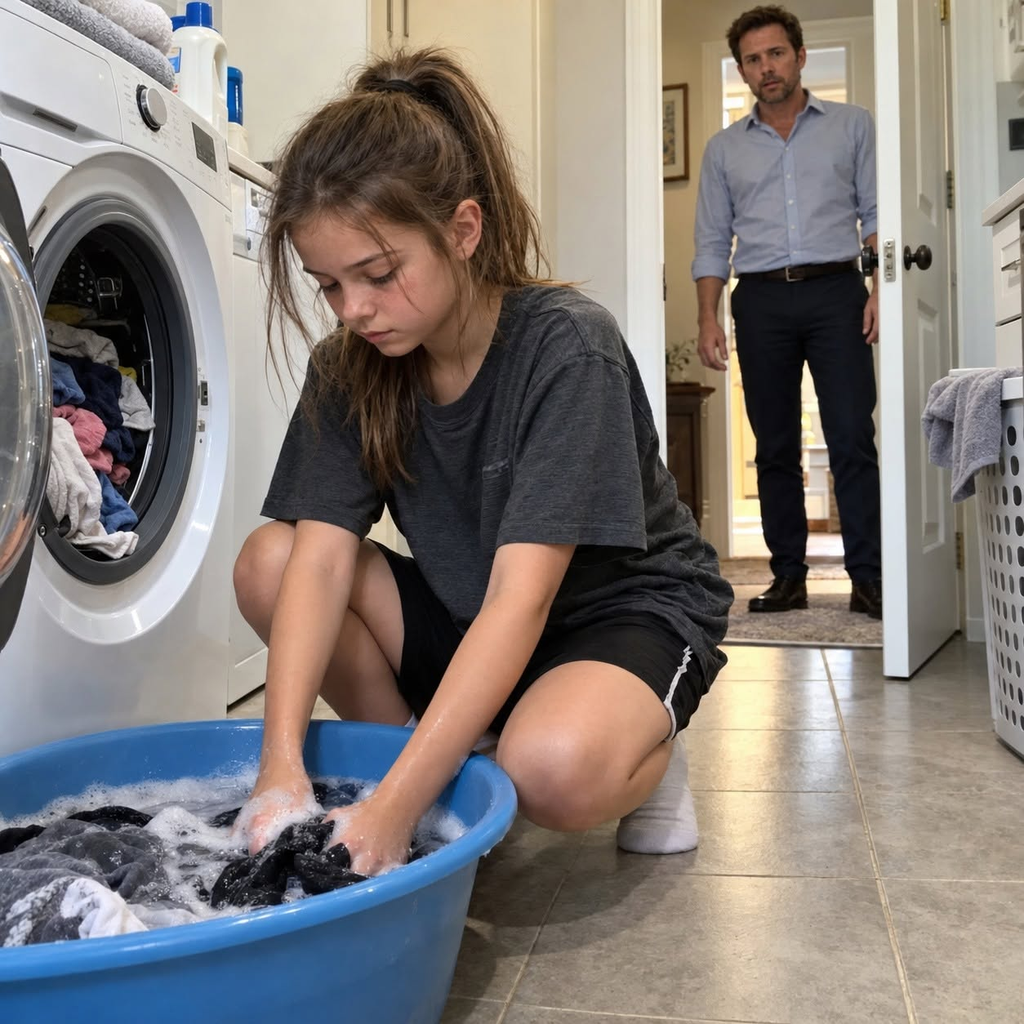
That’s where I found my sixteen-year-old daughter, Sofia.
She was bent over a plastic bucket, scrubbing a sweatshirt by hand in freezing water. Her fingers were red and raw.
Beside her, the washing machine was running.
It was filled with everyone else’s clothes.
“Sofia?”
She looked up so quickly that she nearly dropped the shirt.
“Dad?”
She looked terrified to see me.
“Where’s Patricia?”
Patricia was my second wife. Sofia’s mother, Elena, had died from cancer years earlier.
Sofia swallowed.
“They went to Cancún.”
“Who?”
“Patricia, her mom, her sister and Bianca.”
Bianca was Patricia’s sixteen-year-old niece, who had been living with us for almost a year.
“They left you here alone?”
Sofia nodded.
“They’ll be back Sunday. They told me everything had to be clean before they got home.”
I pointed toward the washing machine.
“Then why are you washing your clothes by hand?”
She looked down.
“I’m not allowed to use the machine for my stuff.”
I thought I’d misunderstood her.
“What?”
“They say wasting electricity and water on my clothes costs too much.”
Then she quickly pulled down the sleeves of her sweatshirt.
That movement caught my attention.
“Sofia.”
She froze.
“Pull your sleeves up.”
“Dad, I’m cold.”
“Please.”
Slowly, she obeyed.
I saw fading bruises, scratches and several dark marks along her forearms.
I didn’t yell.
I didn’t call Patricia.
I didn’t start smashing things.
Thirty years of driving trucks had taught me something important: when something goes wrong at highway speed, panic makes everything worse.
I told Sofia to shower and get some sleep.
Then I finished hanging the family’s laundry myself.
Afterward, I sat alone in the kitchen until sunrise.
At five in the morning, I made oatmeal pancakes.
Elena used to make them for Sofia.
When my daughter walked into the kitchen, I placed a plate in front of her usual chair.
“Sit down.”
She hesitated.
“You can sit here.”
She slowly lowered herself into the chair.
“Now tell me everything.”
It took several minutes before she started talking.
And once she did, she spoke without crying.
That frightened me even more.
She told me about meals she’d been denied.
Punishments that kept her awake until early morning.
Bianca hitting and humiliating her.
Her phone being hidden.
Patricia answering calls from school and pretending to speak for her.
Then Sofia told me about her birthday.
They had bought a cake.
Invited people.
Put up decorations.
Even used the candles I’d paid for.
But the party wasn’t for Sofia.
They’d celebrated Bianca instead.
“You called that day,” Sofia said quietly.
I remembered.
Patricia had told me Sofia was asleep.
“I wasn’t asleep,” my daughter said.
“I was outside.”
I stared at her.
“Outside where?”
“In the backyard.”
She looked down at her pancakes.
“I watched them through the window.”
Something inside me broke.
Then Sofia said:
“There’s something else.”
“What?”
“The silver cup Mom left me.”
I immediately knew which one she meant.
Elena had left Sofia a small engraved silver keepsake before she died.
“I found it in Patricia’s nightstand.”
I stood.
Upstairs, I opened the drawer.
The silver keepsake was wrapped inside a handkerchief.
But underneath it were things I wasn’t expecting.
Pawnshop receipts.
Bank cards carrying names I didn’t recognize.
Financial documents.
And a thick folder.
One word was written across the front:
WIDOWERS.
I opened it.
And suddenly, the marks on my daughter’s arms were only the beginning.
PART 2
Inside were printed obituaries from Guanajuato, Querétaro and San Luis Potosí.
Beside each name were handwritten notes.
Owns property.
No children.
Savings.
Vulnerable.
In progress.
Then I reached the fourth page.
My name was there.
Gabriel Torres. Widower. Transportation business. Strong assets. Daughter emotionally dependent on father.
Beside it, Patricia had written:
TARGET ALMOST SECURED.
I felt physically sick.
Patricia hadn’t entered my life by accident six months after Elena died.
Those sympathetic conversations at the cemetery hadn’t been coincidence.
Neither had our “unexpected” encounters at the supermarket.
Even the pot of soup she’d brought me because she supposedly understood grief suddenly looked different.
Before touching anything else, I took out my phone.
I recorded every drawer.
Every page.
Every receipt.
Inside the closet, I found packed suitcases, enough clothes for months, and nearly four hundred thousand pesos in cash.
Then I found Sofia’s phone hidden beneath a stack of towels.
When I turned it on, messages flooded the screen.
Teachers.
Friends.
School administrators.
And nineteen missed calls from me.
For months, Patricia had been controlling Sofia’s communication with the outside world.
Then I found a video.
Bianca was smashing Sofia’s bicycle against the curb while laughing.
The filename read:
PROOF FOR HER DAD.
That was when I stopped investigating alone.
I took Sofia to the hospital.
Doctors documented older injuries and signs of mild malnutrition.
Then I went to the bank.
The statements revealed regular withdrawals from an additional card Patricia had access to.
For nearly two years, she’d been transferring money to her sister, Lorena, and her mother, Elvira.
More than 1.2 million pesos was gone.
That afternoon, I visited our neighbors, Ernesto and Rosario.
Ernesto loved photographing birds from his rooftop.
Without realizing it, his camera had also documented what happened across the street.
There were photographs of Sofia carrying garbage outside at four in the morning.
Sofia standing alone beside a window eating.
Sofia watching from the backyard while Bianca blew out candles on the birthday cake meant for my daughter.
Rosario started crying.
“I brought her food that day,” she told me. “She thanked me like I’d saved her life.”
I contacted my business partner, Rafael, and an attorney named Isabella Salazar.
We froze what accounts we legally could, reported Sofia’s treatment to the appropriate child-protection authorities, and provided evidence to investigators.
Then Isabella discovered something worse.
One woman listed in the folder had been marked:
COMPLETED.
Her name was Teresa Aguilar, a widow from San Luis Potosí.
When Isabella contacted her, Teresa recognized Elvira immediately.
Elvira had worked as her caregiver shortly before Teresa’s life savings disappeared.
Meanwhile, Patricia kept sending me vacation pictures from Cancún.
One message read:
We miss you, sweetheart. Home Sunday.
I replied with four words:
I’ll be waiting here.
Sunday afternoon, their SUV pulled into the driveway.
Patricia stepped out smiling and deeply tanned.
Then she saw Isabella.
She saw the documents spread across the dining table.
And finally, she noticed the police vehicle parked outside.
Her smile vanished.
Elvira saw the open folder.
“Where did you get that?”
I placed the page containing my name on top.
“From the luggage you were apparently preparing for after you finished emptying my accounts.”
Patricia immediately started crying.
Lorena asked to speak with me privately.
Bianca tried to slip toward the back door.
Then an officer entered the house with another woman.
Teresa Aguilar.
The moment Teresa saw Elvira, she pointed at her.
“That’s her.”
The room went silent.
“She took everything from me.”
But one question remained.
Who had decided that breaking Sofia down was necessary to finish their plan?
The answer was worse than I expected.
PART 3
For several seconds, nobody moved.
Patricia stood beside the table.
Elvira’s expression hardened.
Lorena kept glancing toward the door.
And Bianca suddenly looked far less confident.
Teresa explained what had happened to her.
“Elvira introduced herself as a caregiver. At first, she helped with my medication. Then she started telling me my children were planning to abandon me.”
Teresa’s voice shook.
“She convinced me to change passwords, sign documents and give her access to my finances. Then one day she disappeared.”
“With my savings.”
Elvira laughed dismissively.
“One confused elderly woman proves nothing.”
Isabella opened her briefcase.
“She isn’t the only one.”
She placed two more files on the table.
Another woman had lost property.
A second had handed over money for a supposed family investment.
Patricia and Elvira appeared in both cases under different names.
I looked directly at my wife.
“When did you start targeting Sofia?”
Patricia began crying harder.
“I never wanted her hurt.”
“That wasn’t my question.”
She wiped her face.
“My mother said Sofia was too close to you.”
I felt my stomach tighten.
“Meaning?”
“As long as Sofia remained the most important person in your life, you wouldn’t sign over enough control.”
I turned toward Elvira.
She spoke almost casually.
“Your daughter was an obstacle.”
I stared at her.
“She was sixteen.”
“She had too much influence over you.”
“So what was the plan?”
Elvira shrugged.
“To make her seem difficult. Disobedient. Unstable. Eventually, you’d agree she should live with relatives or attend boarding school.”
I could barely process what I was hearing.
“And the marks on her arms?”
“Discipline.”
“The food?”
“Consequences.”
“And making her watch another girl celebrate her birthday?”
For the first time, Elvira looked away.
Then Bianca started crying.
“My grandmother told me to provoke Sofia.”
Everyone turned toward her.
“She said I should only record when Sofia reacted. She promised I could keep her bicycle.”
Bianca’s voice broke.
“And she said when we turned eighteen, I’d get a car.”
Lorena covered her face.
Then she started talking too.
“My mother planned everything. Patricia chose the targets. I moved money through smaller transfers.”
I felt sick.
“How did you choose me?”
Nobody answered.
Isabella already knew.
The folder contained everything.
My transportation business.
Two fully paid trucks.
A house without a mortgage.
And most importantly:
A job that kept me away for long stretches.
I had been perfect.
The final step was supposed to be a broad power of attorney.
Months earlier, Patricia had asked me to sign one, claiming she needed it to handle contracts and administrative matters while I traveled.
I’d told her I’d have my own lawyer review it first.
Apparently, that was when Elvira decided Sofia needed to be pushed out faster.
The legal process lasted months.
More evidence surfaced.
Messages showed Patricia telling Bianca to hide Sofia’s charger.
Other messages praised Elvira because Sofia had “almost stopped fighting back.”
There were recordings giving instructions for my calls.
Turn the television up.
Make her say everything is fine.
Don’t let her talk too long.
But the message that hurt most had been sent on Sofia’s birthday.
Make her watch from outside. She needs to understand she’s not his most important daughter anymore.
I had to leave the room when that message was read.
I stood in the hallway with both hands against the wall.
Then I heard footsteps.
Sofia.
“Dad.”
I turned.
She looked directly at me.
“What Patricia wrote wasn’t true.”
“I know.”
“I was still your daughter.”
My throat tightened.
Then she said something I’ll never forget.
“You just weren’t looking.”
She wasn’t trying to hurt me.
She was finally saying aloud what I’d failed to see.
And she was right.
FINAL PART
Patricia eventually faced serious consequences for the financial scheme and what had happened inside our home. Elvira’s role in organizing the operation and directing others brought even greater consequences. Lorena cooperated with investigators, returned part of the money and provided information about other victims.
Bianca was sent to live with her biological father, who had apparently known almost nothing about what was happening.
But legal consequences didn’t magically repair my daughter.
For months, Sofia still asked permission before opening the refrigerator.
If she accidentally broke a glass, she’d freeze and wait for someone to yell.
Sometimes I found bread hidden inside her backpack.
The first time it happened, she immediately said:
“I didn’t steal it.”
I felt my heart crack.
“I know.”
“Sometimes I’m scared there won’t be food later.”
From that day forward, I kept a basket filled with bread, fruit and snacks on the kitchen table.
Not because Sofia needed permission.
Because I wanted her to see it every time she walked past.
Food was hers too.
The house was hers too.
She didn’t have to earn either one.
I reduced my long-distance routes and hired another driver.
Eventually, I sold one of my trucks.
Sofia looked shocked when she found out.
“You and Mom worked for years to build the business.”
“I know.”
“Doesn’t selling it hurt?”
“Yes.”
“Then why do it?”
I looked at her.
“Because losing a truck hurts less than losing my daughter.”
One morning, I made breakfast and burned the tortillas.
Sofia took one bite and suddenly smiled.
“Mom used to say you could drive across all of Mexico but couldn’t heat one tortilla.”
I laughed.
Then nearly cried.
Elena used to say exactly that.
I went upstairs and returned carrying the silver keepsake Patricia had hidden.
I placed it in front of Sofia.
She carefully turned it over.
There was an engraving on the bottom.
For our daughter. Never doubt your place.
Sofia traced the words with her finger.
“Patricia told me Mom gave this to you.”
“She lied.”
“I knew it was mine.”
She looked down.
“But I didn’t think you’d believe me.”
That sentence hurt more than any accusation could have.
I lowered my head.
“I gave you reasons to think that.”
She stayed quiet.
“When Patricia sent you that video of me fighting with Bianca,” she finally said, “you asked why I hit her.”
“I remember.”
“You didn’t ask what happened before the video started.”
“I remember that too.”
“When I tried to explain, I sounded angry. Patricia always sounded calm.”
I nodded.
“So you believed her.”
“Yes.”
There was no excuse worth giving.
For years, I’d checked every shipment I transported.
Every seal.
Every invoice.
Every route.
But inside my own home, I’d accepted the easiest version of events because believing it allowed me to keep working without confronting what might really be happening.
“That wasn’t because you explained badly,” I told Sofia.
“It was because I listened badly.”
Her eyes filled with tears.
“So I’m sorry.”
I reached across the table but stopped before touching her hand.
“I won’t ask you to trust me immediately. I’ll earn it back for as long as it takes.”
Slowly, Sofia placed her hand over mine.
Recovery wasn’t dramatic.
It happened through ordinary things.
When Sofia woke at four in the morning and started cleaning the kitchen because her body was still used to doing chores before sunrise, I made hot chocolate and put on a movie instead.
When she asked permission to sit at the table, I reminded her that her chair had never belonged to anyone else.
When she said “I’m fine” too quickly, I learned to listen twice.
A year after the birthday she’d watched through a window, I woke before sunrise and made oatmeal pancakes.
There was fruit.
Hot chocolate.
And a cake far too large for the number of people coming.
Rafael arrived.
Isabella came.
Ernesto and Rosario brought food.
Even Sofia’s school counselor stopped by.
No expensive decorations.
No huge party.
Just crooked balloons, homemade food and people who knew exactly whose birthday they were celebrating.
Sofia came downstairs and stopped.
Her chair was positioned in the center of the table.
Rosario pointed toward it.
“Sit down before breakfast gets cold.”
Sofia smiled.
Then she sat.
Later that afternoon, she told me something I hadn’t known.
“Mom hid letters inside some of my books before she died.”
“Elena did?”
Sofia nodded.
“I found them when I used to wake up early to clean.”
“How many haven’t you read?”
“Nine.”
“Then read them whenever you want.”
She looked at me.
“You don’t have to save them?”
“No.”
I shook my head.
“You don’t have to ration comfort because you’re afraid it’ll run out.”
That evening, I climbed into the cab of my truck out of habit.
Through the side mirror, I saw Sofia standing on the porch holding her mother’s silver keepsake.
She raised one hand.
It was exactly how Elena used to wave goodbye before every long trip.
I put my hand on the ignition.
Then stopped.
I climbed back down.
Sofia looked confused.
“Forget something?”
I walked toward the porch.
“Yeah.”
“What?”
I sat beside her.
“I forgot I don’t have anywhere I need to rush off to today.”
For years, I’d driven other people’s cargo across Mexico, carefully checking every seal, document, weight and route.
Yet somehow I’d stopped checking the silence of my own daughter.
I can’t undo what happened to Sofia.
I can’t give her back the months when she felt like a stranger inside her own home.
But I came home before I lost her completely.
Now, every evening, we tell each other the best and worst part of our day.
I learned that “everything’s fine” can hide fear, hunger and shame.
And Sofia learned something even more important.
Her place at our table doesn’t depend on being quiet.
It doesn’t depend on working until sunrise.
And it doesn’t depend on being perfect.
That seat belongs to her.
Because this is her home.
And a child should never have to prove they deserve a place in their own family.