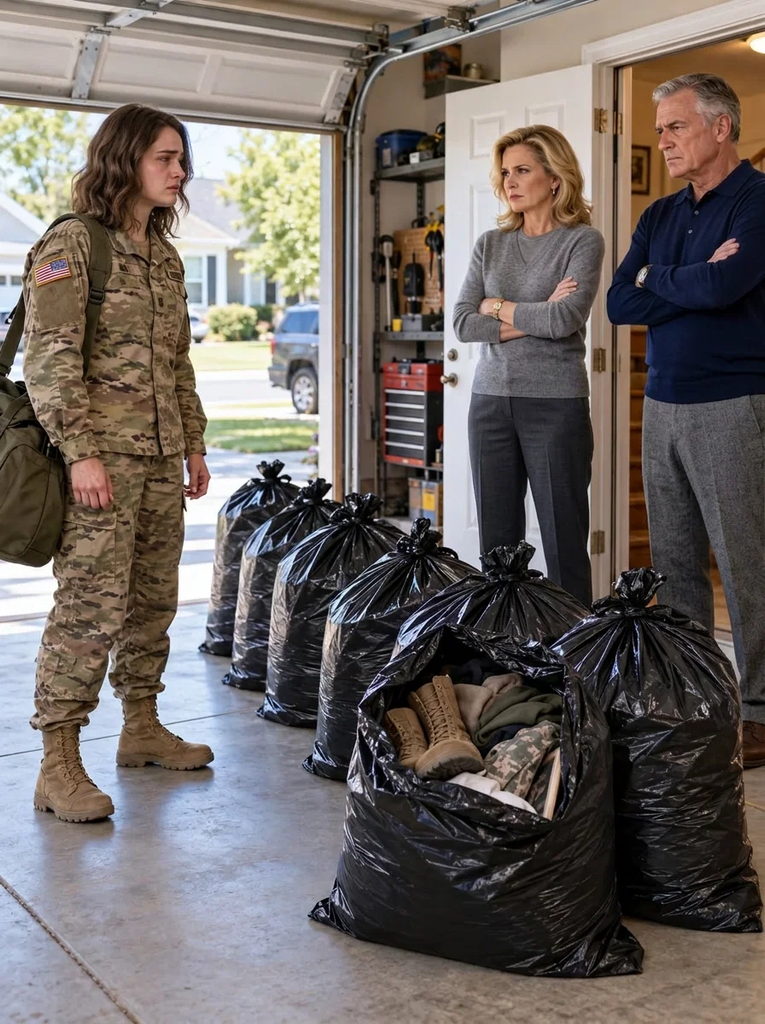
I finished tying the garbage bag and turned toward them.
Evelyn stood there in her usual pressed blouse as if she had somewhere important to be. My dad, Richard, stood behind her with his arms crossed, posture straight, still carrying himself like the colonel title had never retired with him.
Neither was smiling.
“You’re back earlier than we expected,” Evelyn said.
I blinked slowly.
“I told you my return date,” I said.
She waved that away like deployment schedules and time zones were optional suggestions.
“Well, things changed.”
Of course they had.
I lifted one of the garbage bags slightly.
“Yeah,” I said. “I can see that.”
Richard stepped forward, not aggressively, just enough to take up space.
“We needed to make some adjustments while you were gone.”
Adjustments.
That word carried a lot of weight in this house.
I looked past them into the living room. The furniture had been rearranged. New throw pillows. A framed photo I didn’t recognize.
None of it was mine.
“Where’s Chloe?” I said.
Evelyn finally smiled.
“Oh, she’s here upstairs resting.”
Resting.
That told me enough.
“And Vance?” I asked.
“Moved in.”
My duffel still sat on the porch behind me like it hadn’t gotten the message.
“And my room?” I asked.
Evelyn tilted her head like she was explaining something obvious.
“Well, honey, Chloe needed the master suite.”
Of course she did.
“She’s been under a lot of stress,” Evelyn continued. “You know how sensitive she is.”
Yeah.
Sensitive enough to need a king-size bed that wasn’t hers.
I nodded once.
“So, where am I sleeping?”
Richard answered.
“You’ve got options,” he said.
Options.
“The basement is available,” he added.
They had moved in last month.
Not visiting.
Not temporarily.
Moved in.
“Or you can head back to the barracks on base. Might be easier with your schedule anyway.”
I stared at him.
An unfinished basement with a cold concrete floor and half-installed drywall, or return to base like deployment had never ended.
Those were my options.
Evelyn stepped closer, using her soft public voice.
“We just thought it made more sense,” she said. “You’re single. You’re gone half the time. You don’t need all this space.”
There it was.
No guilt or hesitation, only certainty, as though they had justified this decision repeatedly before I ever got home.
“Be a good sister for once,” Evelyn added.
And there was the role I had played my whole life.
The reliable one.
The one who adjusted.
The one who made everything work.
They expected an argument.
I gave them none.
Instead, I walked between them.
Richard shifted slightly, maybe expecting me to go upstairs and make a scene.
I didn’t.
I passed the living room and kitchen and went straight to the basement.
The air grew colder as I descended.
Same unfinished walls.
Same dust and old paint.
Nothing had changed because no one cared enough to change it.
Behind several storage bins, I knelt beside a floor panel that didn’t quite match the others.
Still there.
Good.
I lifted it carefully.
The safe sat exactly where I had left it.
Digital keypad.
No scratches.
No sign anyone had touched it.
They hadn’t looked.
They didn’t know.
I entered the code.
Click.
Inside, protected by a waterproof sleeve, was one folder.
I opened it.
The original deed.
Still crisp.
Still untouched.
Not in Richard’s name.
Not in some shared family trust.
Mine.
Transferred years earlier, quietly and legally, protected through layers they had clearly never bothered to understand.
My grandfather had made sure of that.
A general didn’t leave loose ends.
My heartbeat steadied.
Upstairs, I heard movement and laughter.
They thought this house belonged to them.
They thought I was the one who no longer belonged.
I looked at the deed and smiled.
Barely.
They had no idea what they had done.
I kept the folder beside me and pulled my laptop from my duffel.
If they wanted to play house, I was going to check the rest of my life.
The laptop screen lit the concrete floor.
I connected to the Wi-Fi.
Same password.
Of course.
Nothing in this house changed unless it benefited Chloe.
I logged into my military banking portal.
Before the dashboard even finished loading, something felt wrong.
Experience teaches you not to ignore that feeling.
Then the balance appeared.
Wrong.
Not slightly off.
Wrong.
Hazardous-duty pay gone.
Deployment bonuses gone.
Not pending.
Not delayed.
Gone.
“Okay,” I muttered.
No panic.
Assessment.
I opened the transaction history.
Multiple transfers.
Clean.
Structured.
Whoever had done this knew when I was deployed, when communication was unreliable, and when I had almost no oversight.
I opened the first large withdrawal.
Domestic wire.
Then another.
Then another.
Different amounts.
Same pattern.
I pulled out a notebook and recorded dates, transaction numbers, and amounts.
This wasn’t emotional anymore.
It was a problem.
Problems could be documented.
I traced the destination accounts until one connected to Evelyn.
I checked twice.
Same routing number.
Same bank.
Same name.
“Of course,” I whispered. “Of course, it was her.”
Then I checked login records.
Every login leaves a footprint.
There were account accesses from my home while I was halfway around the world.
Same device signature.
Same location.
No attempt to hide it.
They had simply assumed I would never check.
Then I found a document uploaded three months earlier.
Power of attorney.
My name at the top.
Evelyn listed as authorized agent.
My signature at the bottom.
Except it wasn’t mine.
It resembled mine enough to fool someone unfamiliar with it, but the pressure and flow were wrong.
Copied.
Not written.
There was a witness signature and notary stamp too.
Official-looking.
Which made it worse.
This wasn’t simply theft.
It had been planned, documented, and filed.
I returned to the transactions and totaled them twice.
$45,000.
The money mattered.
But the access, intent, and forged paperwork mattered more.
I followed the trail beyond Evelyn’s account.
Large credits.
Irregular payments.
Then I saw the name attached to the debts.
Vance.
I stared at the screen and laughed once.
Sharp.
Of course.
Lieutenant Vance.
Perfect uniform.
Perfect posture.
Always talking about integrity and career progression.
Meanwhile, he was buried in gambling debt severe enough to require $45,000 to disappear quietly.
Debt that could destroy his security clearance.
And his career.
Everything clicked.
Evelyn hadn’t stolen from me for herself.
She had done it to protect Vance.
To protect Chloe’s perfect life.
At my expense.
I closed my eyes briefly and locked the facts into place.
Federal wire fraud.
Identity theft.
Forgery.
And an active-duty officer.
Vance wasn’t simply a man with bad habits anymore.
He was a liability in uniform.
I documented everything.
Screenshots.
Transaction logs.
IP records.
Copies of the forged power of attorney.
Everything duplicated and organized.
Then I connected my portable printer.
The pages came out one by one.
$45,000.
Forged authorization.
A paper trail running through my mother and directly to my sister’s husband.
I aligned the pages and slid them into the tactical folder I normally used for deployment briefings.
Appropriate.
Upstairs, they still thought this was about a bedroom.
About me being difficult.
It wasn’t.
This was evidence.
And I knew where evidence belonged.
I packed the laptop and went upstairs.
Before reaching the top, I smelled barbecue.
Then came laughter and clinking glasses.
I opened the door.
They were hosting a party in my backyard.
String lights.
Folding tables.
A full barbecue spread.
Officers everywhere.
Captains.
A major I recognized.
Even a lieutenant colonel near the cooler.
I hadn’t been home twelve hours, and somehow I was the guest.
Evelyn moved through the crowd effortlessly, touching shoulders, smiling warmly, laughing at exactly the right moments.
Perfect.
Always perfect.
“Harper,” she called loudly enough to turn heads.
Performance time.
I walked forward calmly.
Every person who looked at me seemed to perform the same quick assessment.
Posture.
Expression.
Condition.
They were trying to match me to whatever version of me they had already heard about.
Evelyn gave me a quick hug.
Too quick to mean anything.
“We’re so proud of you,” she said just loud enough for the nearby group to hear.
I didn’t hug her back.
“Didn’t know I was getting a welcome party,” I said.
Her smile tightened.
“Oh, it’s just a small thing. You know how your father likes to keep connection strong.”
Translation: this wasn’t for me.
Across the yard, Vance stood near the grill, laughing too loudly and networking like his career depended on it.
Beside him stood Chloe.
New dress.
Perfect hair.
Perfect makeup.
And an expensive designer watch on her wrist.
I looked at it half a second longer than necessary.
She noticed.
Her smile widened, and she lifted her wrist while adjusting her hair to make sure I saw it.
Message received.
I walked past her.
“Captain Harper.”
I turned.
Major Collins.
I had met him once during a logistics briefing.
“Sir,” I said with a nod.
“Welcome back,” he said. “Heard you had a rough deployment.”
“Nothing I couldn’t handle.”
Before he could continue, Evelyn appeared beside us.
“Oh, she’s being modest,” she said with a soft laugh. “It’s been difficult.”
I didn’t look at her.
“She’s had a lot of stress,” Evelyn continued. “We’re just trying to give her space to adjust.”
Major Collins shifted slightly.
Tiny movement.
But I noticed.
This was how Evelyn worked.
Not accusations.
Suggestions.
Plant the idea first, then let everything I did afterward be interpreted through it.
“I’m fine,” I said.
Simple.
Direct.
Evelyn smiled as though my answer proved her point.
“Of course you are, honey,” she said gently. “We all just want what’s best for you.”
Concern used as control.
I took a sparkling water from the table.
No alcohol.
I wanted a clear head.
As I moved around the yard, I listened.
Richard mentioned I might need time.
Combat zones changed people.
Good thing I had family.
Every comment carefully framed.
By the time I told anyone the truth, they wanted everyone prepared to question it.
Smart.
Almost impressive.
I stopped near the grill.
Vance looked up.
“Hey Harper,” he said like we were old friends. “Good to see you back.”
“Lieutenant.”
His smile twitched.
Rank mattered to men like him.
“How is overseas?” he asked.
“Hot,” I said.
He laughed too loudly.
“Yeah, I bet. Nothing like being back home though, right?”
I looked directly at him.
“Depends on the home.”
His smile remained, but his eyes changed.
Chloe moved beside him and slipped her arm through his.
“We made your room really nice,” she said. “I think you’ll like the basement once it’s finished.”
Once it was finished.
They already had future plans for my house.
I took another drink without answering.
Across the yard, Richard watched me.
He nodded toward the side of the house.
Private conversation.
Of course.
I followed him.
“You need to handle something tomorrow,” he said immediately.
No greeting.
Just an order.
“What kind of something?”
“A transfer,” he said. “Paperwork. Simple.”
I already knew where this was going.
“Transfer of what?”
“The house.”
There it was.
“Chloe needs stability,” he continued. “You’re not here enough to justify holding on to a property like this.”
Holding on to.
Interesting.
“I’m here now,” I said.
He ignored that.
“You’ll go down to the office tomorrow,” he said. “Sign the documents. Make it official.”
Not a request.
“And if I don’t?”
His tone shifted.
“I still have connections,” he said. “People who remember what I’ve done, who I’ve helped.”
The old colonel emerged.
“You’re up for major soon,” he added. “It would be a shame if something complicated that process.”
I looked at him carefully.
This wasn’t family.
It was leverage.
Pressure.
Control.
Same tactics.
Different battlefield.
He still thought he was in command.
I let the silence sit.
Then I smiled.
“I’ll make sure the paperwork is handled exactly as it should be, Dad.”
He searched my face for resistance.
Found none.
“Good,” he said.
Then he walked away.
I stayed there, listening to the party.
Chloe still displaying the watch.
Vance still networking.
Evelyn still smiling as though everything was under control.
My smile stayed.
Through sunset.
Through the guests leaving.
Through the night.
And into the fluorescent-lit JAG office early Monday morning.
I carried my folder under one arm.
Clean floors.
Quiet halls.
No emotion.
Perfect.
A specialist checked me in, and two minutes later I sat across from Captain Morales.
Sharp eyes.
No small talk.
“You said this was urgent,” she said.
I slid the folder toward her.
“It is.”
She started with the bank records, then the IP logs, then the power of attorney.
I let her read.
Her expression barely changed until she reached the forged signature.
“That’s not yours,” she said.
“No,” I replied.
She continued.
“45,000,” she said. “Transferred while you were deployed.”
“Yes, ma’am.”
“And this individual, Vance, he’s active duty lieutenant.”
She leaned back.
“All right,” she said. “This is already bad.”
I knew it got worse.
“I need to bring in someone else,” she said. “This overlaps with civilian property law if there’s more tied to it.”
“Call him,” I said.
Ten minutes later, I sat with a civilian real-estate attorney in his mid-fifties.
Mr. Dalton.
Direct.
No wasted words.
“Captain,” he said, “Let’s see what we’re dealing with.”
Morales handed him the folder.
Dalton moved through it quickly, focusing less on the fraud and more on where it led.
Then he stopped.
“Hold on,” he muttered.
He pulled out a document I hadn’t seen.
“That yours?” he asked.
Purchase agreement.
My address.
My house.
Buyer: private development firm.
Sale price: $650,000.
“Where did you get this?” I asked.
“Pulled from preliminary filings,” he said. “This was submitted for processing last week.”
Last week.
While I was overseas.
Seller: Richard.
Signature: Richard.
Co-signed by Evelyn.
Then an attached deed bearing my name and another forged signature.
Cleaner than the power of attorney.
Still wrong.
“They don’t own this property,” Dalton said.
“I do,” I replied.
“Through what structure?”
“A revocable trust,” I said. “Transferred by my grandfather.”
His attention sharpened.
“Is it recorded?” he asked.
“Not at the county level,” I said. “Protected. Private.”
Dalton nodded.
“Then they assumed it was still part of the estate,” he said. “Thought they could transfer it clean.”
“They didn’t check.”
“They didn’t know what to check,” he corrected.
Fair.
Morales leaned forward.
“So they forged a deed,” she said. “Attempted to sell a property they don’t legally own while also committing financial fraud using a forged power of attorney.”
Dalton whistled quietly.
“That’s not a mistake,” he said. “That’s a pattern.”
Exactly.
“They planning to pocket the money?” he asked.
I pictured Chloe’s watch and the way she had told me they made my room nice.
“Yes,” I said.
“All of it?”
I nodded.
“All right,” he said. “Then we don’t warn them.”
Morales agreed.
I leaned forward.
“What’s the fastest way to stop this?”
Dalton answered immediately.
“Lis pendens,” he said.
A formal notice of legal dispute tied to the property.
Once filed, the transaction stopped.
No sale.
No clean title.
No access to the property until the dispute was resolved.
“And the trust?” Morales asked.
“We record it,” Dalton said. “Public record. That kills their claim completely.”
“Do it.”
If we moved quickly, everything could be filed when the county clerk opened at eight the next morning.
“I’ll be there,” I said.
Morales closed the folder.
“I’m opening an official report on the financial side,” she said. “This will trigger an investigation into Vance’s conduct under UCMJ.”
“Understood.”
She studied me.
“You’re handling this well,” she said.
“I’ve had worse problems.”
That earned a small smile.
The meeting ended in under an hour.
No drama.
Only process.
At eight the next morning, Dalton was already waiting at the county clerk’s office with coffee and paperwork.
“You’re on time,” he said.
“I don’t miss deadlines.”
We filed the lis pendens.
Stamped.
Recorded.
Then the trust documentation.
Public record.
Permanent.
Dalton handed me the receipt.
“That’s it,” he said. “They’re done.”
The pages weighed almost nothing.
But they carried everything.
“Now we wait,” he said.
I had no problem waiting.
By late afternoon, my phone buzzed.
Unknown number.
Then a voicemail.
Richard.
“Who the hell is this developer talking about?” his voice snapped through the speaker. “They’re saying there is a legal dispute on the property. That the title is invalid. What did you do?”
I listened without replying.
“You need to call me back now.”
The message ended.
I could picture him pacing the living room, trying to understand how a deal he believed was finished had collapsed.
In his mind, the paperwork was signed.
The sale was secure.
The money was practically his.
Now the developer was telling him the property wasn’t his, the transfer was invalid, and the documents exposed him.
Another message arrived.
This time I answered.
“Harper,” I said.
“What did you do?” he demanded.
“I handled the paperwork,” I said.
Silence.
“What paperwork?”
“The kind that reflects reality,” I said.
His breathing quickened.
“Don’t play games with me,” he snapped. “This developer is threatening legal action. He’s saying fraud. Breach of contract. I don’t even understand what he’s talking about.”
“You should read what you signed,” I said.
“I know what I signed,” he shot back.
“No,” I said. “You thought you did.”
Silence again.
For once, he had no control.
“I’ll deal with this,” he said finally. “Just stay out of it.”
“Too late,” I said.
Then I hung up.
I knew what came next.
Confusion.
Panic.
Anger.
Richard didn’t process losing control quietly.
He escalated.
That evening, I returned to the house.
All four of them were waiting in the living room.
Richard paced near the center, jacket off, shirt wrinkled.
Vance stood by the window with his arms crossed.
Evelyn sat composed.
Chloe looked ready to cry.
The door clicked shut behind me.
“Harper,” Richard snapped.
“I’m here.”
He stepped forward.
“What did you do?”
Same question.
Different fear underneath.
“We were trying to make a practical decision for the family.”
I looked at Evelyn.
“For the family,” I repeated.
Chloe let out a shaky breath.
“This is unbelievable,” she said. “You come back and just destroy everything over a house.”
There it was.
Shrink it down.
Make it sound petty.
Richard moved closer.
“We need to fix this,” he said. “Now.”
“How?”
He wanted my deployment money.
My military savings.
Evelyn softened her voice.
“Harper, listen,” she said. “We can resolve this cleanly. You cover the financial gap. We finalize the transfer to Chloe and everyone moves on.”
There it was.
The full plan.
Use my money to rescue the fraudulent deal.
Then give Chloe the house anyway.
“We want to stabilize the situation,” she said.
Of course.
Chloe sniffed.
“I can’t believe you’re doing this,” she said. “You’ve always been like this. Selfish.”
Richard let the accusation stand.
I reached into my pocket, tapped my phone, and stopped the recording.
The room went silent.
Evelyn sat straighter.
Chloe stared.
Vance’s jaw tightened.
“We need to talk.”
I set my keys on the table and turned toward them.
“I handled the paperwork,” I said.
Richard’s jaw tightened.
“Don’t say that like it’s nothing,” he snapped. “This developer is threatening to sue us for fraud. Deployment pay. Use it.”
I held his gaze.
“Use it for what?”
“To settle this?” he snapped. “Pay off the developer. Make this go away.”
“You signed the contract,” I said. “Not me.”
His face flushed.
“This affects all of us,” he shot back. “You’re part of this family.”
Family.
Again.
“You want me to pay for your fraud?” I said. “And then sign over the house.”
Evelyn didn’t flinch.
“Everything has to be about you.”
$45,000 gone.
A forged deed.
An illegal sale.
And somehow I was selfish.
Vance finally spoke.
“You’re making this worse than it needs to be,” he said, low and controlled. “This can still be handled quietly.”
I looked at him.
“Really?” I asked. “You mean before your command finds out?”
His silence was enough.
Richard stepped closer.
“You’re going to fix this,” he said. “That’s not a request.”
“And if I don’t?”
Evelyn stood slowly.
No soft tone.
No smile.
“Then you are no longer our daughter.”
Their final leverage.
The threat they thought still worked.
I looked at each of them and memorized the certainty on their faces.
Then Richard noticed my phone.
“What is that?”
I raised it.
“20 minutes,” I said. “Everything you just said.”
Evelyn’s face changed.
“You’ve been recording us,” Chloe snapped.
“Yes.”
Vance’s jaw tightened.
“Delete it,” he said.
I ignored him and stepped forward.
“You have exactly seven days to vacate my property.”
No one moved.
“After that,” I continued. “You’re trespassing.”
Richard blinked.
“This is my house,” he said.
“No,” I said. “It’s not.”
Evelyn stepped forward.
“Harper.”
I cut her off.
“You forged documents,” I said. “You stole money. You tried to sell something you don’t own.”
Each fact stood alone.
“I’m done negotiating.”
That was when the shift happened.
Chloe looked toward Richard, then Evelyn, waiting for one of them to fix it.
They couldn’t.
I turned toward the door.
“Seven days,” I repeated.
Then I left.
No shouting followed me.
Only silence.
I drove to a hotel.
Check-in took less than five minutes.
Credit card.
ID.
Room key.
Simple.
Quiet.
Temporary.
I blocked every number.
Richard.
Evelyn.
Vance.
Chloe.
Then I set a reminder.
Seven days.
After that, I opened my laptop.
There were still financial connections I had maintained for the family because making their lives easier had become automatic.
First was car insurance.
Family policy.
Four vehicles.
My account.
Autopay.
I turned it off.
No warning.
Then the cell-phone plan.
Four lines.
Unlimited service.
International coverage.
Paid by me.
Autopay canceled.
My card removed.
Utilities weren’t mine.
There was no mortgage.
That almost made me smile.
They had tried to sell a debt-free house they never owned.
I stopped there.
The goal wasn’t chaos.
It was separation.
The next morning, I put on my uniform and went to work.
Captain Morales was waiting.
“You ready to file?” she asked.
“Yes, ma’am.”
She handed me the official report covering fraud, identity theft, and financial misconduct involving an active-duty service member.
Vance.
I read every detail.
Every number.
Then signed.
“That’s it,” she said.
“What happens next?”
“His command is notified,” she said. “Investigation opens immediately. His security clearance will be suspended pending review.”
I thought of Vance at the barbecue, laughing as though his future were guaranteed.
Not anymore.
“Understood.”
Morales watched me.
“You’re sure you want to go this route?” she asked.
“They already chose the route,” I said.
She nodded.
“Fair enough.”
Two days later, the first crack appeared.
My hotel phone received repeated calls from an unknown number.
I ignored them.
Eventually I listened to the voicemail.
Chloe.
Crying for real now.
“Harper, you need to call me,” she said. “Something’s wrong with the cards. They’re all getting declined. I don’t know what you did, but this isn’t funny.”
Delete.
This wasn’t a negotiation.
Day three, Richard left another message.
“The insurance company called,” he said. “Our coverage is being reviewed. You need to fix this.”
He still believed something had malfunctioned.
That I would step in and repair it.
Delete.
Day four brought silence.
That meant they were trying to patch things themselves.
Good.
Day five brought the real consequence.
I was on base near the formation area when an officer approached Vance.
Command presence.
Direct movement.
No warning.
The officer said something brief.
Vance immediately stiffened.
Then he stepped out of formation and followed.
Everyone remained still.
You don’t get removed that way over something minor.
Later that afternoon, confirmation came through proper channels.
Security clearance suspended.
Effective immediately.
Investigation pending.
Fast.
But fraud connected to financial activity during a deployment moved quickly for a reason.
Day six was silent.
Then at two in the morning, my phone rang.
Blocked number.
I answered without speaking.
Chloe exploded.
“What did you do?”
No greeting.
Pure panic.
“He’s being investigated,” she screamed. “They pulled him out of formation, Harper. They’re talking about court martial. Do you understand that?”
I let her continue.
“We have no money,” she said. “The cards don’t work. The insurance is messed up. Everything is falling apart, and this is your fault.”
My fault.
Of course.
“You need to fix this,” she said. “Right now. Call whoever you called. Stop whatever you started.”
I stared at the ceiling.
“You should have stayed out of my bedroom.”
Silence.
Immediate.
Sharp.
She had nothing.
I ended the call and went back to sleep.
By morning, their desperation was obvious.
Money disappearing.
Protection gone.
Reputation cracking.
And they couldn’t reach me.
People like Evelyn don’t accept that quietly.
If they can’t control events, they control the narrative.
I knew where she would go next.
The biggest stage available.
The place where image mattered most.
The brigade ball.
I adjusted my dress uniform before leaving.
Sharp lines.
No wrinkles.
Everything exactly where it belonged.
The ballroom was already full.
Officers.
Spouses.
Command staff.
Every meaningful rank represented.
I moved through the room like I belonged there because I did.
At the VIP section, the base commander looked up.
“Captain Harper,” he said. “Good to see you back.”
“Sir.”
We shook hands.
“Join us.”
I sat beside him.
Conversation stayed professional.
Operations.
Deployment rotations.
Nothing personal.
But awareness sat underneath it.
News traveled fast, especially when money, misconduct, and an active-duty lieutenant were involved.
No one asked me directly.
Professionals watched.
Then the atmosphere shifted.
Fast footsteps crossed the polished floor.
Then a voice.
“Harper.”
Evelyn.
I turned.
She crossed the ballroom in formal clothes as though she belonged there.
Richard behind her.
Chloe gripping his arm, eyes red, makeup disturbed just enough.
Vance followed in uniform, tense and visibly uncomfortable.
They walked directly to the commander’s table.
Every person nearby could see.
Evelyn raised her voice.
“You need to explain yourself.”
The table fell silent.
The commander watched.
Evelyn turned slightly toward him.
“I’m so sorry to bring this here,” she said, voice trembling. “But I don’t know what else to do.”
Victim first.
Accusation next.
“She’s trying to throw her own family out on the street,” Evelyn continued louder now. “My daughter is pregnant and she’s being evicted from her home.”
Low murmurs spread through the room.
Chloe sobbed on cue.
“And she’s taken money, our money, and cut us off completely,” Evelyn added. “I don’t even recognize her anymore.”
I stayed seated.
No reaction.
No defense.
This was exactly what I expected.
Public pressure.
Social leverage.
They thought if they made it loud enough, I would fold.
The commander finally spoke.
“Captain Harper,” he said, calm and even. “Is there something you’d like to address?”
I stood slowly.
Opened my clutch.
Removed a plain manila folder.
Then placed it on the table.
No speech.
Evidence.
He opened it.
Bank statements.
Transaction logs.
The forged power of attorney.
The quitclaim deed.
Official legal notice.
Active JAG investigation.
He read each page carefully.
Then he looked up.
Not at me.
At Richard.
His expression hardened.
“Colonel,” he said. “Retired or not.”
Richard straightened automatically.
“Sir.”
“You attempted to sell property you do not legally own,” the commander said, “using falsified documentation.”
Silence.
“You also appear to be connected to financial fraud involving a service member under my command.”
No one moved.
Vance went pale.
The commander turned his head.
“MP.”
Two military police officers moved immediately.
Within seconds, they reached Vance.
“Lieutenant, you need to come with us.”
He didn’t resist.
Chloe grabbed his arm.
“What’s happening?” she cried.
No one answered.
The MPs escorted him through the ballroom.
Hundreds of eyes followed.
No whispers.
Only silence.
Evelyn’s composure cracked.
Richard had nothing to say.
The commander stood.
“This is not the place for this,” he said. “But it will be handled.”
Handled.
A word with weight.
He returned my folder.
“Thank you, sir.”
Evelyn opened her mouth.
Then closed it.
For the first time, her voice didn’t matter.
Staff members calmly guided the family out.
No second performance.
I sat back down and took a drink.
Slowly, the room returned to normal.
That was what systems did.
They absorbed disruption and continued.
I didn’t stay long.
I walked to my car without looking back.
Their image was gone.
Their control was gone.
Their leverage was gone.
By morning, there would be no version of the story they could easily rewrite.
Day seven arrived before sunrise.
I stood on the porch while the street remained quiet.
Behind me, the house was exactly as it should be.
Clean.
Silent.
Mine.
On the lawn were six black garbage bags.
Neat.
Tight.
Sealed.
I hadn’t thrown or broken anything.
Clothes.
Shoes.
Personal items.
Everything handled better than they had handled mine.
Two military police officers waited beside the driveway along with a county sheriff.
He checked his watch.
“Any minute now,” he said.
Ten minutes later, Richard’s car pulled into the driveway.
Richard got out first.
Then Evelyn.
Then Chloe.
No Vance.
Of course not.
Chloe froze when she saw the bags.
Confusion became anger, then fear.
“What is this?” she said.
I didn’t answer.
Richard moved toward the house.
“What did you do?” he demanded.
Same question.
Different ending.
The sheriff stepped in.
“Sir,” he said calmly. “I’m going to need you to stop right there.”
Richard kept moving another step.
“I’m not stopping on my own property,” he snapped.
The sheriff remained calm.
“Actually,” he said, taking out a document. “You are.”
He handed Richard the papers.
Richard read.
For once, he had no immediate response.
Official eviction notice.
Stamped.
Legal.
Attached documentation connected to the fraud case and multiple counts.
Evelyn stepped closer.
“Let me see that,” she said.
Richard handed it over.
Her composure lasted seconds longer.
“This is ridiculous,” she said. “There’s been a misunderstanding.”
“No, ma’am,” the sheriff replied. “There hasn’t.”
Simple.
Final.
Chloe stepped forward.
“You can’t just throw us out,” she snapped. “We live here.”
I finally answered.
“No,” I said. “You don’t.”
All three turned toward me.
Richard stepped forward.
“This isn’t over,” he said.
“It is,” I replied.
Evelyn tried another approach.
No audience.
No performance.
Only desperation.
“Harper,” she said softly. “We can fix this.”
I said nothing.
“We made mistakes,” she continued. “But this, this is too far. We’re still your family.”
Family.
Again.
I looked at her.
No control left.
No strategy.
Just fear.
“I gave you seven days,” I said.
She stepped closer.
“Please,” she said.
That word didn’t fit her.
“Not after everything. Not after the lies, the theft, the setup.”
Chloe started crying again.
This time it wasn’t controlled.
It was messy and real.
“Where are we supposed to go?” she said.
I didn’t answer.
That question wasn’t mine to solve.
It never was.
Richard clenched his jaw, trying to find something left to stand on.
There wasn’t anything.
The sheriff stepped forward.
“You need to collect your belongings and vacate the property,” he said. “Now, no room for debate. No room for delay.”
Evelyn looked at me one last time, searching for hesitation.
She found none.
I stepped inside and closed the door.
The lock clicked.
Final.
I didn’t watch them leave.
I went into the kitchen and made coffee.
Simple.
Routine.
Normal.
I carried the mug into the living room and sat down.
Sunlight came through the windows, clean and uninterrupted.
For the first time in a long time, there was no pressure behind the quiet.
Only space.
The aftermath came quickly.
Vance’s court-martial proceedings started fast.
Fraud tied to financial misconduct.
Security clearance gone.
Career over.
Discharge followed.
Not honorable.
Not even close.
Richard no longer had a uniform to protect him.
But reputation still mattered.
Once his cracked, the damage spread.
Calls stopped.
Invitations disappeared.
People who once wanted to stand beside him suddenly had somewhere else to be.
Evelyn lost the perfect image and the control she had spent years maintaining.
And Chloe faced reality hardest.
No house.
No safety net.
No credit.
No access.
She got a retail job at minimum wage.
For the first time in her life, she had to show up and earn something.
I didn’t interfere.
I didn’t monitor them.
That chapter was closed.
I took another sip of coffee.
People think blood means loyalty.
That family is automatic, permanent, untouchable.
It isn’t.
Family is built, maintained, earned.
And when it becomes something that only takes, cutting access isn’t necessarily betrayal.
Sometimes it is survival.
I looked around the room.
My house.
Not theirs.
Never was.
And I didn’t feel guilty.
But once the noise disappeared, another truth became harder to ignore.
Situations like mine rarely begin with one enormous betrayal.
They build slowly.
Quietly.
Almost politely.
I didn’t wake up one morning and suddenly become the person my family exploited.
I let small things pass repeatedly because dealing with them seemed harder than keeping the peace.
Because they were family.
Because I believed being reliable meant something.
It did.
Just not what I thought.
It made me predictable.
They knew I would cover the bill.
Fix the problem.
Stay quiet.
Adjust.
That wasn’t love.
That was convenience.
I didn’t see it clearly until I stood in my garage looking at my life packed into garbage bags.
That wasn’t where the problem started.
It was where the problem became impossible to ignore.
The signs had existed for years.
Being “the bigger person” can feel like maturity.
Sometimes it is.
But there is a line.
If you never define it, someone else eventually will.
And they probably won’t define it in your favor.
I hadn’t created real boundaries.
I told myself I was being supportive.
Understanding.
A good daughter.
A good sister.
What I was actually doing was teaching them that whatever happened, I would adjust.
I would absorb the impact.
I would keep showing up.
No consequences.
That wasn’t simply a family dynamic.
It had become a system.
And I was the resource keeping it running.
That was difficult to admit.
But it was true.
Betrayal rarely arrives in one moment.
It comes in layers.
A comment you ignore.
A favor that becomes routine.
A small boundary crossed because confronting it seems petty.
Then another.
Eventually, behavior that once would have shocked you becomes normal.
They could call me family while treating me like an option.
Those things were never mutually exclusive.
And if I continued giving without limits, they would continue taking.
Not necessarily because every person involved had to be purely evil.
Because the arrangement worked for them.
That was the uncomfortable truth.
The $45,000 wasn’t even what shocked me most.
Neither was the attempted sale.
What stayed with me was how reasonable it all seemed to them.
The way decisions about my life were made without me.
The way my money became shared whenever it benefited them.
The way Chloe’s problems became emergencies while mine were simply things I was expected to handle.
No discussion.
No balance.
Only expectation.
And I had played my role perfectly.
We talk endlessly about what others do to us.
We talk less about what we repeatedly tolerate because tolerance can feel like strength.
A favor becomes an expectation.
The expectation becomes a responsibility.
Then the responsibility becomes an obligation you never agreed to.
Before you realize it, you’re no longer participating in the relationship.
You’re supporting it.
That was why taking the house felt normal to them.
Years of unchecked behavior had taught them I would always step in before consequences arrived.
So they stopped preparing for consequences.
They expected rescue.
That is where respect begins disappearing.
Quietly.
Gradually.
Until one day it is gone.
Here’s what I learned.
Being needed is not the same as being valued.
People can depend on you without respecting you.
They can rely on you while taking advantage of everything you provide.
The only part of that pattern I could directly control was my participation in it.
I couldn’t force them to respect me.
I couldn’t make them value me.
But I could decide what behavior I tolerated.
What access they received.
When enough was enough.
And when I finally reached that point, I didn’t need an explosive confrontation.
I simply stopped.
Stopped explaining.
Stopped fixing.
Stopped paying.
Stopped absorbing.
That changed everything.
When the person holding a dysfunctional system together steps away, the system starts failing.
The people benefiting from it become confused.
Then frustrated.
Then desperate.
Often not because they suddenly understand how much they valued you.
Because they understand how much you were doing for them.
There is a difference.
Once I saw that, I couldn’t unsee it.
If you’re always the one adjusting, giving, cleaning up, or making excuses for everyone else, that discomfort you feel matters.
Sometimes it is your boundary trying to exist.
Ignoring it doesn’t make the problem disappear.
It only makes the eventual lesson more expensive.
Mine cost money.
Trust.
Time.
Peace.
And a family relationship I had spent years trying to preserve.
But taking control didn’t happen in one dramatic moment.
It started when I stopped reacting emotionally.
That distinction mattered.
When I walked into my house and found my belongings in garbage bags, I had two choices.
React.
Or assess.
Most people react.
My training taught me to assess.
In my work, emotional reactions can get people hurt.
You slow down.
Gather information.
Understand the situation.
Then move.
So I didn’t scream in the garage.
I didn’t fight about the bedroom.
I went to the basement.
Checked the deed.
Opened my laptop.
Found the facts.
That was the first shift.
I stopped treating it purely as a family dispute and started treating it as a situation that needed to be handled correctly.
The second shift was communication.
I stopped telling them everything.
Not because silence automatically makes someone powerful, but because explaining what you know to people already manipulating you gives them information they can use.
While they talked, I collected.
Bank records.
IP logs.
Legal documents.
Signed filings.
Things that could be verified.
Opinions can be dismissed.
Records are harder to dismiss.
Once I had documentation, I didn’t need to convince anyone emotionally.
The third shift was giving up the need for confession or closure.
Most people confronting someone who wronged them want acknowledgment.
They want the other person to say:
Yes, I did it.
Yes, you were right.
Yes, I hurt you.
I stopped needing that.
Their admission wouldn’t change the facts.
I needed the truth documented.
After that, everything became procedural.
File the report.
Record the trust.
Submit the evidence.
Protect the property.
Each action was simple on its own.
No argument required.
That taught me something else.
Systems exist for situations where emotions distort reality.
Legal systems.
Military systems.
Financial systems.
When functioning correctly, they care about documentation, accuracy, timelines, and proof.
They don’t care that someone says, “But we’re family.”
They don’t care that someone calls you selfish because you refuse to pay for their choices.
That can feel cold.
But structure is useful when guilt and obligation are being weaponized against you.
My family’s entire argument depended on emotion.
“Be a good sister.”
“We’re family.”
“You owe us.”
None of those statements changed who owned the house.
None changed the forged signature.
None erased the $45,000.
Facts stripped away the emotional camouflage.
The fourth shift was timing.
I didn’t reveal everything the moment I discovered it.
I waited.
I let them continue moving forward with their plan.
The further they went, the more exposed they became.
That can be difficult.
People want to react immediately.
But timing matters.
They continued the property transfer because they believed no one would challenge them.
That created documentation.
They pressured me directly.
That created a recording.
Vance continued behaving as though his career couldn’t be touched.
Then the investigation reached command.
At the brigade ball, Evelyn tried to turn the situation into a public story about a cruel daughter abandoning her pregnant sister.
By then, I had facts ready for the same audience she had chosen.
None of that was random.
It was timing.
And the final shift was the hardest.
I stopped saving them.
For years, that was what I had been doing.
Covering bills.
Removing obstacles.
Fixing problems.
Softening consequences.
I had called it support.
Sometimes it was.
But constant rescue also prevented the people around me from facing what their choices actually cost.
When I stepped away, everything collapsed quickly.
Not because I created their problems.
Because I stopped preventing those problems from reaching them.
That distinction mattered.
Someone else’s consequences are not automatically yours to carry because you love them.
You are not responsible for solving every problem you didn’t create.
You don’t have to destroy your own stability to keep another adult comfortable.
That isn’t loyalty.
It is self-neglect.
If I reduced everything I learned to a process, it would be simple.
Stop reacting long enough to think.
Get the facts.
Document what matters.
Use the legal, professional, or financial systems available to protect yourself.
Be patient enough to act at the right time.
Then let consequences happen.
Even when watching them is uncomfortable.
That is where real change becomes possible.
For them.
And for you.
When it was over, I didn’t feel victorious.
That surprised me.
After the house, investigation, public confrontation, and eviction, I expected some emotional high.
There wasn’t one.
I sat in the same living room, in the same chair, on another quiet morning.
What I felt was clarity.
Clarity isn’t loud.
It is still.
For the first time in years, I wasn’t waiting for a crisis.
I wasn’t anticipating another call asking me to solve something.
I wasn’t bracing for another problem that somehow belonged to me.
There was simply space.
And in that silence, I realized something.
I didn’t lose my family in seven days.
I stopped pretending I had the kind of family I thought I did.
That was harder to accept than losing money.
Most of us grow up hearing that family is permanent.
You stay.
Forgive.
Work things out.
Maintain the connection.
Those ideas sound good until one person carries most of the weight.
Until connection becomes obligation.
Until love requires constant self-erasure.
For a long time, I feared walking away would prove I was the difficult one.
Cold.
Selfish.
Disloyal.
That I would be responsible for breaking the family apart.
But a relationship that works only while one person sacrifices themselves was already broken.
Staying longer doesn’t automatically repair it.
Sometimes it only delays the damage.
I didn’t leave because I hated them.
I left because trust was gone.
Respect was gone.
Without those, all we had left was habit.
And habit wasn’t enough.
Boundaries would have been easier if I had built them much earlier.
Instead, I made exception after exception.
I told myself each was temporary.
Small.
Not worth a fight.
But people adapt quickly to what you repeatedly allow.
First they appreciate it.
Then expect it.
Then depend on it.
Eventually, they may demand it.
And when you finally say no, your refusal feels like the disruption.
But setting a boundary isn’t creating the problem.
Sometimes it is finally interrupting a pattern that should have stopped years earlier.
Boundaries don’t automatically drive healthy people away.
They reveal which relationships only worked because you had none.
That truth can hurt.
But it can also be freeing.
Once I understood it, I stopped negotiating my value.
Stopped explaining why basic respect should matter.
Stopped proving myself to people who benefited from me accepting less.
Most importantly, I stopped staying in situations that cost me more than they gave.
Walking away didn’t mean I stopped caring.
It meant I finally included myself among the people I was willing to protect.
Once that happened, I couldn’t return to the old version of myself.
I saw things differently.
Moved differently.
Chose differently.
And yes, life became quieter.
Some relationships don’t survive when the person who always gives starts requiring balance.
Those relationships fall away.
Not necessarily because you pushed them away.
Sometimes because they only functioned with the version of you that never said no.
That silence isn’t always loss.
Sometimes it creates room for something healthier.
Peace.
Clarity.
Control over your own life.
Self-respect.
Those things became more valuable to me than approval or keeping relationships alive at any cost.
So when I think back to that first moment with the garbage bags, I don’t see the beginning anymore.
I see the final warning.
The pattern had existed long before that day.
I simply couldn’t ignore it anymore.
And if any of this feels familiar—if you’re always the one adjusting, fixing, paying, or making everything work—there is one question worth asking yourself.
Are the people around you there because they truly value you?
Or because they have never had to learn how to live without everything you provide?
The answer matters.
Mine changed everything.