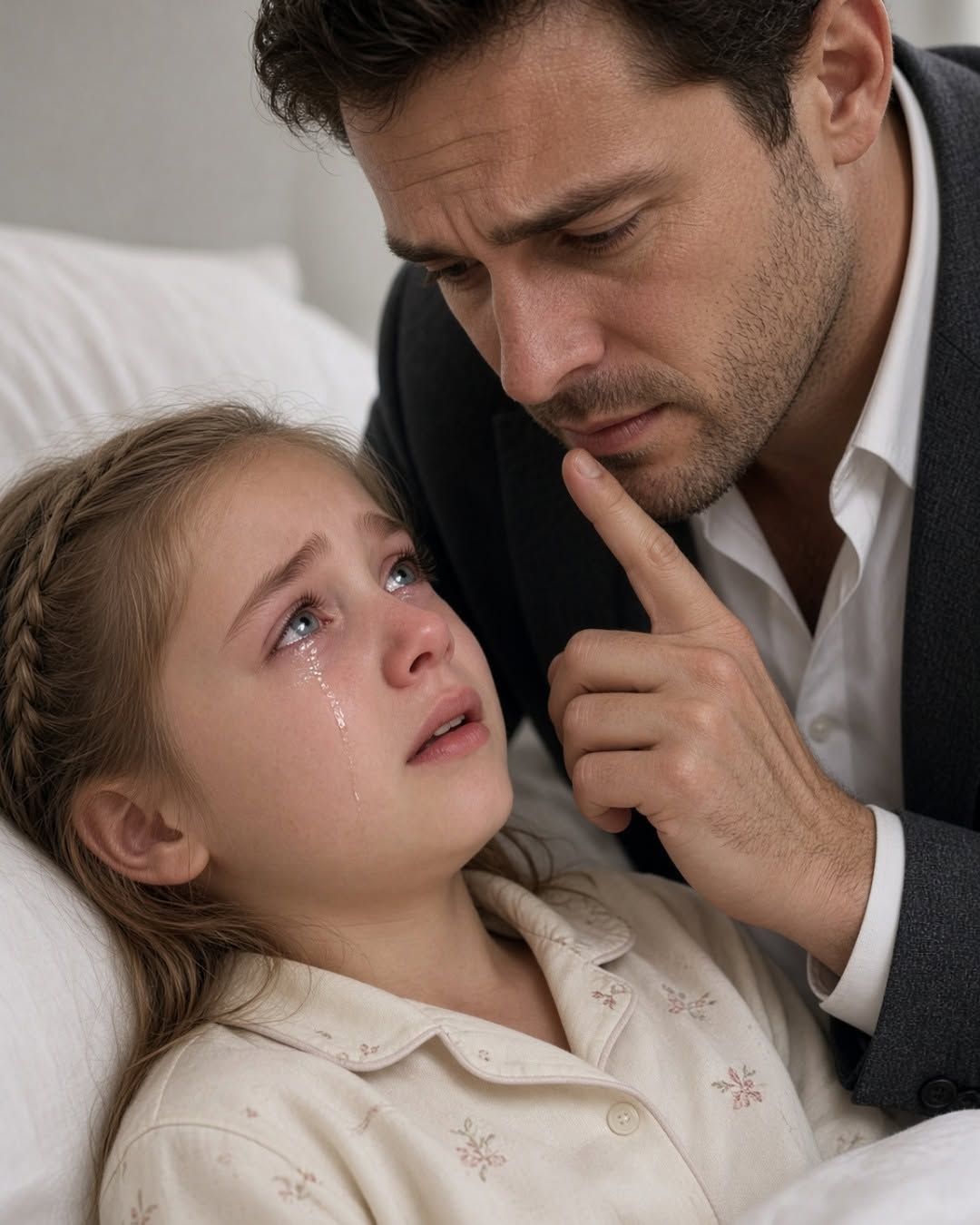
“Dad… my back hurts so bad I can’t sleep.”
Those were the first real words my daughter said to me after I came home from a business trip.
Not welcome home.
Not did you bring me anything.
Not I missed you.
“My back hurts so bad I can’t sleep.”
Then she added the sentence that changed the entire house around me.
“Mom told me not to tell you.”
I had been home less than fifteen minutes.
My suitcase was still standing beside the front door.
The handle was extended because I had not even bothered collapsing it.
My jacket was lying across one corner of the couch.
I had walked inside expecting the ordinary chaos that usually came with getting home after being gone.
Lily normally heard my key before I had the door fully open.
She would come running.
Sometimes in socks.
Sometimes barefoot.
Sometimes already talking before she reached me.
That evening, nothing happened.
No footsteps.
No laugh.
No hug.
The house was quiet enough that I noticed it immediately.
I called her name.
No answer.
I thought maybe she was asleep.
Then I heard her from down the hallway.
“Dad.”
Her voice was soft.
Not sleepy.
Careful.
I turned toward the bedroom.
“Hey, sweetheart.”
A pause.
“Please don’t be mad.”
That stopped me.
I had one hand still resting on my suitcase.
“Why would I be mad?”
Another pause.
Then she said, “Mom said if I told you, things would get worse.”
I remember the exact feeling in my chest.
Not anger first.
Fear.
Because children say things in ways adults do not.
They do not always know what sounds serious.
They do not always understand which detail will change a room.
“But my back hurts,” Lily whispered.
Her voice cracked.
“So bad I can’t sleep.”
I let go of the suitcase.
It tipped slightly, then settled against the wall.
“Where are you?”
Her bedroom door moved.
Lily appeared only halfway.
She did not step into the hall.
She stayed partly hidden behind the door as though it gave her protection.
She was eight years old.
Still small enough that the oversized pajama shirt she wore reached nearly to her knees.
Her shoulders were stiff.
Her eyes stayed on the floor.
“Come here, sweetheart.”
She did not.
I took one step.
Then stopped.
Something about her posture made me slow down.
“Dad’s here.”
Still nothing.
So I walked toward her carefully.
Not because I expected her to be afraid of me.
Because she looked afraid of everything.
When I reached the doorway, I crouched.
That was when she flinched.
A small movement.
Barely noticeable.
But I saw it.
Her shoulders jumped.
Her body pulled back.
A cold feeling moved through me.
“Lily.”
She looked down.
“Where does it hurt?”
Her fingers found the hem of her pajama shirt.
She twisted it.
“My back.”
“Can you tell me where?”
“It just hurts.”
“How long?”
“All the time.”
I tried to keep every question simple.
My instinct was to ask ten things at once.
What happened?
When?
Who was there?
Did you fall?
Did Mom know?
Why didn’t anyone call me?
But Lily already looked like she was trying to decide whether speaking was dangerous.
So I slowed down.
“Did something happen while I was gone?”
She nodded.
“What?”
“Mom said it was an accident.”
That sentence told me almost nothing and somehow made me more afraid.
“What kind of accident?”
Lily’s eyes flicked toward the hallway behind me.
I turned my head.
Nothing.
Empty hallway.
Quiet house.
Then I looked back.
“Is Mom home?”
Lily shook her head.
“Okay.”
Her hands twisted the shirt tighter.
“She told me not to tell you.”
“Why?”
“She said you’d get mad.”
I swallowed.
“And something bad would happen.”
I had no idea what that meant.
Bad for Lily?
Bad for her mother?
Bad for me?
Children repeat warnings exactly as they understand them.
Sometimes the ambiguity is worse.
I reached toward Lily’s shoulder.
It was automatic.
The same gesture I had made a thousand times when she was upset.
My fingertips barely touched the fabric.
She gasped.
Her entire body pulled away.
“Please… don’t.”
I froze.
“It hurts.”
My hand dropped immediately.
“Okay.”
I could hear how quickly I was breathing.
I forced myself to slow it down.
“I won’t touch it.”
Lily nodded.
Her eyes finally lifted toward mine.
That was when I saw the fear clearly.
Not the fear of a child who expects to be scolded for breaking something.
Something heavier.
“Tell me what happened.”
She looked toward the hallway again.
Then down.
For several seconds, she did not speak.
I stayed on my knees.
Eventually she whispered, “Mom got mad.”
“About what?”
“I spilled juice.”
I waited.
“She said I did it on purpose.”
“Did you?”
Lily looked shocked.
“No.”
“I believe you.”
That mattered.
Her face loosened slightly.
“What happened after that?”
Lily rubbed her thumb over one knuckle.
“She pushed me.”
The words were almost too quiet to hear.
I did not move.
“Where?”
“My back.”
“No, sweetheart. I mean where were you standing?”
“By my room.”
“Okay.”
She swallowed.
“My back hit the door handle.”
Everything in me tightened.
“Hard?”
She nodded.
“I couldn’t breathe.”
Her voice cracked.
“I thought…”
She stopped.
I waited.
“I thought I was going to disappear.”
That sentence has stayed with me more than any other.
Not because I knew exactly what she meant.
Because I did not.
An eight-year-old does not always have words for pain, panic, or the feeling of having the air knocked out of her.
Disappear was the word Lily found.
I remember looking at the bedroom door.
At the metal handle.
At the distance between it and where she stood.
Everything in the house suddenly looked different.
The doorway.
The hallway.
The quiet.
I had been gone.
That simple fact became unbearable.
I stood up that morning in another city, worked through meetings, answered emails, boarded a flight, complained silently about airport delays.
Meanwhile, Lily had been here.
Hurting.
Told not to tell me.
I wanted to ask why her mother had not taken her somewhere.
Why she had not called.
Why Lily had been left to manage pain overnight.
But the person in front of me was eight.
My questions could wait.
She could not.
“You did the right thing telling me.”
Lily looked down.
“I’m not mad at you.”
Nothing.
“You hear me?”
A tiny nod.
“None of this is your fault.”
I did not know yet what every fact would turn out to mean.
I knew only what Lily had told me.
That she had spilled juice.
Her mother got angry.
Her mother pushed her.
Her back struck the door handle.
She had been hurting since then.
And she had been told to keep it secret.
“How long has your back been hurting?”
“Since yesterday.”
“Did you sleep?”
She shook her head.
“Not really.”
“Did you tell Mom it still hurt?”
A nod.
“What did she say?”
Lily’s mouth tightened.
“She said I was overreacting.”
I looked away for one second.
That was the closest I came to losing control.
Not because I was certain yet how serious the injury was.
Because Lily had asked an adult for help and been told her pain was not real enough.
I looked back at her.
“Can you show me where it hurts?”
Her hands stopped twisting the shirt.
She hesitated.
“I’m not going to touch it.”
Another pause.
Then she slowly turned.
Her bedroom door remained open beside her.
The handle sat at about the same height as the area she was trying to protect.
That detail made my stomach turn.
Lily reached for the back of her pajama shirt.
She lifted it only a little.
Stopped.
I could see uncertainty in the way her hands shook.
“You’re okay,” I said quietly.
“I’m right here.”
She lifted the fabric enough for me to see.
My vision blurred at the edges.
There was a visible injury where she had indicated.
Closed.
Non-graphic.
But unmistakably painful.
I did not touch it.
I did not ask her to hold the shirt higher.
I did not need more proof from an eight-year-old.
Lily twisted her head slightly.
“Is it bad?”
That almost broke me.
I forced my expression into something calmer.
“You didn’t do anything wrong.”
“That’s not what I asked.”
Even scared, she was still Lily.
I swallowed.
“It’s enough that we’re not ignoring it.”
She lowered the shirt.
I stood slowly.
Only then did I realize how hard I was clenching my jaw.
I looked down the hallway.
“Where’s Mom?”
“She went out.”
“When?”
“Before you got home.”
“Do you know where?”
Lily shook her head.
“When is she coming back?”
“I don’t know.”
My suitcase was still visible from where we stood.
That stupid ordinary object.
A reminder that less than twenty minutes earlier I thought the biggest inconvenience in my life was unpacking after a business trip.
I turned back toward Lily.
“We’re leaving for a little while.”
Her face changed immediately.
Fear.
“Where?”
“I’m going to make sure somebody checks your back.”
She looked toward the front of the house.
“Is Mom going to be mad?”
That question told me the next thing I needed to know.
Lily was not worried about getting help.
She was worried about permission.
“You let me worry about Mom.”
Her lip trembled.
I wanted to pull her into my arms.
I did not.
Not after seeing her recoil from touch.
Instead, I held out one hand.
Palm open.
I waited.
Lily looked at it.
Then at me.
After a few seconds, she placed her hand in mine.
That tiny choice meant everything.
I squeezed gently.
No harder than she squeezed back.
We walked toward the front room.
She moved carefully.
Not dramatically.
Just a little slower than usual.
Every step made me more aware of how long she had already been trying to act normal.
I picked up my keys.
Then my phone.
Three unread work emails.
A message from a coworker.
Nothing from Lily’s mother.
“Do you need shoes?”
Lily nodded.
I helped her find them without rushing.
She sat on the edge of the couch.
When she bent forward, she stopped halfway.
Pain crossed her face.
I crouched again.
“I can do the laces.”
She hesitated.
Then let me.
Small things.
That was all I focused on.
Shoes.
Coat.
Keys.
Car.
I could not control the whole situation in that moment.
I could control the next five minutes.
I finished tying the second shoe.
Then my phone lit up.
Her mother’s name appeared on the screen.
Lily saw it.
Her fingers tightened around the couch cushion.
I looked at her.
She looked at me.
The phone kept ringing.
“Do I have to talk to her?” Lily whispered.
“No.”
That answer came easily.
I silenced the call.
Lily exhaled.
Then another call came almost immediately.
I let that one ring too.
A message appeared.
Where are you?
I read it once.
Then put the phone facedown.
I was not interested in having a hallway argument while Lily sat three feet away watching my face.
We walked toward the door.
Lily stopped beside my suitcase.
“You just got home.”
“I know.”
“You’re going away again?”
The question hit me in a different place.
“No.”
I crouched.
“I’m going with you.”
She looked at me.
I realized how important the distinction was.
For the last few days, adults had been deciding things around her.
What happened.
What counted as pain.
What she could say.
Who she could tell.
I wanted at least one thing to feel different.
“You and me,” I said.
She nodded.
We left.
The drive was quiet.
I did not question her again.
I did not ask for the story a second time.
She had already told me.
I believed that repeating it for my reassurance could wait until someone else actually needed the information.
Lily rested against the seat carefully.
Every bump in the road made me notice her face.
My phone buzzed twice in the cup holder.
I ignored it.
At a red light, Lily spoke.
“Dad?”
“Yeah?”
“Are you mad?”
I looked at her.
“Not at you.”
She nodded.
That seemed to matter.
A few blocks later, she asked another question.
“Are you going to yell at Mom?”
I gripped the steering wheel.
“No.”
That was true.
At least not in front of Lily.
Not before I understood everything.
Not while anger would make the next decision worse.
She looked out the window.
“Okay.”
When we arrived, I got out first.
Then opened her door.
I did not lift her.
I offered my hand again.
She took it.
Inside, I explained only what I knew.
My daughter was eight.
She had persistent back pain after striking a door handle.
She said she had been pushed.
She had been unable to sleep.
I kept my voice factual.
No conclusions beyond what Lily had told me.
That was harder than shouting.
But I needed the adults around us to hear her story clearly, not my rage.
Lily sat beside me.
Her hand stayed in mine.
My phone buzzed again.
I checked it only when Lily looked away.
Another message.
Answer me.
Then another.
Why did you take her?
I locked the screen.
The question was almost impossible to process.
Why did you take her?
Because she was in pain.
Because she asked for help.
Because she was eight.
Because I was her father.
Because somebody had to listen.
Lily leaned against my arm carefully.
For the first time all evening, she looked slightly less afraid.
That was when I realized the secret itself was not the only thing frightening her.
She had been carrying responsibility for what might happen if she told me.
Adults had put that on her.
I could not erase what had happened.
But I could stop asking her to carry what came next.
I turned the phone completely off.
Lily noticed.
“Why’d you do that?”
“Because right now I’m here with you.”
She looked down.
Then leaned her head against my arm.
Very gently.
I stayed still.
My suitcase could wait by the door.
Work could wait.
Every argument waiting back at the house could wait.
For the first time since I stepped off the plane, nothing mattered more than the small hand holding mine.
And one thing had become painfully clear.
The moment Lily whispered, “Mom told me not to tell you,” this stopped being about spilled juice.
It became about whether my daughter believed home was a place where telling the truth made her safer.
I did not know yet what came after that night.
I did know what had to change first.
Lily would never again have to wonder whether I wanted to hear her.
I already had.