PART 1 — THE WEIGHT I CARRIED
For eighteen years, I believed love could survive almost any disappointment.
I believed that if I stayed patient enough, defended my husband enough, and worked hard enough to hold our family together, Patrick would eventually stop looking at me as though I had stolen the life he was supposed to have.
I was wrong.
Every year that passed made the distance inside our home a little wider.
And our son was the one paying the highest price.
My name is Serena.
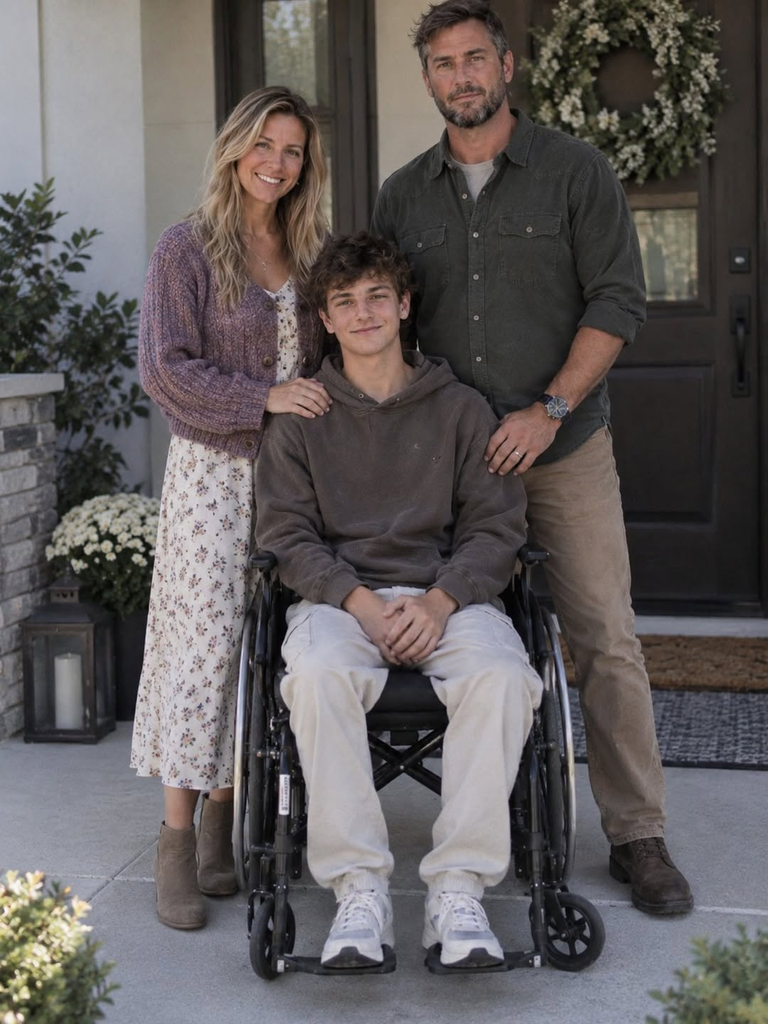
My son, Connor, has used a wheelchair since he was a little boy.
Not once did I look at him and wish he had been someone else.
Connor was funny.
Thoughtful.
Ridiculously intelligent.
The sort of kid who could solve a problem adults had been arguing about for twenty minutes and then act confused when everyone stared at him.
He remembered birthdays.
Noticed when another child was sitting alone.
Fixed computers for neighbors without charging them.
At twelve, he designed a simple attachment for his wheelchair so he could carry his school backpack without it sliding into the wheels.
At thirteen, he modified the design for another boy at his adaptive basketball program.
To me, Connor was never a tragedy.
He was my son.
Patrick never seemed able to separate Connor from the son he had imagined before Connor was born.
Patrick grew up in Ohio in a family where football was almost a religion.
His father had coached high school football for years.
Patrick could describe Friday nights from his childhood in perfect detail.
The stadium lights.
The marching band.
The wet smell of the field after rain.
The sound of his father shouting from the sideline.
Before we married, Patrick once told me:
“When we have a boy, I’m teaching him everything Dad taught me.”
At the time, I thought it was sweet.
I pictured Patrick throwing a football with a little boy in our backyard.
Neither of us knew life would look different.
Connor was three when specialists finally confirmed that the mobility problems we had been investigating were related to a genetic condition.
We had spent years hoping someone would tell us it was only a developmental delay.
It wasn’t.
I remember the examination room.
Connor playing with a plastic truck on the floor.
The doctor speaking carefully.
I looked at my little boy and could not understand how anyone could hear that information and see anything except the same child we had walked in with.
Patrick barely spoke during the drive home.
At first, I thought he needed time.
So I gave it to him.
Then he started missing Connor’s therapy appointments.
He stopped asking what the specialists said.
He buried himself in work.
Eventually, his sadness changed into something else.
Blame.
During one argument, he looked at me and said:
“If you had noticed sooner, maybe things would be different.”
I stared at him.
“The doctors told us this is genetic.”
“You should have pushed harder.”
“For what?”
“More testing. Other doctors. Anything.”
“We did everything they asked.”
He walked away.
Patrick rarely said directly:
You caused this.
He did not need to.
He said everything around it.
If you had noticed.
If you had pushed.
If you had known.
If you had done more.
And after enough years, I started answering questions nobody should have asked me.
Maybe I should have.
Maybe I missed something.
Maybe I failed Connor.
Logically, I knew better.
Emotionally, guilt is not logical.
And when the person you love repeats the same accusation long enough, sometimes the accusation becomes part of the furniture.
You stop noticing how ugly it is.
PART 2 — THE JOKES
As Connor grew older, Patrick learned to hide resentment inside humor.
That made it worse.
When neighbors talked about their sons making varsity teams, Patrick would laugh.
“Well, at least I’m saving money on football equipment.”
People smiled awkwardly.
Nobody knew what to say.
I usually changed the subject.
Connor usually looked down.
Once, at a neighborhood barbecue, another father said:
“My son’s coach thinks he might start next season.”
Patrick lifted his beer.
“Must be nice.”
The father’s smile disappeared.
Connor sat beside me.
He was fourteen.
I reached for his shoulder.
He moved slightly away.
Not because he was angry with me.
Because he did not want everyone to see that he needed comforting.
That night, I confronted Patrick.
“You embarrassed him.”
“I made a joke.”
“It wasn’t funny.”
“You’re too sensitive.”
“No.
Connor heard you.”
“He knows I love him.”
“Does he?”
Patrick’s face hardened.
“What is that supposed to mean?”
“It means you keep assuming Connor knows things you almost never say.”
He walked away.
That became our marriage.
I raised concerns.
Patrick interpreted them as attacks.
I softened them.
He dismissed them.
Then I apologized for the argument.
PART 3 — COACH CALLAHAN
Connor found adaptive basketball when he was twelve.
I did not even know the community center had a program.
Connor discovered it through school.
One afternoon after practice, I walked into his room and found him smiling.
Patrick had made another comment at dinner.
Something about never needing to buy football cleats.
I sat beside Connor.
“I’m sorry.”
He frowned.
“For what?”
“For everything.”
He stared at me.
Then:
“Mom, that is a very large category.”
Despite myself, I laughed.
He took my hand.
“Coach Callahan says people spend too much time thinking about what they can’t do.”
“Who is Coach Callahan?”
“My basketball coach.”
“You have a coach?”
“I told you.”
“You told me the community center had basketball.”
“That usually involves coaching.”
“Smart mouth.”
He grinned.
“What else did she say?”
“She said when everybody is staring at the thing you can’t do, they miss everything you can.”
I pulled him into a hug.
“That is a very smart coach.”
“Yes.”
Then:
“You should meet her.”
I did.
Patrick didn’t.
For years.
PART 4 — THE SON PATRICK MISSED
Connor’s life became full.
Adaptive basketball.
Science competitions.
Coding club.
Volunteer tutoring.
Student council.
Then engineering.
He once spent an entire summer helping a local nonprofit map accessibility problems around public buildings.
He measured curb heights.
Ramp slopes.
Door widths.
Then built a simple online map that helped wheelchair users identify accessible entrances.
The city council recognized him.
Patrick missed the ceremony.
Work meeting.
Another time Connor won a statewide academic award.
Patrick attended.
Left early.
“Big client call.”
Connor never complained.
That worried me more than anger would have.
He became skilled at expecting nothing.
Children should not have to learn that skill from a parent.
PART 5 — THE COLLEGE LETTERS
During Connor’s senior year, our mailbox began filling with envelopes.
Universities.
Scholarships.
Engineering programs.
One afternoon, I spread everything across the dining table.
“Connor!”
He rolled in from the living room.
“What happened?”
“Look.”
He stared.
“No way.”
“Yes way.”
One university offered full tuition.
Another included housing support.
A California school with a nationally respected engineering and assistive-technology research program offered him a substantial scholarship and a place in an undergraduate innovation lab.
Connor held that letter like it was made of glass.
“This one.”
“You haven’t even visited.”
“I know.”
“Then how do you know?”
“The lab.”
Of course.
Patrick arrived home twenty minutes later.
I practically ran toward him.
“You need to see this.”
He glanced at the table.
“What?”
“Connor’s acceptances.”
Patrick loosened his tie.
“Good.”
Connor held out the California letter.
“Dad, look.”
Patrick glanced.
“California is expensive.”
“They offered a scholarship.”
“Still expensive.”
Then he went upstairs.
Connor watched him leave.
I looked at my son.
He gave me a little smile.
“I guess good is technically positive.”
That broke something in me.
PART 6 — “I DIDN’T ASK FOR THIS”
I followed Patrick upstairs.
“Could you have acted any less interested?”
He sighed.
“Serena.”
“Your son just got into some of the best engineering programs in the country.”
“I said congratulations.”
“You said good.”
“Same thing.”
“No.”
Patrick sat on the edge of the bed.
“What do you want from me?”
“Joy.”
He stared.
“Excitement.”
“Serena.”
“Pride.”
“I am proud.”
“Then why does Connor never get to see it?”
Patrick stood.
“You always turn everything into a trial.”
“Because you treat every achievement like a consolation prize.”
“That isn’t true.”
“If he had scored a touchdown instead of winning an academic award, would you have said good and gone upstairs?”
His face tightened.
“Don’t start.”
“I am starting.”
He pointed toward the hallway.
“I did not ask for this life.”
Silence.
Neither of us noticed Connor had stopped outside his bedroom down the hall.
Patrick continued.
“I had plans.”
“So did I.”
“You don’t understand.”
“I understand perfectly.”
I lowered my voice.
“You imagined a son.
Then Connor arrived, and instead of changing the dream, you spent eighteen years punishing the people who did.”
Patrick turned away.
I left.
Neither of us knew Connor heard everything.
PART 7 — GRADUATION
Connor graduated first in his class.
His principal described him as one of the most intellectually curious students he had taught in thirty years.
The audience stood.
I cried.
Coach Callahan shouted from several rows behind us.
Valerie cried louder than I did.
My brother Marcus recorded almost the entire ceremony vertically despite everyone repeatedly telling him to rotate the phone.
Patrick clapped politely.
Afterward, Connor posed with teachers.
Friends.
Coach Callahan.
Me.
Patrick stood near the edge of the group.
Looking like a guest.
I remember thinking:
Maybe university will change everything.
Maybe Patrick will finally see the man Connor is becoming instead of the child he imagined losing.
Hope can survive ridiculous amounts of evidence.
PART 8 — THE PARTY
Connor’s eighteenth birthday came a few weeks later.
My sister Valerie insisted on a real celebration.
“He is eighteen once.”
“I know how birthdays work.”
“Then stop trying to make it six people and a cake.”
So we invited everyone.
Neighbors.
Teachers.
Family.
Coach Callahan.