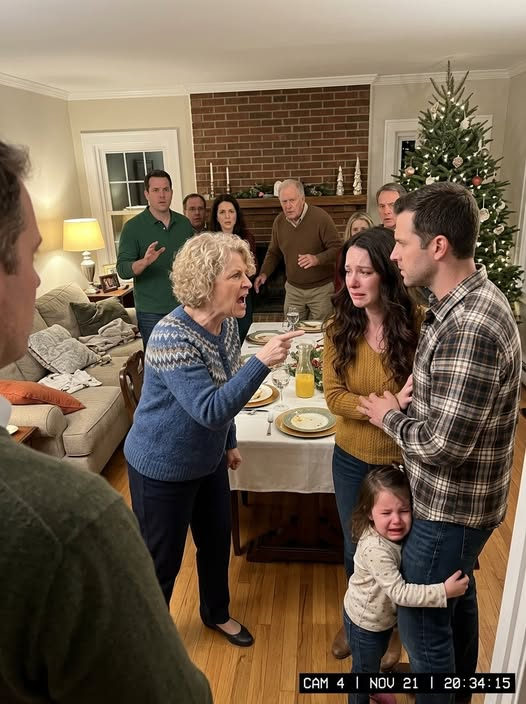
Christmas dinner at my parents’ house in suburban Ohio had barely reached dessert when my sister, Lauren, leaned across the table and said, “Must be nice to show up empty-handed and still expect Mom and Dad to rescue you.”
I put down my fork. “I didn’t ask anyone to rescue me.”
Lauren laughed. My mother, Diane, didn’t.
For months, she had been telling relatives that my husband, Ethan, and I were “struggling.” The truth was less dramatic. Ethan had changed jobs after his company downsized, and we had spent a year cutting expenses while I worked part-time from home and cared for our five-year-old daughter, Lily. We weren’t wealthy, but our bills were paid.
But to understand exactly how we got from that dinner table to a doorstep confrontation in a new driveway eleven months later, you need to understand the family I actually grew up in, the one my mother had spent decades quietly narrating into a story that mostly served her.
I’m Emily, thirty-three, the older of two daughters. Lauren is thirty, sharp-tongued and quick to laugh in a way that used to charm every teacher, boyfriend, and family friend she ever met. Growing up, I was the responsible one, the one who did homework without being asked twice, who got a part-time job at sixteen not because we needed the money but because I wanted my own, who chose a steady accounting degree over anything riskier. Lauren was the exciting one, the one whose failures somehow always got reframed as bold experiments and whose successes got amplified into legend.
My father, Robert, ran a small contracting business, Bennett Construction, for almost thirty years, steady, unglamorous work that put a roof over our heads, quite literally, and paid for two unremarkable but comfortable childhoods. He was a good man underneath it all, though a passive one, the kind of husband who let my mother manage nearly every domestic and financial decision in their marriage because it was easier than arguing with her, a pattern I watched play out for decades before I fully understood how much damage that particular kind of passivity could eventually do.
My mother, Diane, was the architect of our family narrative in every sense that mattered. She decided, somewhere early in our childhoods, which daughter played which role, and she enforced those roles with a consistency that would have been almost admirable if it hadn’t been so quietly corrosive. Lauren was the spirited one, forgiven easily, celebrated loudly. I was the reliable one, which in my mother’s particular vocabulary somehow always translated into the one who needed less, deserved less fuss, required less celebration, because I could apparently be trusted to simply manage.
I got a partial scholarship to a decent state university, the kind of achievement that should have earned genuine pride, and my mother mentioned it exactly once at a family gathering before pivoting the conversation toward Lauren’s upcoming senior trip to Europe, fully funded, no scholarship required. I noticed. I filed it away, the way you file away a hundred small moments before you’re finally ready to see the pattern they form.
I met Ethan during my last year of college, steady and quietly funny in exactly the way I needed after growing up in a house where quiet steadiness was mistaken for a lack of ambition. We married four years later, a modest ceremony that my mother spent most of her toast describing in terms of how proud she was that I’d “finally found someone patient enough” for me, a line that got a laugh from the room and left a mark on me that outlasted the laugh by years.
Lily was born five years before that Christmas dinner, and I left my full-time accounting job shortly after, building a remote bookkeeping practice instead that let me work around her schedule. My mother described this decision at every subsequent family gathering as me “not really working,” a phrase she used so consistently that I eventually stopped correcting her, exhausted by the effort of defending an arrangement that, frankly, wasn’t hers to evaluate.
Ethan’s layoff came eighteen months before that Christmas, a company-wide downsizing that took nearly a third of his department with him. He found a new position within four months, a lateral move rather than a step up, and we spent that stretch tightening our budget carefully, deliberately, the way responsible people do when facing a temporary setback rather than a crisis. We weren’t struggling in any real sense. We were being careful.
My mother, somewhere in that stretch, decided our carefulness was actually desperation, and she began quietly telling relatives, in the particular tone she reserved for concerned confidences, that Ethan and I were “struggling,” a narrative she apparently found useful, though I didn’t fully understand why until much later.
Three years before that Christmas, my father had called me privately, his voice tight with an embarrassment I rarely heard from him. His business had been hit by two unpaid commercial invoices, clients who’d simply stopped paying after work was completed, and he needed twenty-eight thousand dollars to cover payroll and avoid laying off several longtime employees right before Thanksgiving.
I had money available, an investment account my grandmother, Evelyn, his own mother, had left directly to me two years earlier, separate from the small cash gifts she’d left each of her four grandchildren. I’d spent years, during Grandma Evelyn’s final stretch of independent living, driving ninety minutes every Wednesday to take her to medical appointments and grocery shopping, sitting with her at her kitchen table sorting mail while she complained about television commercials and insisted every restaurant put too much salt in its soup. I never once expected anything from that time beyond her company, which I genuinely enjoyed, but apparently she’d noticed, and quietly decided, on her own, to leave that particular account to me alone.
I transferred the twenty-eight thousand dollars to my father without hesitation, without telling my mother, at his specific request, because, he’d explained carefully, “your mother worries too much, and I don’t want her carrying this.” I understood, even then, that there was something else underneath that request, some family dynamic I wasn’t fully seeing, but I didn’t push.
Dad repaid it in installments over the following two years, careful, regular payments that I tracked in a spreadsheet the way I track everything, out of habit more than suspicion. The final eight-thousand-dollar payment had arrived the previous spring.
Which brings us back to that Christmas table, Lauren leaning forward with her particular satisfied smile, asking why Dad had given me money last spring, apparently having caught wind of that final repayment without any of the actual context.
My father looked down at his plate. “That was repayment,” I said. “Dad borrowed from me.”
The room went silent. My mother’s face changed. She stood so fast her chair scraped the floor.
“You liar.”
“Mom, I have the bank records.”
She crossed the space between us and spat directly in my face.
Nobody moved.
“You are a leech,” she screamed. “My money is not for you.”
Then she pointed at Lily, who had started crying beside Ethan.
“Take that burden and get out.”
Ethan was on his feet before I could speak. He took my hand. “Let’s go.”
I wiped my face with a napkin, picked up Lily’s coat, and walked out while Lauren stared at me with a strange, satisfied expression. Dad followed us to the porch but said only, “I’m sorry.”
I didn’t answer.
We drove forty minutes home in silence. Once Lily was asleep, Ethan locked the front door and asked, “Do you think your mom knows?”
“Knows what?”
He glanced toward the hallway leading to the office, where a folder of closing documents sat in a locked drawer.
Three weeks earlier, Ethan and I had quietly closed on a house. Not our current townhouse. A second house, a renovated four-bedroom property outside Columbus that we had purchased partly with money from that same investment account my grandmother left directly to me years ago. We had planned to move in after New Year’s and rent out the townhouse. I hadn’t told my mother because every financial detail in our family became a competition, and I wanted, at least for a little while, to keep one good thing entirely ours.
I want to explain a bit more about that house, and about the two years of careful planning that led to it, because it mattered far more than a simple real estate purchase. Ethan and I had started saving seriously not long after Lily was born, setting aside a portion of every paycheck into a dedicated account we barely touched, watching it grow slowly over years the way real savings actually grows, unglamorously, in small increments that don’t photograph well for anyone’s social media. When his layoff hit, we drew on that fund carefully rather than panicking, exactly the kind of financial discipline that should have earned some acknowledgment rather than my mother’s whispered narrative of struggle.
We found the Columbus house through a realtor friend of Ethan’s, a genuine fixer-upper that a previous owner had already renovated most of the way, good bones, a large backyard, a neighborhood with a decent school district we’d been eyeing for over a year. Between our savings, a reasonable mortgage, and a portion of my grandmother’s investment account, we could afford it comfortably, without stretching ourselves the way my mother’s narrative had always assumed we must be stretching.
I hadn’t told my mother, and honestly, sitting in my kitchen that Christmas night with my face still faintly stinging from where she’d spat on me, I felt a complicated relief that I hadn’t. Whatever was coming, at least she hadn’t gotten to it first.
The next morning, my phone rang at 7:12. Dad. I almost ignored it. When I answered, he sounded breathless.
“Emily,” he said, “your mother just found out about the house.”
My stomach tightened. “How?”
“Lauren saw the county property transfer online. She showed her.”
I closed my eyes. Dad lowered his voice. “Your mother thinks you stole the money from us.”
Then I heard Diane shouting in the background. And Dad whispered, “She’s coming to your house.”
Ethan was already dressed when I told him what Dad had said. “Then she can stand outside,” he replied. “She is not coming in.”
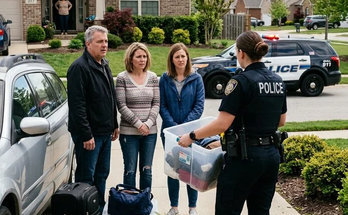
Twenty minutes later, my mother’s SUV stopped crookedly at the curb. Lauren was in the passenger seat.
Diane marched up the driveway carrying a thick envelope. She pounded on the front door hard enough to wake Lily.
“Emily! Open this door!”
I stayed behind the glass storm door while Ethan stood beside me.
“What do you want?”
My mother held up several printed pages. “You bought a four-bedroom house for three hundred and eighty-two thousand dollars?”
“Yes.”
“With what money?”
“Mine.”
Her laugh was sharp. “You expect me to believe that after your father has been slipping you cash?”
I looked at Lauren. “Did you tell her Dad’s transfer was repayment?”
Lauren folded her arms. “Dad never told me that.”
“Because it was none of your business.”
Mom slammed the papers against the glass. “This family helped you for years.”
“No. You told everyone you helped me. That isn’t the same thing.”
I went to the office, retrieved a folder, and returned with copies of the bank statements. I did not open the door. I held the pages against the glass so she could see the highlighted transfers.
Lauren’s expression changed first. Mom’s did not.
“That inheritance should have stayed in the family,” she said.
“It did. Grandma left it to me.”
“She knew you would waste it.”
“Buying a home is wasting it?”
“You hid it.”
“Because of this.”
For several seconds, nobody spoke. Then Lauren said, “Wait. How much did Grandma leave you?”
There it was. Not concern. Not disbelief. A number.
I looked at Mom. “You told Lauren there was no inheritance, didn’t you?”
Mom’s jaw tightened.
Dad’s mother had died six years earlier. She had left small cash gifts to all four grandchildren, but she also left me a separate investment account because I had spent years helping her manage appointments, groceries, and bills after she stopped driving.
I had never asked for it. Dad knew. Apparently Mom had made sure Lauren did not.
Lauren turned toward her. “You said Grandma’s estate barely covered the nursing home.”
“It’s complicated.”
“No,” I said. “It isn’t.”
Mom suddenly pointed at Ethan. “This is him. He’s turned you against us.”
Ethan shook his head. “I didn’t spit in her face.”
That silenced even Lauren.
I opened the storm door just enough to slide the copies onto the porch, then locked it again.
“These are the records. Dad borrowed money from me. Dad paid it back. The new house was purchased with our savings, the inheritance account, and a mortgage. You can believe the documents or keep telling lies.”
Mom stared at the papers but did not pick them up. “You think a bigger house makes you better than us?” she asked.
“No. I think locking my door makes me safer from you.”
Her face went white. She stepped closer. “You will regret humiliating me.”
I almost laughed. “You spat on me at Christmas dinner.”
Behind her, Lauren was scrolling furiously on her phone. Then she looked up. “Mom,” she said slowly, “why does Dad’s business address show a second mortgage filed against your house last year?”
Diane turned around. For the first time since she arrived, she looked frightened.
That afternoon, Dad came alone. He sat at our kitchen table with both hands around a cup of coffee he never drank.
“There’s something else you need to know,” he said.
“What?”
He swallowed. “Your mother didn’t come here because she thought you stole from us.” I stared at him. “She came because she needs money.”
Dad finally lifted the coffee, but his hands were shaking badly enough that the cup clicked against the saucer.
“How much?” I asked.
He looked at Ethan, then at me. “A little over ninety thousand.”
I thought I had misheard him. “Ninety thousand dollars?”
Dad nodded.
Ethan pulled out the chair across from him. “What happened?”
For years, Mom had handled most of my parents’ household finances. Dad managed his contracting company, but Diane paid the personal bills, moved money between accounts, and handled their taxes with an accountant.
According to Dad, she had started borrowing against their house after his business slowed down. At first, she told him it was temporary. Then she refinanced a line of credit without explaining how much she had taken.
“What did she spend it on?” I asked.
Dad rubbed his forehead. “Some of it went to Lauren.”
I leaned back. Of course.
Lauren had opened a boutique eighteen months earlier in a fashionable shopping district. On social media, it looked successful: white brick walls, expensive displays, launch parties, champagne, carefully staged photos.
At family gatherings, Mom bragged about her “entrepreneur daughter” while describing my remote bookkeeping work as something I did “between cartoons and laundry.”
“How much went to Lauren?” Ethan asked.
“About fifty-two thousand.”
I stared at Dad. “Does Lauren know?”
“She knows your mother invested. I don’t think she knows the money came from the house.”
“And the rest?”
“Credit cards. Trips. Renovations. Your mother’s SUV. Some tax payments we were behind on.”
I stood and walked to the kitchen window. Yesterday, my mother had called my daughter a burden. Today, I learned she had quietly put more than fifty thousand dollars into Lauren’s business while telling the family that I lived off her generosity.
“Why tell me now?” I asked.
Dad answered without looking at me. “Because Diane found the deed for your new house and decided you had enough money to help.”
“Help?”
“She wants you to lend us seventy-five thousand. She thinks if we pay down the home-equity balance and clear two cards, we can stabilize everything.”
Ethan’s expression hardened. “After last night?”
Dad looked ashamed. “I told her not to come here.”
“But you still came to ask?”
“No.” He finally met my eyes. “I came to tell you not to give her anything.”
That stopped me.
Dad pulled a folded sheet of paper from his jacket. It was a list of balances, interest rates, and monthly payments in his handwriting.
“I should have paid attention sooner,” he said. “I signed things because I trusted her. That’s on me. But if you give her money now, nothing changes. She’ll call it family helping family, and six months from now there’ll be another emergency.”
Ethan asked, “What are you going to do?”
“I’m meeting a financial counselor Monday. I’m separating the household accounts. And I may sell the house.”
My parents had lived there for twenty-seven years. The thought landed heavily, but Dad seemed more relieved than devastated.
Then he added, “There’s another reason she’s angry about your inheritance.”
I turned from the window.
When Grandma made her estate plan, she had apparently considered leaving the investment account to Dad. Instead, she left it directly to me. Dad told me that his mother had worried Diane would pressure him to use the money for Lauren.
I felt the room narrow. “She said that?”
Dad nodded. “Mom loved all of you. But she noticed things.”
“What things?”
“The same things you noticed.”
He did not need to explain.
Lauren got the expensive graduation trip. Lauren’s failed first business was called “experience.” My missed promotion after Lily was born became proof that I lacked ambition. When Ethan and I skipped vacations to build our savings, Mom told people we were broke. When Lauren leased a luxury car, Mom called her successful.
The pattern had been there for years. I had simply treated each incident as separate because admitting there was a pattern would have required admitting what it meant.
Dad left before noon. At the door, he hesitated. “Your mother will call,” he said. “She’s already telling people you’re refusing to save your parents.”
“Then people can call me.”
“I’m sorry, Emily.”
This time I answered. “I know.”
My phone started ringing before dinner. First Aunt Carol. Then my cousin Megan. Then an uncle I saw twice a year. I ignored the first two calls, but when Aunt Carol sent a message saying, Your mother says your father may lose his home because you won’t return money that belongs to the family, I stopped ignoring it.
I created one group message. I attached the bank records showing my loan to Dad and his repayments. I attached the relevant page from Grandma’s estate documents confirming the investment account had been left to me. I did not include the details of my parents’ debt because that was Dad’s private financial information.
Then I wrote one paragraph:
Mom spat in my face at Christmas dinner, called me a leech, called Lily a burden, and ordered my family out. The next morning she came to my home demanding explanations about property Ethan and I legally purchased. I have never taken money from my parents. The payment Dad sent me last spring was repayment of a loan I made to him. I will not discuss this again through relatives.
I sent it.
For the next hour, my phone was silent. Then Megan replied. I’m sorry. I had no idea.
Aunt Carol called again. This time I answered. She sounded different.
“Your mother said Robert had been supporting you.”
“He hasn’t.”
“I saw the statements.”
“Good.”
There was a pause. “Diane also said you bought the house with money your grandmother intended for all the grandchildren.”
“That’s false. You can read the estate page.”
Another pause. “I did.” I could hear embarrassment in her voice, but I was too tired to make it easier for her.
“I shouldn’t have accused you,” she said.
“No, you shouldn’t have.”
After we hung up, Ethan looked at me from the couch. “You okay?”
“No,” I said. “But I’m finished explaining myself.”
Two days later, Lauren appeared at the townhouse alone. I almost didn’t answer. Through the camera, I saw that she was carrying a folder instead of anger.
Ethan stayed in the living room with Lily while I stepped onto the porch and closed the door behind me.
Lauren looked exhausted. “Did Dad tell you about the money for the boutique?”
“Yes.”
She shut her eyes. “I found out where it came from yesterday.”
“And?”
“And I’m trying to figure out how much I can repay.”
That was not what I expected.
She sat on the porch step. “Mom told me she had money from an investment account,” Lauren said. “She said Dad knew. I never asked enough questions because I wanted to believe her.”
I stayed standing.
Lauren looked toward the street. “She also told me you were jealous of me.”
I gave a short laugh. “Of course she did.”
“I believed that too.”
“Why are you here?”
She opened the folder. Inside were printouts from the boutique’s accounting software, a commercial lease, and a proposed repayment schedule.
“I’m not asking you for money,” she said. “I came to say I was wrong at Christmas.”
I waited. Her eyes filled, but she did not cry.
“I kept attacking you because Mom made everything between us a scoreboard. And because I liked being the one who was winning.”
It was the first truly honest thing I had heard from her in years.
“That doesn’t excuse what you said.”
“I know.”
“And you sat there when she spat on me.”
Lauren looked down. “I know.”
I did not hug her. I did not tell her everything was fine. It wasn’t. But I listened.
She planned to sell her car, reduce the boutique’s inventory, cancel a second location she had been considering, and repay Dad monthly. The business was not as successful as it looked online, but it was profitable enough to survive if she cut expenses.
“Mom is furious with me,” she said.
“Why?”
“Because I told Dad I’d sign an agreement acknowledging the fifty-two thousand as a loan.”
I almost smiled. “That would make her furious.”
Lauren stood. Before leaving, she said, “She’s also telling people you manipulated Grandma.”
That hurt more than I expected.
Grandma Evelyn had been stubborn, sharp-minded, and impossible to manipulate. During her last two years, I drove ninety minutes every Wednesday to take her to medical appointments and grocery shopping. We spent long afternoons at her kitchen table sorting mail while she complained about television commercials and insisted that every restaurant put too much salt in its soup.
Once, after I told her she did not need to leave me anything, she had tapped my hand with a pen. “I know what I need to do,” she said.
At the time, I thought she meant paying the electric bill. Now I understood more.
On New Year’s Day, Ethan and I moved into the new house. It was not a mansion. It was a thirty-year-old brick colonial with a repaired roof, refinished floors, and a backyard large enough for Lily’s swing set.
We had spent months planning the purchase, calculating the mortgage, and keeping an emergency fund untouched. Lily chose the smallest upstairs bedroom because its window faced a maple tree.
“This is my tree,” she announced.
“It belongs to the yard,” Ethan said.
“So it’s my yard tree.”
“Fair enough.”
While we unpacked the kitchen, a car pulled into the driveway. Mom. Ethan looked at me. “I’ll handle it.”
I stepped outside before she reached the door.
Diane was dressed perfectly, as always. Her coat was buttoned to her throat. Her lipstick was fresh. If someone had photographed her standing there, nobody would have guessed our family was coming apart.
“So this is it,” she said, looking at the house.
“This is it.”
“Four bedrooms for three people.”
“We have an office and a guest room.”
She smiled without warmth. “Must be nice.”
I said nothing. She looked past me toward the front windows. “Your father is selling our house.”
“I heard.”
“He’s blaming me.”
“I’m not involved in that decision.”
“You caused it.”
“No.”
“If you had helped—”
“No.”
Her eyes sharpened. I had spent most of my life filling silence around my mother. Explaining. Defending. Softening sentences so she would not explode. I did none of that now.
She tried again. “Your sister has turned against me because of you.”
“Lauren made her own decision.”
“Your father is humiliating me.”
“Dad is dealing with his finances.”
“And you’re standing here enjoying it.”
“No. I’m standing in my driveway.”
That seemed to enrage her more than shouting would have. She stepped closer. “After everything I did for you.”
I looked at her carefully. “What did you do for me, Mom?”
Her mouth opened. Nothing came out.
“I’m not saying you never fed me, housed me, took me to school, bought birthday presents, or helped when I was young. You were my mother. But you’ve spent years turning ordinary parenting into a debt I’m supposed to repay forever while pretending every accomplishment I have came from you.”
“You ungrateful—”
“And you called Lily a burden.”
Her face shifted. “I was angry.”
“She heard you.”
“I didn’t mean her.”
“You pointed at her.”
Diane looked toward the front window. Lily’s small face was visible behind the curtain before Ethan gently drew her away. For one second, Mom looked uncertain. Then pride returned.
“So you’re keeping my granddaughter from me now?”
“I’m protecting my daughter from someone who treated her cruelly.”
“I said one thing.”
“You did one thing that ended years of excuses.”
She stared at me. “What do you want, an apology?”
“I’m not asking you for anything.”
That was the moment she finally understood. She could not bargain because I was not negotiating. She could not threaten to withdraw money because I did not need it. She could not threaten to tell the family stories because I had already shown them the records. And she could not make me chase her approval because I had stopped running.
Mom walked back to her SUV without saying goodbye.
For nearly four months, we did not speak. Dad sold the family house in March, paid off the home-equity line and credit-card balances, and moved into a two-bedroom condo ten minutes from his office. He and Mom did not divorce, at least not then, but they separated their finances completely. Mom moved into the condo too after realizing that renting an apartment by herself would stretch her budget.
Lauren sold her car and began repaying Dad. Our relationship did not magically repair itself. We met for coffee once a month. Sometimes the conversation was awkward. Sometimes we argued. But for the first time, we argued about actual things instead of competing for a position our mother had assigned us.
In April, Lauren apologized directly to Lily. She did not make a dramatic speech. She sat at our kitchen table while Lily colored a picture and said, “I was mean to your mom at Christmas. I shouldn’t have been.”
Lily considered that with the seriousness only a five-year-old could manage. “Grandma was mean too.”
“Yes,” Lauren said quietly. “She was.”
Mom sent birthday gifts to Lily in May. I returned them unopened. In June, Dad asked whether I would consider letting Diane write Lily a letter.
“Not yet,” I said.
He nodded. He no longer tried to mediate. That made it easier to trust him.
By Thanksgiving, almost eleven months after Christmas dinner, Mom finally emailed me. The message was six paragraphs long. The first five explained how stressed she had been, how betrayed she felt by Dad, how worried she was about money, and how hurt she was that I had embarrassed her in front of relatives.
The sixth paragraph contained nine words that mattered. I was wrong to say those things about Lily.
It was not enough for reconciliation. But it was the first sentence I had ever received from my mother that admitted wrongdoing without immediately making someone else responsible.
I replied with three sentences. I’m glad you understand that what you said hurt her. Ethan and I are not ready to resume contact. If that changes, I will let you know.
Then I closed my laptop and went outside. Ethan was hanging lights along the porch. Lily stood below him wearing a red knit hat and giving instructions as if she were supervising a construction crew.
“More on that side, Daddy!”
“I’m following the roofline.”
“The roofline needs more sparkle.”
I laughed. Our new neighbors were putting up a wreath across the street. Somewhere nearby, someone was burning leaves. The air had that cold metallic smell that arrives before snow.
A year earlier, I would have felt guilty standing there. Guilty for having a house my mother did not know about. Guilty for having savings. Guilty for not lending money. Guilty for exposing a lie. Guilty for leaving Christmas dinner instead of staying to smooth things over.
Now, none of those things felt complicated.
The house had never been the real secret. The real secret was that my mother’s power depended on all of us accepting the version of the family she narrated: Lauren was the successful daughter. I was the needy one. Dad was the provider. And she was the generous center holding everyone together.
One property record had cracked that story open. What followed was ugly, expensive, and painful. Dad lost the home he expected to retire in. Lauren had to face how much of her success had been subsidized. I had to accept that being treated unfairly for years did not guarantee anyone would eventually recognize it and make things right.
Nobody won everything. But the lies stopped working.
The following Christmas, we did not go to my parents’ condo. Dad came to our house for breakfast. Lauren arrived later with cinnamon rolls from a bakery near her boutique. We kept the gathering small. Mom was not invited.
At noon, Lily ran through the living room wearing reindeer pajamas while Ethan carried a tray of coffee from the kitchen. Dad stood by the window looking at the backyard.
“She would have liked this place,” he said.
I knew exactly who he meant. Grandma Evelyn.
“Yeah,” I said. “She would have complained about the property taxes.”
Dad laughed. Then he looked at me. “For what it’s worth, she didn’t leave you that account because you were her favorite.”
“I know.”
“She left it to you because she trusted what you would do with it.”
I looked through the window at Lily trying to catch snowflakes on her tongue. Part of that money had helped Dad save his employees’ paychecks years earlier. Part of it had helped us buy the house. Most of what remained was still invested for our future.
I did not feel the need to defend any of it.
The doorbell rang. Lauren called from the hallway. “Emily, your daughter says I’m not allowed inside unless I know the password.”
“What’s the password?”
Lily shouted, “I forgot!”
Everyone laughed.
I opened the door. And for once, nobody at the table owed anyone an explanation.