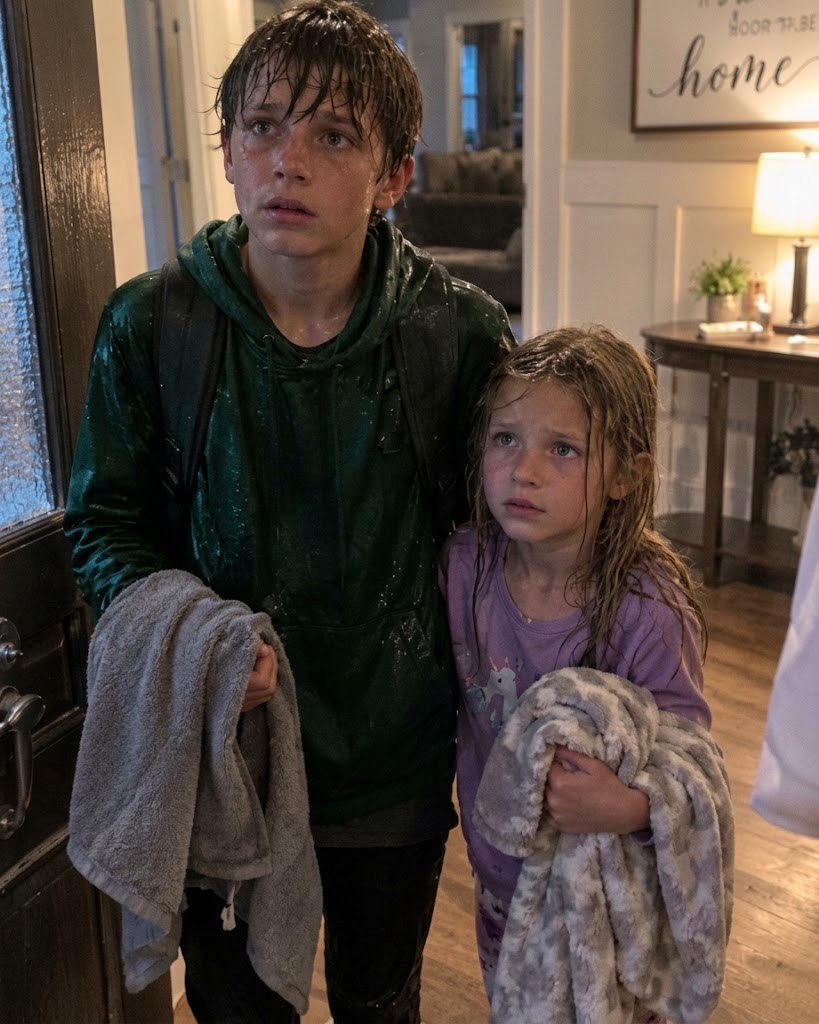
The boy was holding her hand so tightly she was almost pressed against his side.
I opened the door.
“Please,” he said immediately. “Can we just stay here tonight?”
His teeth were chattering.
The little girl had no jacket.
“Where are your parents?”
He looked past me into the house.
“Please don’t call the police.”
That was the moment every reasonable instinct I had started screaming.
Two children were out late at night. All alone.
They were begging me not to call anyone.
I should have called someone immediately.
I know that.
But something about the boy’s face stopped me.
Not because I thought keeping children hidden from authorities was smart.
He just looked exhausted.
Not mischievous or rebellious.
I stepped aside.
“Come in.”
The girl rushed inside first.
The boy hesitated.
“You’re not calling the police?”
“Not tonight.”
That was the only promise I made.
I got them towels and dug through the hall closet until I found some of my nephew’s old pajamas.
They were too big for the girl, but she didn’t complain.
The boy’s hands shook so badly he had trouble holding the towel.
“I’m Teresa,” I said.
He looked at me for a second.
“I’m Ben.”
The girl whispered, “I’m Lucy.”
“Okay, Ben and Lucy. Are you hungry?”
Lucy looked at Ben before answering.
That bothered me.
Ben nodded. “A little.”
They ate grilled cheese and soup at my kitchen table.
Lucy finished everything.
Ben barely touched his.
“Where did you come from?” I asked.
“Not far.”
“How far is not far?”
He looked down. “I don’t know.”
“Do you know your address?”
“Yes.”
“Are your parents looking for you?”
He didn’t answer.
Lucy stared at her soup.
I decided not to push.
Not yet.
I made up the guest room.
There was only one bed, so I brought in an air mattress.
Lucy immediately climbed onto the bed and pulled the blanket to her chin.
Ben said he would take the floor.
“You can take the air mattress.”
“I’m fine.”
“Ben.”
He looked at me. “You don’t have to sleep on the floor.”
That seemed to surprise him.
He eventually agreed.
I told them I was right across the hall if they needed anything.
Then I went to my room and lay awake for almost two hours.
I had already decided I was calling someone in the morning.
Police, child protective services, somebody.
I just wanted them dry, fed, and rested first.
Around two in the morning, I got up to use the bathroom.
As I passed the guest room, I heard whispering.
“Do you think she suspects something?” Ben asked.
“I think so,” Lucy whispered.
“Let’s just sleep. We’ll figure it out tomorrow.”
I stopped and listened. The door was open maybe a few inches.
Then Ben pulled his pajama shirt over his head.
“My back itches,” he said.
His sister sighed, “Don’t worry, we’ll get help tomorrow.”
As the pajama shirt fell beside him, the hallway light caught his back.
I almost gasped. His skin was covered in scars.
Some were pale and old.
Others were angry red patches across his shoulder blades and lower back.
One area looked raw enough that I wondered if it was infected.
My first thought was abuse.
Someone had hurt him.
Maybe badly.
I backed away before they saw me.
Then I returned to my room and didn’t sleep at all.
By 6:30 a.m., I was in the kitchen making pancakes.
I needed to think.
I didn’t want to wake them with police officers at the door unless there was immediate danger.
But after seeing Ben’s back, I wasn’t willing to pretend this was simply two kids who had gotten lost in a storm.
They came downstairs just after 7:00 a.m.
Lucy looked much better after sleeping.
Ben looked pale.
He moved carefully when he sat down.
“Morning,” I said.
Lucy smiled. “Morning.”
Ben nodded.
I put pancakes on the table.
“You like blueberries?”
Lucy said, “Yes.”
Ben said, “Anything’s fine.”
That answer strangely irritated me.
Twelve-year-olds are supposed to have opinions about pancakes.
I sat with them.
We talked about harmless things first.
School, cartoons, and books.
Lucy liked dinosaurs.
Ben liked drawing.
Apparently, he was good at it.
“Can you draw a T. rex?” I asked.
“He can draw anything,” Lucy said proudly.
Ben smiled for the first time.
It disappeared quickly.
After breakfast, I made hot chocolate.
Then I sat across from them.
“I need to ask you something.”
Ben immediately stiffened.
Lucy looked at him.
I kept my voice calm.
“Last night, I accidentally saw your back.”
He went completely still.
“Ben, is someone hurting you?”
He answered quickly, “No.”
“Are you sure?”
“Yes.”
“Are those marks from somebody hitting you?”
“No.”
“Harming you in any way?”
“No.”
“Ben, are you sure?”
“I’m not being abused.”
Lucy put her mug down.
“We need to tell her.”
Ben looked at her.
“No.”
“We ran away to get help.”
“Lucy, stop.”
“You said we were going to get help.”
“I know.”
“Then tell her.”
He looked furious for a second.
Not at me. At the situation.
Lucy reached across the table and took his hand.
“You said we’d go to the hospital.”
Ben closed his eyes.
I felt my stomach drop. “The hospital?”
He opened his eyes.
Then he said, “It’s my skin.”
I waited.
“I have a condition.”
“What kind?”
He hesitated.
“It’s autoimmune.”
He gave me the name.
I recognized it vaguely but not enough to pretend I understood.
He explained that his immune system caused severe inflammation that affected his skin and joints.
The marks I had seen were from repeated flare-ups.
Some had healed into scars. Others were newer.
“Does it hurt?”
He shrugged.
Lucy answered for him.
“Yes.”
Ben gave her a look.
She ignored it.
“Sometimes he can’t sleep.”
I looked at him.
“Are you getting treatment?”
Ben stared at the table. “I was.”
“What happened?”
His jaw tightened. “Mom stopped taking me.”
“To appointments?”
He nodded.
“Why?”
He looked embarrassed.
That surprised me.
Like this was somehow shameful.
“She joined this group.”
“What kind of group?”
“People who think doctors make you sicker.”
I didn’t say anything.
Ben continued. “It started online. Then she found meetings.”
He explained that his mother had always worried about his medication.
At first, that seemed normal.
He had been diagnosed young.
There were side effects.
Blood tests, specialists, and appointments.
Then she started reading forums and watching videos.
She listened to people who claimed children were being “poisoned” by doctors.
“She said my treatment was weakening me,” Ben said.
“Was it?”
He shook his head. “I was doing better.”
That was the part that made me cold.
He had been improving.
Then his mother started canceling appointments.
The first one. Then another.
Then she stopped refilling one prescription.
After that, she began cutting back another medication without talking to his doctor.
“Does your doctor know?” I asked.
“No.”
“When was your last appointment?”
Ben looked down. “Seven months ago.”
“Seven?”
He nodded.
Lucy squeezed his hand.
I asked, “Have you been getting worse?”
He laughed once.
A bitter little laugh that did not belong to a 12-year-old.
“Yeah.”
The red areas on his back had spread.
His joints hurt.
He had headaches.
Some mornings he felt dizzy.
The pain medication she still allowed him to take helped enough for him to sleep.
Then two nights earlier, Ben and Lucy had overheard their mother talking on the phone.
“She said she was going to stop everything,” Ben said.
“Everything?”
“My pain medicine too.”
“Why?”
“She said pain is the body detoxing.”
I had to stop myself from reacting.
Lucy whispered, “He cried after.”
Ben looked humiliated.
“I didn’t.”
“You did.”
“It’s okay,” I said.
He looked at me.
“It is okay to cry when you’re hurting.”
His eyes filled immediately.
He looked away.
That nearly broke me.
I asked what happened next.
Ben said he had been thinking about leaving for weeks.
Not forever.
Just long enough to reach a hospital.
He had no phone because his mother had taken it after catching him looking up his old doctor’s office.
Lucy overheard him planning to leave and refused to stay behind.
“I told her no,” Ben said.
Lucy frowned. “He wasn’t leaving me.”
“You should’ve stayed home.”
“No.”
She said it firmly.
He rolled his eyes, but there was affection in it.
The storm had given them their chance.
Their mother fell asleep early.
The power went out.
Ben packed a backpack with a few clothes, a bottle of water, and the little cash he had.
Lucy put crackers and two stuffed animals into her school bag.
They slipped out the back door.
They knew roughly where the nearest hospital was.
They thought they could walk there.
Then the storm got worse.
Visibility dropped.
Water started rushing along the streets.
Lucy got scared.
Ben saw my porch light.
So they stopped.
I sat there for a long moment.
Then I said, “I’m going to call an ambulance.”
Ben’s face changed.
“No.”
“Ben.”
“No police.”
“I said ambulance.”
“They’ll call people.”
“Probably.”
He started breathing faster.
“They’ll take Lucy.”
Lucy looked frightened now too.
I moved my chair closer. “Listen to me.”
He wouldn’t look at me.
“You came out in a storm because you needed medical help.”
His eyes stayed on the floor.
“So that’s what we’re doing first. Getting medical help.”
“Mom’s going to be mad.”
“I know.”
“She thinks she’s protecting me.”
“I believe you.”
His head came up.
“I don’t think your mother wakes up wanting you to hurt.”
He stared at me.
“But wanting to protect you and actually protecting you are not always the same thing.”
He started crying then.
Lucy climbed out of her chair and wrapped her arms around him.
I called emergency medical services.
The paramedics arrived less than 20 minutes later.
One of them examined Ben’s back and asked questions about his medications.
His expression became serious.
They recommended taking him to the hospital immediately.
The paramedics allowed me to ride with the children because Ben asked me to.
At the hospital, everything moved quickly.
Blood work. An exam. Calls to specialists.
Lucy sat beside me, coloring with crayons a nurse brought her.
A doctor eventually came to speak with us.
Ben’s condition had flared significantly.
He was dehydrated.
Several inflammatory markers were concerning.
Some of the skin lesions were at risk of infection.
The doctor said stopping treatment abruptly could lead to serious complications.
Ben needed monitoring and a proper treatment plan restarted under specialist care.
That was when child welfare became involved.
A social worker came in.
She spoke to Ben alone.
Then spoke to Lucy and me.
Their mother was contacted.
Her name was Allison.
She arrived at the hospital furious.
The moment she saw me, she said, “Who are you?”
“Teresa.”
“What did you tell them?”
“Only what your children told me.”
She turned to Ben. “How could you run away?”
He looked terrified.
Allison’s face changed slightly when she saw that.
“I was trying to help you.”
Ben started crying.
“You wouldn’t let me see my doctor.”
“Because they were making you dependent.”
The doctor stepped in.
“We need to talk about his current medical condition.”
Allison immediately became defensive.
“I’ve done my research.”
“I’m sure you have.”
That calm answer seemed to disarm her slightly.
The conversation lasted a long time.
She insisted the medications were dangerous.
The doctor acknowledged that every treatment had risks.
Then he explained, very plainly, what was happening to Ben without treatment.
For the first time, I saw Allison’s certainty crack.
She looked at her son’s back when the doctor showed her one of the worsening areas.
Her face changed. “I didn’t know it was that bad.”
Ben whispered, “I told you.”
She covered her mouth.
That was the first moment I felt sorry for her.
Not because what she had done was okay. It wasn’t.
But she did not look like a mother who wanted her son sick.
She looked like someone who had become so convinced she was saving him that she had stopped hearing him.
Child welfare took the situation seriously.
Ben and Lucy were not sent home that night.
A maternal aunt was contacted and cleared for temporary emergency placement.
The children could stay together.
That mattered more to Ben than anything else.
Allison was given clear conditions.
She had to cooperate with Ben’s medical care.
She could not alter or discontinue prescribed treatment on her own.
She had to participate in parenting support and counseling.
Medical appointments would be monitored for a while.
Her contact with the children began supervised.
Ben stayed in the hospital several days.
I visited once.
He looked better already.
Still tired. But better.
Lucy had drawn me a picture.
It showed a house in blue crayon.
Rain everywhere. Three stick figures inside.
She handed it to me.
“That’s your house.”
I swallowed. “I figured.”
“That’s you.”
The biggest figure had yellow hair.
I do not have yellow hair.
I didn’t correct her.
A few months have passed now.
I know some of what happened afterward because Allison’s sister kept me updated, with permission.
Ben is back under specialist care.
His skin has improved.
His pain is much better controlled.
He’s started drawing again.
Allison is still in therapy.
Apparently, part of the work has been helping her understand how deeply the group she joined influenced her thinking.
She had built an entire community around people who reinforced the same fears.
Every side effect became proof.
Every doctor who disagreed became suspicious.
Every improvement was credited to something else.
Once Ben deteriorated badly enough to require hospitalization, she finally began questioning what she had believed.
She has apologized to him.
More than once.
From what I’ve been told, Ben didn’t accept it immediately.
Good. He shouldn’t have had to.
Trust is not a light switch.
Their visits gradually became less tense.
Then longer.
Eventually, with approval from the people involved in the case, the children began spending more time with her.
Reunification is being handled carefully.
No one is pretending everything is fixed.
But Allison now attends appointments.
She asks questions.
She disagrees sometimes.
Then she listens to the answers.
That is progress.
Ben called me once.
I didn’t expect that.
He said, “Mom came to my appointment.”
“How’d it go?”
“She didn’t argue with the doctor.”
I laughed. “That’s good.”
“She asked like nine questions, though.”
“That sounds like a mom.”
He laughed too.
Then he said something quieter. “Thanks for calling the ambulance.”
“You don’t have to thank me.”
“I told you not to.”
“I remember.”
“You did it anyway.”
“Yes.”
There was a pause. Then he said, “Good.”
I think about that a lot.
That night, those children begged me not to call anyone.
For a few hours, I respected that request.
But there are promises adults should never make to children.
Keeping danger a secret is one of them.
Ben’s mother loved him.
I believe that.
Love was not the problem. Fear was.
And fear, reinforced by misinformation, convinced her that denying her son medical care was the same thing as protecting him.
It wasn’t.
Sometimes helping someone means listening.
Sometimes it means respecting what they want.
And sometimes, especially when a child is in danger, helping means doing the thing they are begging you not to do.
I’m just glad Ben and Lucy knocked on my door before that storm carried them any farther.
When a parent has been deeply influenced by misinformation, should the priority be punishment, rehabilitation, or both?