My eight-year-old son, Tyler, had always been incredibly close to my mother.
When I was raising him alone and working long shifts, Grandma was the person who stepped in whenever I couldn’t be there. She packed his lunches before school, helped him with his homework, listened to him practice spelling words, attended his school concerts, and somehow remembered every little detail about the things he loved.
To Tyler, she wasn’t simply his grandmother.
She was one of the safest people in his world.
So when my mother’s heart condition suddenly worsened and doctors told us she needed major surgery, Tyler took the news harder than I expected.
The surgery itself went well, but her recovery was difficult. She came home weak and exhausted, taking several medications and needing help with even some of the things she had once done without thinking.
I brought her home with us so I could take care of her.
But almost immediately, Tyler decided that taking care of Grandma was his responsibility too.
He became her little shadow.
“Grandma, you need water.”
“I already have water.”
“You haven’t drunk it.”
My mother would look at me and laugh.
“He’s bossier than you.”
Tyler would proudly shrug.
Sometimes he brought her blankets. Sometimes he fetched her glasses. He reminded me when her medication alarm went off. And when Mom was too tired to talk, Tyler would sit beside her bed and read comic books aloud.
“I learned from the best,” he’d tell her.
It was sweet.
At first, I thought it was simply the way an eight-year-old showed love.
Then he started sleeping outside her bedroom.
The first morning I found him, I nearly tripped over him.
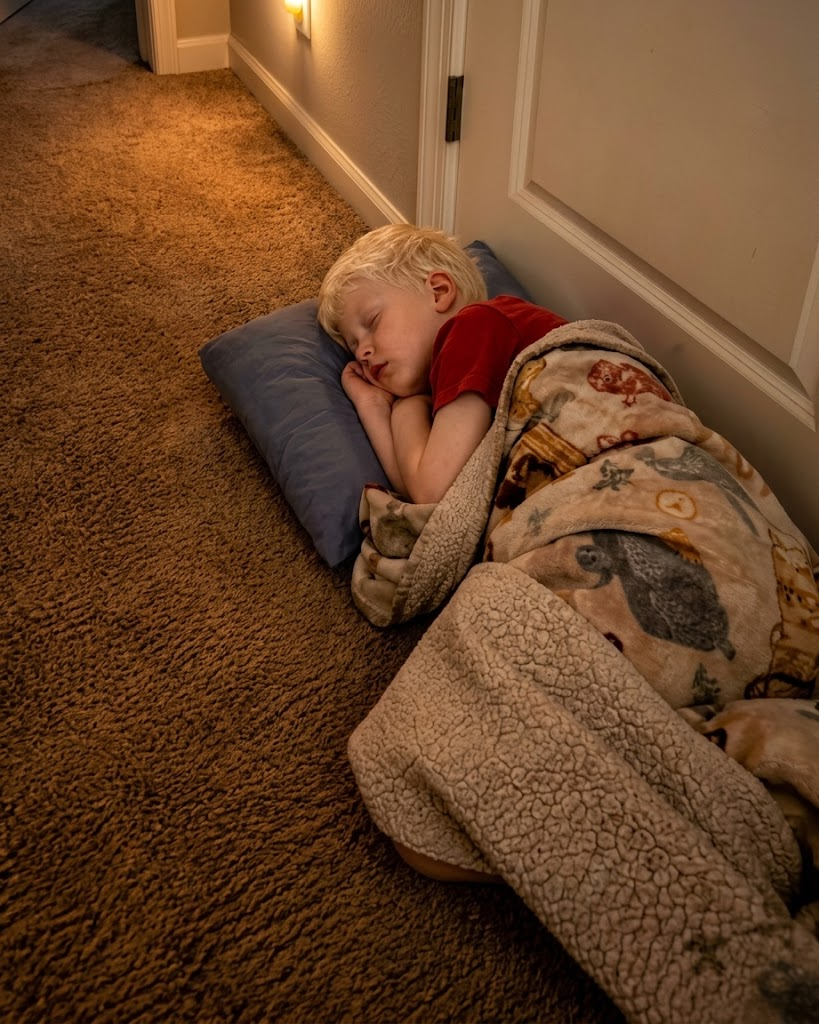
He was curled up on the hallway floor with his pillow underneath his head and his dinosaur blanket wrapped around his legs.
“Tyler?”
He opened his eyes.
“What are you doing out here?”
He rubbed his face.
“Nothing.”
I smiled and crouched beside him.
“Wouldn’t you be more comfortable in your own bed?”
He glanced toward Grandma’s closed bedroom door.
“Sweetheart, Grandma is safe. I’m right across the hall.”
“I know.”
“Then why are you sleeping here?”
He hesitated.
“I just want to be close.”
I didn’t think much of it.
My mother had been seriously ill. Tyler had watched the strongest woman he knew become weak enough to need help walking down the stairs. Maybe he was frightened that something might happen to her while everyone else was asleep.
So I hugged him and carried his pillow back to his bedroom.
The next morning, he was outside Grandma’s door again.
“Tyler.”
“I know.”
“Grandma is okay.”
“I know.”
“Then you need to sleep in your own bed.”
“Okay, Mom.”
But that night, he returned to the hallway.
And the night after that.
Soon, it became a routine.
Every evening, after brushing his teeth, Tyler would take his pillow and blanket and settle himself directly outside my mother’s bedroom.
Every morning, I would find him there.
I kept telling myself it was harmless.
I didn’t realize he was watching for something.
Around the same time, my younger brother, Jason, began coming over almost every day.
Jason is four years younger than me. He runs a small contracting business and has always been charming, outgoing, and the kind of person who believes he can fix almost anything.
After Mom’s surgery, he seemed determined to help.
He brought groceries.
He repaired a loose railing on the stairs.
He replaced a light fixture I’d been meaning to deal with for months.
Whenever I needed to leave the house, he’d wave me toward the door.
“Go. I’ve got Mom.”
“You sure?”
“Of course. You’ve got enough on your plate. Let me help.”
I appreciated it.
With Mom recovering in my house, having another family member around seemed like a blessing.
I even gave Jason a spare key.
At the time, it seemed practical.
I never imagined that key would eventually become part of something much more disturbing.
Because little by little, I began noticing something strange about Tyler.
Whenever Jason went upstairs, Tyler followed him.
If Jason carried food or tea toward Grandma’s room, Tyler suddenly appeared behind him.
If Jason offered to sit with Mom while I ran an errand, Tyler suddenly found a reason to stay in the room.
One Saturday afternoon, Jason picked up a cup of tea and started walking upstairs.
Tyler immediately stood up.
Jason looked over his shoulder.
“You coming too, little bodyguard?”
He laughed and reached down to ruffle Tyler’s hair.
Tyler didn’t laugh.
He simply followed him upstairs.
At the time, I found it irritating rather than alarming.
Later, I pulled Tyler aside.
“Uncle Jason is trying to help Grandma.”
“I know.”
“You don’t have to follow him everywhere.”
Tyler stared at the carpet.
“If Grandma needs something, she can call me. Uncle Jason isn’t bothering her.”
“I’m not.”
“You are.”
He didn’t argue.
He just looked down.
I crouched in front of him.
“Tyler, Uncle Jason loves Grandma. He’s helping us.”
“Okay, Mom.”
“Promise me you won’t keep following him.”
“Okay.”
That night, he slept outside Grandma’s door again.
I carried him back to his bed around midnight.
The next night, he was back.
I started wondering whether I should talk to someone about how anxious he seemed.
I didn’t understand that Tyler wasn’t simply anxious.
He was afraid.
And he believed he had a reason to be.
Then came Thursday morning.
It was a little after 4 a.m.
I woke because I thought I heard someone talking.
At first, I assumed Mom was calling for me.
I lay still for a few seconds.
Then I heard a child’s voice.
It was coming from the hallway.
I opened my bedroom door.
Tyler was lying on the floor outside Grandma’s bedroom beneath his blanket.
But he wasn’t asleep.
He was staring directly at the bedroom door.
One small hand was wrapped tightly around his pillow.
“I won’t fall asleep tonight,” he whispered.
I froze.
Then he whispered something else.
“I won’t let Uncle Jason do it to Grandma again.”
My entire body went cold.
“Tyler?”
He jumped and sat upright so quickly that his blanket slid onto the floor.
I hurried toward him.
“What did you just say?”
He immediately looked toward Grandma’s bedroom.
“Nothing.”
“Tyler.”
His eyes filled with tears.
“Mom, promise you won’t tell anyone.”
My heart started pounding.
“What won’t you let Uncle Jason do again?”
He covered his face with both hands.
“What happened?”
He shook his head.
“Tyler, you need to tell me.”
He finally leaned toward me.
Then he whispered one sentence into my ear.
I could barely process what I was hearing.
By the time he finished, my hands were shaking so badly that I had to grip the wall.
“Tell me exactly what happened,” I whispered.
Tyler looked terrified.
He kept glancing at Grandma’s door.
Finally, he said:
“Uncle Jason keeps making Grandma sign things when you’re not here.”
I stared at him.
“What things?”
“I don’t know.”
“Tyler, what things?”
“Papers.”
“What papers?”
He wiped his eyes.
“He brings a folder upstairs when you leave.”
My stomach tightened.
“How do you know?”
Tyler hesitated.
Then he explained.
A few days earlier, he had been sitting in Grandma’s bedroom reading when Jason came in carrying a folder.
Jason told him to go downstairs.
So Tyler did.
But instead of staying downstairs, he eventually came back.
He had hidden near the landing because he didn’t like the way Jason had spoken to him.
From there, he could hear parts of the conversation.
Jason had apparently placed several papers on Grandma’s blanket.
He told Mom they were documents that would allow him to “help with everything” while she recovered.
Tyler didn’t understand what the papers meant.
But he remembered hearing Grandma repeatedly ask where she was supposed to sign.
Then she signed.
A lot of pages.
Tyler said Jason folded the documents quickly and put them back inside his folder.
“Why didn’t you tell me?” I asked.
He looked ashamed.
“Because you told me to stop following him.”
That sentence broke something inside me.
He had tried to protect his grandmother.
He had been watching.
He had been afraid.
And I had told him he was simply being difficult.
“What else happened?” I asked.
Tyler hesitated.
Then he told me something even more frightening.
Jason had come into the house late one night.
I had been asleep.
Tyler had heard the front door open.
Jason had used the spare key.
He went upstairs to Grandma’s room.
According to Tyler, Jason told her she had signed something in the wrong place and needed to sign another document.
Tyler had stayed awake in the hallway.
That was when I finally understood why he had started sleeping outside her door.
He wasn’t trying to comfort himself.
He was guarding her.
He believed he was the only person awake enough to stop something from happening.
I immediately went into my mother’s room.
She startled when I turned on the lamp.
“What happened?”
“Mom, I need to ask you something.”
She pushed herself upright.
“Has Jason been bringing you documents?”
She frowned.
“What documents?”
“Papers to sign.”
She thought for several seconds.
“I don’t know.”
“Mom, please think.”
She closed her eyes.
“He said something about paperwork.”
“What kind of paperwork?”
“I think something for the bank.”
My stomach dropped.
“Did you sign anything?”
She looked confused.
“Maybe some forms.”
“Did Jason explain exactly what you were signing?”
“No.”
I didn’t sleep again that morning.
As soon as the sun came up, I called our family attorney, Denise.
She had handled my father’s estate years earlier and knew my mother’s financial arrangements.
I told her everything Tyler had told me.
Her response was immediate.
“Don’t confront Jason yet.”
By 8:30 that morning, Mom, Tyler, and I were sitting in Denise’s office with every financial document we could find.
Denise spoke to Mom carefully.
“Did you knowingly give Jason permission to access or manage any of your accounts?”
Mom frowned.
“No.”
“Did he explain that any of the documents you signed could give him that kind of access?”
“No.”
Denise looked at me.
Then she picked up the phone.
“Let’s call the bank.”
That call changed everything.
Jason had submitted documents requesting access to more than one of Mom’s accounts.
Some requests were still under review.
But one had already resulted in him being added to an account.
Mom stared at the phone.
“Why would he do that?”
I didn’t know.
But I knew we needed to find out.
That afternoon, the answer walked through my front door.
Jason arrived carrying another folder.
He stepped into the kitchen and immediately noticed Denise’s business card lying on the table.
His expression changed.
“Hey,” he said slowly. “Where’s Mom?”
“Upstairs.”
He nodded.
Then he looked back at the table.
I pointed toward a chair.
“Sit down.”
He didn’t.
“What happened?”
“Sit.”
He finally sat.
I placed copies of the documents on the table.
“Explain these.”
He stared at the paperwork.
Then he looked at me.
“It’s not what you think.”
“Then tell me what it is.”
“I was helping Mom.”
“By getting access to her accounts?”
He rubbed his jaw.
“Come on.”
“How much did you need?”
He didn’t answer.
“Jason.”
Silence.
“How much?”
Finally, he whispered:
“Twenty.”
“Twenty what?”
“Twenty thousand.”
My hands went cold.
“Why?”
He looked down at the papers.
And then everything came out.
His business was in trouble.
Payments were late.
Two major jobs had fallen through.
He was behind on equipment financing.
He owed suppliers.
Bills were piling up.
He had tried to keep everything hidden because he was embarrassed.
“Mom has money sitting there,” he said.
“You asked her before, didn’t you?”
Jason looked away.
“Before her surgery?”
He said nothing.
Then a voice came from the stairs.
“Yes.”
We all turned.
Mom was standing there, holding onto the railing.
“Mom,” Jason whispered.
I moved toward her, but she shook her head.
She slowly walked into the kitchen.
“You asked me before the surgery,” she said.
Jason stared at the table.
“You asked me for money.”
He didn’t respond.
“And what did I tell you?”
His eyes remained down.
“I said no.”
Jason finally looked up.
“I was desperate.”
Mom’s voice remained calm.
“Helping me would have meant listening when I said no.”
Jason swallowed.
“I thought I could pay it back.”
“You lied about what I was signing.”
“I didn’t mean for it to go this far.”
“You brought papers into my bedroom when I was sick.”
“I thought I could fix everything.”
Mom looked at him.
“That wasn’t your decision to make.”
Jason’s frustration suddenly erupted.
“Because I’m tired of being the worst of the bunch!”
Nobody spoke.
He looked toward the stairs.
“When you got sick, I thought I could finally be useful.”
Mom’s expression softened for only a moment.
Then she shook her head.
“You were useful.”
Jason looked at her.
“You brought groceries. You fixed things. You helped me.”
His eyes filled with tears.
“But you weren’t satisfied with helping.”
He looked down.
“So you decided to take control.”
Jason didn’t answer.
“My business was falling apart,” he finally said. “I just couldn’t admit how badly I’d messed things up.”
“You could have asked for help.”
“I did.”
“And when I said no?”
Jason looked at her.
“I was desperate.”
Mom shook her head.
“And when the answer was no, you decided my answer didn’t matter.”
Jason stared at the papers.
For once, he had nothing to say.
The room became completely silent.
Then Mom spoke again.
“You could have come to me honestly.”
Jason wiped his face.
“I was ashamed.”
“You should have been honest anyway.”
He nodded.
There was no dramatic reconciliation.
No instant forgiveness.
No easy ending.
There couldn’t be.
What Jason had done had damaged the trust between him and the family.
With Denise’s help, Mom revoked every authorization she had not knowingly approved.
The bank opened a formal review.
I took back Jason’s spare key.
Mom locked away her financial documents.
And Jason was no longer allowed to be alone with her while she recovered.
But there was one person I owed an apology to more than anyone else.
My son.
That night, I sat beside Tyler on his bed.
He was quietly playing with the corner of his blanket.
“I should have listened to you,” I said.
He didn’t answer.
“I should have believed you.”
After a moment, he looked at me.
“I tried to tell you.”
“I know.”
He looked down.
“I tried to tell you without telling you.”
I felt tears come to my eyes.
He was eight years old.
He didn’t have the words to explain bank forms, financial authorization, manipulation, or abuse of trust.
He only knew that something was wrong.
So he did what he could.
He watched.
He stayed close.
And when the adults weren’t paying attention, he stood guard.
Adults often ask children why they didn’t speak sooner.
Sometimes children do speak.
They simply don’t speak in the language adults expect.
A few nights later, I woke before sunrise and opened my bedroom door out of habit.
The hallway outside Grandma’s room was empty.
For the first time in weeks, Tyler’s pillow wasn’t lying on the floor.
His dinosaur blanket wasn’t there either.
He had slept in his own bed all night.
I stood there for a moment, realizing what that meant.
He finally believed Grandma was safe.
Jason eventually called Mom and asked if he could come over.
She agreed.
But she didn’t forgive him immediately.
She told him that rebuilding trust would happen on her terms, not his.
When he came to the house, he brought no groceries.
No tools.
No folder.
He simply came to apologize.
Mom listened.
She didn’t promise everything would go back to normal.
She told him trust would have to be earned again.
And this time, Jason understood.
Months later, Mom was back on her feet.
She was stronger, moving around the house more easily, and slowly returning to her normal routine.
One afternoon, she called Tyler into the kitchen.
“I need your help with something.”
She had a new folder sitting on the table.
Across the front, written in huge letters, were the words:
ASK ME FIRST.
Tyler laughed.
Mom handed him a marker.
“Add something.”
He thought for a moment.
Then he wrote underneath:
AND LISTEN WHEN I SAY SOMETHING.
The room went quiet.
I looked at Tyler.
He looked back at me.
I didn’t need to ask who that second sentence was really for.
Because sometimes the smallest voice in the room is the one everyone needs to hear.
And sometimes a child sleeping on the floor outside a bedroom door isn’t being difficult, dramatic, or afraid.
Sometimes he’s standing guard over the person he loves.
And sometimes, when an eight-year-old keeps trying to tell you that something is wrong, you have to stop dismissing the way he’s saying it long enough to understand what he’s actually trying to tell you.