PART 1
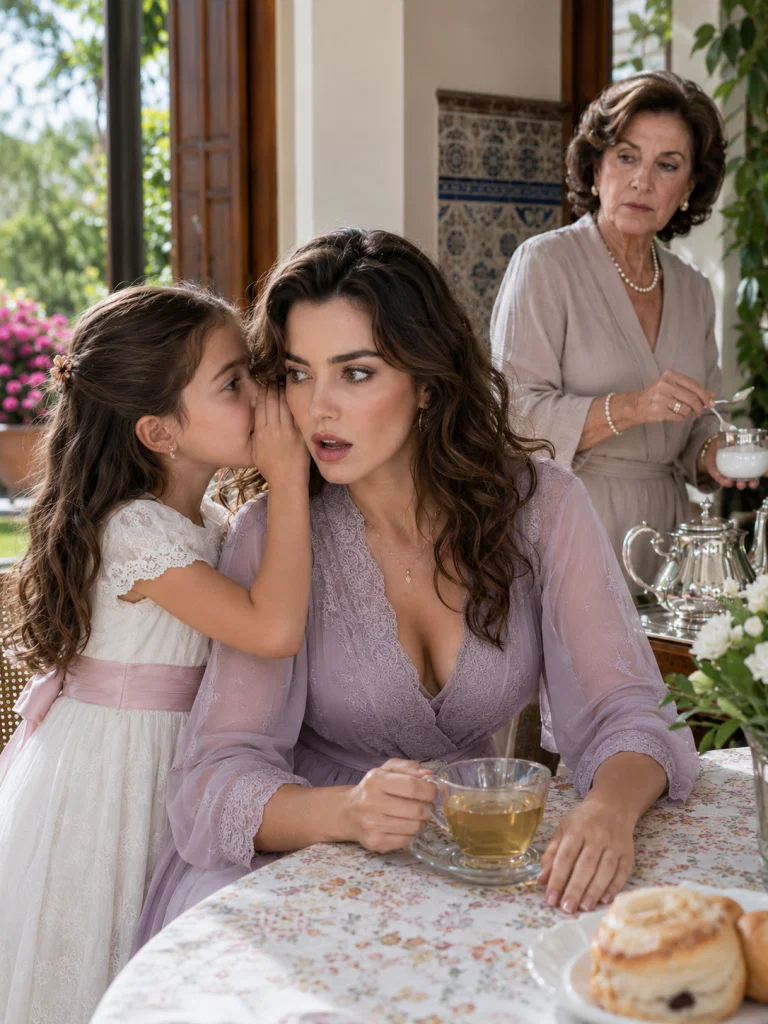
“Mommy, Grandma puts a white powder in your tea when she thinks no one is watching,” my eight-year-old daughter Danielle said to me while I was standing in our quiet living room in San Diego.
I was folding a crisp shirt belonging to my husband, Donald, and I felt the fabric bunch tightly in my fist as her words sank in.
“Are you absolutely sure about that, sweetie?” I asked, looking into her innocent eyes while trying to keep my voice steady.
“Yes, she takes it out of a small white bottle, stirs it into the liquid, and then watches you until you drink every last drop,” Danielle explained, her voice remarkably calm for such a chilling revelation.
At that exact moment, my mother-in-law, Rachel, appeared from the hallway carrying a laundry basket full of fresh clothes. She had been living under our roof for ten whole years, and I had always treated her like my own flesh and blood because my own mother passed away when I was still in college. I paid for all her specialist doctors, her expensive monthly medicines, and even her long vacation trips back to her hometown in Phoenix. Rachel took care of Danielle after school, cooked our daily family meals, and every single morning without fail, she brewed and served me a hot mug of chamomile tea.
“Here you go, Madison, drink it up while it is still warm because it works wonders for your sensitive stomach,” Rachel always said with a gentle smile that I had mistaken for pure maternal affection for a whole decade.
That afternoon, after Danielle’s unsettling warning, I walked slowly into the kitchen and noticed my tea mug sitting quietly on the counter. Looking closely at the bottom, I spotted tiny, chalky white lumps that had not fully dissolved, so I quickly poured the whole liquid down the drain without uttering a single word. During dinner, Rachel served me a steaming bowl of chicken noodle soup and commented with a softness that sent icy shivers down my spine.
“Make sure you finish that soup, my dear, because you have been looking so terribly pale and exhausted lately,” she said, resting her wrinkled hand over mine.
Her words immediately triggered memories of my recent medical test results, which showed severely altered liver enzymes, relentless fatigue, painful joint inflammation, and mysterious skin blotches that no specialist in the city could explain. After we finished dinner, I pretended to clean the kitchen counters and casually reached toward a white porcelain jar tucked behind a box of Earl Grey tea. Rachel turned around with alarming quickness and physically blocked my path before I could touch it.
“What exactly are you looking for back there, Madison?” she asked, her eyes narrowing slightly in suspicion.
“Oh, it is nothing, as I just thought that little container held the extra table sugar,” I lied, keeping my tone light.
Rachel forced a thin smile that completely failed to reach her cold eyes. “Those are just special dried cooking herbs that have a very harsh smell, so it is really best if you leave the jar closed.”
I did not sleep a single second that long night, and at five thirty in the morning, I hid quietly behind the kitchen door to observe her routine. Rachel turned on the overhead light, carefully prepared my usual chamomile tea, and opened the secret jar with the fluid ease of someone who had done it thousands of times before. She scooped out a precise teaspoon of the white powder into my mug, paused for a second, added half a teaspoon more, and stirred methodically until the substance completely vanished.
My stomach dropped violently, and I felt as though the solid floor was giving way beneath my bare feet.
I slipped out of the house before anyone else woke up and immediately called my closest friend, Charlene, who worked as a senior research chemist at the local hospital. She rushed me into a private room to run emergency blood and urine panels, and an hour later she sat down in front of me with a face pale from sheer disbelief.
“Madison, your lab work shows heavy traces of a potent immunosuppressant in your system that was definitely not an accidental dosage,” Charlene said, her voice shaking with concern. “Someone has been giving this to you repeatedly over a long period, and it is actively damaging your liver, lungs, and bone marrow.”
I did not shed a single tear, but instead I pictured the hundreds of innocent tea mugs I had swallowed while Rachel stood nearby, smiling warmly while waiting to make sure I did not leave a single drop behind. Charlene urged me to secure a physical sample of the powder and record the act so we would have undeniable legal evidence. That very same afternoon, I secretly installed a tiny hidden camera disguised as a wall outlet right above the kitchen counter.
Later that night, I scooped a tiny sample of the powder into a plastic bag, and right underneath the jar, I discovered a crumpled pharmacy receipt made out to a man named Agustin Wickham, an individual whom no one in our family had ever heard of.
The following morning, Rachel proudly placed the freshly made tea mug right in front of me at the dining table. Just as I raised the ceramic rim toward my lips to play along, young Danielle came bounding into the room.
“Mommy, I am so thirsty, so can I please have a big sip of your sweet tea?” Danielle asked, reaching her small hands toward the warm cup.
Rachel turned deathly pale in an instant and shrieked at the top of her lungs, “Do not dare drink from that cup, child!”
My husband, Donald, slowly lowered his morning newspaper and looked at his mother with deep confusion. “Mom, what on earth is inside Madison’s tea that makes it so dangerous for our daughter to drink?”
Rachel stared blankly at the tea mug, then looked directly into my cold eyes, and for the first time in ten years, her sweet maternal mask completely shattered into pieces.
PART 2
Rachel frantically stammered that the tea was far too hot for a child, but Donald reached over and touched the side of the mug only to find that it was barely lukewarm. I immediately changed the subject to de-escalate the tension because I needed to protect our growing mountain of evidence before taking any drastic legal action. I grabbed my keys, took Danielle to her elementary school, and sternly instructed her never to accept any food or drink from her grandmother unless I was standing right beside her.
“Is Grandma trying to poison you, Mommy?” Danielle asked, her bright eyes welling up with genuine terror as she clutched her backpack.
“I am taking care of everything, my sweet girl, so I just need you to trust me and stay safe,” I reassured her before watching her walk safely through the school gates.
Sitting in my car in the parking lot, I forwarded digital copies of the hidden camera footage and medical files to Charlene and a secure backup email address. Around four in the afternoon, my phone buzzed with an automated alert from the hidden kitchen camera showing an intruder inside our home. It was a rugged man in his mid-fifties wearing a dark baseball cap, and Rachel led him directly into the kitchen without hesitation. He inspected the white porcelain jar, handed her a small package wrapped tightly in aluminum foil, and right before walking out, he pointed his finger directly at the hidden outlet camera.
Rachel approached the outlet slowly, and a second later, the video feed went completely pitch black.
I panicked and called Donald repeatedly, but his phone went straight to voicemail, so Charlene called and urged me to retrieve Danielle from school without delay. When I sprinted into the school’s front office, the principal dropped a bombshell by informing me that Rachel had picked up my daughter ten minutes earlier using her authorized guardian card.
I felt as if all the oxygen had been violently ripped right out of my lungs.
Donald and I pulled up to our house at almost the exact same minute, only to discover that Rachel, Danielle, the porcelain bottle, and the foil package were all gone. I knew I could no longer keep the horrifying truth hidden from him, so I pulled up the camera footage, the toxicological reports, and the pharmacy receipt bearing Agustin Wickham’s name. Donald watched his own mother deliberately poison my morning tea on video, and he collapsed heavily onto a kitchen chair with his head in his hands.
“This cannot be happening, because my mother could never be capable of doing something so evil,” he sobbed in total disbelief.
“I naively believed that exact same thing for ten whole years, but right now we have to put our feelings aside and go save our daughter,” I replied sternly, pulling him up by his jacket.
A cousin of Donald remembered that Rachel had recently asked for detailed driving directions to a dilapidated family chapel located deep in the mountains near Flagstaff. We immediately notified the local police department and sped off into the heavy downpour that was flooding the highway. Halfway up the winding mountain roads, my cell phone rang with an incoming call from an unknown number.
“Mommy, please come get me because I am so cold and scared,” Danielle sobbed over the line before the phone was yanked away.
Rachel’s bitter voice came through the speaker. “Do not bother bringing the police, Madison, because I just want Donald to finally see what he did to me ever since he met you.”
“Give me back my daughter right now, Rachel, or I swear I will ruin you,” I screamed into the receiver.
“You stole my only son away from me, Madison, after I gave my entire life to raise him, and you just came along and took everything I had,” she hissed before hanging up.
We located Rachel standing under the dripping stone overhang of the ancient chapel, holding Danielle tightly by the shoulder with one hand while clutching the white pill bottle with the other. Donald stepped forward slowly into the rain and begged his mother to let our terrified daughter go free. Rachel burst into erratic tears as the wind howled around us.
“At first I only wanted Madison to get a little bit sick, thinking that if she was weak, she would work less, stay home, and you would finally need your mother again,” Rachel confessed, her voice trembling. “Agustin was the one who supplied the powder and told me exactly how much to mix in every morning.”
The moment the loud sirens echoed in the distance, Danielle pulled away from Rachel’s grasp and ran frantically into my open arms. The white porcelain jar slipped from Rachel’s trembling hands and shattered on the muddy ground, spreading the deadly white powder into the rainwater. As the responding officers wrestled Rachel to the ground and slapped heavy steel handcuffs on her wrists, she screamed wildly toward us.
“I did not plan all of this on my own, because Agustin knew Madison’s late mother, and he has been waiting for decades to exact his revenge!” she shrieked.
A few hours later at the station, detectives discovered disturbing surveillance photographs inside a motel room that Agustin had been renting nearby. The photos showed our house, Danielle leaving her school grounds, and old pictures of my mother from when she was a young woman. Taped to the wall was a detailed notebook tracking our daily schedules, with one specific line heavily underlined in red marker: “If Rachel fails her task, activate Plan B with the young girl.”
My phone buzzed on the metal interrogation table with a picture message from an unregistered cell phone number. It was a close-up photograph of Danielle’s personalized silver bracelet, which she had accidentally lost during the chaos at the chapel earlier that evening.
A short text message beneath the image read: “Your mother was no innocent hero, so come alone to the old site if you want to learn the truth.”
In that dark moment, I realized with absolute horror that my mother-in-law had merely been a pawn in a far more dangerous game.
PART 3
Detective Qualls grabbed my smartphone before I could even process a response, and his team immediately attempted to trace the signal, though the burn phone was registered to a dead-end shell company. Agustin was clearly not attempting to flee the state, but was instead deliberately laying a trap to lure me into a confrontation.
Inside the briefing room, Detective Qualls laid out a dusty, yellowed photograph from thirty years ago showing my late mother, Susan, standing outside a defunct pharmaceutical plant near Tucson. Standing right behind her in the background was a younger Agustin Wickham, who had served as the facility’s primary inventory warehouse manager.
The detective explained that the plant had been under federal investigation for illegally manufacturing toxic medications with contaminated raw ingredients and falsifying safety records. My mother had worked in the accounting department back then, and she had secretly photocopied internal ledgers, chemical manifests, and fraudulent wire transfers. Agustin was fired immediately after she blew the whistle to upper management, but the official legal case was eventually dropped due to missing paperwork, and the company dissolved shortly after.
“Agustin claims his entire life was ruined because of what your mother did,” Detective Qualls said grimly. “However, our records indicate he was actively participating in the cover-up himself.”
I could barely catch my breath as a faint memory surfaced from my childhood, recalling a quiet conversation with my mother right before she passed away. She had warned me never to trust anyone who brought up her former corporate employer, telling me to walk away immediately if strangers ever approached me about her past. I had spent years assuming those warnings were just the confused ramblings of a woman fading from illness.
Rachel confessed under interrogation that Agustin had tracked her down five years ago in Phoenix, where he skillfully exploited her bitter jealousy by convincing her that I was turning Donald against her. He began selling her the crushed immunosuppressant pills for three thousand dollars a month, which Rachel paid for using the very allowance money I generously provided for her personal expenses.
The reality was far more twisted than I could have ever imagined, as Agustin had used my mother-in-law’s domestic resentment as an open doorway to enter my household.
Later that afternoon, another text arrived with a specific address directing me to an abandoned industrial warehouse on the outskirts of Tucson. The message explicitly demanded that I arrive alone if I ever wanted to recover the hidden files that my mother had buried decades ago. Detective Qualls immediately organized a tactical operation and fitted me with a concealed wire beneath my coat. Donald begged the police to let him join the team, but the lead detective firmly denied his request for safety reasons.
“If Agustin spots a police convoy or extra civilian vehicles, he will slip away into the desert and we will lose him forever,” Detective Qualls warned.
Before heading out to the site, we dropped Danielle off at Charlene’s heavily guarded apartment in the city, where plainclothes officers were posted at every exit. I knelt down in the hallway and grabbed my daughter’s small hands gently in mine.
“I need you to promise me that you will not open that front door for anyone under any circumstances,” I whispered to her.
“Are you really coming back home to me, Mommy?” Danielle asked, her voice trembling with intense vulnerability.
“I will always come back to you, no matter what happens,” I promised, kissing her forehead before walking away.
The warehouse was vast, dark, and filled with the overwhelming smell of rust and decaying chemicals. Agustin emerged slowly from the shadows near the back of the building, his face weathered by decades of obsessive hatred.
“You have your mother’s exact eyes, Madison,” he sneered, tossing Danielle’s silver bracelet onto a rusted metal table beside a faded folder.
“What do you actually want from my family after all these years?” I demanded, keeping my voice firm for the microphone hidden in my collar.
“Your mother stole internal files and then panicked, delaying her report to the authorities,” Agustin spat, his voice filled with venom. “If she had turned over those documents immediately instead of hiding them, the bad batch would have been recalled and my young son would not have died from that contaminated medicine.”
I stood perfectly still as he recounted how his seven-year-old boy had suffered a fatal toxic reaction to the plant’s illegal drugs. According to Agustin, my mother had known about the fraud for months but held back the evidence out of fear for her own job, and by the time she finally spoke up, the medicine had already hit the market.
“She chose to protect her own cozy life while letting my innocent boy perish,” Agustin yelled, pointing a trembling finger at me. “That is why I decided you deserved to watch someone you love slowly rot away from the inside out.”
“So your sick idea of justice was to poison a young girl who was not even born when all of this happened?” I countered sharply.
“Sins are passed down through bloodlines, Madison, and debts must be paid in full,” he declared coldly.
For the first time since this nightmare began, I felt no fear, but rather an overwhelming sense of crystal-clear clarity.
“Blood does not inherit guilt, Agustin,” I said plainly. “You lost your son because of corrupt executives who made toxic drugs, and perhaps because of your own illegal choices to cover for them. My mother may have made terrible mistakes out of fear, but that does not make my eight-year-old daughter responsible, and all you have done is become the exact monster you claim to hate.”
Agustin’s face contorted with rage as he pulled a small glass vial filled with dark liquid from his coat pocket.
“Do you know how easy it was to convince Rachel to poison you?” he laughed sinisterly. “It took less than five minutes of talking to her, because she was desperate to feel needed again, so we made a perfect team.”
“Rachel made her own evil choices, and so did you,” I replied, keeping him talking to ensure the police tactical unit had complete audio coverage.
Suddenly, Agustin’s phone buzzed loudly in his pocket, and as he glanced down at the illuminated screen, a dark smile spread across his face. “It seems my partner has just initiated Plan B at your friend’s apartment.”
My heart stopped, and icy horror flooded my veins.
Detective Qualls and his armed tactical team kicked open the heavy warehouse doors and rushed the floor, but Agustin violently shattered a chemical vial on the concrete, releasing a cloud of blinding tear gas. Officers quickly hauled me out through a side emergency exit while medics checked my breathing. Detective Qualls ran over to his patrol car as a high-priority emergency dispatch call echoed over the radio speaker.
“We have an active break-in attempt at the apartment complex by a suspect posing as a utility technician,” the dispatcher announced frantically.
Donald and I sped through the city streets directly behind the police escort, my hands shaking violently as I dialed Charlene’s cell phone over and over again. She finally answered on the fifth ring, her voice reduced to a frantic whisper.
“We are barricaded inside the master bedroom while this man is violently beating on the wooden door with a heavy tool,” Charlene whispered frantically as crashing sounds echoed in the background.
“Do not unlock that door under any condition, because the police are pulling up to your building right now,” I pleaded into the phone.
On the other end of the line, I could hear heavy thuds against the wood while Danielle cried softly in the background. Charlene had managed to wedge a heavy oak wardrobe against the doorframe while screaming for help out the bedroom window, which alerted several neighbors in the hallway and forced the intruder to flee down the stairwell.
By the time our car screeched to a halt outside, armed officers were already sprinting into the lobby, and moments later, a voice confirmed over the tactical radio that the suspect had been intercepted on the twelfth floor.
A female officer walked out of the front entrance holding Danielle safely in her arms, and my daughter immediately leaped into my arms the moment she saw me.
“Mommy, I remembered your exact words and I never opened the door for that bad man,” Danielle sobbed, burying her face into my neck.
“You were so brave, sweetie, and everything is going to be alright now,” I cried, holding her tight.
The captured intruder was identified as Brycen Morley, a hired accomplice who was carrying a bag filled with toxic chemical compounds, zip ties, and detailed floor plans provided by Agustin. Brycen quickly agreed to cooperate with federal prosecutors, leading to the rapid arrest of Agustin Wickham as he attempted to cross the state border in a stolen truck.
The recovered folder from the warehouse contained a digital memory card holding the original corporate files my mother had gathered, alongside a handwritten letter addressed to me that she had hidden decades ago.
“My dearest Madison, I was so terrified of the powerful men running that plant that I hid the evidence for far too long, and by the time I spoke up, innocent people had already suffered,” the letter read. “I was no heroic savior, but just a frightened mother trying to fix her terrible mistakes, so if this dark past ever finds you, please do not let hatred turn you into another bitter villain.”
Reading her final words brought a flood of tears, giving me a profound sense of closure.
The recovered files proved that Agustin was far from an innocent bystander, as he had personally accepted cash bribes to sign off on contaminated raw chemical shipments that directly caused the tragedy. My mother had eventually turned the evidence over to a regional inspector, but that official had been paid off by the pharmaceutical board to bury the case entirely. Agustin had spent thirty years hiding from his own crushing guilt by constructing an elaborate lie that blamed my mother for his personal failures.
The cold case against the pharmaceutical executives was officially reopened by federal prosecutors, resulting in multiple indictments for criminal negligence and corporate fraud. Agustin Wickham faced charges of attempted murder, conspiracy, kidnapping, and stalking, ensuring he would spend the remainder of his natural life behind bars. Rachel was formally charged as a primary co-conspirator, admitting during her deposition that she had been poisoning my daily tea for over five years to make me weak and dependent on her care.
Donald went to visit his mother a single time at the county detention facility, and when he returned home that evening, he sat silently on our patio and wept for hours.
“She begged me to hire an expensive lawyer to get her out of jail, but I told her that I could no longer save her from the horrific choices she made,” Donald confessed, staring out into the night.
I did not offer him a hug, because the deep emotional trust between us was still fractured. For ten years, I had mistakenly confused avoiding marital conflict with maintaining real peace, while Donald had turned a blind eye to his mother’s subtle manipulations and boundary violations. He was not directly responsible for her criminal acts, but he needed to understand that his passive silence had created the environment for her abuse to flourish.
“I will never ask you to forgive her, Madison, and I will never again allow anyone to minimize the damage she caused to our family,” Donald said firmly.
That single honest admission was the very first step toward rebuilding our shattered marriage.
A month later, we packed our belongings and moved into a bright new home near Danielle’s elementary school, changing our personal phone numbers and installing a state-of-the-art security system. Danielle began seeing a pediatric trauma therapist, and for the first few months, she refused to consume any food or drink unless she watched me prepare it with her own eyes. My liver damage required ongoing medical monitoring, but doctors assured me that my organs would make a full recovery over time.
On our very first morning in the new house, I boiled fresh water, opened a sealed box of tea bags, and carefully prepared a warm mug for myself. I sat at the wooden kitchen island and watched the steam rise into the air until Donald walked over and sat down beside me.
“You do not have to drink that if it brings back painful memories,” Donald said gently.
I took a slow sip of the warm liquid and cried quiet tears of immense relief, reclaiming a simple daily ritual that had once been turned into a weapon against my life.
Three months down the road, we returned to our old house one final time to load the remaining storage boxes into a moving truck. Danielle walked into the empty kitchen and pointed up at a plain ceramic cup that had been left behind on the top shelf.
“Are we going to pack that cup and take it with us to the new house, Mommy?” Danielle asked softly.
“No, sweetie, because there are some painful things from the past that simply do not deserve a place in our new life,” I answered, shutting the cabinet door forever.
Before her criminal trial commenced, Rachel sent me a lengthy handwritten letter from her jail cell. She wrote that she had confused maternal love with an unhealthy right to control her adult son’s life, admitting that every generous gift I had ever bought her made her feel small and inadequate. She acknowledged that Agustin had merely given a voice to the dark resentment that was already lurking inside her heart.
I chose not to write back, because genuine healing does not require offering forgiveness to those who calculatedly harm you.
On the day the judge delivered Rachel’s lengthy prison sentence, Donald held my hand tightly inside the packed courtroom. As we stepped outside onto the courthouse plaza, the dark storm clouds had finally cleared, leaving behind a bright, open blue sky over the city.
“Mommy, are all the scary things finally over now?” Danielle asked, looking up at me while holding her small stuffed animal.
I knelt down on the stone steps and adjusted the buttons on her warm winter coat. “The bad memories do not vanish overnight, my sweet girl, but we are never going to live our lives in fear ever again.”
Donald walked right beside us, no longer trying to rush ahead or make excuses for the past. Behind us lay a shattered household, a poisoned tea mug, and a dysfunctional family structure that had mistaken toxic control for genuine love. Ahead of us lay medical checkups, family therapy sessions, difficult conversations, and normal, peaceful days.
I finally understood the vital truth that my own mother had not been able to teach me in time. True love never demands blind obedience, it never seeks to weaken others to make itself feel needed, and it never treats family members as personal property. A family is not saved by sweeping dark secrets under the rug to avoid public embarrassment, but rather it is saved when a brave eight-year-old child speaks up about the truth, and the adults around her finally find the courage to listen.
I squeezed Danielle’s hand tightly as we walked down the street together toward our car. My body still needed time to fully heal, our marriage still required hard work to rebuild, and some emotional scars would remain forever, but the terrifying darkness was no longer hiding inside our kitchen.
For the very first time in my life, the future did not taste like fear.
THE END.