My Father Smashed My Son’s Special Costume to Teach Him a Lesson
Part 1
My son Oliver had spent three years building the knight.
Not a costume. Not really. A costume was something you bought in a plastic bag from a Halloween aisle, with thin fabric that smelled like chemicals and a mask that cracked before midnight. What Oliver made was different. It was armor, story, patience, math, design, and a thousand quiet evenings spent hunched over foam, wire, glue, paint, and sketches.
He was twelve years old, but when he worked, he looked older. Focused. Careful. His dark hair would fall into his eyes, and he would push it away with the back of his wrist because his fingers were usually covered in silver paint or contact cement. He kept notebooks filled with measurements and drawings. Shoulder plates. Greaves. Gauntlets. A shield with a dragon curled around a crescent moon. He had redrawn that dragon at least forty times until the wings looked exactly right.
The afternoon my father destroyed it, the house smelled like cheddar crackers, sliced apples, and the lemon cleaner I had used on the kitchen counters that morning.
I was arranging snacks on a plate because Oliver planned to show my parents the finished armor after dinner. I had not invited them. That should be clear from the beginning. My parents did not believe in waiting for invitations. They had a key because years earlier, after my divorce, my mother said, “What if there’s an emergency?” and I was too tired to argue.
That was my mistake.
I heard the front door open without a knock.
My father’s voice came first. “Claire?”
Not hello. Not are you home. Just my name, said like a command.
I wiped my hands on a towel and stepped into the hallway. Dad stood near the door in his usual brown jacket, shoulders squared, jaw set as if the world had once again failed his standards. My mother stood behind him, carrying a casserole dish covered in foil. She looked around my living room with that tight little expression she always wore, silently pricing my choices and finding them disappointing.
“Where’s the boy?” Dad asked.
“Oliver is upstairs,” I said. “He’s finishing his costume.”
Mom gave a small snort. “Still with that nonsense?”
My fingers tightened around the towel. “It isn’t nonsense. He’s worked really hard.”
“He’s twelve,” Dad said. “He should be outside toughening up, not playing dress-up in his bedroom.”
“It’s not dress-up. He’s learning construction, painting, design, problem-solving—”
Dad was already moving toward the stairs.
“I’ll put an end to it,” he said.
Something cold slid through my stomach.
“Dad, don’t.”
He ignored me.
I followed, my pulse starting to climb. Mom came behind us, heels clicking on the wood floor. Oliver’s door was open at the top of the stairs. Warm light spilled into the hallway. I heard him humming softly, the little tuneless hum he made when he was happy.
He stood in front of his mirror wearing the armor.
For one second, even my fear paused.
It was beautiful.
The breastplate looked like aged steel, though I knew it was foam he had shaped with a heat gun and painted in layers of black, silver, and blue. The shoulder pieces curved naturally when he moved. The chain mail shirt shimmered beneath the plates, made from hundreds of plastic and aluminum rings he had linked by hand while watching tutorial videos. The shield leaned against the bed, the dragon emblem catching the light.
Oliver saw us in the doorway and smiled.
A full, open smile.
“Grandpa,” he said. “Look. I’m almost done.”
My father looked at him as if he had found mold growing in the walls.
“This,” Dad said, stepping into the room, “is what you’ve wasted three years on?”
Oliver’s smile faltered. “It’s for the regional convention. There’s a craftsmanship contest. I thought—”
“You thought wrong.”
“Dad,” I said sharply.
He picked up the helmet from the dresser.
It had two carved horns, small decorative rivets, and a narrow visor Oliver had rebuilt three times because the first version blocked too much vision. He had spent weeks on the weathering effects alone.
Dad turned it in his hands. “Garbage.”
Oliver took one step forward. “Please be careful.”
My father raised the helmet.
I knew what he was going to do a half-second before he did it.
“No!” I shouted.
He brought the helmet down on the corner of the dresser.
The foam split with a dull crack. One horn snapped off and bounced across the carpet.
Oliver froze.
His mouth opened, but no sound came out.
My father was not finished.
He grabbed the shield.
The dragon shield.
The one Oliver had painted by hand with tiny scales and gold lining around the wings. He lifted it and slammed it across his knee. The wooden backing splintered. The painted surface split through the dragon’s chest.
Oliver made a sound I will never forget.
Not a scream.
A broken little gasp, like the air had been pulled from him.
“Stop,” I said. “Stop right now.”
Mom picked up the chain mail from the bed.
“Costumes are stupid anyway,” she said. “You’ve made him soft, Claire.”
She flung the chain mail against the wall. Rings scattered across the floor like silver tears.
Oliver dropped to his knees, grabbing at pieces with shaking hands.
“Please,” he whispered. “Please don’t. I made that.”
Dad kicked a cracked armor plate aside.
“Maybe now you’ll learn not to waste your life.”
I looked at my son kneeling in the wreckage of three years of love, and something inside me went silent.
Then my father raised his hand toward the breastplate.
And I realized he had not come to teach Oliver a lesson.
He had come to prove he could still destroy whatever we loved.
Part 2
I stepped between my father and the breastplate.
For a moment, we stood so close I could smell his aftershave, sharp and old-fashioned, mixed with the stale coffee on his breath. He towered over me the way he had when I was a child, when his anger filled the kitchen and I learned to read the floorboards instead of his face.
Not this time.
“You are done,” I said.
He blinked, surprised more than intimidated.
“I am teaching him discipline.”
“You are destroying his work.”
“It’s junk.”
“It is not yours.”
My mother made a disgusted sound behind me. “Claire, stop being dramatic. He’s a boy. He’ll get over it.”
Oliver was still on the floor, gathering broken rings from the carpet. His face had gone blotchy from crying. The cracked helmet lay beside his knee like the skull of some small animal.
I turned toward him.
“Oliver, honey, go downstairs.”
He shook his head quickly. “No. I need to— I need to find the pieces.”
His voice broke on pieces.
That did something to me. Something sharp.
My goal became clear: get my parents out of the room before they could hurt him further.
The conflict was that they still believed this was their house in every way that mattered.
“Both of you need to leave,” I said, keeping my voice low. “Now.”
Dad laughed once, short and humorless. “You don’t give me orders.”
“In my home, I do.”
Mom’s eyes narrowed. “Your home? We helped you after the divorce. Don’t get high and mighty.”
Helped.
That word had been hanging over me for years.
Yes, they had loaned me money once after my divorce, though I paid back every cent. Yes, Mom had watched Oliver for two weeks when my work schedule collapsed, though she reminded me of it every holiday. Yes, Dad had fixed the back fence and then used it for five years as proof he owned a vote in my life.
I had mistaken debt for love.
No more.
“Leave,” I said again.
Dad stepped closer, his face reddening. “That boy needs a man in his life.”
“He had one,” I said. “You just smashed his heart in front of him.”
His hand moved before I could brace.
The slap cracked across my face.
Pain burst hot and white from my cheekbone to my ear. My head turned with the force of it. For a second, the room tilted. Oliver shouted, “Mom!”
My mother did not gasp.
She did not say my father’s name.
She did not move toward me.
Dad lowered his hand, breathing hard. “I don’t apologize to children,” he said. “And I don’t apologize for doing what’s necessary.”
Oliver scrambled up and ran toward me.
“Mom, are you okay?”
Before he reached me, Mom caught his shoulder.
“Don’t start,” she snapped.
He tried to pull away.
She shoved him.
Not hard enough to throw him across the room, but hard enough that he stumbled backward, hit the edge of his bed, and slid down to the carpet.
My son stared up at her with pure shock.
Mom pointed down at him. “You deserved that for acting hysterical. Look at this crying. This is exactly what your grandfather means.”
For one second, the room went very quiet.
A quiet like the moment before glass breaks.
I looked at my father.
Then my mother.
Then Oliver, sitting among broken armor, one hand on the bed frame, eyes wide and wet.
And I understood something I had spent my entire adult life avoiding.
My parents had not lost control.
They were in control.
This was who they were when nobody stopped them.
I walked out of Oliver’s room without saying another word.
Behind me, Dad barked, “Where are you going?”
I did not answer.
The stairs blurred under my feet. My cheek throbbed. My hands shook. I moved through the kitchen, past the snack plate I had made for people who did not deserve to sit at my table, and into the garage.
It smelled like sawdust, motor oil, and cold concrete.
Oliver’s bicycle leaned against the wall. Beside it, in the corner, was an aluminum baseball bat from the season he had tried Little League and discovered he hated standing in the outfield while adults yelled.
I picked it up.
The weight settled into my palms.
Solid.
Simple.
My reflection in the garage window looked pale except for the red mark blooming across my face. I did not look angry. That almost scared me.
I looked decided.
When I walked back inside, my parents had moved to the living room. Dad stood near the fireplace, checking his watch, as if the whole episode had bored him. Mom was smoothing her blouse and muttering about “sensitive children.”
They both looked up when I entered with the bat.
Mom’s face drained.
“What are you doing?” she asked.
I did not answer.
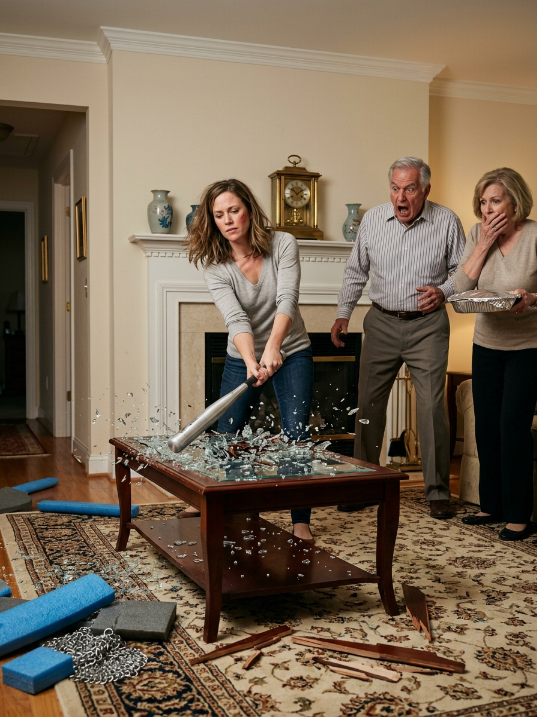
Instead, I walked to the mahogany coffee table in the center of the room.
It had been a housewarming gift from my parents, though “gift” was generous. Mom mentioned its price every time she visited. It had a glass top, carved legs, and a smug history of being described as “too nice for this room.”
I raised the bat.
Dad’s voice sharpened. “Claire.”
I brought the bat down.
The glass exploded.
Mom screamed.
Shards scattered over the rug, glittering in the late afternoon light.
I swung again.
The wooden frame cracked.
Dad stumbled backward. “Have you lost your mind?”
I looked at him through the wreckage.
“How does it feel,” I asked, “watching someone destroy something you value?”
Neither of them answered.
Their faces told me everything.
They understood perfectly.
They had simply believed only their things deserved respect.
Part 3
The second thing I destroyed was the clock.
It sat on the mantel in a position my mother had chosen, because of course she had. An antique clock with brass feet, a painted face, and a pendulum that had never once kept accurate time. It had belonged to my grandfather. Dad had given it to me after my divorce, saying, “Every home needs history.”
What he meant was every home needed a reminder of him.
I crossed the living room in three steps.
Mom cried, “No, not the clock!”
That sound—her panic, real and immediate—confirmed what I already knew. She could not understand Oliver’s pain when his work was destroyed, but she understood perfectly when the object belonged to her.
I swung.
The clock fell from the mantel and hit the hearth. The glass face cracked. I brought the bat down again, and gears jumped loose across the brick like little gold insects.
Dad made a strangled sound. “That was worth thousands.”
I turned on him.
“Oliver’s costume was worth three years.”
Mom clutched her chest. “You’re behaving like a lunatic.”
“No,” I said. “I’m using your teaching method.”
My goal was not revenge exactly. It was translation.
My parents did not speak empathy. They spoke possession. Value. Control. Consequence. So I gave them a lesson in their native language.
The conflict was that even while afraid, they still believed they had authority over me.
Dad stepped toward me. “Put the bat down.”
I lifted it slightly.
“Do not come closer.”
He stopped.
For the first time in my life, I saw my father afraid of me.
Not deeply. Not permanently. But enough.
The decorative vases came next.
Three of them, all gifts from Mom over the years, all things I had never liked and displayed because refusing them was “hurtful.” Blue ceramic. White porcelain. A tall green one with gold trim.
I swept the bat across the shelf.
They shattered one by one.
Mom sobbed. “Please stop.”
I looked at her. “Did Oliver ask you to stop?”
She cried harder.
“Did you?”
She had no answer.
Above the sofa hung their wedding portrait. A formal oil painting they commissioned for their fortieth anniversary and then gave me a framed copy because Mom said it would “ground the family visually.” My father looked stern in it. My mother looked regal. Neither looked happy.
I struck the frame.
The glass cracked in a spiderweb pattern.
Dad shouted, “That is irreplaceable!”
I lowered the bat slowly.
“So was his trust in you.”
That finally silenced them.
The room around us was wrecked now. Glass on the rug. Wood splinters near the table. Clock gears on the hearth. Ceramic shards under the shelf. The air smelled like dust and broken varnish.
My heartbeat pounded in my ears, but my voice came out quiet.
“Get out.”
Mom wiped her cheeks. “Claire, we can talk—”
“No.”
Dad pointed at me. “You will regret this.”
“Maybe,” I said. “But not as much as I’d regret letting you stay.”
“You’re our daughter.”
“And Oliver is my son.”
He opened his mouth.
I raised the bat just enough.
His mouth closed.
“You assaulted me,” I said. “You put your hands on my child. You destroyed his property while he begged you to stop. Leave now, or I call the police and press charges.”
Mom looked stunned. “You would call the police on your own parents?”
“Yes.”
The word came easily.
That scared them more than the bat.
Dad grabbed Mom’s arm and steered her toward the door. She bent once as if to pick up her purse from near the broken table, then thought better of stepping through glass. I kicked it toward her. She snatched it up with shaking hands.
At the front door, she turned back.
“You’ll come crawling back,” she said. “You always do.”
I said nothing.
I watched them leave.
When the door closed, the house fell into a silence so complete I heard my own breathing. The bat hung heavy in my hand. The adrenaline began draining out, leaving my legs weak.
Then I heard a soft sound from the stairs.
Oliver stood halfway down, one hand gripping the banister. His eyes were huge.
“Mom?”
I set the bat against the wall immediately.
“Come here, sweetheart.”
He ran to me.
I caught him in the middle of the ruined living room. He was shaking. So was I. We stood there surrounded by broken glass and broken history, and I held him while he cried into my shirt.
“I’m sorry,” he whispered.
“No,” I said fiercely. “No. You did nothing wrong.”
“My costume—”
“I know.”
“It’s gone.”
“I know.”
His grief came in waves. He cried until his breath hitched. I guided him carefully around the glass and sat with him on the stairs, away from the wreckage. My cheek still burned. His shoulder had a red mark from Mom’s hand.
I touched it gently.
He flinched.
That flinch changed everything.
Not the destruction. Not the slap. That.
My son flinched because my mother had hurt him.
New information arrived in my body like law.
This could never happen again.
Not after apologies. Not after holidays. Not after guilt. Not after illness. Not after years.
Never.
I looked at the door my parents had walked through.
Then at the key hook near the kitchen.
Their spare key hung missing, because they had it.
And I realized the first thing I needed to rebuild was not the costume.
It was safety.
Part 4
The locksmith came before dinner.
His name was Rafael. He had kind eyes, a gray beard, and the professional calm of a man who had seen many people change locks while pretending they were only updating hardware. He did not ask why my cheek was swollen or why broken glass filled a cardboard box near the hallway.
He simply said, “All exterior doors?”
“Yes.”
“Garage too?”
“Yes.”
“Any keypad codes?”
“Reset them.”
As he worked, Oliver sat at the kitchen table with a mug of hot chocolate untouched between his hands. He had not wanted to go upstairs. I did not blame him. His room held the remains of something sacred.
My goal that evening was to make the house feel safe enough for him to sleep.
The conflict was that every room seemed to remember what happened.
The living room smelled like dust and glass cleaner. I had swept the big pieces but left the rest for morning because my hands would not stop shaking. The kitchen snack plate still sat on the counter. Crackers going stale. Apple slices browning at the edges. The casserole my mother brought remained by the sink, foil untouched.
I threw it in the trash.
Oliver watched me.
“Good,” he said softly.
After Rafael left, I locked the door and tested it twice.
Then I sat across from Oliver.
“We need to talk about what happened.”
He looked down. “Do we have to?”
“Not every detail. But enough.”
He nodded.
“What Grandpa and Grandma did was wrong. Destroying your work was wrong. Hitting me was wrong. Pushing you was wrong. None of it was your fault.”
His eyes filled again, but he blinked hard.
“Grandpa said I wasted my life.”
“Grandpa is wrong.”
“What if he’s right about it not being useful?”
I took a breath.
There it was. The real damage.
Broken foam could be replaced. Broken confidence had to be handled like cracked glass.
“Oliver, usefulness is not the only reason something matters. But even if it were, what you’re doing is useful. You learned design. Measurement. Painting. Problem solving. Patience. You built something from nothing with your own hands.”
His mouth trembled.
“It was good,” he whispered.
“It was incredible.”
He stared at his hot chocolate.
“I don’t want to go upstairs.”
“Then don’t. We’ll make the couch up tonight.”
“The living room is broken.”
I looked toward the hallway.
He was right.
“Then my room,” I said.
That night, Oliver slept in my bed while I lay on the floor beside him with a blanket and a phone in my hand. I did not sleep much. Every time the house creaked, I imagined my parents trying the old key. Every time Oliver shifted, I thought of my mother’s hand on his shoulder.
At 2:13 a.m., Dad called.
I let it go to voicemail.
At 2:17, Mom called.
Voicemail.
By morning, there were fourteen missed calls, nine texts, and three voicemails.
Dad: You acted like a maniac. We need to discuss this.
Mom: I can’t believe you destroyed family heirlooms.
Dad: You owe us an apology.
Mom: Oliver needs to learn that tears don’t control adults.
I saved everything.
Then I called the police non-emergency line.
The officer who came was a woman named Officer Henson. She stood in my living room, notebook in hand, surveying the broken furniture and my bruised cheek. I showed her photos of Oliver’s destroyed costume before I moved anything. I showed her the red mark on his shoulder. I told the story carefully, start to finish, while Oliver sat in the kitchen with headphones on, watching a cartoon and pretending not to listen.
Officer Henson took pictures.
“Do you want to file a report?” she asked.
“Yes.”
My voice did not shake.
That was new.
I had spent my life smoothing things over, translating my parents’ cruelty into generational differences, discipline, stress, “that’s just how they are.”
Not anymore.
Officer Henson gave me a report number and advised me to document all contact. She also suggested speaking with an attorney about a protective order.
When she left, Oliver came to the doorway.
“Are they going to jail?”
“Probably not right now.”
“Oh.”
“Do you want them to?”
He looked at his socks. “I don’t know.”
That was fair.
Twelve-year-olds should not have to decide the legal fate of grandparents.
At noon, I took him to the hardware store.
The smell of lumber, rubber, paint, and metal washed over us as the automatic doors opened. Oliver moved slowly at first, like a person visiting the scene of an accident. Then we reached the aisle with foam mats, adhesives, blades, paints, clamps, sandpaper, and sealants.
His eyes changed.
Just slightly.
Hope, but cautious.
I grabbed a cart.
“We’re rebuilding.”
He looked up. “We are?”
“Yes. But this time, no scavenged scraps unless you want them. We’re using better materials.”
He touched a sheet of professional-grade EVA foam. “This is expensive.”
“So was letting them think they could decide what your work was worth.”
He did not smile.
Not yet.
But he placed the foam in the cart.
Then heat gun attachments. Contact cement. Metal rivets. Leather straps. Acrylic paints. A respirator. Better gloves. Sanding blocks. LED strips he had once mentioned and decided were too costly.
At checkout, my credit card winced.
I did not.
In the parking lot, loading supplies into the trunk, Oliver said, “What if I can’t make it again?”
I closed the trunk and leaned beside him against the car.
“Then you make something different.”
He looked at me.
“Not worse. Different.”
He nodded slowly.
When we got home, the new locks shone in the afternoon light. For the first time all day, Oliver walked inside without glancing over his shoulder.
That evening, we carried the broken costume pieces to the garage.
Not to throw away.
To study.
He laid the cracked shield on the workbench and traced the split through the dragon with one finger.
“I want to keep the emblem,” he said.
“How?”
“I’ll rebuild around the broken line. Make it look like a battle scar.”
There it was.
The first reversal.
My father had tried to make destruction the end of the story.
Oliver was already turning it into design.
Part 5
The garage became our workshop.
Before that, it had been a place for half-empty paint cans, Oliver’s bike, holiday decorations, and things I did not know where else to put. Afterward, we cleared a corner, hung pegboard, bought two folding tables, and installed cheap LED shop lights that hummed softly when switched on.
The first night we worked out there, rain tapped against the garage door.
The concrete floor was cold under my sneakers. A space heater glowed orange near the wall. The air smelled like foam, glue, and sawdust. Oliver wore safety goggles too large for his face and a seriousness that made him look like a tiny engineer.
My goal was to show up.
Not direct. Not take over. Show up.
The conflict was that I knew almost nothing about costume building.
Oliver knew that too.
“You don’t have to help with the actual parts,” he said carefully. “I know you’re busy.”
“I want to learn.”
“You might get bored.”
“I raised you through a dinosaur phase that lasted four years. I do not bore easily.”
That got a small smile.
We watched tutorials together. Foam shaping. Heat sealing. Weathering techniques. Safe blade handling. Pattern drafting. Leather strapping. Basic electronics. I ruined three practice pieces trying to bevel edges. Oliver laughed for the first time since the destruction, not meanly, just with relief.
“Mom, you’re holding the blade like it owes you money.”
“It does.”
He took my hand and adjusted the angle.
The motion was gentle, patient.
My son teaching me.
That became the rhythm of our evenings.
School. Dinner. Homework. Workshop.
We did not talk about my parents every night. That was important. I did not want the garage to become a shrine to what had happened. It was a place of making. A place where broken lines became battle scars and mistakes became texture.
Still, the outside world kept pressing in.
Mom sent cards.
We returned them unopened.
Dad left voicemails.
I saved them, then blocked him.
Aunt Veronica called after Mom recruited her to “talk sense into me.” Veronica was my father’s younger sister, sharp-tongued and usually allergic to drama unless she could solve it with a cigarette and a raised eyebrow.
“Your mother says there was a disagreement about Oliver’s hobby,” she said.
I was standing in the grocery store freezer aisle when she called, staring at peas I did not need.
“A disagreement.”
“That was her word.”
“Did she mention Dad slapped me?”
Silence.
“No.”
“Did she mention she shoved Oliver down?”
A longer silence.
“No.”
“Did she mention they destroyed three years of his work while he begged them to stop?”
Veronica cursed under her breath.
I told her everything. No embellishment. No softening. The helmet. The shield. The chain mail. The slap. The shove. The living room. The police report.
When I finished, Veronica said, “I’ll handle your mother.”
“Please don’t handle anything. Just don’t pass messages.”
“Done.”
That was the first family member who believed me without requiring a debate.
It mattered more than I expected.
A week later, I met with an attorney named Patricia Lancing. Her office smelled like coffee, paper, and peppermint gum. She reviewed my photos, the police report, medical documentation of my cheek, and Oliver’s statement written in his neat school handwriting.
“They assaulted you and a minor,” she said. “And destroyed property.”
“I destroyed property too.”
“Your own property, in response to witnessing assault and destruction. Not ideal, but different from striking people.”
“I used a bat.”
“On furniture.”
She looked at me over her glasses.
“Claire, I’m not saying it was tidy. I’m saying judges understand the difference between breaking a table and pushing a child.”
We filed for a protective order.
My parents fought it.
Of course they did.
At the hearing, Dad wore a suit and brought an attorney who tried to make me sound unstable. He said I had “escalated emotionally” and “engaged in destructive conduct.” He held up photos of my shattered coffee table like evidence I was the danger.
Patricia stood and calmly placed photos of Oliver’s destroyed costume beside photos of my bruise and his shoulder mark.
“My client broke objects she owned,” Patricia said. “Her father struck her. Her mother pushed a child. Their argument is that property deserves more protection than people.”
The judge, a woman in her sixties with silver hair and a face that suggested she had raised children and patience had not survived the experience, looked at my father.
“Sir, did you smash the child’s costume?”
Dad lifted his chin. “I was teaching him not to waste his time.”
“Did he ask you to stop?”
Dad shifted.
“Did he?”
“Yes.”
“Did you stop?”
“No.”
The judge’s expression cooled.
She granted the order.
Two years. No contact. No coming within five hundred feet of me, Oliver, our house, or his school. No messages through relatives. No gifts. No showing up at events.
When we walked out, Mom cried in the hallway.
Dad glared at me like I had betrayed him.
Oliver was not there. I had spared him that.
That evening, I told him the judge had agreed we deserved protection.
He listened quietly while cutting foam for the new gauntlet.
“So they can’t come to the competition?” he asked.
“No.”
His shoulders relaxed.
That was new information for me.
He had been afraid of that.
I had thought the legal order was for the past.
For Oliver, it protected the future.
Part 6
The regional costume competition was held in October, almost exactly one year after Oliver first planned to enter with the original knight.
The convention center smelled like popcorn, hot pretzels, carpet cleaner, and a hundred different types of fabric glue. People filled the halls in armor, gowns, masks, wings, capes, and creatures I could not name. There were elves eating nachos, robots checking phones, and one very tired dragon sitting against a wall drinking iced coffee through a straw.
Oliver stood beside me wearing the rebuilt armor.
Not the same armor.
Better.
The breastplate was darker now, with layered weathering that made it look forged in some ancient kingdom. The dragon shield had been remade around the fracture line, which he painted like a glowing scar of blue light running through the emblem. The helmet’s broken horn had inspired an asymmetrical design, one side intact, the other shaped as if damaged in battle and repaired with brass plates.
He called it The Knight Who Survived.
I did not cry when he told me the name.
Not in front of him.
Our goal that day was simple: let him be seen.
The conflict was that being seen after being mocked is terrifying.
Oliver kept adjusting his gauntlets.
“What if the judges think the battle damage is messy?”
“Then they do not understand story.”
“What if they ask about the old one?”
“Tell them what you want to tell them. Or don’t.”
He nodded, then looked around the hall.
“Do you think they would have liked it? Grandpa and Grandma?”
The question landed softly but deeply.
I took a breath.
“I think they would have found a reason not to. That doesn’t mean anything about the work.”
He absorbed that.
Then straightened.
“Okay.”
When the judges came, one of them was a woman named Maren Voss, a professional costume designer who had worked on television productions and films. She had silver-streaked hair, a measuring tape around her neck, and hands that moved over craftsmanship without touching until invited.
“Did you make this?” she asked Oliver.
“Yes. My mom helped with some techniques, but I designed it and built most of it.”
Maren crouched slightly to examine the shield.
“This crack effect is excellent. Intentional?”
Oliver glanced at me, then back at her.
“Kind of. It came from something that broke. I rebuilt it into the design.”
Maren nodded slowly.
“That’s usually where the best design comes from.”
I had to look away.
He did not win first.
He won third.
That may sound like a small thing to some people. It was not small in our house.
The trophy was a little plastic column with a metal figure on top, but Oliver held it like it was made of gold. He also received a $200 prize and an invitation to display his work in the main exhibition hall the next day.
At dinner that night, in a burger place with sticky tables and neon signs, he talked nonstop. Techniques he had seen. A foam smithing workshop. Someone who made articulated wings. Maren Voss telling him he had “real design instincts.”
Then he went quiet.
“What?” I asked.
He stared at his fries.
“Thank you for believing me.”
I frowned. “Believing you?”
“That it mattered.”
My throat tightened.
I thought of my father saying waste.
My mother saying stupid.
Oliver kneeling on the floor.
“It always mattered,” I said.
He nodded.
“I know now.”
That was the reversal I had been waiting for.
Not the trophy.
Not the judge’s praise.
That sentence.
I know now.
Winter brought more opportunities.
Oliver built an online portfolio using the photography kit I bought him for Christmas. He learned lighting, angles, editing. He posted progress breakdowns. Other creators commented. Some asked questions. He answered carefully. Then, in January, he received his first commission request from a Renaissance fair performer in California who wanted custom dragon-themed armor.
He showed me the message with wide eyes.
“She wants to pay me.”
“That happens when work has value.”
“She offered twelve hundred dollars.”
I nearly dropped my coffee.
We spent a week building a proper plan. Materials. Timeline. Shipping. Deposit. Contract. Since he was twelve, everything went through me legally. But the design was his. The work was his. The pride was his.
At the same time, a talent scout from a children’s educational show contacted us after seeing his exhibition photos.
The show featured kids with unusual creative projects.
Oliver might be one of them.
He danced around the kitchen for three full minutes when I told him.
Then stopped suddenly.
“Do you think Grandpa and Grandma will see it?”
“Maybe.”
He looked down.
“Does that scare you?”
He shook his head.
“I hope they do.”
There was no bitterness in his voice.
Only a clean, bright desire to be witnessed by people who had tried to make him invisible.
I did not know then that they would see much more than a show.
They would see the life we built after their absence made room.
Part 7
My parents tried to come to Oliver’s school in March.
That was the first violation.
They did not make it past the front office.
I had already given the school a copy of the protective order, photographs, and a list of people approved for pickup. The receptionist, Mrs. Lane, was a soft-spoken woman who wore cat sweaters and remembered every child’s allergy. She called me at work with steel in her voice.
“Claire,” she said, “your parents are here.”
My stomach dropped.
“Is Oliver safe?”
“He’s in science. He has not seen them. The resource officer is with me.”
“What do they want?”
“They say they brought a gift and want to surprise him.”
Of course they did.
A gift.
Not an apology.
Never an apology.
“Call the police,” I said. “They are violating a court order.”
There was a pause.
Then Mrs. Lane said, “Already done.”
I left work anyway.
By the time I reached the school, two officers were speaking to my parents near the front entrance. My mother was crying. My father looked furious, red-faced, one hand chopping the air as he talked. A wrapped box sat on the bench beside them.
When Dad saw me, his mouth tightened.
“You called the police on us?”
“No,” I said. “The school did.”
Mom pressed a tissue under her nose. “We just wanted to give Oliver something.”
“You are not allowed near him.”
“He’s our grandson.”
“He’s protected.”
Dad took one step forward. An officer shifted.
Dad stopped.
Good.
The conflict had changed. In my parents’ house, their anger ruled. In public, under law, it had borders.
The officer issued a formal warning and documented the violation. Patricia later used it to strengthen our file.
Oliver found out that evening because I refused to lie.
He sat at the workbench, soldering LED strips under my supervision.
“They came to school?” he asked.
“Yes.”
“With a gift?”
“Yes.”
“What was it?”
“I don’t know.”
He nodded slowly. “I don’t want it.”
“I know.”
His hands shook just slightly when he picked up the wire again.
I covered his hand with mine.
“You’re safe.”
“I know.”
But knowing is not the same as feeling.
That night, he slept with his desk lamp on.
I hated them for that.
Spring moved into summer.
Oliver’s commission business grew carefully. One project at a time. No overbooking. No pressure. I made sure he still had school, friends, lazy afternoons, video games, and space to be a child. We set aside part of his earnings for materials, part for savings, part for “fun money,” which he mostly spent on better tools.
The children’s show filmed two segments with him in our garage. The crew was respectful. They let him explain heat shaping, patterning, safety gear, and how he turned damage into design. When the producer asked what inspired The Knight Who Survived, he glanced at me.
Then he said, “Sometimes something breaks, but you can decide what it becomes next.”
I stood behind the camera and cried silently.
The episode aired in August.
My parents saw it.
I knew because Aunt Veronica texted me:
Your father watched the show. He didn’t say a word. Your mother cried. Not saying this to guilt you. Just thought you’d want to know they saw what they tried to destroy.
I stared at that message a long time.
Then replied:
Thank you. Please don’t update me again unless it affects safety.
She wrote back:
Understood. Proud of you both.
One year after the destruction, I marked the day privately.
Not with sadness exactly.
With recognition.
Oliver and I ordered pizza, worked in the garage, and put the third-place trophy on a new shelf beside printed photos of his commissions. He was taller now. His voice had begun to crack at inconvenient moments. His hands were steadier than mine with a blade.
Then the doorbell rang.
I checked the security camera.
My parents stood on the porch.
Dad held a large wrapped package.
Mom looked smaller than I remembered, her hair grayer, her face lined. Dad still tried to stand like a man who expected doors to open.
My pulse slowed.
Not from calm.
From readiness.
The protective order had recently expired. I had considered renewing it, but they had been quiet for months after the school incident. That was another mistake, though not one I would make twice.
I opened the door with the chain on.
“What do you want?”
Mom’s smile trembled. “Claire, please. We came to talk.”
“No.”
Dad lifted the package. “We brought Oliver something.”
“I don’t care.”
“It’s a costume,” Mom said quickly. “Professionally made. Your father ordered it from a studio. It cost a fortune.”
I stared at them through the narrow gap.
The emotional reversal was immediate.
A year ago, a gift like that might have confused me. Might have made me think they were trying. Might have made me search for meaning underneath money.
Now I saw it clearly.
They had brought a replacement for something that could not be replaced, because buying was easier than apologizing.
“Where are the words?” I asked.
Dad frowned. “What words?”
“I’m sorry.”
Mom looked down.
Dad’s jaw set.
“We came all this way,” he said. “We spent good money.”
“Say you are sorry for destroying his work. Say you are sorry for hitting me. Say you are sorry for pushing him.”
Silence.
Behind me, upstairs, Oliver called, “Mom?”
Dad pushed the package slightly toward the door.
“Take it.”
“No.”
Mom’s eyes filled. “He’s our grandson.”
“He was your grandson when he begged you to stop.”
Dad’s face reddened. “This is ridiculous.”
“No,” I said. “This is over.”
And as I closed the door, I realized I did not feel guilty.
I felt free.
Part 8
Oliver came down the stairs slowly.
He had heard enough. Not everything, but enough. His backpack hung from one shoulder, and his hair was still damp from his shower. He looked at the locked door, then at me.
“Was it really them?”
“Yes.”
“With a costume?”
“Yes.”
“Did they apologize?”
“No.”
He considered that.
Then said, “That’s dumb.”
I almost laughed. “Very.”
He dropped his backpack by the stairs and came to hug me. At thirteen, he was getting tall enough that I had to adjust how I held him, but he still tucked his head against my shoulder for one second like he had when he was small.
“Thanks for not taking it,” he said.
“I wouldn’t.”
“It wouldn’t have fixed anything.”
“No.”
He pulled back. “Also, I don’t want a costume someone else made to replace mine.”
That sentence was the entire lesson.
The costume had never been about foam and paint.
It had been proof of what his own hands could do.
Outside, through the window, Dad threw the wrapped package into the back seat of his car. Mom stood near the passenger door crying. They sat in the driveway for several minutes, probably arguing. Then they left.
Two hours later, the doorbell rang again.
My stomach tightened, but the camera showed only a delivery driver.
The box on the porch was addressed to Oliver.
Inside was a set of professional leatherworking tools, the kind he had been eyeing online and never asked for because he knew they were expensive. The card read:
Proud of you both. Keep creating.
Aunt Veronica.
Oliver ran his fingers over the tools like they were treasure.
“She gets it,” he said.
“Yes.”
“Can we invite her to the next showcase?”
“If you want.”
“I do.”
That was how family began being rebuilt in our house. Not by blood. By behavior. One person at a time.
My goal moving forward was to protect peace without making fear the center of our lives.
The conflict was that my parents still existed in the world, and people like them rarely accept closed doors quietly.
Three months later, Dad showed up at my workplace.
Security called me from the lobby.
“There’s a man here asking for you. Says he’s your father.”
My whole body went cold.
“Is he causing trouble?”
“Not yet.”
Not yet was not comforting.
I considered having him removed immediately. Then I decided I wanted to hear which tactic came next. I told security I would meet him in the public seating area, with cameras, near people.
Dad stood when I approached.
He looked older.
That startled me. His hair had gone nearly white at the temples. His jacket hung looser. For one brief, dangerous second, he looked like just an old man.
Then he spoke.
“Five minutes.”
I sat across from him. “You have three.”
His mouth tightened, but he swallowed the argument.
“Your mother is sick.”
The sentence entered me like cold water.
“What kind of sick?”
“They found something during her checkup. She starts treatment next month.”
Cancer.
He did not say the word, but it sat between us.
Concern flickered despite everything. She was my mother. Biology does not ask permission before stirring old instincts.
But instincts are not orders.
“I’m sorry to hear that,” I said.
“She wants to see Oliver.”
There it was.
Not I came to tell you.
Not she wanted you to know.
She wants access.
I leaned back.
“Did she ask you to come?”
He hesitated.
“No.”
“So you’re using her illness as leverage.”
His eyes flashed. “I am telling you because family matters.”
“Family mattered when she shoved him.”
“That was one mistake.”
“No. It was one choice in a lifetime of choices.”
He exhaled sharply. “You are hard.”
“I had to become hard where you kept hitting.”
For a moment, he looked genuinely wounded.
Maybe he was.
That did not change my answer.
“Has she apologized?” I asked.
“She’s sick.”
“That is not an apology.”
“She could die.”
“Then she should not waste time avoiding the words.”
He stared at me, jaw working.
“You would deny your mother comfort?”
“I would deny her access to the child she harmed.”
He stood abruptly, then remembered where we were. Office workers passed nearby carrying lunches and laptops. Security watched from the desk.
Dad lowered his voice. “You will regret this when she’s gone.”
I looked up at him.
“No. I will regret every time I let you make me choose your comfort over my son’s safety. I’m done collecting those regrets.”
He left without another word.
That evening, I told Oliver.
Not dramatically. Not with guilt.
Just truth.
“Grandma is sick. Grandpa came to my work and said she wants to see you.”
Oliver sat at the garage table, turning a leather strap over in his hands.
“Do I have to?”
“No.”
“Do you want me to?”
“No.”
He looked relieved, then troubled. “Is that bad?”
“No.”
“But she’s sick.”
“Yes.”
“And I still don’t want to.”
“Both can be true.”
He nodded slowly.
“Can we work on the commission tonight?”
“Yes.”
We did.
Because illness does not erase harm.
Because pity is not a key.
Because some bridges, once burned, are not rebuilt by emergency.
Part 9
My mother sent a letter in February.
Not directly. Through Aunt Veronica, who called first.
“I have something from your mother,” she said. “I told her I would only pass it along if you agreed. If not, I’ll burn it in my sink and enjoy myself.”
That was why I loved Veronica.
“Does it contain an apology?” I asked.
“I read the first paragraph. It contains the word sorry, but I don’t know yet if it behaves.”
I almost smiled.
“Send me a photo. Not the original.”
The letter arrived as images on my phone while I stood in the garage watching Oliver package his first California commission. Bubble wrap, tissue paper, care instructions, thank-you card. He handled it like a professional.
My mother’s handwriting was shaky.
Claire,
I am sorry things went so wrong last year. I think about Oliver crying, and I know I could have handled things differently. Your father and I were raised to believe children needed correction, and maybe we went too far. I am sick now, and sickness makes you see what matters. I don’t want to die with my family broken.
I stopped reading.
Could have handled things differently.
Maybe we went too far.
Family broken.
I handed the phone to Oliver only after reading the whole thing and asking if he wanted to see it. He said yes.
He read quietly.
His face did not change much, but I knew him well enough to see the tension around his mouth.
When he finished, he handed it back.
“She didn’t say she was sorry for pushing me.”
“No.”
“She said things went wrong.”
“Yes.”
“Like it was weather.”
Exactly.
“What do you want to do?” I asked.
He looked at the package on the workbench.
“I don’t want to write back.”
“Then we won’t.”
He nodded and returned to taping the box.
The commission shipped the next day.
The buyer sent photos two weeks later: a young performer in beautiful dragon armor, smiling so wide you could feel it through the screen. Oliver printed one photo and pinned it above his workbench.
“First official client,” he said.
“First of many.”
He rolled his eyes but smiled.
By spring, he had five commissions completed, a small savings account, and a website I helped him build. We called his little business Dragonline Studios. He designed the logo himself: a dragon curled around a needle and hammer.
He also started teaching monthly workshops at the library.
The first one was for kids ages ten to fourteen: Intro to Foam Armor. I sat at the back while he stood in front of twelve children with safety scissors, foam scraps, and the serious confidence of someone who had earned his knowledge the hard way.
“Measure twice,” he told them. “Cut once. But if you mess up, don’t panic. Mistakes can become details.”
The librarian looked at me.
“He’s remarkable.”
“I know.”
I said it without modesty.
New information came through the community, not my parents.
People saw Oliver differently now. Teachers praised his patience. Other parents asked how he learned. A local theater director commissioned three simple prop pieces. Maren Voss, the competition judge, emailed to ask if Oliver would be interested in shadowing her workshop team for a summer youth production when he was older.
He was building a world where my parents’ opinion had no authority.
That mattered more than revenge.
But my parents were not finished.
In June, Dad filed a petition for grandparent visitation.
Patricia called me herself.
“I’m sorry,” she said. “I’ll send the documents.”
The petition claimed I had alienated Oliver from loving grandparents after a “disciplinary disagreement.” It mentioned my mother’s illness. It called the costume destruction “unfortunate but well-intentioned.” It said Oliver had been “emotionally manipulated” by me.
My hands went cold as I read.
The conflict had returned in legal form.
Oliver found me at the kitchen table with the papers.
“What is it?”
I considered hiding it.
Then remembered what hiding had cost us before.
“They’re asking a court to force visits.”
His face paled.
“They can do that?”
“They can ask. It doesn’t mean they’ll get it.”
“I don’t want to see them.”
“I know.”
His voice shook. “Mom.”
I stood and pulled him into my arms.
“I will fight it.”
The hearing was ugly.
My parents sat together, Mom wearing a headscarf and looking frail enough to make the room soften. Dad held her hand. Their attorney spoke about family bonds, aging grandparents, illness, forgiveness, and one regrettable incident blown out of proportion.
Then Patricia presented the police report, the protective order, the school violation, the voicemails, the photos, the medical records, and Oliver’s therapist’s statement that forced contact would likely cause distress.
The judge interviewed Oliver privately with a child advocate present.
When he came out, he looked tired but steady.
Later, the judge denied the petition.
No visitation.
No forced contact.
The order stated that my parents’ prior conduct showed disregard for Oliver’s emotional and physical safety.
When we got home, Oliver went straight to the garage.
He picked up a marker and wrote something on the inside of his workbench drawer.
I looked after he went upstairs.
No one gets to destroy what I build.
I closed the drawer gently.
That was not just about costumes anymore.
Part 10
My mother died the following winter.
I had expected to feel relief.
I did not.
I had expected grief.
Not that either.
What came instead was a hollow, complicated quiet.
Dad left one voicemail through an unknown number before I blocked it.
“She’s gone,” he said. “You got what you wanted.”
I saved it for legal reasons, then sat on the edge of my bed for a long time, phone in my hand.
What I wanted was impossible.
I wanted a mother who had never pushed my son.
I wanted a father who had never lifted his hand.
I wanted grandparents who saw creativity and protected it.
I wanted childhoods, mine and Oliver’s, that did not require recovery.
Her death did not give me those things.
The funeral was held on a rainy Thursday.
I did not attend.
Oliver did not ask to.
Aunt Veronica went. She called me afterward.
“It was small,” she said. “Your father looked lost.”
“I’m sorry for that.”
“I know.”
“Did people ask about me?”
“Yes.”
“What did you say?”
“I said illness is sad, but it doesn’t rewrite history.”
I closed my eyes.
“Thank you.”
Dad did not try legal action again after Mom’s death. For a while, he disappeared into silence. I heard, through Veronica only when necessary, that he sold their house and moved into a smaller place outside town. He was alone now.
That fact sat near me sometimes.
A stone I did not pick up.
My goal in the year after Mom died was to teach Oliver that peace could remain even when people tried to make guilt holy.
The conflict was that guilt has a way of changing its voice.
It no longer sounded like Mom crying or Dad shouting.
It sounded like my own thoughts.
Should I have let her see him once?
Would it have hurt?
Was I cruel?
Then I would remember Oliver’s face when they came to school. His shoulders relaxing after the judge denied visitation. The words inside his drawer.
No one gets to destroy what I build.
And guilt would lose the argument.
Oliver turned fifteen that year.
Dragonline Studios had become more than a hobby. He still moved slowly, one commission at a time, with school first and rest protected. But his work had improved so much that adults forgot he was a teenager until he spoke. He learned sewing. Electronics. Mold-making. Digital pattern drafting. He saved money for a professional workshop space someday.
Maren Voss became a mentor.
She invited him to shadow the costume department for a local theater production. I drove him every Saturday. The backstage area smelled like dust, paint, fabric, and nervous actors. Oliver came home glowing.
One night, he said, “I think I know what I want.”
“What?”
“To design costumes for film. Not just cosplay. Like real productions.”
I smiled. “Then we’ll figure out the path.”
He looked at me. “You’re not going to say it’s unrealistic?”
“No.”
“Expensive?”
“Probably.”
“Hard?”
“Definitely.”
He grinned.
“Good.”
That summer, he won first place at the regional competition.
The winning piece was not armor.
It was a wizard robe with layered fabric, hand-painted symbols, and LED constellations that lit gradually as he moved. The judges praised the storytelling. Maren hugged him. I cried openly because by then I had stopped pretending not to.
During his acceptance interview, someone asked what advice he had for other young creators.
Oliver looked toward me.
Then said, “Don’t let people who don’t make things tell you what making is worth.”
The clip went viral in our little corner of the internet.
A week later, Dad sent a letter.
Not to Oliver.
To me.
Claire,
I saw the video. Your mother would have been proud.
That was the first lie.
I almost threw it away.
But I read on.
I was wrong about the costume. I was wrong to hit you. I was wrong that day. I don’t know how to fix what I did. I know you won’t believe me. Maybe I don’t deserve that. I am not asking to see Oliver. I just wanted to say I know I was wrong.
Dad
I sat with the letter for a long time.
It contained the words.
Finally.
Years late.
After court. After illness. After death. After Oliver had already rebuilt himself without them.
I showed it to Patricia first, then to Oliver.
He read it twice.
“What do you feel?” I asked.
He shrugged.
“Nothing much.”
“That’s okay.”
“Do you believe him?”
“I believe he regrets something.”
“Is that the same?”
“No.”
He handed it back.
“I still don’t want to see him.”
“Okay.”
“Do you?”
I looked at my son.
Then at the garage door beyond the kitchen.
“No.”
That was the truth.
An apology can arrive too late to be useful.
I filed the letter away.
No reply.
Part 11
By the time Oliver was sixteen, our garage was no longer enough.
Materials crowded every shelf. Foam rolls stood in corners like sleeping soldiers. Leather scraps filled bins. Mannequin forms occupied space where my car used to park. LED wires, paints, clamps, fabrics, and half-finished commissions had taken over so completely that opening the garage door felt like raising the curtain on a small, chaotic theater.
“We need more room,” Oliver admitted one Saturday, stepping over a box of buckles.
“I have been saying that since the wizard robe ate the lawn mower.”
He laughed.
My goal was to help him grow without turning his passion into pressure.
The conflict was money.
We were not rich. Dragonline brought in income, but we reinvested most of it. I still worked full-time. Legal fees had left scars on my savings. But I had been putting aside what I could, and Oliver had saved nearly every commission payment.
We found a small studio space behind a community arts building. Not fancy. Cement floor, high window, utility sink, good ventilation, enough electrical outlets to make him emotional. The rent was manageable if we were careful.
He stood in the empty room, turning slowly.
“This could be real,” he whispered.
“It already is real.”
“You know what I mean.”
I did.
We signed the lease together, under my name, with his business listed properly. Dragonline Studios moved out of our garage and into a place with a door sign he painted himself.
The opening day was small.
Maren came. Aunt Veronica came with a cake shaped like a dragon that looked slightly ill but tasted wonderful. The librarian came. Three former workshop students came. A local theater director came. No grandparents.
That absence no longer felt like a hole.
It felt like space.
Oliver gave a tiny speech, cheeks red.
“Thank you for coming. This studio exists because people believed making things matters.”
He looked at me.
I looked away before I cried.
Too late.
That year, he applied for a summer program in theatrical design. Competitive. Expensive. Prestigious. He spent weeks preparing his portfolio. The original rebuilt knight. The wizard robe. Commission pieces. Workshop photos. Design sketches. A short essay titled, “What Survives the Breaking.”
When the acceptance email came, he was eating cereal.
He screamed so loudly I dropped a mug.
We danced in the kitchen like fools.
The program offered partial scholarship. Aunt Veronica quietly covered the remaining fees before I could protest.
“Don’t argue,” she said. “I’m investing in the dragon empire.”
Dad found out somehow.
Maybe through town. Maybe through the internet. Maybe through Veronica, though she swore it was not her.
He sent one final letter.
Claire,
I am selling the last of your mother’s jewelry. I want to send money for Oliver’s program. Not as a bribe. Not for contact. Just because I should have supported him when I had the chance.
There was a cashier’s check enclosed.
Five thousand dollars.
I stared at it.
The conflict returned, softer but still sharp.
Money from him felt contaminated.
But Oliver’s program was expensive, and the letter did not demand access.
I asked Oliver.
His face tightened when he saw the check.
“I don’t want to owe him.”
“You wouldn’t.”
“It feels like owing.”
“We can return it.”
He thought for a long time.
Then said, “Can we donate it? To the library workshops?”
So we did.
We created a small fund for kids who could not afford materials for the library crafting classes. Foam, glue, safety gear, paints, basic tools. The librarian cried when I handed her the check.
We sent Dad a receipt.
No note.
He did not write again.
Years passed that way.
Oliver went to the summer program. Then another. Then college applications. He chose a school with a strong costume design and production program. When his acceptance letter arrived, I found him in the studio sitting on the floor, crying quietly.
“I did it,” he said.
“You did.”
“We did.”
I sat beside him.
“Yes,” I said. “We did.”
Before he left for college, he opened the workbench drawer where he had written those words years earlier. The drawer front was worn now, paint speckled, one corner chipped.
No one gets to destroy what I build.
He took a photo of it.
Then he said, “I think I don’t need the drawer anymore.”
“What do you mean?”
“I still believe it. I just don’t need to keep proving it.”
That was healing.
Not forgetting.
Not forgiving.
Growing so large around the wound that the wound no longer held the center.
Part 12
Oliver is twenty now.
He is in his second year of costume design school, where he complains about sleep, praises industrial sewing machines like saints, and sends me photos of projects at hours no reasonable person should be awake. His dorm room is a disaster of fabric swatches, coffee cups, and sketches. His professors love him. His classmates borrow his tools. He charges them late fees in snacks.
Dragonline Studios still exists.
Smaller during school, but alive. He takes select commissions over breaks and teaches one summer workshop at the library every year. Kids sit wide-eyed while he shows them how to cut foam safely, seal edges, and paint shadows into armor. He always tells them the same thing:
“Your work matters before anyone else understands it.”
I sit in the back sometimes.
Not because he needs me.
Because I like watching him become.
My father is still alive, as far as I know.
We are not in contact.
After the donation receipt, he stopped trying. Aunt Veronica says he lives quietly, keeps to himself, and watches Oliver’s public portfolio updates without commenting. I do not ask for more.
My mother is gone.
I do not visit her grave.
Some people would call that cold.
Those people did not see my son on the floor gathering broken rings with shaking hands.
I did not forgive them.
Let me be clear about that.
I accepted Dad’s late admission as something he needed to say, not something I needed to reward. I donated his money because Oliver chose to turn it into tools for other children. I allowed the fact of my mother’s death to be sad without letting it become a passport back into my conscience.
There is peace in refusing false endings.
Not every family story needs a reunion. Not every apology needs an embrace. Not every old person deserves access because time has made them smaller. Sometimes the happiest ending is the child safe, the door locked, and the art still being made.
Last month, Oliver invited me to his school showcase.
The building smelled like paint, fabric, dust, and ambition. Students displayed costumes under bright gallery lights. There were gowns, monster suits, armor, puppets, masks, impossible hats. Oliver’s piece stood at the center of his section: a full fantasy knight redesigned from the old concept.
Not a copy.
A transformation.
The armor was dark silver with blue-lit cracks running through the shield. The dragon emblem had returned, wings spread, its body wrapped around a visible break repaired with golden seams.
Kintsugi, he explained.
The art of honoring damage instead of hiding it.
His artist statement hung beside it.
When I was twelve, something I built was destroyed by someone who thought creativity was weakness. This piece is about repair, not restoration. I did not rebuild the original. I built the person who could make this.
I read it three times.
Then I cried in public, which I have become very good at.
Oliver found me near the display and smiled.
“Too much?”
“No,” I said. “Exactly enough.”
A professor came by and told me my son had unusual emotional intelligence in his design work.
I laughed.
“He earned it the hard way.”
That night, after the showcase, we ate at a diner near campus. Oliver ordered pancakes even though it was nine at night. I ordered coffee and fries because adulthood is flexible if you insist.
He showed me messages from people interested in his work.
A small theater company. A film student. A designer offering summer assistant work.
Then he grew quiet.
“Do you ever miss them?” he asked.
I knew who he meant.
I looked out the window at the wet street, headlights streaking across the glass.
“No,” I said. “I miss who I wished they were.”
He nodded.
“Me too, sometimes.”
“That’s okay.”
“I don’t feel bad about not wanting them back anymore.”
I reached across the table and squeezed his hand.
“Good.”
He smiled, then stole one of my fries.
On the drive home, he fell asleep in the passenger seat like he had when he was little, head tilted against the window, face softened by passing streetlights. For a moment, I saw him at twelve, holding a broken helmet. Then at thirteen, painting the battle scar. Then at sixteen, opening the studio. Then now, hands calloused from work he loved.
My parents had tried to teach him that his passion was worthless.
Instead, they taught me what protecting it was worth.
Everything.
When I got home, I went into the garage. It is mostly storage again now, but one shelf remains untouched. On it sits the cracked piece of the original shield, the part with half the dragon’s wing and the split running through it. Oliver told me once I could throw it away.
I never did.
Not because I worship pain.
Because it reminds me of the day I stopped being a daughter first.
I became only and entirely his mother.
The baseball bat is gone. I donated it years ago. The coffee table was replaced by a cheap one with rounded edges and no emotional history. The clock was never repaired. The wedding portrait went into the trash with the broken glass.
Our house is lighter without heirlooms that came with chains.
If anyone listening to this has a child who loves something you do not understand, listen carefully: you do not need to understand the thing to protect the light in their eyes. You do not have to know why foam armor matters, or drawings, or songs, or bugs, or rocks, or stories about dragons. You only have to know that the world will try hard enough to make children ashamed of joy.
Do not help it.
Stand between.
Lock the door.
Buy the better materials.
Learn beside them.
And if someone destroys what your child built to teach a lesson, make sure the lesson learned is this:
No one who breaks your spirit gets to call it love.
Oliver built again.
So did I.
And the life we made afterward was stronger than anything they smashed.


