Richard called me a useless fool on a rainy October evening, while I stood in our kitchen holding the ownership certificate to an old garage I had inherited from my grandfather.
Not a house. Not money. Not the New York apartment my sister had received.
A garage.
The paper trembled in my hands as Richard stared at it, first with interest, then with disappointment, and finally with a disgust so naked it seemed to strip 15 years of marriage down to bone.
“Your sister got a 2-bedroom apartment in New York,” he said. “And you got a dump.”
I tried to breathe. The kitchen smelled faintly of dish soap and the soup I had made for dinner. Ordinary things. Domestic things. Things that belonged to the life I thought I still had.
“Grandpa didn’t have to leave us anything,” I said quietly.
Richard’s mouth twisted.
“Shut up, Victoria. I’ve put up with you for 15 years. Fifteen years waiting for you to bring something – anything – to this family. And this is what you bring? A garage?”
His voice hardened.
“Get out.”
I stared at him.
“What?”
“Get out of my house.”
“Our house,” I said. “We bought it together.”
He laughed. It was not amused laughter. It was cold and sharp, the sound of someone finally saying aloud what he had thought for years.
“Your little librarian salary? Those pathetic pennies barely covered utilities. I paid for this house. It’s mine.”
The words struck harder than shouting would have. For 15 years, I had cooked in that kitchen, planted flowers in the garden, folded his shirts, sat beside him through fevers, listened to his complaints, apologized when I had done nothing wrong, and told myself that marriage meant patience.
Now he looked at me as if I were a stain on his floor.
“You have 30 minutes,” he said. “After that, I’m throwing your things into the street.”
He stormed out, slamming the door so hard that our wedding photograph fell from the wall. The glass cracked across his smiling face.
For a moment, I stood there looking at it.
How fitting, I thought.
I packed like someone moving through water. A few clothes. My documents. My bank card. My phone charger. The ownership certificate. The heavy, strangely carved key the notary had given me. My hands folded everything neatly because my mind had no room for chaos. Richard stood in the bedroom doorway watching with a kind of cruel curiosity.
“Where are you going to go?” he asked.
I did not answer because I did not know.
My parents had died 5 years earlier. My sister Julia had never truly liked me, and after the way the inheritance had been divided, she was not someone I could call. My friends had faded over the years, one by one, each dismissed by Richard as foolish, jealous, boring, or beneath us until I stopped seeing them altogether.
He had made my world small and then mocked me for having nowhere to run.
When I left the house, rain was falling harder. I placed the house key on the coffee table, looked once at the rooms I had mistaken for home, and walked out with my suitcase.
I sat on a park bench not far away while the cold soaked into my coat. My bank account held only a few hundred dollars from my last paycheck at the library. A hotel would last 1 or 2 nights, maybe. After that, I had no plan.
Then I remembered the garage.
The old crumbling garage on the edge of town. The inheritance Richard had laughed at. The property Julia had dismissed as a useless shack.
It was mine.
The journey took almost 2 hours by bus. By the time I reached the industrial district, night had settled over the rows of rusted metal doors and cracked pavement. The place looked abandoned, dim streetlights reflecting in puddles as rain ran down the corrugated walls.
Garage 123 stood near the end of the row.
The door was thick with rust. The lock looked as though it had fused shut decades ago. I fitted the old key into the keyhole and tried to turn it.
Nothing.
I tried again, harder. The mechanism groaned but refused to move.
A laugh almost escaped me then, though there was nothing funny about it. Of course. Even my last shelter had a locked door I could not open.
“What did I do to deserve this?” I whispered, pressing my forehead against the cold metal.
Then the lock clicked.
I stepped back.
The key turned smoothly, as if some invisible hand had finally allowed it. The garage doors creaked open, their sound echoing through the empty industrial zone.
My phone flashlight cut through the darkness.
Something metallic gleamed beneath an old tarp.
For a few seconds, I forgot the rain, Richard, my suitcase, and the cold. I stepped inside and pulled the tarp away.
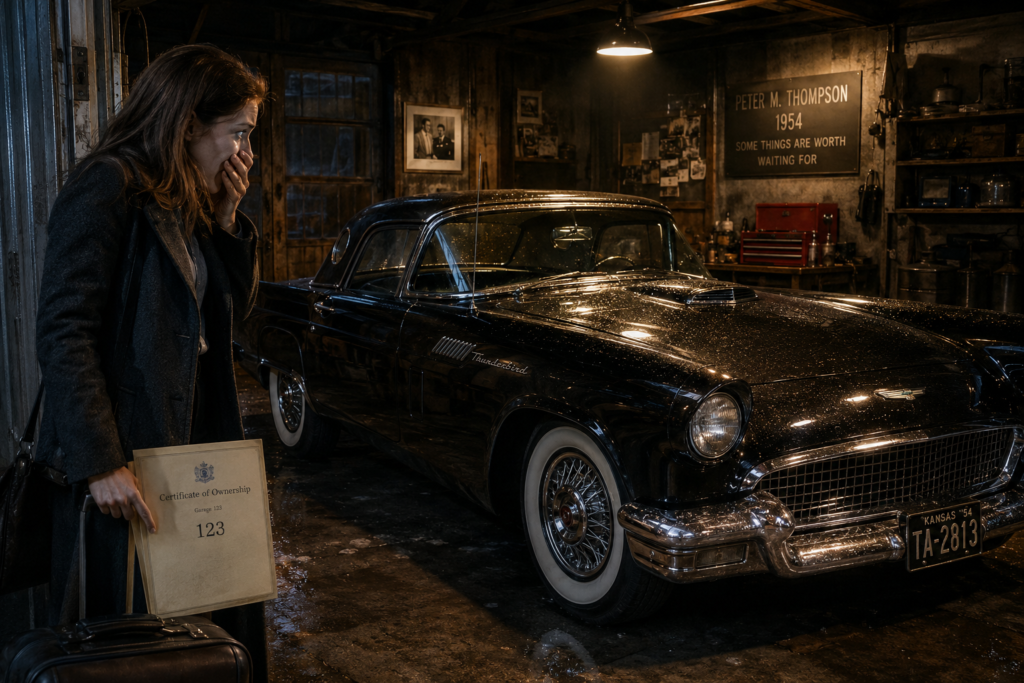
Underneath was a black Ford Thunderbird from the 1950s, perfectly preserved, chrome shining, paint flawless, leather seats uncracked, as though it had driven straight out of another century and waited there for me.
I knew almost nothing about classic cars, but even I understood that this was not junk.
This was treasure.
Grandpa Peter Michael Thompson had once told me about his first car, a black Thunderbird he had bought with his first big bonus in 1954. He always said he sold it when my father was born, trading freedom for practicality. Sometimes, he said, he missed the feeling of the whole world opening when he turned the key.
He had lied.
The car had never been sold.
Behind it stood an old wooden table. On it sat a carved box decorated with the same intricate pattern as the garage key. Inside was an envelope yellowed with age, sealed and marked in my grandfather’s firm handwriting.
Victoria, open when the time comes.
My knees weakened.
How could he have known the time would come tonight?
Inside the envelope was a letter, several pages long, and a small key wrapped in metallic cloth. The key was delicate, with a crown-shaped head.
I unfolded the first page.
My dear Victoria,
If you are reading this, I am gone, and you have found your way to my old garage. You have probably already seen my Thunderbird, the car I never actually sold.
I sat on the edge of an old crate and read with shaking hands.
Grandpa confessed that he had not simply been an engineer and technical college instructor, as we had always believed. That respectable life had been his cover. In reality, he had worked for a secret service department involved in industrial espionage, obtaining foreign technologies, plans, prototypes, and documents. The Thunderbird had been part of his work. It contained hidden compartments where he had carried materials and sometimes even people who needed to disappear.
I looked back at the car, no longer seeing only beauty. Now I saw history. Danger. Secrets.
Then the letter turned toward me.
He wrote that he had chosen me because I was like him in ways I had never understood. Not loud. Not forceful. Not like Julia. But patient. Observant. Capable of seeing good in difficult places. Capable, he believed, of strength that had not yet been tested.
I remembered a summer afternoon years earlier, when I helped him in the garden while everyone else went swimming.
“You have a strong character, Victoria,” he had said.
I had laughed because it sounded impossible.
“You just don’t know it yet,” he added.
Now, sitting in that garage after being thrown out by my husband, the words felt less like comfort and more like preparation.
The letter told me the Thunderbird had a hidden compartment. The small crown key would open it. Inside, he wrote, I would find something that could help me start over. But it was not only a gift. It was a responsibility.
What you find will change not only your life, but the lives of many others. Use it wisely.
And one more thing: never fully trust anyone, especially those who seem closest. Betrayal often comes from where you least expect it.
I did not need him to explain that line.
Richard had already done that.
I found the compartment in the side of the driver’s seat, almost invisible unless you knew to search for it. The crown key turned with a soft click, and a section of the leather shifted aside.
Inside was a metal box.
I opened it and found a passport with my photograph, my date of birth, and a different name.
Victoria Patricia Williams.
There was a driver’s license with the same name, a bank card, a sealed envelope labeled Kodi, a keychain marked with the letter D, and stacks of cash in dollars and euros. There was also a short note.
Apartment at Park Avenue 42, apartment 17. Car in underground parking spot 42. Safety deposit box at Chase Bank on Madison Avenue, number 237. All documents are in order. Lie freely, Victoria. You deserve this.
P.M.
I sat behind the wheel of the Thunderbird with the box in my lap, trying to understand the impossible thing my grandfather had built for me.
He had not left me a garage.
He had left me an escape route.
There was a couch in the corner of the garage, a folded blanket, and a small table. On the table sat a modern thermos and another note.
Mint and lemon balm tea. Always helps calm the nerves. Rest, Victoria. Tomorrow is a new day.
P.M.
The thermos was warm.
Grandpa had been dead 3 months.
I did not know who had placed it there. I did not know whether some old contact of his still watched over the garage, or whether he had arranged everything with such precision that even after death his hand still seemed present.
All I knew was that the tea tasted exactly like childhood.
I drank it wrapped in a blanket that smelled faintly of tobacco, forest, and something safe. For the first time that day, I cried without shame.
That night, I dreamed I was riding in the Thunderbird with Grandpa driving, young again, his hair black instead of white, his blue eyes fixed on the road.
“Where are we going?” I asked.
“To a place where you can be yourself,” he said.
“Does such a place exist?”
He smiled.
“It exists everywhere, Victoria. You only need the courage to see it.”
The next morning, I locked the Thunderbird back inside the garage, tucked the box into my bag, and went to the station.
I bought a ticket to New York.
Not as the frightened wife Richard had thrown away.
As Victoria Williams.
Part 2
The building on Park Avenue looked like something from another life.
Elegant prewar stone, polished brass, tall windows, and an entrance watched by a concierge who knew exactly how to make strangers feel either welcome or exposed. I stepped inside with my suitcase in one hand and my heart pounding hard enough to hurt.
Behind the desk sat an older man with a neatly trimmed gray beard.
“Good afternoon,” I said, trying to sound like someone who belonged there.
He smiled.
“Good afternoon, Victoria. Nice to see you again.”
For a moment, I froze.
He knew me.
Or rather, he knew the woman Grandpa had created.
When he offered to help with my bag, I declined and mumbled something about being out of practice after so long away. He nodded as if that made perfect sense.
“Yes, we haven’t seen you in almost a year. Peter said you were away on a long assignment. Your apartment is ready. He arranged for monthly cleaning. They were here last week.”
Peter.
Grandpa had not only left me papers. He had built an entire life sturdy enough for strangers to recognize.
Apartment 17 was on the fourth floor.
When I opened the door, I stood in the entryway and forgot to move.
It was beautiful. Not gaudy, not coldly expensive, but thoughtful. A spacious living room with tall windows looking over a quiet courtyard. A kitchen with modern appliances. A bedroom with a canopy bed. Shelves and shelves of books in the living room, in the office, beside the bed, even in the bathroom.
Grandpa knew books were the one place I had never felt small.
In the wardrobe, I found clothes in my size. Wool suits, silk blouses, cashmere sweaters, simple dresses, all elegant without being showy. In the bathroom were cosmetics, migraine medication, allergy pills, everything I actually used. In the kitchen, the refrigerator was stocked. In the freezer were containers labeled with meals I loved.
He had built a life I could step into.
On the living room table sat a framed photograph of Grandpa and me laughing in front of the Statue of Liberty.
I had never been to the Statue of Liberty with him.
The photograph was fake, flawless, and deeply unsettling.
Beside it was another envelope.
Welcome home, Victoria. I hope you like it here. There is food in the fridge and good wine in the cupboard. Rest. Gather your strength. Then decide what to do next. But remember: you are no longer alone.
P.M.
I spent the afternoon moving through the apartment like someone inside a museum dedicated to a version of herself that had never existed, yet somehow had always been waiting.
In the office, I found the safe.
It was hidden behind a sliding bookshelf activated by pressing a copy of The Master and Margarita, my favorite novel. The code was Grandpa’s birthday: 071554.
Inside were folders, more money, and a small gun with a silencer.
I recoiled from it at first.
Then I understood. Grandpa had not left me comfort. He had left me protection.
I opened the first folder.
The photographs inside destroyed the last fragile illusions I still carried.
Richard on a yacht with women I had never seen. Richard in expensive restaurants with men who were not bank colleagues. Richard leaving a mansion with a briefcase. Richard in places he had claimed never to have visited.
Then came the photograph that made the room tilt.
Richard sitting in a cafe across from Julia.
My sister.
They were holding hands.
The date stamped on the back was 3 years earlier.
I kept turning pages. Richard and Julia at a restaurant. In a park. Leaving a hotel. Kissing in a car. Then a photograph of both of them with Grandpa, seated across from him at a table, his face stern and unreadable.
Grandpa had known.
The next folders contained bank statements, company contracts, foreign property documents, offshore transfers, front companies, shell corporations, and Swiss account records. Richard’s finances were far beyond what a bank employee could earn. Julia’s name appeared again and again, connected to transfers, international accounts, and companies that looked legitimate only from a distance.
Their affair was not the real secret.
It was only one thread in something much larger.
In the Chase Bank safety deposit box, I found the full structure. Records tied not only to Richard and Julia, but to high-ranking officials, politicians, business leaders, state corporation heads, and powerful public figures. Billions moved out of the country through offshore companies, fake contracts, property acquisitions, yachts, villas, and private jets.
Richard had designed much of the machinery. Julia helped move it across borders.
In the last folder lay another letter from Grandpa.
He wrote that I now knew about Richard and Julia’s betrayal, but that their betrayal of me was only a small part of the harm they had done. He could have stopped them himself. He had the resources. He had the connections. But he wanted the choice to be mine.
Not for revenge.
For truth.
You can use this information to stop them, or you can walk away and live peacefully as Victoria Williams. I will not tell you which choice is right. That is yours alone. But whatever you choose, I am proud of you.
I sat alone in the vault room with his letter in my hands and understood that the garage had not simply saved me from homelessness.
It had placed a war in my lap.
By nightfall, I was in the office of Steven Mitchell, an investigative journalist known for exposing corruption at the highest levels. He was younger than I expected, maybe 35, with sharp eyes behind stylish glasses and the tired focus of someone used to hearing terrible things.
I introduced myself as Victoria Williams.
Then I told him enough to make him listen.
He did not ask unnecessary questions. He cared about documents, proof, timelines, names, structures, accounts. When he asked if I had evidence, I gave him a flash drive with copies from the files.
“This is dangerous,” he said. “The people you’re talking about control billions. They don’t like exposure. Once we publish, you become a target.”
“I understand.”
“Why do this?”
For a moment, I thought of Richard’s face when he called me useless. Julia’s hand in his. Grandpa’s faith in me. My years of silence.
“Because people deserve to know the truth,” I said. “And because silence makes people like them stronger.”
Mitchell watched me for a long time.
“All right,” he said. “I’ll investigate.”
Over the following weeks, my life became secret meetings, document analysis, secure communication, and the strange discipline of becoming someone I had never believed I could be. Mitchell was impressed by how quickly I understood the financial mechanisms. I did not tell him that I spent nights studying Grandpa’s notes until my eyes burned.
The first article did not name Richard or Julia.
It explained the structure. The scale. The network. The offshore flows. The involvement of high-level figures. It was enough.
The country erupted.
Television debates. Social media fury. Political denials. Accusations of foreign interference. Demands for investigations.
Three days after publication, Mitchell called.
“They’re mobilizing,” he said. “They’re trying to find the source.”
That same evening, an unknown number began calling me.
I ignored it until a text arrived.
Victoria, we need to talk urgently.
Julia.
I had changed names, phones, and cities, but my sister still found me. Of course she did. Julia had always known how to find doors that were supposed to be closed.
Then she came to the apartment.
I watched her through the peephole. She stood in the hall, makeup smudged, hair disheveled, nothing like the polished sister who had always made me feel unfinished.
“Victoria, I know you’re in there,” she said. “Open up. We need to talk.”
I did not open the door.
“What do you want, Julia?”
“At least listen. What you’re doing isn’t just exposing corruption. You’re interfering with people who control billions. They will stop at nothing.”
“Is that why you’re here? To threaten me? To protect yourself?”
Her voice broke.
“Because despite everything, you’re my sister, and I don’t want you to get hurt.”
I laughed bitterly.
“Did you think about that when you were sleeping with my husband?”
There was silence.
Then she said, “It’s more complicated than you think.”
I eventually opened the door.
We sat in the kitchen drinking tea while Julia told me the truth. She had been recruited through her international company, drawn into a special job she could not refuse without losing not only her career but possibly her life. Richard had already been part of the system, a financial architect who created laundering structures sophisticated enough to evade auditors. She said she did not know at first that Richard was my husband.
By the time she knew, she said, it was too late.
“Too late?” I asked. “You came to holidays. You accepted gifts from me. You looked me in the eyes for 3 years.”
“I’m not proud of it.”
“And my marriage?” I asked. “Was that part of the plan too?”
She looked away.
That was answer enough.
“At first, yes,” she admitted. “Richard needed a cover. A respectable family-man image. A quiet wife who didn’t ask questions. You were perfect.”
The pain was so clean it almost felt calm.
My marriage had not only failed.
It had been designed.
Julia warned me again to leave. Go to Europe. Canada. Anywhere. She knew about the passport because Grandpa had told her before he died that he had left me a way out if things went wrong. I wondered then whether he had trusted her, or whether he had given her one final opportunity to choose decency.
I told her I would not stop.
“Then let me help,” she said.
The offer stunned me.
She had access to names, dates, amounts, accounts, and internal communications that Grandpa’s documents did not contain.
“Why?” I asked.
“Because you’re my sister,” she said. “And maybe this is my only chance to do something right after years of doing what I had to do instead of what I believed was right.”
I did not trust her.
Not fully.
But the next weeks proved that Julia’s information was real. Through cautious calls, dead drops, and one tense meeting in Central Park, she gave me documents that pushed the investigation from scandal to catastrophe. She also told me something more disturbing: Grandpa had belonged to a secret organization whose influence stretched through intelligence, finance, and government. Julia had been recruited too, though not to destroy the system. Her role had been to control parts of it.
The world, she said, was not cleanly divided between good and evil. Sometimes people entered darkness claiming they could steer it.
I told her that did not make the darkness righteous.
She did not argue.
Soon after, Richard was arrested on what news outlets called embezzlement charges from a major energy corporation. Julia said it was not justice. It was internal politics. Someone above him wanted him contained before he became a liability.
“They’ll slap him, fine him, maybe keep him under house arrest,” she warned. “Then the system continues with new faces.”
That was when I understood the scale of what remained.
Richard was not the end.
He was a door.
At my final meeting with Mitchell before disappearing, I gave him everything: Grandpa’s files, Julia’s additions, account maps, names, dates, offshore structures, internal communications. He understood the danger immediately.
“This is declaring war,” he said.
“I know.”
“What will you do when they start hunting for the source?”
“I’ll disappear.”
“That’s not as easy as it sounds.”
“I have resources,” I said. “And methods.”
He looked at me, then nodded.
“I’ll publish gradually,” he said. “Enough for each revelation to land before the next one breaks.”
We shook hands.
When I left the cafe, I no longer felt like the librarian Richard had mocked or the wife he had discarded.
I went back to the Park Avenue apartment, packed only what I needed, and closed the door behind me.
In underground parking spot 42, the D key opened a black BMW with tinted windows and plates I was sure were legal but untraceable to me.
I started the engine.
For the first time in years, I felt peace.
Then I drove out of New York.
Not knowing where the road would lead.
Knowing only that I would never again be the Victoria who chose the path of least resistance.
Part 3
Five years passed.
Five years since I drove out of New York under a name my grandfather had built for me. Five years since I stopped being Victoria Thompson in any useful sense and became Victoria Williams, an American woman with no past anyone could easily touch.
Five years since the documents I gave Steven Mitchell detonated like a political bomb.
The first articles caused argument.
The next caused panic.
Then came the proof too detailed to dismiss. Bank records. Corporate structures. Offshore transactions. Luxury properties. Shell companies. Names that had appeared for years on television as respectable public servants, patriots, executives, reformers, philanthropists.
At first, officials called it fake news. Then foreign propaganda. Then an attack on national stability.
When international agencies began asking questions and foreign banks froze accounts, the denials changed shape. Investigations were announced. Then arrests.
Small players first.
Accountants. Frontmen. Mid-level facilitators.
Then larger ones.
Richard was initially arrested on lesser financial charges. Later, more serious accusations followed: international money laundering, participation in criminal networks, and treason. His trial was closed to the public. Few details leaked, but rumors spread that he had made a deal. Names, dates, account numbers, transaction routes. He gave prosecutors what they needed to climb higher.
People who had once seemed untouchable fell.
High-ranking officials. Oligarchs. Heads of state corporations. Men and women who had spent years standing behind flags while moving fortunes into private hands.
As for Julia, I heard nothing.
Sometimes I thought I saw her in a crowd, in the reflection of a shop window, in the quick turn of a stranger’s head. But it was never her. My sister disappeared as effectively as I did. Maybe her organization pulled her out. Maybe she hid from the people she betrayed. Maybe she was dead.
I learned not to dwell on possibilities I could not survive.
After leaving New York, I moved through Europe carefully, never staying in one city too long. Paris. Vienna. Prague. Lisbon. Train stations, rented rooms, quiet hotels, small cafes where no one asked personal questions. I became good at noticing whether I was followed. I became good at packing quickly. I became good at leaving.
Eventually, I stopped in a small town in Portugal by the ocean.
It was the kind of place where white houses climbed hills toward blue sky, where laundry moved gently from balconies, where old men drank coffee at the same tables every morning, where time did not run so much as drift.
I bought a small house near the water and opened a bookstore.
The librarian in me had not died. She had only been waiting.
At first, the shop was mostly a place to hide respectably. Then people began coming in. Locals. Expats. Travelers. Children after school. Lonely widowers. Young women trying to find themselves in novels because real life had become too loud. I recommended books the way some people offer medicine.
Slowly, I built a life.
Not the life Grandpa had created for me in New York. Not the life Richard had controlled. Not the life Julia had judged.
My own.
I kept up with the news through international papers and careful messages from Mitchell, who found ways to reach me without revealing where I was. Sometimes he sent only a single line.
Another arrest.
Or:
Committee hearings begin Monday.
Or:
Your grandfather would be proud.
I did not know if the world became better because of what I did. Not entirely. Corruption does not vanish because a newspaper series exposes a network. Power does not apologize and dissolve itself. Systems adapt. People lie differently. New names replace old ones.
But something changed.
People knew.
Documents entered history. Names entered court records. Money trails became public memory. A structure that had hidden in shadow was dragged, however imperfectly, into light.
That mattered.
At night, when the shop was closed and the ocean sounded against the dark rocks below town, I sometimes thought about Richard.
I wondered what he felt when he realized the useless fool he had thrown out of his house had helped dismantle the machine he had built. I wondered whether he ever understood that his cruelty had not destroyed me. It had delivered me to the garage.
Then I would stop wondering.
Richard no longer deserved much space in my mind.
One autumn morning, almost 5 years to the day after he kicked me out, a package arrived at the bookstore. No return address. The wrapping was plain brown paper tied with string.
My hands went cold before I opened it.
Inside was a small wooden box carved with the same intricate pattern as the garage key.
For a long moment, I could not breathe.
Inside lay a photograph.
Julia.
Older. Thinner. Hair cut short. Standing somewhere that looked like a mountain village, though there was nothing in the image to identify where. Behind the photograph was a note.
You were right.
Some darkness cannot be steered.
It has to be exposed.
I am alive. That is all I can safely give you.
J.
I sat behind the counter with the note in my hand and cried.
Not because forgiveness had arrived. It had not. Not fully. Maybe it never would. Julia had betrayed me in ways no apology could erase. She had helped turn my marriage into a cover story. She had lied, cheated, and built systems that hurt people she would never meet.
But she had also chosen, eventually, to help.
That did not cancel the harm.
It meant she was alive, and somewhere, perhaps, trying to become better than what she had been.
I placed the photograph in my desk drawer beside Grandpa’s first letter.
The Thunderbird remained in the old garage for years. I never sold it. I arranged through careful channels to have it maintained, protected, and eventually shipped across the ocean. When it arrived in Portugal, crated and shining after its long voyage, I stood in the warehouse and touched the hood as if greeting an old friend.
I learned to drive because of that car.
At first, I was terrible. I stalled, panicked at roundabouts, and nearly hit a stone wall outside town. My instructor, a patient woman named Inês, laughed more than was polite but never unkindly.
“You drive like you are asking permission from the road,” she told me.
I smiled.
“I used to ask permission from everything.”
“Then stop.”
So I did.
The first time I drove the Thunderbird along the coastal road alone, windows down, wind pulling at my hair, I understood what Grandpa had meant about freedom. Not the dramatic kind. Not the kind made of passports and hidden cash and false names, though those had saved me. This was quieter.
A hand on the wheel.
A road ahead.
No one beside me telling me who I was.
I drove until sunset and parked above the ocean. The sky turned gold, then rose, then violet. Waves struck the rocks below with patient force.
I thought of Grandpa Peter Michael Thompson: engineer, teacher, spy, gardener, strategist, secret keeper, and the only person in my family who had seen my strength before I did. He had left me more than wealth. More than evidence. More than escape routes.
He had left me a chance to decide.
For most of my life, I believed kindness meant yielding. I believed love meant obedience. I believed peace meant avoiding conflict at any cost. Richard used that against me. Julia misunderstood it. Even I mistook patience for weakness.
Grandpa did not.
He knew patience could become power when it finally chose its moment.
Sometimes I wondered what would have happened if Richard had not thrown me out that night. If he had laughed, shrugged, and told me to sell the garage. If he had hidden his contempt just a little longer, would I have ever gone there? Would I have found the Thunderbird? The passport? The safety deposit box? Would the truth have remained sealed behind rust, tarp, and silence?
Maybe Grandpa knew Richard better than I did.
Maybe he knew cruelty cannot resist revealing itself when disappointed.
Years later, Mitchell visited the bookstore.
He arrived quietly, wearing a linen jacket and carrying a notebook he probably did not need. His hair had more gray in it. His eyes were still sharp.
“You’re hard to find,” he said.
“That was the idea.”
He walked the aisles, smiling faintly at the shelves.
“This suits you.”
“It does.”
He told me the final article in the series had won awards, though he said that with the embarrassment of a man who knew awards were not the point. He told me some reforms had passed. Some failed. Some criminals went to prison. Others escaped. Some money was recovered. Much was not.
“Was it enough?” I asked.
Mitchell looked toward the window, where afternoon light fell across a table of used novels.
“Truth is never enough by itself,” he said. “But without it, nothing else can begin.”
That answer stayed with me.
Before he left, he gave me a sealed envelope that had been held by one of Grandpa’s remaining contacts. It was to be delivered, the contact said, only after the first wave of danger had passed and only if I had not disappeared beyond reach.
Inside was one final note from Grandpa.
My dear Victoria,
If you are reading this, you chose.
I will not pretend I knew exactly which path you would take. I hoped, but hope is not certainty. I built the doors. You decided which ones to open.
Remember this: freedom is not the absence of danger. It is the right to decide what danger is worth facing.
I am proud of you.
Not because you were brave.
Because you became yourself.
P.M.
I folded the letter and placed it with the others.
That evening, I closed the bookstore early and drove the Thunderbird down the coast. The road curved along cliffs and small beaches, the engine humming like a memory made mechanical. The setting sun filled the windshield. For a moment, I imagined Grandpa beside me as he had been in my dream: young, smiling, eyes on the road.
“I did it,” I said aloud.
The passenger seat remained empty.
But somehow, I felt heard.
My name was Victoria Thompson once. Then Victoria Williams. Sometimes, on quiet mornings in the bookstore, I felt like both and neither. The woman Richard humiliated did not vanish. She became part of me. The woman Grandpa prepared did not replace her. She gave her tools. The woman I became in Portugal was not a disguise.
She was the truth that had been waiting beneath all the borrowed names.
Richard thought I inherited a useless garage.
Julia thought I would never fight.
I thought I had no strength.
Grandpa knew better.
And in the end, the garage on the edge of town, the place everyone else dismissed, held the door to my real life.
All I had to do was turn the key.


