“Are you seriously saying this?”
My own voice came out so dry it almost sounded unfamiliar, the words flattening against the walls of the dining room in the house where I had grown up. Every inch of the room had been dressed for Christmas with the kind of expensive enthusiasm that was meant to impress people before they even sat down. Garland wound around the banister in the entryway. Crystal candleholders threw warm light across the polished wood table. A heavily flocked tree glowed in the corner near the window, and the smell of cinnamon, roast beef, and butter hung in the air like something thick enough to taste.
In front of me lay an expensive-looking envelope. The paper was heavy, the kind chosen to suggest importance. Inside it, however, was one single flimsy check.
In the amount box, the words $200 had been scribbled in a hurried hand.
“What exactly are you unhappy about, Amanda?”
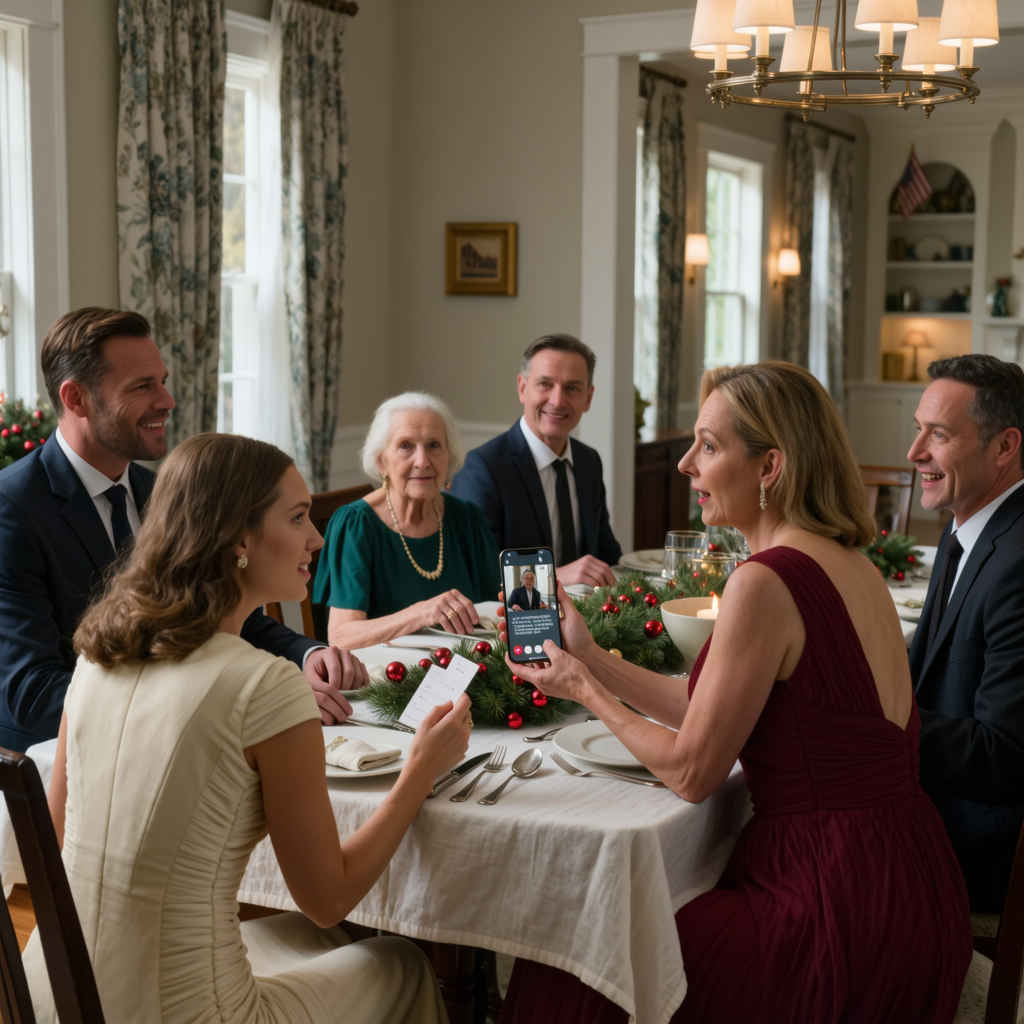
My mother, Susan, let out an exasperated sigh, the kind she had used on me since childhood whenever she wanted everyone in the room to understand that I was being difficult again. Beside her, my younger sister Rachel swayed slightly in a brand-new designer dress, one shoulder angled toward the light as if she had positioned herself there on purpose. She gave me a thin, spiteful smile.
“It’s a gift from Grandma,” she said. “You should be grateful and accept it.”
“Yeah, Amanda,” Rachel added, tilting her head. “Why don’t you use it toward the rent on that run-down apartment of yours?”
On her finger, an absurdly large diamond ring flashed under the chandelier.
I let out a small breath and looked at it for half a second too long.
My name is Amanda. I’m a real estate appraiser working in Manhattan, and I earn three hundred thousand dollars a year. On paper, I am the kind of person people assume has everything under control. The kind of woman relatives describe with a mixture of pride and resentment. The one who “did well for herself.”
And yet, despite that income, I had been trapped for months in an old apartment I no longer wanted because some strange problem kept dragging down my credit. Loan after loan, screening after screening, application after application—rejected. No clear explanation. Just a polite version of no, over and over again.
I lifted the check between two fingers.
“Thank you,” I said evenly. “I’ll give Grandma a call and thank her myself.”
The reaction was immediate.
As soon as I took out my phone, my mother’s hand froze in midair.
“No,” she said too quickly. “There’s no need to call. Grandma’s already asleep.”
Her voice cracked on the last word, and the sound of it sent a sharp, professional warning straight through me.
In real estate, when someone standing between you and the person with actual authority tries to block direct contact, there is almost always something wrong beneath the surface. A concealed defect. A hidden clause. A number nobody wants you to see.
It was only seven o’clock.
Ignoring her attempt to stop me, I pressed the call button and set the phone on speaker.
After two rings, my grandmother answered.
“Oh, Amanda. Merry Christmas.”
“Merry Christmas, Grandma.” I kept my eyes on my mother. “I just received the check. Thank you for the two hundred dollars.”
There was a brief silence.
Then my grandmother’s voice rose so sharply it cut through the room like broken glass.
“What? You must be joking.”
My mother visibly flinched.
“I didn’t send you two hundred dollars,” my grandmother said. “I instructed Susan to distribute one point two million from the trust as funds for purchasing your new home.”
Time stopped.
One point two million dollars.
The check in my hand.
The difference between those two figures was so large my mind calculated it automatically: $1,199,800.
My mother’s face lost all color. The knife she had been holding slipped from her hand and clattered against her plate. Rachel stood frozen, mouth half open.
“Hang up,” my mother snapped. “Grandma’s confused. She’s senile.”
She lunged toward the phone, but I moved faster and pulled it back.
Senile.
I had spent my adult life evaluating properties, documents, signatures, liabilities, risk. I had seen enough lies presented in polite packaging to recognize the expression of deception when it appeared. And the look on my mother’s face at that moment was the exact look I had seen on people trying to cover fraud.
“Sorry, Grandma,” I said quietly. “The reception seems bad.”
And I ended the call.
I did it on purpose.
Making a scene right then, in the middle of Christmas dinner with no physical evidence in my hand, would only give them room to dismiss the truth as the confusion of an elderly woman. I wasn’t going to hand them an easy escape.
I set my phone down and looked at my mother.
“So what exactly is this supposed to mean?”
For a fraction of a second, panic moved across her face. Then she visibly relaxed. Relief softened her shoulders.
“I told you, didn’t I?” she said with a sigh. “Her memory is getting worse. There’s no way she has one point two million dollars just sitting around. Poor Mom.”
“Yes,” Rachel said quickly. “Poor Grandma.”
I played the part they expected.
I let confusion settle over my features. I picked up my bag. I stood.
“I’m not feeling well,” I said. “I’m going home.”
I turned toward the front door.
And that was when I saw it.
A stack of documents hidden behind the sofa had shifted just enough to catch my eye. Rachel moved too late, trying to block them with her body. What I glimpsed was enough: a luxury furniture catalog and a set of property transfer documents from a real estate company.
On top was a sticky note in my sister’s handwriting: Furniture list for new home.
The dots connected all at once.
The reason I kept failing screening after screening despite my income.
My unemployed sister’s glittering new lifestyle.
The missing one point two million dollars.
I pretended not to notice. I quietly closed the door behind me and stepped out into the cold.
Outside, the night bit hard at my face. The front yard was dusted with snow, and across the street one of the neighbors had lined their porch with red bows and old-fashioned white lights. Somewhere farther down the block, a child laughed. A dog barked once, then went quiet.
I stood under that winter sky and pulled out my phone.
From that moment on, this was no longer a matter of family. This was an appraisal in the truest sense—an investigation into value, ownership, transfer, and fraud. And this time, the asset at stake was my own life.
The next morning, I was in my Manhattan office before sunrise.
There was no trace of Christmas cheer there. No wrapping paper, no sentimental leftovers, no tree glowing in a corner. Only the cold blue light of the monitor reflecting against the glass wall beside my desk. In one hand, I held black coffee gone half-cold. In the other, my mouse.
As a real estate appraiser, I have authorized access to databases that most people never see. Public property records. Credit investigations. Banking histories tied to closings. Analytical tools used to detect irregularities in transactions and trace suspicious money movement patterns in property deals.
I looked at the screen and whispered, “All right. Let’s begin the appraisal.”
First, I opened my own credit report.
When the number appeared, a dry laugh slipped out of me.
FICO score: 450.
It was a number sitting barely above financial collapse. A number associated with defaults, distress, and deep damage. A number that had no business belonging to a woman earning more than three hundred thousand dollars a year.
“So that’s why,” I murmured.
That was why every application had quietly died.
I clicked into the detailed report from the credit bureau.
What filled the screen made the coffee in my stomach turn bitter.
Five credit cards I had never opened.
AmEx. Visa. Mastercard. One after another, all maxed out to the limit.
I opened the PDFs of the statements.
Every transaction read like a guided tour through my sister’s vanity.
A luxury resort in the Maldives: fifteen thousand dollars.
The date matched Rachel’s honeymoon.
A Birkin bag: twelve thousand dollars.
A high-end steakhouse dinner: eight hundred dollars.
There it was, the bag she had shown off online with a caption thanking “the best husband ever.” There was the expensive trip. There was the polished fantasy life.
Not one dollar of it had been paid for with Rachel’s money or her husband’s money.
It had been paid for with my name.
My mother had used my Social Security number, opened credit cards without my knowledge, and let my sister spend freely while every collection notice was sent to my parents’ house and hidden from me. The bills had gone unpaid again and again, long enough to grind my financial reputation into dust.
I swallowed another mouthful of cold coffee and forced down the surge of anger rising inside me.
My hands were shaking.
My mind was not.
Next, I turned to the trust my grandmother had mentioned.
The Brooks Family Trust had been established by my paternal grandmother twenty years earlier. The listed beneficiaries were all of the grandchildren, including me. The trustee—the person legally responsible for distributing the funds—was my mother, Susan Brooks.
I entered the trust bank’s system and pulled up the transaction history.
Filter by date.
Filter by beneficiary.
Filter by amount.
There.
September 15.
$1,200,000 transferred from the Brooks Family Trust account to the Amanda Brooks beneficiary distribution account.
I stared at the words until they sharpened.
Then I followed the money.
September 16.
$1,200,000 transferred from the Amanda Brooks beneficiary distribution account to Sentinel Title Company.
I sat back slowly.
A beneficiary distribution account?
I had never heard of such an account in my own name.
I dug deeper.
The account had been opened on September 10.
Account opener: Susan Brooks, acting as trustee.
Account holder: Amanda Brooks, beneficiary.
Notification address: my parents’ home.
Every piece slid into place with chilling precision.
Using her legitimate authority as trustee, my mother had opened an account in my name. To the bank, it probably looked routine. A trustee opens an account for a beneficiary. Funds are transferred. Distribution is made. On paper, everything appeared proper.
Except I had never known the account existed.
Every notice went to my parents’ address. My mother controlled all information, all access, all visibility. And from that account, she had transferred the money meant for me to buy my sister’s house.
I closed my eyes for one second.
This was not sloppy theft.
This was planned. Technical. Calculated. A crime built around legal blind spots and the assumption that I would never look closely enough.
I kept going.
Tracing the wire records to Sentinel Title Company led me to the property itself.
A mansion with a swimming pool in an affluent residential area of Connecticut.
Purchase price: $1.25 million.
Then I pulled up the property registration.
I looked at the owner section.
And nearly crushed the mouse in my hand.
Rachel Coleman and Jason Coleman.
My sister and her husband.
They had used the money meant to buy me a home to purchase a luxury house for themselves.
But that still wasn’t the worst part.
I scrolled to the mortgage lien section.
There, in black and white, was an entry so outrageous that for a moment my vision blurred.
Joint guarantor: Amanda Brooks.
My name.
They had apparently taken out additional financing to cover closing costs and furniture expenses that the stolen trust funds had not fully covered, and somehow I had been listed as guarantor without my consent.
My credit score had not fallen by accident.
It had been dragged into a hole by debts I didn’t recognize, missed payments I never knew existed, and liabilities I had never agreed to carry.
They hadn’t just stolen my money.
They had used my identity as infrastructure.
They had taken the very thing my profession depends on—credibility—and burned it for their own comfort.
I stared at the screen in silence.
This was no longer a painful family betrayal.
It was a structure of serious offenses dressed up in the language of family convenience.
Abuse of trust.
Forgery.
Identity theft.
Fraud.
I downloaded the certified registry PDF, created copies, backed everything up to secure storage, and then took out my phone.
There was only one person I trusted for the next part.
Eric.
A college friend. Brilliant. Unpleasantly patient. The kind of man who could rebuild the truth from scraps other people thought were gone forever. He worked in digital forensics now.
I typed: It’s been a while. I need you to pull something ugly apart for me. I’ll pay.
Then I added: I’m going to put their whole fake life on the market.
It was late on New Year’s Eve when Eric finally called back.
“Amanda,” he said, and his voice had lost all casual warmth. “Brace yourself before you open this. This is worse than you think.”
I downloaded the encrypted file he sent.
The room was dark except for the pale blue glow of the monitor and the yellow wash of city light through the window. Outside, Manhattan was counting down toward midnight. Somewhere below, people were laughing. Taxis moved through wet streets. Fireworks were beginning to pop in the distance.
Inside my apartment, the truth kept getting darker.
What Eric had obtained was the hard drive from an old laptop my mother had left in my parents’ basement.
“You remember,” he said, “your mother mentioned she was cleaning out the basement and throwing away the old family computer? I took that seriously.”
I did remember.
Last Thanksgiving, she had said casually, “It’s ancient. Nobody uses it anymore. I’ll get rid of it.”
The device had once been shared family property. Legally, it lived in a gray area. As evidentiary material tied to a criminal matter, however, what mattered most was what it contained.
And what it contained was devastating.
Eric had recovered deleted emails, temporary files, chat logs, and image fragments. Together, they formed a complete record of something my mother and sister had apparently been calling Project Dream Home.
Project Dream Home.
I opened the first recovered chat log.
August 20.
Rachel: Won’t Amanda find out?
Susan: It’s fine. If I open the account using my authority as trustee, it will look legal. All the notifications will come to our address.
Rachel: Then we can really get a house with a pool.
Susan: Amanda is single. She doesn’t need a big house anyway.
I kept reading.
September 1.
Susan: I’ll pay the notary five thousand to cooperate. I’ll write Amanda’s signature myself. I’ve practiced it for years.
I leaned back in my chair.
Practiced it for years.
A laugh escaped me, but there was no amusement in it.
Among the recovered files was an altered image of my driver’s license. The face photo had been changed using an older picture of me, blended and manipulated to help Rachel resemble me at a glance.
Filename: ID_modified.jpg
Creation date: August 15.
There were also email exchanges with the title company representative, full of details that made my skin crawl. One email included an attachment labeled something like a Zoom recording.
Eric had added one simple note.
You need to watch this.
I clicked the file.
A Zoom call window appeared on the screen.
In it sat a woman in a mask under deliberately poor lighting. The hairstyle had been arranged to resemble mine. But even before she moved, I knew. The eyes gave her away.
Rachel.
The title representative’s voice came through the speakers.
“Ms. Amanda Brooks, correct? For identity verification, could you please hold your driver’s license up to the camera?”
The woman on the screen held up the altered ID.
“Thank you,” the representative said. “Could you lower your mask slightly so we can confirm your face?”
A pause.
Then the mask slid down just enough.
The camera quality had clearly been reduced on purpose. The room was dim. The shot was muddy. But it was still unmistakably my sister, carefully styled to mimic me.
“No problem,” the representative said. “Then we’ll proceed with confirming the contract details.”
I stopped the video.
I couldn’t watch the rest.
For a moment I thought I might be sick.
My mother and sister had not only stolen from me. They had impersonated me in a formal real estate transaction with a level of planning that belonged in a criminal case, not a family dispute.
But even then, the sharpest cut came from another recovered chat.
October 3.
Rachel: Has Amanda contacted you?
Susan: No. Nothing. She still hasn’t noticed.
Rachel: Amazing. An account opened in her own name, one point two million moving around, and she doesn’t notice a thing.
Susan: She’s always focused on work and never checks her own credit. She’d never imagine suspecting us.
Rachel: We’re family after all lol.
Susan: Exactly. Family helps family. If she does find out, we’ll just say it was for tax purposes or temporary name use. I’ve already prepared the paperwork.
I stared at the screen until the letters blurred.
To them, family was not loyalty.
It was a shield.
An excuse.
A permission slip to exploit.
My hands trembled as I backed up every file to an encrypted USB drive.
Then I called Eric.
“Thank you,” I said. “This is enough.”
“Are you going to the police?”
“Yes,” I said. “But not first.”
“Then what first?”
I turned and looked out across the city lights.
“My job,” I said. “I need to notify the owners that their property has a serious defect.”
That night I didn’t sleep.
I organized everything in chronological order: trust account records, property registries, forged identity files, email logs, chat histories, video screenshots, social media captures. I added notes. Cross-references. Legal timelines. I built it the way I would prepare a report for a hostile review—precise, dry, devastating.
By dawn, I had assembled a report so clean it practically spoke for itself.
The warmest part of my heart, the part that had once still wanted to believe my mother loved me in whatever broken way she knew how, had gone cold.
Not dramatic cold.
Not theatrical.
Concrete cold.
The kind that lets you function.
No tears came. That season had ended.
Now it was my turn to send the invoice.
Even after the new year began, after the city took down its wreaths and stripped the lights from storefront windows, December 25 never really ended inside me. I took paid leave from work and pulled what remained of my savings together. If I was going to do this, I was going to do it properly.
On January 5, I pushed open the heavy oak door of a law office downtown and met Arthur.
Arthur specialized in corporate law and trust violations. He had silver-rimmed glasses, a careful voice, and the sort of face that gave away nothing unless he meant it to.
I handed him the files.
For thirty minutes, he said almost nothing. He scrolled, read, compared, skimmed, returned to earlier pages, and finally adjusted his glasses.
“Perfect,” he said.
I stared at him.
“This alone is enough to file criminal charges.”
He turned a page.
“Abuse of authority as trustee. Misuse of a beneficiary distribution account. Identity theft. Forgery, apparently in collusion with a notary. If this is prosecuted aggressively, your mother as principal actor could face several years of incarceration. Your sister, as an accomplice, likely less but still significant. The notary, if the bribery is proven, would lose his position and face serious penalties.”
I looked out the office window at the winter light caught between buildings.
“Is it enough to make sure they can’t talk their way out of it,” I asked, “and that I recover the money?”
Arthur smiled faintly.
“More than enough. But if we add physical corroboration, it becomes even stronger.”
“Physical corroboration?”
“Yes. Evidence of repeated intent. Paper traces. Routine concealment. Anything that proves planning rather than misunderstanding.”
There is always a risk, however small, that digital evidence will be called fabricated, tampered with, or taken out of context. Arthur wanted the case locked so tightly that every possible excuse collapsed before it could even be spoken.
From that day forward, my life changed shape.
In the daytime, I buried myself in libraries, case law, and trust statutes. I sat under brass lamps in reading rooms and marked passages about fiduciary abuse until the margins of my notebook filled with neat black ink. At night, I put on a dark hoodie, drove out to Connecticut, and headed to 450 Oak Street.
Upscale neighborhoods are quiet after dark.
The silence there was polished, curated, expensive. Even the driveways seemed arranged to suggest good breeding. Streetlights cast clean pools of light onto manicured curbs. Wreaths still hung on front doors in January because families like Rachel’s never rushed anything seasonal if it still looked elegant.
Posing as a local resident, I approached their trash bins on collection nights.
It was humiliating work.
I, a licensed real estate appraiser trusted by banks and law firms, was crouched beside garbage in the cold, going through what my sister had thrown away.
I did it anyway.
And I got results.
Discarded credit card statements, torn and tossed carelessly aside. Printed on them were records of luxury purchases charged to accounts opened in my name. There were scraps shredded so finely they looked useless. I brought them home, spread them across my dining table, and reconstructed them late into the night with tweezers and patience.
What finally emerged was a handwritten memo from my mother.
Excuse list for Amanda.
Grandma’s memory issues.
Temporary trust name arrangement for tax purposes.
Amanda verbally approved.
Family verbal agreement.
They had prepared a script in advance.
A list of explanations to use if I ever discovered the truth.
That paper alone proved premeditation more clearly than any emotional confession ever could.
At the same time, I investigated the notary Arthur had flagged as critical: Daniel Foster.
He ran a modest office, but recently his lifestyle had shifted upward in a way that didn’t fit. A new Porsche. Frequent casino visits. Visible spending.
I hired a private investigator.
The investigator followed Daniel and photographed him meeting my mother at a café terrace. In the photos, my mother handed him a thick brown envelope. The timestamp in the corner read September 12—three days before the beneficiary distribution account was opened.
During all of this, my mother kept calling.
“Amanda, how are you? You haven’t come by lately.”
Her voice sounded exactly the way it always had when she wanted something: soft, maternal, empty in the middle.
I would take a breath, look at myself in the mirror, and answer as calmly as possible.
“Sorry, Mom. I’ve been put in charge of a really big project. I’m buried in work. I think I’ll finally breathe again by spring.”
“Oh, I see,” she would say. “Don’t overdo it.”
She had no idea that by then she was already surrounded.
Sometimes after hanging up I would make it to the bathroom and get sick.
Fear had already passed through me by then. So had anger. So had grief.
What remained was clarity.
By mid-February, everything was ready.
Trust records. Forged registry documents. Digital forensic files. Reconstructed notes from the trash. Private investigator photographs. Legal analysis from Arthur. A full complaint draft.
Ninety-two pages total.
I bound the entire thing and typed one simple label on the cover:
Project Truth
Arthur looked over the final version and said, “Everything’s ready. When do you want to go to the police?”
“Not yet,” I said.
He raised an eyebrow.
“The police move last,” I told him. “Before that, the interested parties need formal notice.”
Arthur smiled, understanding exactly what I meant.
In real estate, material facts must be disclosed.
If a property has a serious defect, you tell the buyer before the closing.
And where, I decided, was the most appropriate place to disclose the material facts concerning my family?
At the next family gathering.
My thirtieth birthday was scheduled for the following Sunday.
Ironically, my mother and sister were already using it as an excuse to gather relatives again, to perform closeness, to show off normalcy, maybe even to ask for something else once everyone was softened by cake and sentiment. It was the perfect stage.
I rented a projector and a screen.
I built a fifty-slide deck.
Its title was simple:
My Family and the Whereabouts of $1.2 Million
The night before everything was set in motion, I made one last call.
My grandmother Natalie answered on the second ring.
“Grandma,” I said, “tomorrow might get noisy. But I need you there. No matter what, please come.”
There was a pause.
Then, softly, “Amanda… did you find something?”
There was hope in her voice. And fear.
“Yes,” I said. “I’m going to reveal everything. I won’t let your gift be wasted.”
After I hung up, I stood by the window and looked out at the snow beginning to fall.
Since Christmas night, lie after lie had been stacking up in my life like snowdrifts. The next day, I was going to melt all of it in public.
I got into bed.
I did not sleep.
February 20. My thirtieth birthday.
The living room of my parents’ house looked almost exactly the way it had on Christmas, except now the holiday decorations had been replaced with polite birthday cheer. Fresh flowers. Champagne. Ribbon. The same relatives. The same old furniture. The same air of polished performance.
The only difference was the massive screen set up in the corner and the HDMI cable in my hand.
“All right, everyone,” my mother said brightly. “It looks like Amanda made a nostalgic slideshow for us.”
She sounded delighted. She truly believed I had put together some sentimental collection of family memories.
On the sofa, Rachel and her husband Jason had already taken the best seats. Rachel held a glass of champagne and smiled at me with that sugary expression she wore whenever she wanted to be the center of attention without seeming obvious about it.
“I’m excited, Amanda,” she said. “Did you include any cute pictures of me?”
“Yes,” I said. “Plenty of moments when you were at your most radiant.”
I dimmed the lights.
Silence settled over the room.
Holding the remote like a microphone, I looked at the faces around me and spoke as calmly as I had ever spoken in my life.
“Let’s begin. The theme of today’s presentation is the misappropriation of trust assets and the legal consequences that follow.”
The projector clicked on.
Light washed across the screen.
The first slide was not baby photos.
It was an enlarged record of trust account transfers.
Transfer source: Brooks Family Trust
Amount: $1,200,000
Transfer destination: Amanda Brooks beneficiary distribution account
Final recipient: Sentinel Title Company
A strange sound escaped my mother’s throat.
Murmurs spread through the room.
I clicked to the next slide.
Up came the certified property registry of the house where Rachel and Jason lived, along with a flowchart showing movement of funds.
“On September 15,” I said, “the one point two million dollars my grandmother instructed to be distributed to me passed through a beneficiary distribution account controlled by my mother. The very next day, the money was sent to a title company. On September 20, it was used to settle the purchase price for the property at 450 Oak Street. However, the title was transferred to Rachel and Jason.”
“Hey, Amanda,” my mother snapped, jumping to her feet. “What kind of joke is this supposed to be?”
“Sit down, Mom,” I said. “We’re still in the introduction.”
The room went still.
I clicked again.
The screen filled with the photograph of my mother meeting the notary and handing him a thick brown envelope. The timestamp glowed in the lower right corner.
September 12, 2024.
A collective gasp moved through the room.
“This,” I said, “is evidence of bribery involving the notary Daniel Foster. My mother paid him five thousand dollars to cooperate in notarizing documents signed with a forged version of my signature.”
“That’s a lie!” Rachel shouted, red flooding her face. Her wine glass slipped from her hand and shattered on the floor. “It’s fake. We would never do something like that.”
“Have I lost my mind?” I repeated softly. “Then shall we call this fake too?”
I clicked again.
The recovered chat logs filled the screen.
All color drained from my mother’s face.
“The next slide,” I said, my voice flat, “is even more interesting.”
I moved on.
My credit report appeared, followed by the list of five credit cards opened in my name.
“My credit score dropped to 450 because Rachel spent over eighty thousand dollars using five credit cards my mother opened without my consent using my Social Security number.”
Next slide.
Detailed purchase histories.
Luxury resort charges. Designer bag. Diamond jewelry.
Next slide.
A screenshot from Rachel’s social media.
Finally, my dream home. If you work hard, dreams really do come true. Thank you, Mom and Dad.
A wave of disgust moved through the room.
I looked down at my sister.
“That house, that bag, that ring—every bit of it was paid for with my money.”
Rachel shot to her feet.
“So what?” she screamed. “You’re single, Amanda. You don’t have a family, no kids. You’re just a lonely woman who works all the time. You didn’t even need a four-bedroom house. Jason and I have a future. Isn’t it obvious the person in the family who needs it most should get to use it?”
The room froze around her.
That wasn’t logic.
That wasn’t even desperation.
It was entitlement stripped bare.
The relatives looked at her with open contempt.
I looked back at her calmly.
“Need,” I said, “does not create ownership. That’s how the adult world works, Rachel.”
“I didn’t know,” Jason blurted suddenly. “I just did what Rachel and Susan told me. I didn’t know where the money came from.”
“No, Jason,” I said. “You did.”
I clicked to the final slide.
The reconstructed memo from the shredder fragments appeared next to chat logs from their shared account.
Jason went pale and dropped back onto the sofa.
“That’s enough.”
The voice came from behind us.
My grandmother had risen to her feet.
She stood with her cane planted hard against the floor, tears bright in her eyes, but there was nothing weak in her expression. I had never seen her look older and stronger at the same time.
“Susan, Rachel, Jason,” she said. “Even disappointment is too gentle a word for what I feel toward you.”
“Mom, this isn’t what it looks like,” my mother said, lurching toward her. “It’s a misunderstanding.”
My grandmother struck the floor once with her cane.
“Don’t touch me.”
Her voice shook the room.
“You stole money meant for my granddaughter’s future and used it for your own selfish wants. And beyond that, you damaged Amanda’s life. This is not a private family matter. This is wrongdoing.”
As she said it, I heard something beyond the walls.
Sirens.
Someone near the window screamed, “It’s the police.”
Red and blue light rotated across the snow-covered yard outside.
My mother turned to me and dropped to her knees so fast her chair fell backward.
“Amanda, please,” she sobbed. “Stop them. We’re family.”
Her face was wet and twisted. For years I had wanted her approval the way a child wants sunlight.
Now, looking down at her, all I saw was someone who had made deliberate choices.
“Yes,” I said quietly. “We are family.”
I let the silence stretch.
“That’s exactly why there has to be a fair reckoning.”
I met her eyes.
“I will recover what you took. And you will face the consequences required by law.”
There was a knock at the door.
I turned off the projector, switched on the lights, and crossed the room.
In the sudden brightness, the only sounds were my mother crying and my sister breaking apart into panicked sobs.
I opened the door.
Two detectives stood on the porch.
“Susan Brooks, Rachel Coleman, Jason Coleman,” one of them said in a clipped, professional voice. “Warrants have been issued in connection with fraud, forgery, and related financial offenses. Please come with us.”
I stepped aside.
My mother collapsed to the floor. Rachel clung to Jason. But the detectives moved forward without hesitation and did what they had come to do.
After that, the legal process unfolded the way serious cases do—slowly, formally, relentlessly.
My mother received a thirty-six-month sentence.
Rachel received twenty-four months.
Jason received eighteen months.
The notary, Daniel Foster, also received thirty-six months and lost his professional standing.
In addition, all of them were held jointly responsible for paying me one point five million dollars.
The mansion at 450 Oak Street was seized.
My grandmother later bought it back and transferred it to me.
One year has passed since then.
Now I sit in the living room of that same house on Oak Street.
The Italian sofa Rachel used to brag about is gone. The tasteless chandelier she adored is gone too. The walls have been repainted a calm cream, and the furniture in the rooms now reflects my taste instead of hers—clean lines, quiet colors, light where it belongs.
This is my home.
And, in a way, it is also my new headquarters.
The aftermath of everything changed my professional life in ways I never expected. In the real estate world, my name now carries a particular reputation: strict, exacting, very difficult to deceive. Someone who does not tolerate fraud, even when it comes wearing the face of family.
Banks began calling.
Investment firms began calling.
Requests for my work multiplied.
My income has increased fivefold since then.
My credit score, once dragged down to 450, now stands at a clean 780.
My father filed for divorce not long after the case concluded. After years of silence, he finally chose distance over complicity. He lives quietly in Florida now. Every so often, he sends an email filled with regret, apology, and a hope that I am doing well.
And sometimes, on a quiet weekend afternoon, my grandmother and I sit by the fireplace with tea between us. Outside the window, the garden stretches in patient green under gentle sunlight.
“It’s become a wonderful home, Amanda,” she told me once.
I looked around the room, at the steady light, the calm walls, the life I had rebuilt with my own hands.
“Yes,” I said. “Because the real value of a house depends on who lives in it and how they choose to live.”
Real estate, after all, is a lot like life.
You can learn the truth of a place by what it hides, by what it reveals under pressure, and by whether the foundation can hold when everything false is finally stripped away.


