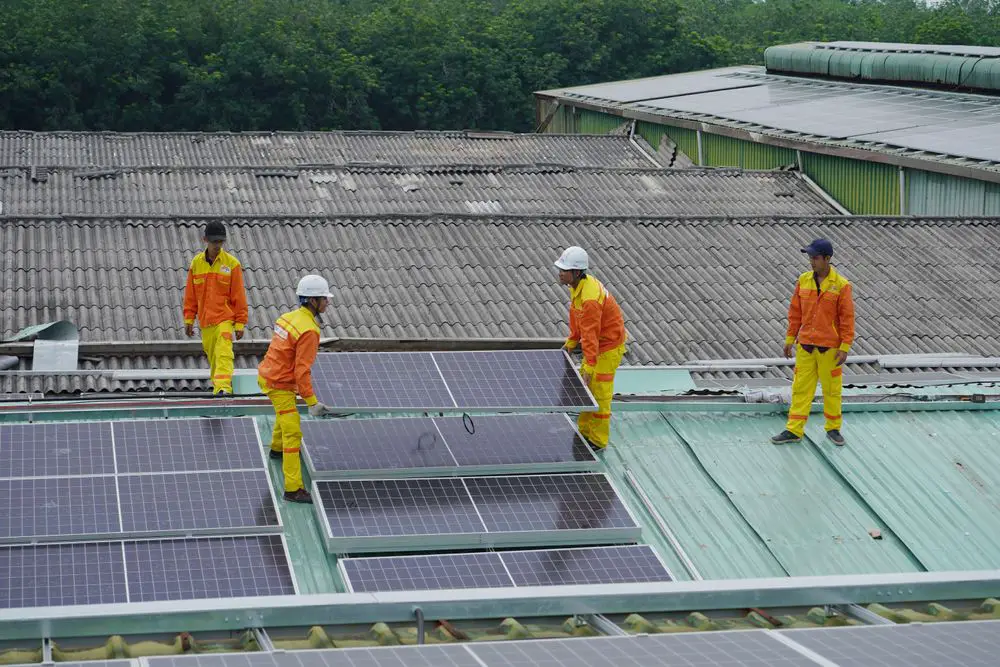
I told my husband everything at once, standing in the kitchen still wearing my work clothes, still coated in dust and tar residue. He listened through all of it without interrupting. When I got to the group chat his jaw tightened. When I got to the vacation printouts he sat back in his chair and went very still.
“Are you going back?” he asked.
I heard how quickly the answer came. “No.”
He nodded once. “Good.”
It rained three nights later.
Not a summer shower. A full midnight downpour with sustained wind, the kind that finds every imperfect seam in a roof installation and applies pressure until the seam gives.
My phone began buzzing at 12:17 a.m.
My sister first. Then my mother. Then my father. Then my sister again. I let all of them ring to voicemail and listened to the messages in sequence while sitting up in bed with the dark and rain pressed against the windows.
My sister was shrieking. “The ceiling came in. Audrey, what the hell did you do?”
My mother’s voice was colder, which landed harder. “You need to fix this immediately.”
My father’s message began with several seconds of breathing, then one sentence: “You’d better pray the damage is limited.”
I put the phone face down on the nightstand and did not respond.
By morning I had thirty-seven missed calls and photographs coming at irregular intervals in the texts. Water pouring through the bedroom ceiling. A sagging wet section above where they slept. Insulation hanging loose. The antique nightstand my mother loved dark with water damage. My father’s camera case soaked through. A suitcase on the floor like someone had tried to save it too late.
My sister sent: Get over there before Dad does something he regrets.
My mother wrote: This is your mess. Fix it.
Not one message acknowledged the three days I had worked. Not one mentioned the group chat or the video or the vacation printouts. In the version of events they were now assembling for themselves and anyone else who would listen, I had appeared from nowhere as the reckless daughter who damaged their home and disappeared.
My cousin Leah texted from a few houses down that afternoon. Two police cruisers outside your parents’ place. What happened?
I called her. She gave me the account from behind her window with barely suppressed laughter in her voice.
My father had stood on the sidewalk telling the responding officers that his daughter had performed unauthorized construction, left the property in an unsafe condition, and abandoned the job without completion. The officer had asked whether there was a contract, whether he had paid me, whether he had invited me to do the work. Yes to the last, no to the first two.
The officer told him it sounded like a civil matter and a poor family decision. My father insisted on filing a report. The officer told him to call a licensed contractor and suggested that perhaps putting family members on a roof and insulting them throughout was not a reliable construction strategy.
Once my parents understood they could not make my departure a criminal matter, they pivoted to making it a moral one.
My sister began posting photographs in the group chat. Before the storm. After the damage. My uncle sent another meme. My mother wrote about how some people offer help they are not actually capable of delivering. My father wrote that he had apparently confused generosity with responsibility.
They needed an audience as much as they needed anything else. The performance of my failure required witnesses.
That evening my husband and I sat at the kitchen table going through everything in sequence. He read the group chat without comment, then pushed the phone back toward me.
“They want you to feel guilty enough to go back and finish the job for free.”
“I know.”
“Are you going to?”
I looked at the messages, at my uncle’s meme, at my mother’s theatrical posts, at my sister’s all-caps demands. Then I thought about the midnight rain finding the seam in the tarp, and how the first response I had was not surprise, and how that absence of surprise told me something I had known longer than I had admitted.
“No,” I said.
The next morning I went to the bank and wrote a check for fifteen thousand dollars. More than the labor cost. More than the immediate repairs likely came to. More than I could easily part with, and it made me sick to do it, but I needed a clean line. I needed them to have no practical argument that I had abandoned them financially. No claim that I walked away from the damage without accountability.
I mailed it without a note.
Four days later, my mother left a voicemail from a number I did not recognize, explaining that they had been going through old records and realized I had never fully repaid a two-thousand-dollar loan from five years ago, and they were discussing stopping the deposit on my check until the older debt was resolved.
I stood in my kitchen listening to the message with a quality of disbelief that was different from ordinary disbelief. I had repaid that loan. Six transfers over six months, on time, each confirmed. I had missed a cousin’s wedding gift to make the final payment, which I remembered specifically because I had felt guilty about it and bought the cousin a nicer gift later.
I checked my records anyway, less out of doubt and more out of the need to see the truth in front of me. Each transfer, each confirmation, each amount. Paid in full. Overpaid by one hundred and eighty dollars on the final installment because I had misread my own notes.
They knew this.
But the debt was never the point. The point was the mechanism. If I paid, they would find another debt. If I explained, they would challenge the explanation. If I sent a check, they would call it an insult. The system was designed so that nothing I did could conclude the obligation, because the obligation was not financial. It was structural. It was my position in the family, which required me to remain in motion toward them at all times.
My husband listened to my father’s follow-up voicemail, which was short and mean and ended with the sentence you owe us, and then he opened his laptop and started a spreadsheet without asking me whether I wanted one.
He titled it simply: What Audrey owes versus what Audrey gave.
At first I found it painful to look at. It felt petty in the specific way of preparing evidence for people who have already decided not to listen. But he kept going, and eventually I sat beside him and added things he did not know about.
Every loan. Every bill I had covered during the year my father’s medical situation supposedly left them without room in the budget. Every transfer I made during their emergencies, some of which had not been emergencies in any verifiable sense. Every weekend I had given to their yard or their house or their various crises. Every birthday gift I had purchased for my sister’s children because she had forgotten to order something in time and did not want to show up empty-handed.
Every shift I had swapped or workday I had arranged around their schedules. Every tank of gas. Every unopened thank-you that had been replaced within days by another request.
Then my husband pulled up the six bank transfers repaying the two-thousand-dollar loan. Plus the extra one-eighty.
He turned the laptop toward me and did not say anything.
I looked at the numbers until my eyes went soft. Not because the total was the largest number I had ever seen. Because of what it represented when you laid it out in chronological order, the shape of a decade of being used in amounts small enough to pass individually as family love.
Before I decided what to do with the file, my father appeared.
Sunday morning. The weather was clear and my husband was in the kitchen making coffee and I was outside watering the plants near the fence when a silver SUV pulled up to the curb and my father stepped out with the careful deliberateness of someone who has rehearsed how to appear calm.
He looked older than the last time I had seen him. More tired. But not sorry.
He stopped about five feet away and said we needed to talk.
He talked about stress. About the difficult year they had been through. About what the trip had meant to my mother and how my check had felt like an insult rather than a resolution. He said maybe they had overreacted, but I needed to understand how things looked from their side.
Then he said the sentence that finished whatever small thread might still have been holding.
“You used to be so grateful. What happened to you?”
I did not answer. I walked back into my house and closed the door.
My husband was at the kitchen window. “You okay?”
“Not yet,” I said. “But I will be.”
Two nights later someone tried to break into my truck. Maybe it was random. Maybe not. The lock was scratched in a specific way, the glove compartment hanging open, nothing taken. The point of entry, not theft.
My husband filed a police report. I added it to the spreadsheet file under the date column.
My mother called from a restricted number and left a voicemail that included crying, a speech about the family falling apart, and near the end, delivered quietly in her particular register: you’re not the only one who knows how to cut people off.
That line chilled me more than the crying did.
Then came the note under my windshield. Plain printer paper, folded once, her handwriting in the stiff little slant she used when she was angry, her perfume still in the fiber.
We won’t forget what you did. This won’t end until you fix it the right way.
I did not bring it inside. I dropped it in the fire pit that evening and watched it go.
Family shifted after that. Not dramatically, not all at once. But my cousin Eric called, which was unusual enough that I answered before I realized I should probably screen it. He said my parents had been telling people I had stormed off the job halfway through, left the property dangerously exposed, ignored their calls, and thrown money at the situation to avoid responsibility.
He had mostly believed them until he remembered the video my father had sent around during the first day of work. He had saved it without thinking at the time. He watched it again and heard my mother’s voice in the background asking if I could do the funny limp thing again after my boot slipped.
He showed it to his father. His father showed it to two other relatives. Small cracks appeared in the story my parents had been building.
Texts began arriving from directions I had not expected. People who said they had always wondered why I was the one who ended up doing things like that for them. People who said the video had not landed the way my father seemed to think it would. No grand apologies. No family intervention. Just enough people seeing the pattern because they had, at various points, brushed up against it themselves.
It turned out I was not the first person my parents had treated this way. Just the first one who left without coming back.
My mother’s legal threats arrived in waves, lawyer language and county filing language and harassment accusation language. Each one added a row to the spreadsheet under my husband’s careful notation system. Date, time, summary, evidence. At some point the process stopped feeling like defense and started feeling like documentation of something I had needed to see clearly for a long time.
Then my sister showed up at my workplace.
No appointment. She walked into the lobby wearing sunglasses and the particular expression she used when she wanted something and did not want to ask for it directly. She said my mother was not eating well and could not sleep. She said the family was falling apart. She said my mother had found an old notebook that confirmed the outstanding loan amount, and they were still willing to settle everything and forgive the rest if I would just apologize and make it even.
Make it even.
I told her I had repaid the loan and overpaid it and I would not give another dollar or another hour.
She called me selfish under her breath and left.
That night my husband and I wrote a letter I never sent. Every hurt, every favor, every version of myself I had trimmed down over the years to stay acceptable in that family. I read it aloud once and then deleted it, because some words are not meant to be understood by the people who caused them. Some words exist only to free the person holding them.
I blocked the last numbers. My parents, my sister, the cousins who had watched and said nothing when it mattered, the group chat, every shared folder and every route back.
I expected guilt.
What I felt was relief so physical that I slept twelve hours straight for the first time in months.
Four weeks later my sister’s daughter showed up at the front door.
Kira. I had not seen her properly in years. She stood on the porch holding a small terracotta pot with a fern in it, knees dusty, eyes too wide, shoulders tense with the uncertainty of someone who was not sure whether she was allowed to be there.
“Aunt Audrey,” she said. “Mom said to give you this.”
I opened the door wider.
She held out the pot with both hands. “She said she’s sorry.”
That was all. No letter attached. No adult courage delivered alongside it. Just a child carrying an apology that was too heavy for her small arms.
I took the fern.
It was wilted at the edges, soil too dry, roots probably crowded in that cheap pot. Before I could ask Kira if she wanted to come inside for water or a snack, my sister’s voice came sharp from the sidewalk.
“Leave it, Kira. Come on.”
Kira flinched. Not much. Just enough.
Then she turned and ran back across the yard.
I stood in the doorway with the plant and watched them go.
My husband came up behind me. “You okay?”
I looked down at the fern. “I don’t know yet.”
He touched one of the drooping fronds lightly. “Needs repotting.”
We brought it inside anyway and set it near the window in the sun room we had been building together. Later that evening he loosened the root ball gently while I found a larger pot and fresh soil, and we worked in comfortable silence, and something about that made my throat ache.
Two people taking care of a plant that nobody else had taken care of properly. It felt obvious and maybe a little on the nose, but there it was.
When we finished the fern looked less doomed. Not healed. Just given a better situation to recover in.
That became the shape of whatever forgiveness I arrived at. Not a reunion, not a reset, not any kind of pretending that what had happened had not happened. Just the decision not to let what they did turn me hard in every direction that remained.
I sent a card to Kira on her next birthday with a bookstore gift card and a short note that said only: You are always welcome here. Nothing about her parents. No adult business delivered through a child.
A week later she mailed me a thank-you note in careful block letters with a tiny fern drawn at the bottom.
That was the first thing in months that made me cry.
Then my father’s brother called.
He said he had stayed out of it because he thought it would resolve itself, and then when it did not resolve, he did not know how to enter it without taking a side. Then he said: You’re not the first one they treated this way. You’re just the first one who walked away and didn’t come back crawling.
I leaned against the kitchen counter and closed my eyes.