That was always his favorite phrase when he wanted me to lower my guard.
We signed incorporation documents that night. We also signed our marriage license the next morning at city hall, because Derek loved efficiency and symbolism in equal measure. He said he wanted our personal vows and our professional promises tied together from the beginning. Romantic, he called it. Visionary. Permanent.
I remember there was one extra packet in the stack he handed me before the ceremony, thicker than the others, clipped with a silver binder. He kissed my forehead and told me it was just estate planning and founder protections, standard language, nothing dramatic. “I’m a lawyer’s son,” he said with that easy smile. “I overprepare. You’ll thank me later.”
So I signed.
I signed because I was in love. I signed because I trusted the man standing in front of me in a charcoal suit, smiling like I was the center of every plan he had for the future. I signed because, back then, it never occurred to me that a person could fold strategy into vows and call it devotion.
After I overheard that bet, I pulled the old contract from our home safe with shaking hands.
Then I read it.
Not like a wife skimming familiar paperwork.
Like a woman searching for the blade she could already feel lodged between her ribs.
And there it was.
A founder-protection clause tied to “voluntary reputational withdrawal” and “marital conflict impacting brand confidence.” Language so slippery it looked harmless until you slowed down and followed where every sentence led. If I resigned during a period of documented emotional instability, Derek could trigger an equity transfer mechanism at a discount valuation. If the board accepted the resignation under those terms, I would lose control of voting shares I hadn’t even realized were exposed.
He had drafted it on our wedding day.
I sat cross-legged on the closet floor reading that contract until midnight, then emailed the first attorney at 12:14 a.m. By noon the next day, I had three: a corporate litigator, a divorce shark with a silk voice and terrifying eyes, and a forensic accountant who asked for six years of records before she asked for my story.
By the evening of December 29, we had enough.
Proof of the affair. Misuse of company funds. Side agreements Greg never disclosed to the board. Messages about manufacturing a narrative that I was “too emotional” to remain in leadership. Draft statements. Hidden transfers. Calendar overlaps. Hotel invoices. A string of texts between Derek and a woman from one of our vendor firms that made me stop reading halfway through because rage started blurring the screen.
On the morning of the gala, my lawyer delivered two sealed envelopes to my apartment.
Not our apartment.
Mine.
I had moved out quietly the night before while Derek was at a “late strategy dinner.” I took only what mattered: my grandmother’s ring, my hard drives, my personal records, and the emerald dress he once said was dangerous on me because it made people underestimate how angry I could get.
By 8:10 p.m., I was standing outside the ballroom doors while waiters floated by with trays of champagne and the band tested sound beneath soft gold light. Through the glass, I could see Derek at the center of a perfect circle of executives, handsome and calm, one hand on a flute, the other touching elbows and backs like he owned the room. Greg stood beside him grinning with the loose confidence of a man who had never once believed consequences applied to him.
I walked in anyway.
And when Derek finally saw me in that emerald dress, his smile faltered for the first time in three years.
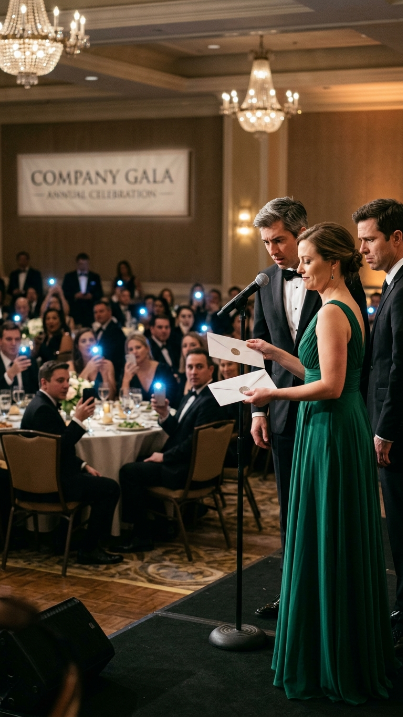
By the time he called my name to announce my “resignation,” I already knew exactly how the room was going to sound when everything they’d built on my silence started to crack, and the moment I stepped toward the microphone with those two envelopes in my hand…
My husband’s laugh floated down the hallway before the words did. I was standing there with his freshly pressed tuxedo over my arm, the plastic garment bag rustling under my fingers. His office door was half open, and his phone was on speaker, just loud enough to spill his conversation into the hall like he wanted the house to witness how important he was.
“She’ll make a scene,” Greg said through the speaker, his voice full of amusement. “I’m serious, Derek. Full breakdown. Tears, yelling, the whole thing. Women like her always think emotion is power.”
Derek chuckled. I heard ice knock against the side of his glass. “Double or nothing,” he said. “She cries before dessert.”
I stopped breathing. The tuxedo slipped down my arm an inch, and I caught it before the hanger could hit the floor. I stayed perfectly still, staring at the thin line of light under his office door like it was the edge of a cliff.
Greg laughed. “A thousand says she loses it as soon as you announce it. You better have somebody ready to film.”
“Oh, someone will,” Derek said. “The whole leadership team will be there. Investors too. She won’t be able to help herself. Drama is like oxygen for her.”
Drama. Like oxygen. He was talking about me. My pulse slammed so hard against my throat it hurt. For one wild second, I wanted to burst into the office, throw the tuxedo in his face, and ask him how long he’d been practicing that version of me in his head—the hysterical wife, the unstable partner, the woman whose public humiliation could be turned into dinner entertainment and a side bet.
But I didn’t move.
Greg kept talking, shifting to gala logistics—who would be seated near the board, when Derek should make the announcement, how to frame it as a graceful transition. My resignation. They never said the word plainly, but I already knew what they meant.
A week earlier, I had seen an email draft on Derek’s laptop with the subject line Leadership Transition and my name placed inside it like a body in a drawer.
I stayed where I was until the call ended. I heard the scrape of Derek’s chair, the clink of his glass, the soft exhale he always made when he thought he’d handled something cleverly. Then his footsteps came toward the door. I backed into the darkness beside the guest bathroom and pressed the tuxedo against my chest.
He walked right past me, scrolling through his phone, his expression relaxed. He didn’t look up. He didn’t see me standing there with his clothes in my arms, my whole marriage breaking open in silence.
After he disappeared down the stairs, I went into our bedroom, hung the tuxedo carefully on the wardrobe door, smoothed the lapels, and sat on the edge of the bed.
The clock said 6:42 p.m. December 27. Four days until the gala. Four days until the night my husband planned to erase me in front of three hundred people and collect a thousand dollars for it.
Most people would say that hallway was where my story began. It wasn’t.
It began three years earlier, inside a glass-walled conference room on the thirtieth floor of a downtown Chicago tower, with champagne in my hand and my name printed in gold on a contract. The city outside was all blue dusk and silver windows.
Derek stood at the head of the table with his tie loosened and his sleeves rolled to the elbow, looking handsome and electric and full of plans. He poured champagne into my flute himself. “To Harrison & Blake Consulting,” he said. “To the firm we’re going to build. To us.”
I smiled and tapped my glass against his. “To us.”
That phrase had always worked on me.
We’d spent months building the company together. I had left a stable director role at a larger firm because Derek said we could do something bigger on our own—smarter, sharper, less bloated. He had the polish and the confidence. I had the operational brain, the client instincts, and the discipline to turn ambition into a structure people could trust.
By the time that conference room door got our names etched into it, I had already brought in two anchor accounts and drafted the first growth strategy. Derek handled visibility. I handled everything that actually held the place upright.
Back then, I loved that balance. Or I thought I did.
The next morning, we got married at city hall. It was Derek’s idea to do everything in one sweep—incorporation paperwork, marriage license, estate planning, founder protections. He called it elegant. Symbolic. Efficient.
He liked language like that, words that made control sound romantic.
I remember standing near the clerk’s desk, still glowing from the night before, while he handed me a neat stack of documents clipped with silver tabs. He kissed my forehead and said, “A few legal housekeeping pieces. Nothing dramatic. You know me. I overprepare.”
I laughed. “I know.”
Then I signed where he pointed.
That was the thing about being deeply loved by a man who wanted to be admired—you mistook certainty for safety.
He moved through the world like someone who had already decided how every scene should end, and if you were in love enough, that confidence felt like shelter. For a while, maybe it was.
The first year of the company nearly killed us both. We worked insane hours, slept on office couches, ate bad takeout over spreadsheets. When payroll got tight in month nine, I sold the condo my grandmother had left me and used the money to keep the staff paid.
Derek cried when I told him—or at least he made me believe he did.
“We’ll never forget this,” he whispered. “When this company is huge, I’m going to tell everyone who really saved it.”
He never did.
Success came quickly after that. Clients signed. The firm grew. We were featured as a married founder duo with complementary strengths.
Derek loved interviews. He had a talent for saying half-true things with total conviction. He called me the strategic heart of the company in public, then cut me out of key conversations in private.
At first it was small. Then it wasn’t.
The first time I felt truly afraid wasn’t when I found evidence of his affair. It was when I realized how often he had been preparing the room before I walked into it—framing me, softening my credibility, planting doubt.
By the time I entered certain conversations, I had already been rewritten.
I didn’t notice it all at once. I noticed it in aftershocks.
And by the time I finally understood what he was doing, he had already written my exit—and placed a bet on my collapse.


