The Architecture of Retribution
Prologue: The Weight of Paper
“YOU ARE NOTHING BUT A PENNILESS FOOL WHO LET ME STEAL HER ENTIRE FUTURE,” my husband sneered, his breath hot with stale airport scotch and sour triumph as he tossed his scuffed, empty designer luggage onto our hallway rug.
He stood in the entryway of our home like a conqueror returning from a sacking, completely oblivious to the fact that every single dollar he blew across the capitals of Europe was a high-interest nail he had personally hammered into his own financial coffin.
I did not flinch. I did not raise my voice. I merely looked at him from the wingback chair in the drawing room, holding a cup of Ceylon tea that had long since gone cold.
As an architectural archivist, my entire life has been dedicated to the study of load-bearing structures. I spend my days unrolling century-old blueprints, analyzing cross-sections, and identifying the precise point where dry rot, systemic fatigue, or hidden stress causes a seemingly impenetrable facade to collapse under its own unearned weight.
Men like Julian Hayes believe the world is made of appearances—of polished veneer, Italian wool, and the loud, hollow assertion of power.
They never inspect the foundation.
Julian truly believed he had executed the ultimate domestic heist. He believed he had stripped an orphaned archivist of her family’s legacy while her eyes were still swollen with funeral tears. But what he failed to understand was that he had not married an unprotected victim. He had married the granddaughter of Evelyn Vance, the fiercest, most brilliant estate planning litigator this city had ever seen.
And my grandmother had spent her final eighty-six years on this earth ensuring that thieves always paid for the wood used to build their own gallows.
Chapter 1: The Theft in the Shadow of Mourning
The scent of white funeral lilies is distinct from any other fragrance in the world. It is heavy, sweet, and suffocatingly cold, carrying with it the unmistakable silence of an ending.
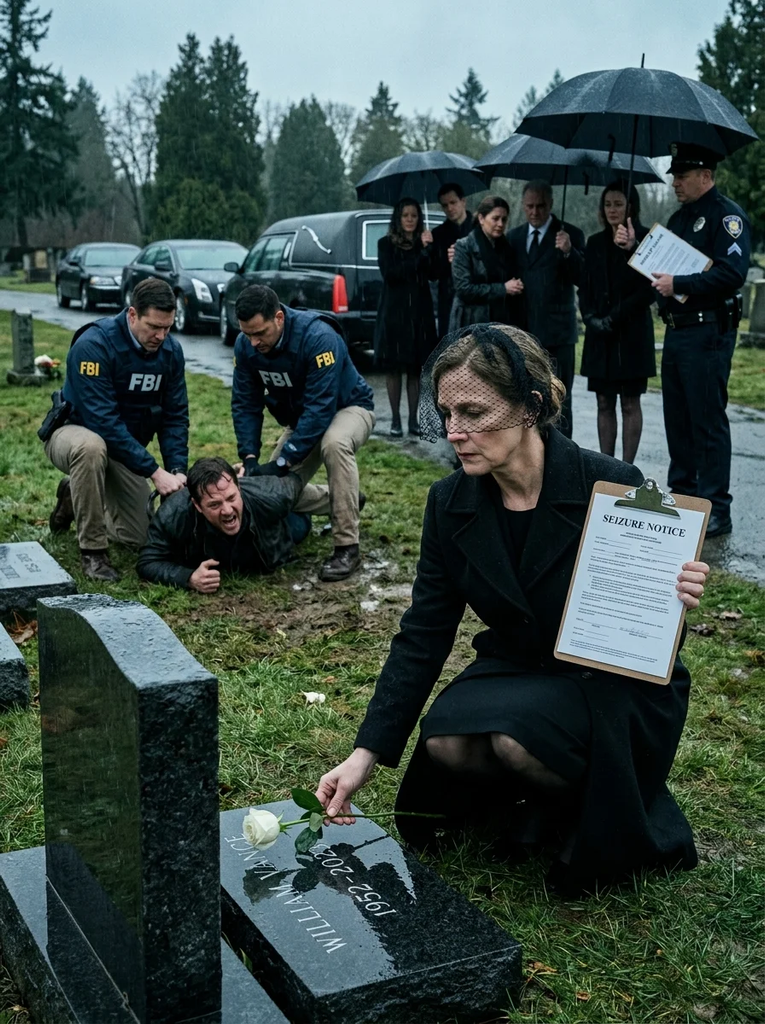
On the morning of my grandmother’s memorial service, rain lashed against the leaded-glass windows of the Vance family home in Oakridge Terrace. The house was a sprawling, three-story Victorian craftsman that Grandmother Evelyn had restored with her own hands in the nineteen-seventies—a place of solid quarter-sawn oak, brass switchplates, and towering mahogany bookshelves lined with leather-bound volumes of the North Eastern Reporter.
I was thirty years old, exhausted down to the marrow of my bones, and kneeling on the Persian rug in the front parlor. My black wool dress felt like lead against my skin. Surrounding me were stacks of ivory memorial programs, silver trays piled high with unopened sympathy cards, and floral wreaths sent by state supreme court justices, former governors, and legal scholars who had revered Evelyn Vance as an institution.
Grandmother Evelyn had been my entire world. When a drunk driver took my parents on an icy interstate when I was seven, it was Evelyn who took my trembling hand, brought me into this house of books and quiet reason, and taught me that tears were meant to clear one’s vision, not obscure it.
She had taught me how to read blueprints, how to analyze the integrity of contracts, and how to look directly into the eyes of an adversary without blinking.
For the past six months, as bone cancer slowly claimed her physical strength, I had slept on a cot beside her bed, administering morphine, holding her paper-thin hands, and listening to her dry, rhythmic breathing.
My husband of four years, Julian, had spent those same six months complaining about the smell of antiseptics in the house.
From the second floor, the rhythmic, frantic thud of heavy footsteps echoed through the ceiling plaster. Floorboards groaned under the weight of someone moving with desperate, predatory speed. Dresser drawers slammed shut in rapid succession. Closet doors banged against their moldings.
I remained on the rug, my fingers trembling as I folded a prayer card inscribed with Evelyn’s favorite passage from Ecclesiastes: To every thing there is a season, and a time to every purpose under the heaven.
The footsteps descended the grand staircase, two treads at a time.
Julian appeared in the parlor archway. He was thirty-two, possessed the chiseled, symmetrical jawline of a television anchor, and wore an air of manic, electric vitality that looked grotesque against the backdrop of my mourning. He was dressed not in the dark charcoal suit we had laid out for the service, but in a brand-new, bespoke camel-hair overcoat and handcrafted Italian leather oxfords. In his right hand, he dragged his sleek, aluminum Rimowa rolling suitcase.
In the breast pocket of his coat, the embossed gold foil of an official legal packet caught the dim chandelier light. The envelope bore the distinct blue-lettered insignia of Pendelton & Vance Attorneys at Law, boldly stamped: VANCE TESTAMENTARY PRE-DISTRIBUTION: CERTIFIED LIQUID ASSET DISBURSEMENT.
My throat tightened. “Julian?” I whispered, my voice frayed from two days of uninterrupted weeping. “The limousine for the church will be here in twenty minutes. Where are you going? Why are you dressed like that?”
Julian stopped at the threshold. He did not step onto the rug. He did not come to kneel beside me, nor did he offer a hand to lift me from the floor.
His gaze swept over the sympathy flowers, the condolence wreaths, and finally settled on me. His pale blue eyes were devoid of grief, devoid of warmth, devoid of even the superficial affection he had pantomimed throughout our courtship. They were the eyes of a man who had finally opened an envelope containing the prize he had stalked for years.
“I’m leaving, Clara,” he said, his tone casual, almost conversational, like an executive announcing a change in his lunch reservation.
I stared at him, my mind struggling to process the syllables. “Leaving? Today? Julian, my grandmother is being lowered into the ground in two hours. You’re one of the pallbearers. Her former colleagues are waiting—”
“Her former colleagues are ancient, irrelevant relics,” Julian interrupted, his voice cutting through the quiet parlor with surgical cruelty. “Just like she was. And just like you are.”
He reached into his overcoat, his fingers lightly brushing the edge of the blue-backed envelope before sliding down to his left hand. With a smooth, practiced motion, he slipped his platinum wedding band off his finger.
He didn’t hand it to me. He tossed it.
The heavy metal bounced off my knee and landed with a dull, hollow click on the open prayer books scattered before me.
“I spent four years playing the doting, patient husband to a boring, sentimental archivist,” Julian said, stepping forward just enough to loom over me, his lips curling into a triumphant, predatory smirk. “Four years of enduring her endless, condescending lectures about ‘legal integrity’ and ‘family heritage’ while we lived in this creaking mausoleum. Four years of listening to you whine about historic preservation while your peers were buying penthouses and flying private.”
“Julian… what are you talking about?” The room seemed to tilt. The scent of the lilies suddenly made me nauseous.
“I’m talking about compensation, Clara,” he said, tapping his breast pocket. “Your grandmother died. Her pre-probate liquid disbursement came through this morning by courier.
One hundred thousand dollars in a certified, un-crossed bank draft made out to bearer. Holder in due course, Clara. That’s legal speak for: whoever holds the paper owns the money.”
“You took the bank draft from her study desk?” The words felt thick, impossible in my mouth. “That was legal paperwork Arthur Pendelton delivered for the estate transition—”
“I didn’t take it; I collected my severance package,” he sneered. “Did you honestly think a man like me was going to stay tethered to a plain, weeping orphan who spends her weekends dusting old municipal blueprints? I’m thirty-two years old. I have partnerships to secure, circles to enter, life to live. A hundred thousand dollars in liquid cash clears every personal balance I have and finances sixty days of the life I was actually born to lead.”
He wheeled his suitcase around, the high-grade casters gliding silently over the hardwood floor.
“Julian, stop!” I pushed myself up from the rug, my legs shaking, my fingers catching the edge of a side table to steady myself. “You cannot do this. You are walking out on our marriage, on my grandmother’s grave, on our life—”
“We don’t have a life, Clara. We had an arrangement that just matured,” he called over his shoulder, walking briskly toward the front door. “My flight to Charles de Gaulle departs in two hours.
Business class. Paris, Berlin, the Amalfi Coast. Real wealth, real society. Don’t bother calling me, don’t bother having your pathetic legal friends draft threatening letters, and don’t bother begging. You couldn’t afford my lifestyle now anyway.”
He opened the heavy oak front door. A gust of wet, freezing November wind swept into the foyer, scattering the white petals of the funeral flowers across the floorboards.
Julian stepped out into the rain, pulled his collar up, and slammed the door behind him. The sound echoed through the high ceilings like a pistol shot, rattling the antique glass in the transom and shaking the framed portrait of Grandmother Evelyn that hung in the corridor.
Silence settled back over the house. A terrible, ringing silence.
I stood in the center of the parlor, my chest heaving, the cold air from the entryway chilling the sweat on the back of my neck. I looked down at the floor. The platinum band sat squarely on the open pages of the hymnal, cold and mocking.
I did not scream. I did not fall to the floor in hysterical tears.
Instead, my eyes moved to the mahogany coffee table beside Grandmother Evelyn’s favorite armchair.
Resting beneath a heavy brass paperweight was an envelope made of thick, handmade linen paper. It was sealed with dark crimson wax, pressed with Evelyn’s personal signet ring—the scales of justice intertwined with an ivy branch.
In her sharp, unmistakable calligraphy, written during her final lucent hours three days before she slipped away, were nine words written in black fountain pen ink:
Open this only after he runs away with the check.