PART 1 — THE BENCH BENEATH COLORED GLASS
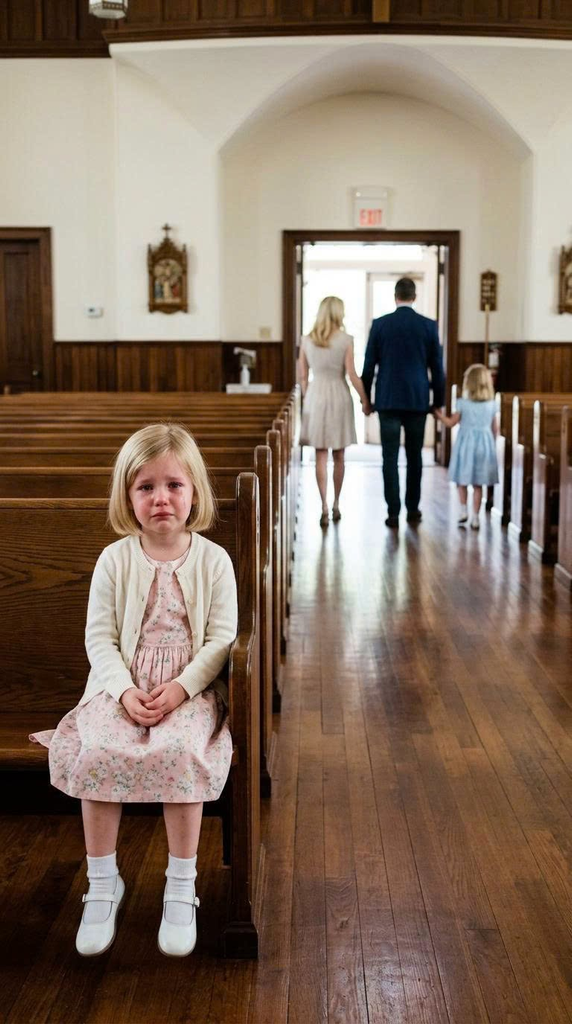
I was four years old when my mother led me into Saint Thomas Aquinas Church and placed me on a wooden pew beneath the stained-glass windows.
I remember my gray coat.
The brass buttons.
My white socks sliding down inside my shoes.
The smell of candle wax.
And my mother’s hands carefully straightening my collar.
She was unusually gentle that afternoon.
That is one of the things I remember most.
Not anger.
Not panic.
Gentleness.
She knelt until our faces were level.
“Stay here, Nora.”
I stared at her.
“Why?”
“God will watch over you.”
My father stood several feet away.
He would not look at me.
My older brother, Leo, was beside him.
Eight years old.
He looked confused.
“Are we coming back?”
I asked.
My mother smiled.
The same soft smile she used when putting me to bed.
“Don’t worry.”
Then she stood.
My father took her hand.
Leo followed.
They walked toward the enormous wooden doors.
I waited for someone to laugh.
For my mother to turn around and say this was some strange game.
Instead, she looked back once.
Smiled again.
Then walked outside.
The doors closed.
I remained on the pew.
My feet did not reach the floor.
I did not cry immediately because I did not yet understand that I had been abandoned.
Children expect adults to return.
That confidence is one of the first things abandonment destroys.
I waited.
Five minutes.
Ten.
Maybe thirty.
Time has never remained clear in that memory.
Eventually a nun named Sister Agnes noticed me.
“Sweetheart, where is your family?”
“They’re coming back.”
She sat beside me.
“Where did they go?”
“I don’t know.”
A priest joined us.
Then another woman.
Eventually police.
Then a social worker.
No note had been left.
No emergency number.
No explanation.
Only me.
I knew my first name.
My parents’ first names.
My brother’s name.
A few fragments of an address I could not explain well enough for adults to immediately locate.
By evening, I had stopped saying:
“They’re coming back.”
By the following morning, other people had stopped pretending they believed it.
My parents had disappeared.
And for a long time afterward, I believed they had taken my brother because there was something about him worth keeping and something about me worth leaving behind.
I was wrong about the second part.
It took another woman many years to teach me that.
PART 2 — FLORENCE MILLER
Her name was Florence Miller.
I met her several months later.
By evening, I had stopped saying:
“They’re coming back.”
By the following morning, other people had stopped pretending they believed it.
My parents had disappeared.
And for a long time afterward, I believed they had taken my brother because there was something about him worth keeping and something about me worth leaving behind.
I was wrong about the second part.
It took another woman many years to teach me that.
PART 2 — FLORENCE MILLER
Her name was Florence Miller.
I met her several months later.
She was fifty-nine.
Widowed.
A church pianist.
She lived in a small cream-colored house filled with books, old records, mismatched furniture, and lavender sachets tucked into almost every drawer.
My first placement after the church had not lasted.
Neither had the second.
I had stopped unpacking completely.
When Florence showed me the room she had prepared, I kept my small suitcase zipped beside the bed.
She noticed.
Did not ask about it.
The first night, she said:
“Do you like the door open or closed?”
I did not know.
“No one ever asked?”
I shook my head.
“Then we’ll try open.”
She left it open.
A nightlight glowed in the hallway.
I woke six times.
Florence was still there every time.
PART 3 — SHE DID NOT PROMISE FOREVER
That may have been why I trusted her.
Florence did not say:
“I’ll never leave you.”
Adults had already taught me promises could become dangerous.
Instead she said:
“Breakfast is at seven.”
And breakfast appeared at seven.
She said:
“I’ll pick you up from school.”
She did.
She said:
“I have choir practice until eight, so Mrs.
Reynolds will stay with you.”
Mrs.
Reynolds arrived at six fifty-five.
Consistency.
That was Florence’s language of love.
Not grand declarations.
Predictability.
PART 4 — WHAT HAPPENED TO MY PARENTS
Authorities tried to locate them.
My childhood case file would later show more effort than I remembered.
Old neighbors interviewed.
Former employers contacted.
Relatives traced.
The apartment my parents had rented was empty.
Utilities disconnected.
My father’s job had ended two weeks before I was abandoned.
A car registered to him was sold for cash.
One relative believed they had moved west.
Another said south.
No one knew.
Or admitted knowing.
This was before social media made disappearing harder.
Before I understood that adults can spend enormous energy avoiding consequences.
The investigation eventually went cold.
My parents were not declared dead.
They simply became absent.
PART 5 — LEO
For years, I dreamed about my brother.
Not my parents.
Leo.
He had been eight.
Old enough to remember me.
Too young, I later understood, to control where our parents drove.
But when I was six?
Eight might as well have been thirty.
Why didn’t he come back?
Why didn’t he tell someone?
Leo.
He had been eight.
Old enough to remember me.
Too young, I later understood, to control where our parents drove.
But when I was six?
Eight might as well have been thirty.
Why didn’t he come back?
Why didn’t he tell someone?
Why did he get to stay?
Florence never answered questions she could not answer.
“He may not have had a choice.”
“Did he love me?”
“I don’t know.”
“Did Mom?”
“I don’t know.”
“Why did they leave me?”
“I don’t know.”
I used to hate those answers.
Now I understand what a gift they were.
Florence never built a comforting lie that reality could later destroy.
PART 6 — ADOPTION
I lived with Florence first as a foster child.
Then under long-term guardianship while courts dealt with my parents’ disappearance.
When I was eight, after years without contact and the necessary legal proceedings, Florence adopted me.
She asked before filing.
“Would you like me to be your mother legally too?”
I stared at her.
“Aren’t you already?”
Florence cried so hard she had to remove her glasses.
I became Nora Miller.
Not because my earlier life disappeared.
Because somebody had stayed long enough to give me a new legal one.
PART 7 — THE CHURCH
Strangely, I never hated Saint Thomas Aquinas.
Florence played piano there
At first, she gave me the choice not to attend.
Then one Sunday I went.
The pew was still there.
For several months I refused to sit anywhere near it.
Eventually I did.
Nothing happened.
No flashback so dramatic that the windows shattered.
Just sunlight.
Dust.
A hymn.
People turning pages.
Slowly, the building stopped belonging exclusively to the worst afternoon of my childhood.
That mattered.
PART 8 — FLORENCE’S RULE
When I was ten, I asked:
“What if Mom comes back?”
Florence answered:
“Then you get information.”
“What does that mean?”
“It means her return would tell you she returned.”
I frowned.
“It would not automatically mean you owe her love, trust, forgiveness, dinner, or a bedroom.”
That sounded strange to a ten-year-old.
Years later, it became one of the most useful sentences anyone ever gave me.
PART 9 — MY LIFE AT TWENTY-FOUR
I earned a scholarship to a small Catholic college.
Majored in social work…