I always believed coming home for Christmas meant returning to a place of comfort, something familiar and warm waiting on the other side of the door. But as I stood on my own front porch, key in hand, my house key wouldn’t slide into the deadbolt at all.
The familiar brass fixture I’d had installed decades earlier was simply gone, replaced by a sleek black digital keypad I’d never once seen before. I stepped back, brushing snow off the shoulders of my coat, and looked more carefully at the front windows.
The heavy velvet drapes I had sewn myself, by hand, ten years earlier, were nowhere to be seen. In their place hung sheer, modern blinds, the kind you’d find in a magazine spread for people half my age.
I hadn’t even been gone that long, really. Three months in Florida, helping my sister recover after knee replacement surgery, sleeping on her pull-out couch and driving her to physical therapy appointments three times a week. Before I left, my son David and his wife Sarah had asked whether they could stay at my house for a few weeks while their apartment lease transitioned, some gap between move-out and move-in dates that needed bridging.
I had agreed without much hesitation. It made sense at the time. My house sat empty, they needed somewhere to land, and I was their mother. I wired David access to a joint checking account before I left, gave him clear, simple instructions, and boarded my flight to Florida without a second thought.
I pressed the doorbell now, standing on my own porch like a stranger. After a minute, the door swung open. Sarah stood there in a soft cashmere sweater I didn’t recognize, holding a mug of coffee between both hands. Her eyes widened for a fraction of a second before her face smoothed itself back into a practiced, welcoming smile, the kind you’d give a client rather than family.
“Catherine, we didn’t expect you until the weekend,” she chirped, stepping aside just enough to let me pass through the doorway.
I stepped into the foyer and stopped completely, my suitcase still in hand.
The entire first floor had been repainted a sterile, icy gray, every wall I remembered as warm cream now stripped down to something cold and showroom-ready. My antique console table, the one my husband and I had found at an estate sale on our tenth anniversary, was gone entirely. The floral rug I’d bought on a trip to Charleston years earlier had been replaced by bare, glossy hardwood, polished to a mirror shine.
“Surprise,” I replied, keeping my voice steady, deliberately mild.
I took off my gloves and set them down on a new minimalist glass table that seemed to have materialized out of nowhere, replacing furniture that had sat in that exact spot for over a decade.
“The physical therapy finished early,” I explained.
David walked out from the kitchen just then, wiping his hands on a dish towel I didn’t recognize either. He froze the instant he saw me standing there.
“Mom. Wow. You’re early.”
“I am.”
I picked my suitcase back up. “I’ll just take this up to my room and wash up.”
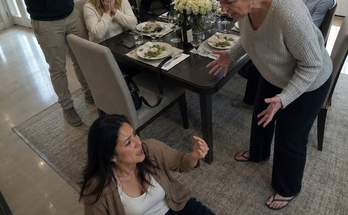
Sarah stepped in front of the staircase before I could move toward it, offering a tight, apologetic grimace that didn’t quite reach her eyes. “Actually, Catherine, about that. We moved into the master bedroom. It just made more sense, honestly, with my remote work setup and everything. We put your things in the guest room down the hall. It’s very cozy.”
I looked over at David. He looked down at the floorboards instead of meeting my eyes.
They hadn’t asked me. They hadn’t discussed a single detail of any of this with me beforehand. They had simply packed up my life, room by room, and moved me into the smallest bedroom in my own house while I was three states away helping my sister recover from surgery.
“I see,” I murmured.
I didn’t drop my bag. I didn’t raise my voice. I simply walked past both of them and headed up the stairs, already knowing exactly what I needed to check first, once I had a moment alone.
The guest room felt like a storage closet someone had hurriedly disguised as a bedroom for the occasion. Boxes of my own personal belongings were stacked haphazardly in one corner, taped shut without any labels. My clothes had been crammed into a narrow wardrobe clearly meant for guest linens, many of the garments visibly wrinkled from careless folding. The bed was made up with cheap, scratchy sheets I had never once purchased or seen before in my own home.
I sat down on the edge of the thin mattress, listening to muffled voices drifting up from the living room below.
“She wasn’t supposed to be here until Sunday,” Sarah hissed, her voice carrying more clearly than she probably realized.
“She’s my mom, Sarah. We can’t just tell her to leave,” David whispered back, though his voice carried almost no real conviction behind it.
“We’ve practically renovated the whole place. We have people coming over for Christmas Eve. We need the space.”
I stood up and quietly, methodically unpacked my small suitcase into the narrow wardrobe, making room among clothes I hadn’t chosen to have there.
I didn’t cry. Tears, I’ve always believed, are a biological response to sudden pain. But what I felt in that moment wasn’t pain, exactly. It was something colder and sharper. Clarity.
For years, I had quietly subsidized nearly every stage of David’s adult life. I had paid his full college tuition without complaint. I had helped him buy his first car the summer after graduation. When he married Sarah three years ago, I had written them a generous check for the wedding, on top of hosting the rehearsal dinner myself.
I had genuinely believed, all those years, that I was simply being a supportive mother, doing what any parent who could afford to help would naturally do.
Standing in that repurposed storage closet of a bedroom, surrounded by boxes of my own belongings, I saw the situation clearly for the first time. I hadn’t been supporting them. I had, without ever intending to, trained them to view my resources as fundamentally their own.
I walked back down to the kitchen. Sarah was busy reorganizing the refrigerator, moving my favorite brand of raspberry jam toward the back to make room for a massive charcuterie platter wrapped tightly in plastic.
“Catherine,” Sarah began without looking up from her task. “Since you’re here early, do you mind keeping out of the main areas tomorrow afternoon? We’re hosting a holiday mixer for my firm. I can bring a plate up to your room.”
David stood near the sink, completely silent, refusing to meet my eyes at all.
“A mixer,” I repeated calmly, letting the word sit there.
“Yes. It’s very important for my promotion this quarter.”
Sarah closed the refrigerator door with a soft click. “And honestly, the kitchen’s going to be pure chaos tomorrow. We just need everything to look perfect for the partners.”
I poured myself a glass of water, taking my time about it, letting the silence stretch a moment longer than was comfortable.
“Of course,” I said, nodding. “I wouldn’t want to get in the way.”
I walked back upstairs to my small, repurposed room. If they wanted to play house so badly, I decided, I would let them, for now. But they had fundamentally, catastrophically misunderstood who actually owned the playground they were so busy redecorating.
I woke at five the next morning. The house was completely, dead quiet around me. I slipped out of the narrow guest bed, pulled on my robe, and made my way quietly down to the basement, careful to avoid the third stair that always creaked.
When I’d left for Florida three months earlier, I had given David access to a joint checking account holding roughly ten thousand dollars. The arrangement had been simple and, I’d thought at the time, entirely reasonable: he would use those funds to cover my property taxes, the household utility bills, and any minor maintenance issues that came up in my absence.
My heavy fireproof safe sat exactly where it always had, tucked behind a row of winter coats in the basement closet. They hadn’t found it, apparently, or hadn’t bothered looking closely enough to notice it was there at all.
I spun the combination lock from memory, pulled the heavy door open, and retrieved my financial ledger along with a spare laptop I kept there specifically for emergencies.
Sitting down at the small workbench I kept in one corner of the basement, I logged into my banking app. The joint account balance read fourteen dollars and fifty cents.
I clicked through into the transaction history, scrolling slowly, my stomach tightening with each line I read. The property taxes had not been paid at all. Instead, there were charges for a custom painting service, a high-end furniture store I’d never heard of, and a local general contractor. One charge in particular caught my eye immediately: four thousand dollars, paid to a place called Coastal Storage Solutions.
They had used my own money to systematically erase me from my own house.
I closed the laptop slowly. My heartbeat, somewhat to my own surprise, stayed steady and even. I didn’t storm back upstairs. I didn’t wake them up to demand answers or explanations.
Arguing with entitled people, I’ve learned over a long life, only ever gives them a stage on which to perform as the victim. You don’t negotiate with someone who is entirely comfortable stealing from you outright. You simply, quietly, remove their access.
I opened a new browser tab and checked the property records directly on the county website. The deed was still fully, securely in my name alone. Catherine Miller, sole owner. Nothing about that had changed, whatever else they’d managed to rearrange around me.
I carefully packed the laptop and a printed copy of the deed into my tote bag. I locked the safe again, turned off the basement light, and walked back upstairs. The smell of expensive coffee had already begun drifting out from the kitchen. Sarah was awake now, presumably preparing for her party.
The game, I understood clearly by that point, was straightforward enough. They were betting, whether consciously or not, that I would choose family peace over enforcing my own boundaries.
It was, as it turned out, a genuinely terrible bet on their part.
After a quick breakfast, eaten standing at the counter while Sarah bustled around me arranging decorative pine cones, I put on my coat and picked up my car keys.
“Going out?” David asked, not quite looking up from his arrangement of pine cones on the dining table.
“Just running some errands.”
I smiled mildly and let myself out.
I drove straight to Coastal Storage Solutions. The manager at the front desk looked up as I approached the counter. I handed him my driver’s license without preamble.
“I need to check on a unit,” I said. “I believe it was recently rented under the name David Miller, but the payment came directly from my personal account.”
The manager tapped through something on his keyboard. “Ah, yes. Unit four-twelve. It’s registered in his name. Ma’am, I’m afraid I can’t give you the gate access code unless you’re listed on the authorized users for the unit.”
“Understood,” I said. “Can you tell me whether the account is currently set to autopay from a card ending in four-four-nine-two?”
He checked. “Yes, it is.”
“I am the owner of that card,” I said, sliding it across the counter toward him.
“I need you to remove this card from the account file immediately. It is no longer authorized for this transaction, or any future ones.”
The manager frowned slightly but processed my request without further argument. “He’ll be locked out of the unit next week if he doesn’t provide a new payment method before then.”
“That sounds like a problem for David to solve,” I replied evenly, tucking my card back into my wallet.
Before I left, I walked around the perimeter fence and located unit four-twelve myself. Through the slightly bent metal grate near the top of the roll-up door, I could see my own life boxed away neatly inside. My heavy oak dining chairs, stacked upside down on top of each other. The paintings my late husband had bought me over the course of our marriage, leaning against one wall wrapped in moving blankets. The grandfather clock, silent now, standing sentinel over cardboard boxes.
They hadn’t sold any of it, I noted. They had simply banished it, quietly relocating an entire life into a locked storage unit while they redecorated the house it had once filled.
I drove to my local bank branch next. I sat down with a personal banker named Thomas, who had known me and managed my accounts for the better part of a decade.
“Thomas, I need to close the joint checking account I share with my son. Today, please.”
“Of course, Catherine.” He pulled up the account. “There’s only a few dollars remaining in it. Should I transfer the balance over to your main account?”
“Yes. And please make sure my main checking and savings accounts are completely locked down going forward. No authorized users of any kind. No secondary cards. Just me, alone, on every account.”
I walked out of the bank afterward feeling noticeably lighter, some knot in my chest finally loosening. The financial tap, as far as I was concerned, was officially shut off for good. David and Sarah were about to discover, rather quickly, exactly how expensive it was to maintain their particular lifestyle entirely on their own dime.
I returned to the house around three that afternoon. The driveway was packed nearly bumper to bumper with luxury SUVs I didn’t recognize. Sarah’s holiday mixer was clearly in full swing. Soft jazz drifted from new ceiling speakers I hadn’t known had been installed. I let myself in quietly through the garage, avoiding the front entirely.
The kitchen was a disaster zone of dirty plates, empty wine bottles, and half-eaten appetizers abandoned on every available surface. Sarah stood near the island, chatting animatedly with two women in sharp business suits. She caught sight of me and immediately excused herself, hurrying over.
“Catherine, hi,” she said, keeping her voice pitched low, her smile bright and entirely fake. “Listen, the caterers were a bit short-staffed today. Would you mind just tossing those plates in the dishwasher for me? It would be a huge help.”
She was, quite plainly, treating me like hired staff in my own kitchen, in the house I had lived in for thirty years.
I looked at the mountain of dirty dishes piled on the counter. Then I looked back at Sarah.
“No,” I said, quite calmly.
Her fake smile faltered visibly. “Excuse me?”
“I don’t mind a great many things, Sarah. But I am not washing your dishes.” I kept my tone entirely conversational, almost pleasant. “Enjoy your party.”
I walked past her, retrieved my coat from the hallway closet where it had apparently been relegated, and walked straight back out the front door.
I drove to a quiet diner a few towns over, ordered a slice of cherry pie, and read a book in a corner booth for three peaceful hours, letting the noise of the day settle behind me.
My phone buzzed around six that evening. A text from David. Mom. My debit card declined at the liquor store. Did you do something to the account? We need more wine for Sarah’s boss.
I read the message, took a slow sip of my coffee, and put the phone back in my purse without replying at all.
When I finally returned home around eight, the party had mostly wound down. The house sat quiet again. I walked up to the front door and typed in the access code David had given me on my very first day back, all those months ago.
- Beep. A red light flashed.
I tried again, carefully, in case I’d mistyped. Beep. Red light again.
I stood there in the freezing cold, snow beginning to fall again around me. They had changed the code entirely. Whether out of petty anger over the dishes, or the declined card, or both, they had deliberately locked me out of my own home.
I didn’t knock. I didn’t ring the doorbell. I simply stepped off the porch and walked around to the side of the house, pushing through the overgrown camellia bushes I kept meaning to trim back.
When my husband and I had bought this house thirty years earlier, he’d installed a heavy-duty manual deadbolt on the side garage door, a detail neither of us had thought about in years. When David upgraded the front entrance to a digital keypad, he apparently hadn’t bothered to touch that old side door at all. He likely didn’t even know a spare key existed for it, let alone where it was kept.
I reached up into the hollow space behind the outdoor light fixture beside that door, my fingers brushing against cold, familiar metal exactly where it had always been. The key turned smoothly in the old lock, the mechanism still perfectly sound after three decades.
I stepped into the dark, silent garage and let myself quietly into the house.
David and Sarah were in the living room, the television murmuring in the background.
“She can sleep in her car if she wants to be petty about it,” Sarah was saying, her voice tight with irritation. “That account was supposed to be for house expenses.”
“It was her money, Sarah,” David muttered back, though without much force behind it.
“It’s our house now, basically. She practically gave it to us when she left for Florida.”
I stood in the shadows of the hallway for a moment, absorbing the sheer, breathtaking delusion in her voice. They genuinely, fully believed they had conquered this space, claimed it outright as their own.
I quietly climbed the stairs to the cramped guest room. I pulled my suitcase out from under the narrow bed and began packing again, methodically. I didn’t take everything, only my essentials — important documents, my jewelry, a few changes of clothes. This house, I realized as I zipped the bag closed, no longer felt like mine in any meaningful sense. It felt contaminated by their entitlement, every room repainted with someone else’s assumptions about what belonged to whom.
But I wasn’t going to fight them for the physical space that night. I was going to let them have it, temporarily, under entirely new terms of my own choosing.
I zipped my bag shut, put on a fresh coat, and walked back down the stairs. I didn’t sneak. My footsteps were deliberate, unhurried, meant to be heard.
David turned around as I reached the bottom step. He saw the suitcase immediately. Panic flashed across his face.
“Mom, what are you doing? How did you even get in here?”
“I used my key, David.” I adjusted the strap of my bag over one shoulder. “I’m leaving.”
Sarah stood up from the couch, crossing her arms defensively. “Oh, please, don’t be dramatic. We just changed the code for security, because of the party. You could have simply knocked.”
I looked directly at her. “I don’t knock on my own front door.”
I opened the door myself and walked out into the winter night, snow still falling steadily, the cold sharp against my face after the overheated living room.
I spent that night at a comfortable hotel just off the interstate, sleeping better, I noted somewhat wryly, than I had in either of the two nights I’d spent in my own guest room.
The next morning, Christmas Eve, I drove into town and met with Martha, an old friend who ran a local property management and real estate company.
Martha poured me a cup of tea in her cluttered but cozy office, listening quietly and without interruption as I explained the entire situation — the unauthorized renovations, the drained bank account, the storage unit, the changed locks.
“You want to evict them?” Martha finally asked, pulling out a legal pad.
“No,” I said, taking a slow sip of the hot tea.
“Evictions take time, Martha. They cause ugly, drawn-out fights, and people like that thrive on drama, on having an audience for their grievances. I am going to remove the ground they’re standing on entirely.”
“What’s the plan, then?”
“I want to sell the house. Immediately. As-is.”
Martha raised an eyebrow, setting down her pen. “Catherine, you’ve lived there for thirty years.”
“And the memories are mine to keep regardless,” I said. “But the building itself has become a weapon they’re actively using against me. I won’t allow that to continue. It’s a seller’s market right now, isn’t it?”
“Very much so,” she confirmed, nodding slowly. “Inventory’s incredibly low at the moment. If we list it aggressively, we could realistically have cash offers by the end of this week.”
“Do it,” I said. “I have the deed right here.”
I pulled the folder out of my tote bag and slid it across her desk. “I want the listing live by tomorrow morning. Put a sign in the front yard at dawn.”
“They’re going to lose their minds,” Martha noted, entirely unfazed by the prospect.
“That,” I said, “is entirely their prerogative.”
Before I left her office, Martha helped me secure a six-month lease on a beautiful, light-filled condo overlooking the river on the far side of town. Fully furnished, quiet, requiring a security fob for entry rather than a code anyone could quietly change behind my back.
I spent that Christmas Eve moving my suitcases into the new condo, one trip at a time. I bought a small tabletop pine tree from a corner lot, a good bottle of red wine, and a roasted chicken from the deli counter down the street. I sat out on my new balcony that evening, watching snow fall steadily over the dark water of the river below.
I was alone. But for the first time since returning from Florida, I finally breathed deeply, fully, without any weight pressing against my chest. I was, at last, in total control of my own life again.
At six-thirty the next morning, while the sky still hung that dark, bruised purple of very early Christmas morning, Martha’s team arrived at my old property. I wasn’t there myself, but Martha texted me updates as they worked.
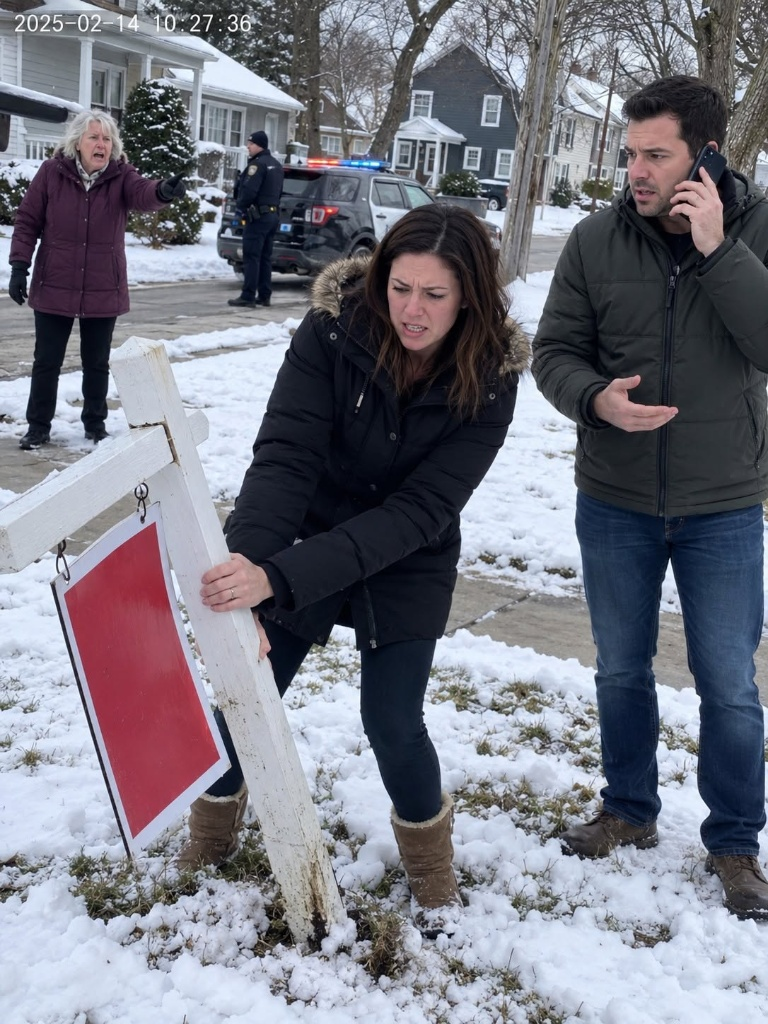
They quietly hammered the heavy wooden post into the frozen front lawn, right beside the walkway I’d shoveled a hundred times over the years. They attached the sleek red-and-white for-sale sign to the top. They didn’t knock on the door. They didn’t disturb the occupants in any way.
They simply, efficiently marked the territory.
I woke around eight in my new condo, made a cup of black coffee, and sat down at the kitchen island. I picked up my phone.
The screen was completely flooded. Fourteen missed calls from David. Twenty-two missed calls from Sarah. Dozens of text messages, growing more frantic with each one.
Mom, what is this sign in the yard?
Mom, call me back right now.
Catherine, this isn’t funny. Tell your real estate friend to remove this immediately.
Mom, people are slowing down in their cars to look at the house. Stop this.
I didn’t reply to any of it. I took a slow, deliberate sip of my coffee instead, watching steam curl up from the mug.
Around nine-fifteen, my phone buzzed with a new voicemail. I tapped the screen and held it to my ear.
It was David, and he sounded completely, thoroughly unhinged.
“Mom, pick up the phone. Sarah went outside to pull the sign out of the ground, and Mrs. Gable next door started yelling at us about destroying real estate property, and now Sarah is screaming right back at her. Mrs. Gable called the cops for a noise complaint. The police are here, Mom. They’re parked in the driveway asking for our IDs. Call me back.”
I lowered the phone slowly, something close to a laugh catching in my throat.
I hadn’t called the authorities myself. I hadn’t set any kind of legal trap for them. I had simply exercised my right to sell my own asset, and their own entitlement had caused them to self-destruct, quite publicly, on the front lawn of a house that had never actually been theirs.
I deleted the voicemail.
By noon, the police had already left my old house. They had simply told David and Sarah to keep the noise down and to stop ripping up professionally installed real estate signage. It wasn’t, in the end, any kind of police matter at all. Just an ordinary neighborhood disturbance, the kind that gets resolved with a stern word and a warning.
At one o’clock, Martha texted me: First showing scheduled for 3:00 p.m. Cash buyer.
I finally sent a single group text to both David and Sarah. The house is on the market. The first showing is at 3 p.m. today. Please ensure the property is tidy. The real estate agent has the master key. I suggest you begin looking for a new apartment. Catherine.
My phone rang immediately. I answered.
“Are you insane?” Sarah shrieked through the speaker, loud enough that I had to hold the phone slightly away from my ear. “You can’t sell this house. We just spent four thousand dollars painting it and buying furniture.”
“You spent four thousand dollars of my money, Sarah,” I corrected mildly. “You drained my property tax account to do it.”
“We are living here,” David yelled somewhere in the background. “You can’t just kick us out on Christmas.”
“I am not kicking you out,” I replied, keeping my voice perfectly level throughout. “I am selling my property, which remains entirely mine. The new owners will very likely give you a standard thirty-day notice to vacate once closing is complete. You’ll have plenty of time to pack. You already boxed up all of my things once, so I imagine you’ll have some practice by now.”
“We will not let anyone inside this house,” Sarah threatened, her voice climbing.
“Martha will be bringing the prospective buyers by regardless,” I said calmly. “If you refuse entry to my authorized agent, the next step will be a formal eviction for squatting. That particular outcome goes on your public record, and it makes renting a decent apartment considerably more difficult going forward. I leave the choice entirely to you.”
I hung up.
At three-fifteen, Martha texted me a photograph. Prospective buyers walking through the kitchen, visible in the background. David and Sarah sitting stiffly on the living room sofa, looking utterly terrified and entirely, finally powerless.
The house sold within four days. A retired couple relocating from Chicago offered cash, five percent over the asking price, apparently charmed by the modern gray walls and the stark, minimalist feel David and Sarah had so carefully, unknowingly curated for someone else’s benefit.
I met David at a coffee shop the following Tuesday afternoon, to hand over some final pieces of mail that had arrived at my new address by mistake. He looked exhausted, unshaven, the arrogant posture he’d carried just a week earlier completely gone from his shoulders.
“We found an apartment,” he mumbled, staring down into his coffee cup rather than at me. “It’s small. Out in the suburbs. We have to pay for the storage unit now too, for all the furniture we bought.”
“I see,” I said simply.
“You really didn’t have to do all this, Mom. We’re family.”
“Family respects boundaries, David. Family doesn’t steal money, take over someone’s home, and then lock the owner out of it.”
I slid a stack of envelopes across the table toward him. “I’ve paid my own storage fees for my antique furniture directly. The rest of our accounts are fully separated now.”
“Sarah is furious,” he added quietly. “She says she’s never speaking to you again.”
“That is a consequence I am fully prepared to live with,” I said, and I meant it entirely.
I smiled politely, stood up, buttoned my coat, and walked out of the coffee shop without looking back.
I didn’t feel any dramatic sense of triumph as I walked to my car. Just a quiet, profound relief, settling into my chest like something finally set right after being wrong for far too long.
I drove back to my new condo by the river. The money from the house sale cleared a month later. I invested the bulk of it quietly and securely, working with Thomas at the bank to set up something sensible for whatever years I had left.
My new space was smaller than the house I’d lived in for thirty years. But it was filled only with things I genuinely loved, and people I had actually invited into it myself. There were no more surprise guests rearranging my furniture while I was away. There was no more quiet financial bleed I hadn’t consented to.
When the sun set over the water each evening, painting the living room in warm golden light, I locked my front door with my own key, the only key that existed for it. The silence in that room, I found, wasn’t lonely at all.
It was, simply and completely, the sound of absolute peace.