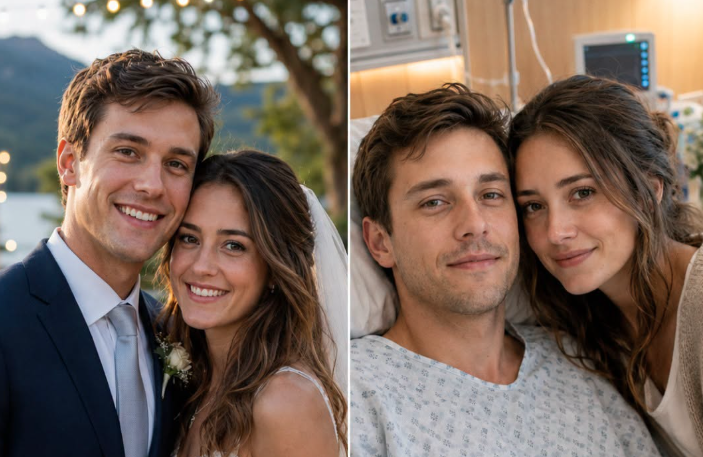
I worked nights.
I came home exhausted.
I drove my husband to chemotherapy.
I organized his medications, cooked his meals, paid the bills, and stayed beside him through the nights when he was too weak to get out of bed.
For eleven months, my entire life became about one thing:
Keeping my husband alive.
So when the doctor finally told us the words we had been praying to hear, I thought our nightmare was over.
Theo was cancer-free.
I cried.
He cried.
For the first time in nearly a year, we could breathe without wondering what terrible news would come next.
But only hours later, while we were still sitting inside the hospital finishing the paperwork, Theo looked at me and said something that broke my heart in a completely different way.
“I want a divorce.”
I honestly thought I had misheard him.
After everything we’d been through, I couldn’t understand how those could be the first words he wanted to say to me after surviving cancer.
Then he picked up his bag and walked away.
And I sat there alone.
That’s when his doctor came back.
He looked toward the hallway where Theo had disappeared.
Then he pulled a chair beside me.
His expression was serious.
“There’s something you should know.”
And what he told me forced me to rethink the entire last year of our marriage.
When Theo was diagnosed with cancer, we had already been married for eleven years.
Our lives changed almost overnight.
He had to stop working.
The medical bills began arriving.
Our savings started disappearing.
And because someone still had to keep the household running, I began taking extra night shifts.
I’d leave for work when most people were getting ready for bed.
I’d work through the night.
Then I’d come home in the morning, sleep for a few hours, and get back up to take Theo to another appointment.
I learned his medication schedule.
I prepared his meals.
I kept track of his prescriptions.
I sat beside him during treatments.
And when he was too weak to walk to the bathroom, I helped him.
Some mornings, I would sit in the driveway for several minutes after getting home because I was simply too exhausted to move.
But I never complained to Theo.
He was fighting for his life.
How could I make his burden heavier?
There were days when the doctors weren’t optimistic.
Days when we were afraid to look at test results.
Days when Theo couldn’t even sit up without help.
But every time he squeezed my hand, he would say the same thing.
“When this is over, I’ll spend the rest of my life making it up to you.”
I never wanted him to make anything up to me.
I didn’t want money.
I didn’t want gifts.
I didn’t want repayment.
I wanted my husband alive.
That was enough.
Then, finally, after months of treatment, we heard the words we’d been waiting for.
No evidence of cancer.
Cancer-free.
I covered my face and cried.
Theo was alive.
We had survived.
At least, that’s what I thought.
Dr. Kahn stepped out of the room to give us a few private minutes.
I remember smiling through my tears.
I started talking about what we should do to celebrate.
Maybe take a trip.
Maybe have dinner somewhere nice.
Maybe simply go home and sleep without an alarm for the first time in months.
Theo didn’t answer.
He was staring at the paperwork in his lap.
Then he looked at me.
“I want a divorce.”
The room suddenly felt freezing.
“What?”
“I’ve made my decision.”
That’s all he said.
No explanation.
No argument.
No warning.
Just those words.
After eleven years of marriage.
After eleven months of cancer.
After everything I had done to help him survive.
I couldn’t understand.
“Why?” I asked.
He wouldn’t answer.
He picked up his bag and walked out.
I watched the door close behind him.
And I stayed there.
Completely numb.
I don’t know how long I sat in that chair.
Then Dr. Kahn returned.
He didn’t ask where Theo had gone.
He already knew.
Instead, he pulled a chair next to mine.
Then he said:
“Theo gave me permission weeks ago to tell you something if this day ever came.”
My heart sank.
“What?”
The doctor took a breath.
“Your husband found something before his diagnosis.”
I stared at him.
“What did he find?”
An old email.
An email I had nearly forgotten existed.
Three days before Theo was diagnosed with cancer, I had scheduled a consultation with a divorce attorney.
I had never gone through with it.
I never told Theo.
But he had found the email while searching through documents during an insurance dispute.
And suddenly, everything made sense.
Our marriage had already been falling apart before cancer entered our lives.
Quietly.
Slowly.
Almost invisibly.
There hadn’t been one giant betrayal.
There wasn’t a single dramatic moment that destroyed everything.
It was years of small wounds.
Missed anniversaries.
Unanswered conversations.
Promises that kept getting postponed.
Feeling invisible beside the person I had married.
I still loved Theo.
But I had become exhausted from feeling alone inside my own marriage.
Three days before his diagnosis, I had finally reached the point where I was considering leaving.
Then we learned he had cancer.
And everything changed.
The divorce consultation disappeared into the background.
I became his caregiver.
His advocate.
His nurse.
His financial partner.
His source of strength.
But Theo had seen that email.
And he had never forgotten it.
According to Dr. Kahn, Theo had been carrying one fear throughout his treatment.
He believed I was staying because he was sick.
He was afraid that if he survived, I would feel trapped by everything I had done for him.
He didn’t want to spend the rest of his life wondering whether I had chosen him—or whether cancer had simply taken away my ability to leave.
That was why he asked for the divorce the moment he was declared cancer-free.
Not because he hated me.
Not because he had suddenly stopped caring.
But because he believed that was the first day I could finally choose him without guilt.
I wish I could say that revelation immediately fixed everything.
It didn’t.
We had spent too long hurting each other without talking about it.
I left our house and stayed with my mother for several weeks.
Theo and I began counseling separately.
For the first time, we were forced to talk about the marriage we had before cancer.
Not the marriage created by hospital rooms and medication schedules.
Not the marriage held together by fear.
The real one.
The one where we had slowly stopped seeing each other.
The one where I had become lonely.
The one where Theo had become convinced that I was already planning to leave.
Eventually, we met for dinner.
It was the same restaurant where Theo had once forgotten our anniversary.
I remembered sitting there alone that night, watching the minutes pass while my food went cold.
Now he was sitting across from me.
Healthy.
Alive.
And finally willing to talk.
Theo looked at me and admitted why he had asked for the divorce.
“I thought you deserved the chance to choose me freely,” he said.
I looked down at my hands.
Then I admitted something I had never said aloud.
During his treatment, being needed had made me feel loved again.
And somewhere along the way, I had confused the two.
Being needed wasn’t the same as being loved.
Being someone’s caregiver wasn’t the same as being someone’s partner.
And surviving something together didn’t automatically mean the marriage had been repaired.
Cancer had forced us to fight for Theo’s life.
But it hadn’t automatically taught us how to fight for our marriage.
We didn’t rush back into marriage.
We didn’t pretend the previous eleven years hadn’t happened.
We didn’t promise that love alone would magically repair everything.
Instead, we made a different decision.
We started dating again.
We continued counseling.
We talked before resentment became silence.
We learned how to ask difficult questions instead of pretending everything was fine.
And most importantly, we stopped confusing obligation with love.
Months later, I realized something that changed how I viewed that terrible day in the hospital.
When Theo said, “I want a divorce,” I thought he was throwing away everything we had survived.
But perhaps, in his own complicated way, he was trying to give both of us something we had lost long before his diagnosis.
A choice.
For nearly a year, I had been his caregiver.
He had been my patient.
Cancer had defined every conversation, every schedule, every decision.
But once the cancer was gone, we had to face the truth we’d been avoiding.
Could we still choose each other when neither of us was fighting a disease?
Could we love each other when there was no crisis forcing us to stay close?
Could we build something new instead of simply returning to what had already failed?
I still don’t know exactly what the final answer will be.
Maybe our marriage will survive.
Maybe it won’t.
But for the first time in years, whatever happens next won’t be decided by fear, illness, guilt, or obligation.
Theo is no longer my patient.
I am no longer his rescuer.
And if we choose each other again, it will be because we truly want to.
Not because we have to.
And sometimes, after everything life takes from us, the greatest proof of love is not holding on at all costs—it is giving someone the freedom to choose you again.