PART 1 — THE TRAFFIC STOP THAT BROKE MY MARRIAGE OPEN
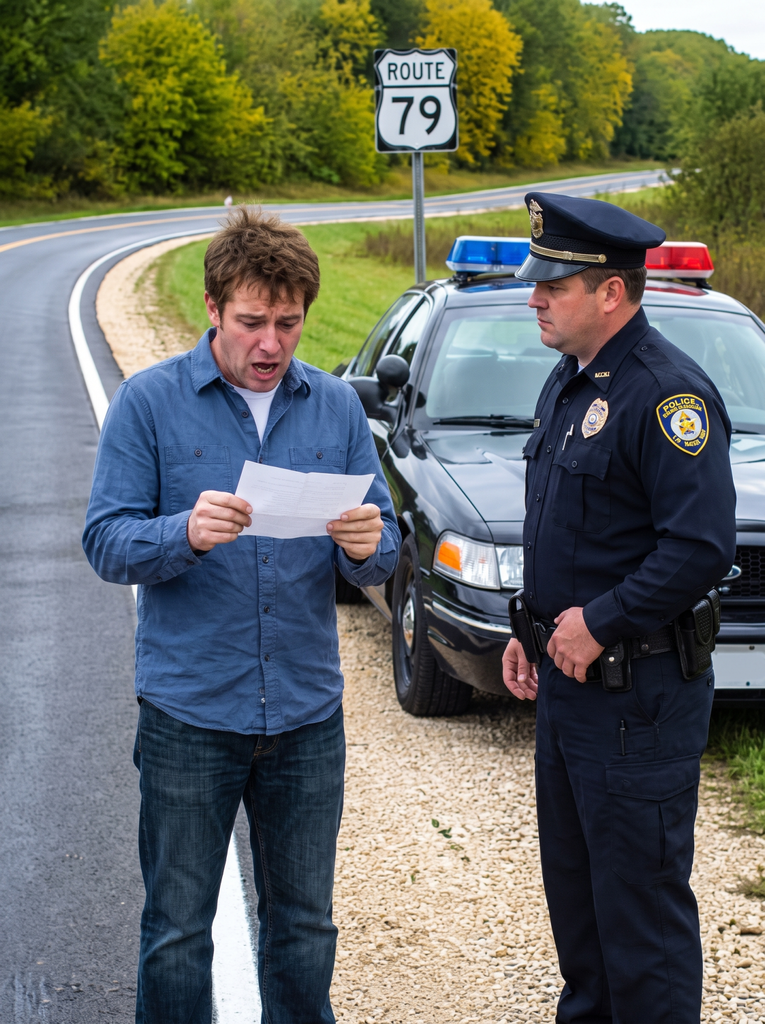
My wife Sarah and I were driving along Route 35 on a Saturday afternoon when flashing red and blue lights appeared behind us. She had been doing seventy-eight in a sixty-five while we were heading to her mother’s house in Millbrook, so neither of us thought much of it when she pulled our Honda onto the shoulder and handed the state trooper her license and registration.
The officer returned to his cruiser, and at first everything looked routine. Then I noticed him staring at his computer longer than expected, sitting straighter in his seat and checking the screen several times before finally getting out again.
Instead of approaching Sarah’s side of the car, he walked directly toward my window.
“Sir, step out of the car for a second.”
Sarah frowned when I looked at her, but neither of us questioned him. I stepped onto the hot pavement, and the officer led me behind the Honda, positioning us far enough away that Sarah couldn’t hear what he was about to say.
“Do not go home tonight. Go somewhere safe. A hotel. A friend’s house. Anywhere she doesn’t know about.”
For several seconds, I simply stared at him because nothing about that warning made sense. Five minutes earlier, my biggest concern had been whether Sarah would receive a speeding ticket; now a stranger wearing a badge was telling me I shouldn’t return home with my own wife.
“What? Why?”
His expression became even more serious.
“Listen carefully.”
“What did you find?”
He hesitated before answering, and somehow that brief pause frightened me more than anything else.
“I can’t explain it here. But it’s bad. Very bad.”
Then he pressed a folded piece of paper into my hand and told me not to open it until I was alone. Before walking away, he gave me one final warning.
“Be careful who you trust.”
I looked toward Sarah through the rear window. She was sitting calmly behind the wheel, brushing her hair behind one ear, looking exactly like the woman I had shared a home, finances, vacations, and years of ordinary married life with.
The trooper returned Sarah’s license and let us continue with a standard warning. There were no sirens following us, no arrest, and nothing that would have suggested to passing drivers that the traffic stop had just planted a terrifying question inside my marriage.
Sarah became strangely quiet after we returned to the highway. She checked the mirrors repeatedly and kept both hands tight around the steering wheel, although when I asked whether something was wrong, she gave me a small smile.
“Fine.”
I didn’t challenge her.
The folded note remained inside my pocket throughout dinner at her mother’s house. Sarah laughed at family stories, passed dishes around the table, and behaved so normally that I occasionally wondered whether I had misunderstood the officer’s warning.
But suspicion changes ordinary details. Her laughter suddenly sounded rehearsed, her warmth seemed deliberate, and behaviors I had ignored for years began returning to me with uncomfortable clarity.
That night, after Sarah fell asleep in the guest room, I quietly entered the bathroom and locked the door. Sitting on the edge of the bathtub, I finally unfolded the note beneath the light from my phone.
There were seven words.
She isn’t who she says she is.
Beneath them was a phone number and one word:
Detective.
I read the message repeatedly before returning to bed. Sarah slept peacefully beside me while I mentally reviewed the pieces of her life I had never examined closely: business trips with vague details, calls taken in other rooms, an office I had never visited, supervisors I had never met, and coworkers whose names I barely knew.
The following morning, Sarah left for what she described as a client meeting.
The moment I was alone, I called the number.
“Detective Adam Reynolds.”
I introduced myself and explained how I had received his number. After a brief silence, Reynolds asked whether Sarah was anywhere nearby.
“No.”
Then he told me the sentence that divided my life into everything before that phone call and everything after it.
“Your wife has been under surveillance for eight months.”
According to Reynolds, Sarah was a subject in a major money-laundering investigation involving shell companies, personal accounts, falsified business activity, and large movements of illicit funds. Even the pharmaceutical marketing company Sarah supposedly worked for didn’t exist.
“You’re telling me my wife used our marriage as camouflage.”
“I’m telling you she has been living two lives. And the one she showed you was useful to the one she kept hidden.”
I sat at the kitchen table staring around the home we had built together.
For years, I thought I knew the woman who lived there.
Now a detective was telling me that knowing me had simply made her other life easier to hide.
PART 2 — THE WIFE I KNEW WAS ONLY A COVER STORY
Once Detective Reynolds began asking specific questions about Sarah’s life, I realized how little I actually knew about the woman I had been married to for ten years. I had never visited her supposed office, never met her supervisor, and couldn’t name more than a few people she claimed to work with, yet I had accepted those gaps because I believed marriage didn’t require investigating the person sleeping beside you.
Her frequent business trips had always seemed reasonable for someone working in pharmaceutical marketing. Sarah regularly took calls in other rooms and became irritated whenever I asked too many questions about clients or projects, but I had interpreted that behavior as professional privacy rather than evidence that the career she described to me didn’t exist.
Reynolds stripped away those innocent explanations one by one. Sarah wasn’t a marketing executive at all; investigators believed she was moving illicit money through shell companies, personal accounts, carefully timed transfers, and fabricated paperwork for a larger criminal network.
She was apparently very good at it.
More disturbingly, my existence had helped.
A stable husband, suburban home, predictable routines, and ten-year marriage made Sarah look respectable. There was nothing obviously suspicious about us from the outside, which meant the ordinary life I considered genuine had also provided the perfect background for everything she wanted to conceal.
Then Reynolds told me something even harder to accept.
“She’s likely preparing to leave.”
“What does that mean?”
“We’ve identified duplicate financial identities, shifting funds and offshore contingencies. It looks like exit planning.”
Sarah hadn’t merely hidden another life from me. Investigators believed she had already begun preparing for the possibility of disappearing, potentially taking whatever assets she could access before I understood what was happening.
Reynolds gave me two choices. I could separate myself from the investigation and allow law enforcement to continue building its case without my involvement, or I could cooperate and help them gather evidence from inside the life Sarah believed remained completely secure.
Either option terrified me.
One required walking away while knowing almost nothing about the woman I had married. The other required returning home, behaving normally, and secretly helping investigators build a case against her.
“I’ll help.”
For the next six weeks, I lived inside the strangest version of my marriage imaginable. Every morning Sarah and I drank coffee together, discussed errands and household problems, and made plans for dinner while I carried the knowledge that the woman sitting across from me was under federal investigation.
The hardest part wasn’t gathering information.
It was pretending nothing had changed.
Under Reynolds’s direction, evidence from Sarah’s devices and conversations began revealing the scale of the deception. I heard recordings in which she discussed money movements with people connected to the investigation, while financial records showed transactions completely inconsistent with the income she had claimed throughout our marriage.
At night, Sarah sometimes climbed into bed beside me and complained about exhausting “client deadlines.” I would listen, nod, and respond exactly as I always had, even though I had already seen records suggesting those clients were another part of the fabricated professional identity she had maintained for years.
Then I found the messages that changed the betrayal from criminal to deeply personal.
Sarah had discussed me with people involved in her hidden life. She didn’t refer to me as her husband. She called me “cover.”
That single word hurt more than the shell companies or secret accounts because it gave our entire marriage a different meaning. My steady career, predictable habits, family relationships, suburban house, and complete trust in her weren’t merely parts of the life we shared; they had apparently made Sarah look exactly like the kind of person nobody would think to investigate.
I began revisiting memories I had treasured for years. Anniversary dinners, Christmas mornings, vacations, evenings spent discussing renovations, and ordinary Sundays on the couch all became harder to interpret because I could no longer determine where Sarah’s genuine feelings ended and the performance began.
Yet I couldn’t confront her.
Reynolds repeatedly warned me that revealing the investigation prematurely could jeopardize the larger case and potentially place me at risk. Sarah was connected to people investigators considered dangerous, and until arrests were ready, I needed to continue behaving like the husband she believed she had successfully deceived.
So every night, I returned home.
Sometimes Sarah kissed me. Sometimes she told me she loved me. And every time, I wondered whether those words had ever meant what I thought they did.
By the sixth week, Reynolds finally called.
“We have enough.”
The arrests would happen Saturday morning.
Sarah would be taken from our home, several other locations would be hit simultaneously, and my only responsibility was to leave before officers arrived without giving my wife any indication that her second life was about to collapse.
For six weeks, I had been pretending our marriage was still intact.
Now I had one final morning to play the role of her unsuspecting husband.
PART 3 — THE LAST MORNING OF OUR FAKE MARRIAGE
By the end of those six weeks, investigators had collected enough evidence to move against Sarah and the network around her. Detective Reynolds told me the arrests would happen simultaneously on Saturday morning, with search warrants executed at several locations so nobody would have enough warning to destroy records, move money, or disappear.
My instructions were deliberately simple. I needed to leave our house using an excuse Sarah wouldn’t question, avoid confronting her about anything I had discovered, and under no circumstances warn her about what was coming.
“Do exactly what you normally do. Then get out.”
Saturday morning arrived with an almost unbearable sense of normality. Sarah was still half asleep beneath the blankets when I dressed quietly and told her I had an early golf game, something ordinary enough that she barely opened her eyes.
“Have fun.”
I stood beside the bed for several seconds looking at her. Her hair was spread across the pillow, her face relaxed with sleep, and for one dangerous moment I felt the familiar urge to sit beside her and pretend the previous six weeks had never happened.
Then I remembered what Reynolds had shown me. The nonexistent company. The hidden accounts. The conversations about money. The plans suggesting Sarah might eventually disappear. And most of all, the messages in which the woman I called my wife had described me simply as “cover.”
I left without saying anything else.
Reynolds had arranged a secure location where I could wait while the operation unfolded. Sitting there was worse than I expected because after six weeks of actively gathering information, there was suddenly nothing left for me to do except imagine officers entering the house where Sarah and I had spent ten years pretending, at least from my perspective unknowingly, to build a future together.
The call finally came.
“Sarah’s in custody. No incident.”
I closed my eyes.
Reynolds continued explaining that seven other people had been arrested across the region. Investigators had seized computers, phones, cash, hard drives, financial ledgers, and account records, while millions of dollars connected to the network were being flagged or frozen.
I expected relief. Instead, I felt grief. Not because I wanted Sarah released, but because the arrest made something irreversible. Until that morning, some irrational part of me could still imagine discovering an explanation that would somehow restore the woman I thought I had married.
Now there was nothing left to restore.
When I returned home that afternoon, the house looked almost unchanged. The couch remained where we had left it, Sarah’s blanket was still draped over a chair, dishes sat in the kitchen, and our wedding photograph continued hanging in the hallway as though the two smiling people inside it belonged to a completely ordinary marriage.
I stood in front of that photograph longer than I should have.
Ten years earlier, I had believed the woman beside me was promising to share her life with me. Now I couldn’t stop wondering whether Sarah had already been hiding parts of herself then, or whether the deception had begun later and gradually expanded until our marriage became useful camouflage.
There was no answer that could make either possibility easier.
The divorce stretched across months because separating our finances required investigators to distinguish legitimate assets from money connected to Sarah’s criminal activity. My accounts, transactions, employment history, and communications were examined before authorities ultimately determined that I had known nothing about the laundering operation before being contacted by investigators.
Being cleared should have felt reassuring.
Instead, I felt humiliated by how completely I had trusted her.
Sarah eventually pleaded guilty and received a twelve-year federal sentence. She refused to cooperate against some of the people above her in the organization, a decision that struck me as painfully ironic because she seemed capable of showing loyalty to people involved in her hidden life while giving her husband none of the honesty our marriage required.
I never visited her. I never wrote.
There were nights when I considered asking why she had married me, whether any part of our relationship had been genuine, or when exactly I had stopped being her husband and become a useful piece of scenery in another life.
But eventually I understood that Sarah was the only person who could answer those questions, and she was also the person whose answers I could no longer trust.
That was the cruelest part. She hadn’t merely lied about her job or hidden money. She had destroyed my ability to know which memories belonged to a real marriage and which ones had been carefully constructed to make the lie believable.
The criminal case had finally exposed Sarah Williams Chen.
But I still had no idea who the woman I had loved for ten years actually was.
PART 4 — WHEN THE CRIME ENDED, THE BETRAYAL DIDN’T
After Sarah was sentenced, people assumed the hardest part must finally be over. The investigation had established that I knew nothing about her criminal activity, the divorce was completed after months of separating legitimate assets from questionable money, and Sarah would spend twelve years in federal prison, yet none of those official conclusions answered the questions that followed me home.
Friends occasionally asked whether I missed her, usually meaning the Sarah they had known. They remembered the woman who attended family dinners, remembered my sister’s birthday, planned vacations with me, rubbed my shoulders when migraines left me miserable, and fell asleep with one hand resting against my chest.
I remembered that woman too.
The problem was that I no longer knew whether she had ever existed.
There was no clean way to separate ten years of memories into genuine moments and performances. Perhaps Sarah really had cared when she comforted me after difficult days, perhaps she genuinely enjoyed our vacations and quiet evenings together, or perhaps those details were simply necessary ingredients in the respectable suburban marriage she needed other people to believe.
That uncertainty became harder to live with than the financial crime itself. Money could be traced, accounts could be frozen, documents could be examined, and prosecutors could place transactions into timelines, but there was no forensic report capable of telling me whether my wife meant it when she said she loved me.
I had given Sarah the ordinary intimacy people offer someone they trust completely. She knew my childhood stories, family history, fears, embarrassing habits, private jokes, insecurities, hopes for retirement, and all the small details that accumulate when two people share a home for a decade.
What disturbed me was realizing that those details may also have helped her make the deception more convincing. She didn’t need to invent an entirely artificial household because I had unknowingly provided her with a genuine one, and she could use my trust to make everything around her hidden life appear normal.
That was why the word “cover” continued bothering me.
The laundering operation had been the crime.
But reducing our marriage to something useful for maintaining appearances felt like the deeper personal violation.
Eventually, I moved out of the house. Staying there meant constantly encountering objects that carried memories I could no longer interpret, from the couch where we spent Sunday mornings to the hallway containing photographs of vacations that suddenly felt like evidence from someone else’s life.
My new apartment was smaller and painfully empty at first. I bought different furniture, established new routines, and learned how strange ordinary questions could become when acquaintances casually asked what had happened to my wife.
There was no comfortable answer.
“She wasn’t who I thought she was.”
That was usually enough.
Rebuilding also meant examining the assumptions that had made Sarah’s deception so easy to maintain. I had mistaken familiarity for transparency, interpreted vague answers as independence, and believed ten years together automatically proved that we knew each other deeply.
I no longer believed any of those things. Charm wasn’t character. Routine wasn’t the same as trust. And longevity couldn’t make a relationship honest if only one person was living inside it truthfully.
For a while, I worried that Sarah had permanently damaged my ability to trust anyone. Whenever someone gave an incomplete explanation or changed a minor detail in a story, part of me immediately searched for the hidden structure underneath it, because once you discover that an entire marriage contained a secret architecture, ordinary uncertainty can begin looking dangerous.
Over time, however, I realized I didn’t want Sarah’s final influence over my life to be permanent suspicion. Trusting her hadn’t been my crime, and refusing to trust anyone afterward wouldn’t recover the years she had taken.
What I needed was something more difficult than suspicion. I needed judgment. I needed to learn that trusting someone didn’t require deliberately ignoring the things that didn’t make sense.
Years later, I still sometimes thought about Officer Martinez standing beside our Honda on Route 35. Sarah had been speeding only thirteen miles above the limit, a forgettable traffic violation that should have ended with a warning and an ordinary drive to her mother’s house.
Instead, the officer checked her license, discovered something serious enough to separate me from the car, and placed a folded note into my hand.
She isn’t who she says she is.
At the time, those seven words felt like the beginning of the destruction of my marriage.
Years later, I understood them differently.
They were the beginning of my escape.
PART 5 — THE TRUTH DIDN’T DESTROY MY MARRIAGE
Years have passed since that traffic stop, yet people still occasionally ask whether I wish Officer Martinez had never pulled us over. They imagine that if Sarah had been driving a little slower that afternoon, perhaps I could have enjoyed a few more months or years without knowing what was happening behind the ordinary life we appeared to share.
I understand the question, but my answer is always no. Ignorance might have preserved the appearance of my marriage for a while longer, but it wouldn’t have made the marriage itself more genuine, and Sarah was already preparing contingencies that suggested she might eventually disappear whether I discovered the truth or not.
Sometimes I still remember the Sarah who existed inside my everyday life. I remember her rubbing my shoulders when migraines made me miserable, remembering birthdays without reminders, falling asleep beside me, and discussing future vacations, paint colors, retirement plans, and all the ordinary details couples accumulate when they assume they have decades ahead of them.
I no longer torture myself trying to decide whether every one of those moments was fake. Maybe Sarah occasionally loved me in whatever way she was capable of loving someone, or perhaps maintaining those details simply made the respectable marriage surrounding her hidden life more convincing.
Either way, I will never receive an answer I can completely trust.
That realization eventually stopped feeling like a problem I needed to solve.
I had already spent ten years believing Sarah’s explanations. I wasn’t going to spend another ten years analyzing memories in the hope of extracting one final truthful explanation from a woman whose deception had been systematic rather than accidental.
My life became smaller after the divorce, at least initially. I moved into a different apartment, created routines that belonged entirely to me, and gradually replaced the objects that carried too many complicated memories from the house Sarah and I had shared.
What surprised me was how peaceful that smaller life eventually became.
There were no unexplained business trips.
No vague client calls.
No carefully guarded laptop.
No strange gaps I had to convince myself were normal because questioning them might make me seem controlling.
I also learned an important distinction between trust and deliberate blindness. I didn’t regret trusting my wife, because a marriage in which one person constantly investigates the other isn’t the kind of relationship I would want anyway, but I regretted how often I had dismissed inconsistencies simply because accepting an innocent explanation was easier than asking another question.
That lesson followed me into every relationship afterward. Charm isn’t character. Routine isn’t trust. And spending years beside someone doesn’t automatically mean both people are sharing the same life.
I never contacted Sarah in prison. She never received a letter from me, and I never accepted the possibility of visiting because anything she said would have forced me into the same impossible question: was I finally hearing the truth, or simply another explanation designed to protect whatever mattered to her at that moment?
Eventually, I stopped needing that conversation. The person whose explanation mattered most was no longer Sarah. It was me.
I had to stop describing myself as the fool who failed to recognize his wife was living a double life. Sarah had spent years constructing that deception precisely because she wanted me not to see it, and trusting the person I married didn’t make me responsible for the choices she deliberately concealed.
I still think about Route 35 occasionally. I remember the red and blue lights reflected across our windshield, Officer Martinez approaching my window instead of Sarah’s, and the strange weight of that folded note when he pressed it into my hand.
She isn’t who she says she is.
Seven words separated two versions of my life.
Before them, I believed I had a wife, a stable marriage, and a future we were building together. After them came surveillance, arrests, divorce, financial investigations, and the painful realization that the person closest to me had been maintaining an identity I was never supposed to discover.
For a long time, I said the truth destroyed my marriage. I don’t say that anymore.
The truth didn’t destroy anything real. It exposed the lie that had been wearing my marriage’s face.
Sarah took ten years from me in the sense that I can never know how much of that decade we genuinely shared. But she didn’t get the years that came afterward.
Those years are mine.
And unlike the life I had with her, I no longer need someone else’s story to tell me whether they are real.