Part 1
“If you show up to the meeting, you’re going to embarrass our daughter in front of the entire school.”
Marcus spoke without looking at me, casually adjusting his gold cufflinks in front of the mirror. I stood a few feet away in an ivory dress I had secretly bought at a small boutique downtown. It wasn’t expensive, but for the first time in years, it made me feel like an actual woman—not just an invisible servant in my own home.
My name is Elena Sterling. I’m thirty-nine years old, and for eleven years, I believed my husband kept me away from our daughter’s school events because he was ashamed of my background. Our eight-year-old daughter, Chloe, was a third-grader at Oakridge International Academy in Greenwich, Connecticut—one of those elite private schools where armored SUVs idle in the drop-off line and parents casually discuss summer homes in Europe while private drivers carry their children’s backpacks.
“Her piano teacher requested a conference to discuss her talent,” I replied softly. “Chloe begged me to be there.”
Marcus let out a dry, condescending laugh. “You don’t speak the language of people in those rooms, Elena. You don’t understand private education, and you freeze up the moment someone asks you a real question. Stay home. I’ll handle it.”
At that moment, Chloe appeared at the doorway, her uniform immaculate, her backpack clutched tightly against her chest. She was only eight, but her eyes held a heavy, weary resignation that no child should ever carry.
“Don’t go, Mom,” she whispered. “Just… make me some soup for when I get back.”
It didn’t sound like a request. It sounded like a warning.
Marcus led her out to his car. I folded the ivory dress and put it back in the closet, trying to convince myself I was overreacting. But twenty minutes later, as I rode my scooter toward the local market, I saw his Mercedes turn down the private drive toward Oakridge Academy. He had lied to me—he told me he was sending his executive assistant.
I followed him.
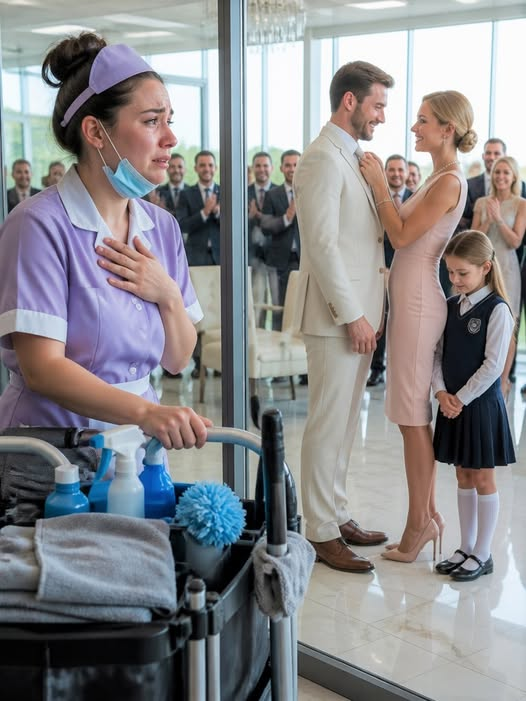
With the help of Sarah, a neighbor who worked on the school’s evening custodial crew, I slipped through the service entrance wearing a blue cleaning uniform, a face mask, and a low baseball cap. Pushing a supply cart down the quiet, polished hallway, I stopped outside the glass observation window of Chloe’s classroom.
Inside, Marcus was sitting in the front row next to Ms. Victoria Vance, Chloe’s elegant private piano instructor.
Victoria stood up, adjusted Marcus’s tie with an unmistakable, practiced intimacy, and addressed the gathered parents.
“My husband, Marcus, and I want to thank the board for supporting our sweet Chloe,” she announced with a bright smile.
The room applauded.
I felt the floor drop beneath my feet. For years, he hadn’t been hiding me out of embarrassment. He had erased me so another woman could step into my life.
Then I looked toward the back of the room. Chloe was sitting alone, her head bowed, digging her fingernails deeply into her own thigh. A dark stain began to spread across her skirt. When the meeting ended, Victoria walked past her, offered a performative smile to the other parents, and pinched Chloe’s arm so hard the little girl flinched—yet didn’t dare to cry.
I wanted to burst through the door, but Marcus grabbed Chloe by the hand and walked out toward the parking lot with Victoria at his side. Before they climbed into the car, I caught the faint sound of my daughter’s trembling voice:
“I promise I’ll be good, Dad. Please… don’t let her lock me in there again.”
I stood frozen in the service corridor, realizing that an affair was only the surface of a much darker nightmare.
Part 2
I rushed back to the house before they arrived and sat waiting in the dark. When Chloe walked in, she kept her eyes glued to the floor. I gently guided her into the bathroom under the pretense of helping her change out of her school clothes. As I unbuttoned her uniform shirt, the air left my lungs.
Her tiny body was covered in bruises—across her arms, her ribcage, and her thighs. Some were yellowing; others were fresh, deep purple marks left by adult fingers.
“Who did this to you, sweetheart?” I asked, trying desperately to keep my voice from breaking.
Chloe broke down, sobbing uncontrollably. “Ms. Victoria. When I play a wrong note, she hits me with a wooden ruler or locks me in the supply closet behind the music room. She said if I tell you, Dad will make sure you’re sent away forever.”
That night, I confronted Marcus in his study, keeping my composure as tightly as I could. He didn’t even bother to feign surprise.
“Children make things up, Elena,” he sneered dismissively. “Victoria is a demanding instructor. Don’t cause a scene, or you’ll get Chloe expelled and everyone in this town will think you’ve finally lost your mind.”
The next morning, I called a phone number given to me by a private investigator named Arthur Reyes, whose son attended the same school. Arthur confessed he had noticed Chloe’s hyper-vigilance and Victoria’s erratic, controlling behavior during school events.
Arthur began tailing Marcus. Two days later, he drove me to a gated luxury high-rise in Stamford. From the car, we watched Marcus step out of the lobby embracing Victoria. Walking alongside them was a five-year-old boy who ran toward my husband, shouting, “Daddy!”
Marcus scooped the boy up, kissed his forehead, and promised to buy him a new bicycle. He had almost never embraced Chloe like that.
Arthur handed me a folder containing a certified birth certificate. The boy, Leo, was Marcus and Victoria’s biological son. He had been born while I was hospitalized with a high-risk pregnancy years ago. Arthur also uncovered financial records showing millions of dollars transferred out of our marital estate, a penthouse purchased under a shell company, and life insurance policies where Marcus had quietly removed Chloe to list his son as the sole beneficiary.
But we still needed concrete, undeniable proof of the abuse.
I sewed a tiny digital audio recorder inside the lining of a decorative bow on Chloe’s backpack. That afternoon, Marcus dropped her off for her private piano lesson. Sitting in my car with a laptop, I listened through a live stream to every strike of the ruler, every desperate sob, and the sound of a heavy door clicking shut and locking.
“Please, Ms. Victoria… don’t hit me anymore,” Chloe cried on the recording.
Then I heard Marcus’s voice from the adjacent room. “Don’t be too rough on her, darling. Though… if that’s what it takes to teach her discipline, leave her in there for a while.”
Victoria laughed softly. A moment later, audio captured Marcus playing with their son while my daughter wept inside a locked closet.
armed with that recording, I met with the state prosecutor’s special victims unit. But Arthur warned me that Marcus had powerful legal connections in the county and that we needed explicit proof of how he had falsified medical records to hide the injuries.
Late that evening, while Marcus lay passed out after drinking heavily, I slipped into his home office. I unlocked his wall safe using his son’s birthday.
Inside lay altered medical charts, hush-money receipts paid to a private clinic, fraudulent deeds, offshore accounts, and corporate shell documents. I took high-resolution photos of every single page with my phone.
As I closed the safe door, the overhead light snapped on.
Marcus stood in the doorway, staring at my phone, his expression twisting into pure fury.
“You just signed your own death warrant, Elena.”
Before I could reach the door, he turned the deadbolt and locked us inside.
Part 3
Marcus moved toward me with a cold, methodical composure that frightened me far more than an outburst of shouting ever could. He wrenched the phone from my grip, scrolled through the photographs, and let out a dark smile.
“I always knew that sooner or later, you’d forget your place, Elena.”
I lunged toward the desk to reach the house phone, but he grabbed my wrist, twisting it painfully, and shoved me back against the heavy mahogany desk. The impact split my lip. He stared at the trickle of blood on my chin without a flicker of remorse.
“You are going to delete every single file,” he commanded, his voice deadened. “Then you will call Victoria and apologize. Tomorrow morning, you will sign a formal declaration transferring your minority shares in the firm to me and agreeing to grant me full, sole custody of Chloe. If you refuse, I will have you committed. I already have three psychologists on retainer who will swear you are unstable, violent, and severely medicated.”
I realized then that he wasn’t improvising. He had laid the groundwork for my legal erasure years ago.
“Did you prepare those fake medical reports for Chloe’s bruises too?” I choked out, wiping the blood from my mouth.
Marcus clenched his jaw. “They were just bruises. Victoria lost her patience a few times. Chloe is weak—just like you. But this entire arrangement would have worked seamlessly if you had stayed in the kitchen and kept your mouth shut.”
What he didn’t know was that the bow on Chloe’s backpack wasn’t the only device Arthur had provided. The pin on my collar contained an active audio transmitter.
Before entering his study, I had sent a pre-arranged distress signal. Arthur was parked two blocks away alongside an attorney from a domestic violence advocacy center and two state investigators authorized by the prosecutor’s office. They were listening to every word, holding the abuse recordings and the preliminary medical findings. They were simply waiting for explicit evidence of physical restraint to breach the property.
When I tried to step toward the window, Marcus grabbed me by the hair, demanding the password to my cloud storage. I pretended to break down and comply.
“It’s on the desktop in the living room,” I whimpered. “I kept the master backup there.”
He dragged me down the hallway by my arm. As we passed Chloe’s bedroom, the door clicked open. My daughter stood there in her pajamas, clutching her stuffed rabbit.
“Dad… let go of my mom.”
Marcus glared at her with absolute disgust. “Get back inside your room, Chloe.”
Chloe trembled, but she didn’t step back.
“I’m not afraid of you anymore.”
Those six words from my eight-year-old daughter changed something fundamental inside me. I wrenched my arm free from his grip and stepped directly between them. Marcus raised his hand to strike me, but before he could make contact, heavy pounding echoed from the front entryway, followed by a loud, authoritative shout:
“State Police! Open the door immediately!”
Marcus froze, his face draining of color. He bolted toward the kitchen, grabbing his car keys in a desperate attempt to flee through the rear patio. But Arthur had already anticipated the exit route; two officers intercepted Marcus at the perimeter gate, forcing him to the ground and pinning his arms behind his back.
As the handcuffs clicked around his wrists, Marcus screamed that it was all a misunderstanding—that I was a hysterical, jealous wife fabricating evidence. But state investigators swept the house, securing the open safe, the altered medical records, the financial ledgers, and taking immediate photographic evidence of my split lip and the deep bruises on my wrists.
By dawn, Chloe and I left the estate accompanied by a child protective caseworker. We took only a single suitcase, her school bag, and the ivory dress I had hidden away in my closet. I packed it because I finally understood that the dress had never been the problem—the problem was the man who needed to keep me small so he could control my entire existence.
We were placed in a secure transitional residence in Hartford. Chloe was examined by pediatric specialists, whose official report confirmed chronic soft-tissue trauma, severe anxiety, and signs of prolonged psychological confinement. The staff child psychologist explained that Chloe had developed self-soothing physical habits to cope with the terror of her environment.
Hearing those clinical terms broke my heart into pieces.
For years, I had interpreted her silence as simple childhood shyness. I hadn’t realized that my little girl was silently crying out for help with every stomach ache before school, every torn notebook, and every night she begged to sleep on the floor beside my bed. The guilt weighed heavily on me, but the psychologist asked me a question that reshaped my perspective:
“Who taught you to doubt your own instincts for eleven years, Elena?”
The answer was Marcus.
He had systematically turned every doubt into proof of my inadequacy. If I asked about our finances, he called me a parasite. If I voiced an opinion about Chloe’s schooling, he called me uneducated. His strategy wasn’t just hiding evidence—it was convincing me that I lacked the intelligence to understand it.
Three days later, Victoria Vance was arrested at her luxury apartment in Stamford while attempting to pack several suitcases of jewelry and bearer bonds. Police executed a search warrant on her private studio at the school, discovering a windowless storage room fitted with an exterior latch, a heavy wooden ruler bearing trace physical evidence, and unprescribed sedatives.
The most horrific discovery was that Chloe was not her first victim. Once the indictment was made public, four other families from Oakridge Academy stepped forward to report severe physical discipline, confinement, and emotional abuse during private lessons. Several parents had raised concerns in the past, but Victoria had assured them the children were lying to avoid practicing. Marcus had used his position as head of the school’s board of trustees to bury complaints and offer tuition waivers in exchange for non-disclosure agreements.
The academy issued a public statement claiming total ignorance. However, state investigators recovered archived emails proving the headmaster had received multiple red flags and chose to shelve them because Marcus was the institution’s primary benefactor. The state department of education launched a full inquiry, forcing the headmaster’s immediate resignation.
As the financial investigation unfolded, state forensic accountants revealed a massive network of fraudulent contracts, shell companies, and tax evasion schemes. Marcus hadn’t just siphoned money from our personal accounts—he had defrauded corporate investors and laundered capital through Victoria’s music consulting firm.
Because I had contributed funds from an inheritance left by my parents when we launched his first firm, my name remained on thirty-five percent of the founding corporate charter. Marcus had always referred to my capital as “a small domestic loan,” but the original legal filings proved I was a founding partner.
My legal counsel immediately filed for an emergency asset freeze and receivership. The Stamford penthouse, luxury vehicles, and multiple investment portfolios were seized.
Marcus attempted to negotiate from the county correctional facility. He initially offered me a substantial monetary settlement. When that failed, he promised to cut all ties with Victoria, enter anger management, and become the father Chloe deserved. When I refused his calls, his tone turned venomous.
“You’re nothing without me, Elena,” he spat during a recorded jailhouse line. “You don’t know how to run a company. You don’t know how to survive in the real world. You’ll come crawling back.”
I hung up without saying a word.
For eleven years, I had believed that staying quiet preserved my family. I finally understood that a family that demands the suffering of a child to maintain the comfort of an adult is not a family worth preserving.
The legal proceedings spanned fourteen months. Marcus’s high-priced defense attorneys tried everything to discredit me, presenting old medical notes showing I had suffered from postpartum anxiety and hiring character witnesses to paint me as emotionally dependent. They tried to turn my vulnerability into a mental defect.
But we had irrefutable facts.
The audio recordings were authenticated by federal forensic experts. Pediatric specialists testified that Chloe’s injuries could not have resulted from accidental falls. The private clinic admitted to altering medical files in exchange for corporate retainers. A former CFO provided detailed ledgers of the shell accounts. Two former domestic staff members testified that Marcus explicitly ordered them to prevent me from attending school functions and to list Victoria as Chloe’s legal guardian on emergency forms.
The pivotal moment of the trial came from my daughter.
The judge permitted Chloe to testify via a closed-circuit video link from a private room, accompanied by her child psychologist. Chloe clearly described how Victoria struck her when she made mistakes at the piano, how she was locked in the dark closet, and how her father told her that it was all for her own good.
Then she explained why she had never told me.
“My dad told me my mom couldn’t live on her own,” Chloe whispered to the camera. “He said if I spoke up, doctors would take my mom away to a hospital, and I would have to live with Ms. Victoria forever.”
Listening to her testimony broke my heart, but it also filled me with immense pride. My daughter, whom they had called weak, possessed the courage to face her abusers and speak the absolute truth.
Victoria Vance was convicted of felony child abuse, unlawful restraint, and assault, receiving an eight-year sentence in state prison. Marcus was convicted of felony child endangerment, conspiracy, corporate fraud, and obstruction of justice, sentenced to twelve years in federal custody, and stripped of all parental rights.
Their son, Leo, was placed in the care of a maternal aunt who had no involvement in the criminal operations. I ensured that no one ever placed blame on the boy—he was simply another innocent child manipulated by toxic adults.
Slowly, Chloe and I began to rebuild our lives.
When the court authorized the liquidation of the firm’s assets, I sold my remaining equity and used the proceeds to launch a small artisanal bakery downtown. Baking had been a chore imposed on me for years; I chose to transform it into my own independent business. I hired three women who had escaped abusive domestic situations and named the establishment Brave, in honor of my daughter.
Chloe didn’t touch a piano for nearly a year, and I never pushed her. One quiet Sunday afternoon, she sat down at an old upright piano in the corner of our new living room and played a simple, delicate melody. She struck a wrong note, froze instantly, and tensed up—waiting for a punishment that would never come.
I walked over, set a hand gently on her shoulder, and said, “In this house, you can make as many mistakes as you want.”
She looked up at me, took a breath, and began to play again. This time, she smiled.
A year later, she performed at a community music recital—not at an elite academy, but at a local arts center where her instructors respected her boundaries and celebrated her progress. Before stepping onto the stage, she searched the audience until her eyes met mine.
I was wearing the ivory dress.
Chloe ran down the aisle and threw her arms around me. “You came, Mom.”
“I will always come whenever you want me here, Chloe.”
She played a short piece. It wasn’t flawless—she paused once, took a deep breath, and restarted the bar. But when she finished, the entire room stood up and applauded. I stared at her hands: her fingernails were no longer digging into her skin. They were relaxed, confident, and free.
Arthur Reyes was waiting near the lobby with a bouquet of flowers. Over the months, he had transitioned from the investigator who uncovered the truth to a steady, patient friend who supported us without ever demanding anything in return.
Sometimes people ask me why I didn’t see through Marcus’s double life sooner. I don’t lower my head anymore. I tell them that abuse doesn’t always start with a physical blow. Sometimes it begins with a condescending remark, a locked door, and a voice constantly telling you that you aren’t smart enough until you finally believe it.
They also ask what my bravest moment was—slipping into the school in disguise, opening the safe, or testifying before a panel of corporate attorneys.
For me, it was none of those. It was the night my eight-year-old daughter looked her father in the eye and said, “I’m not afraid of you anymore,” and I chose to believe in her strength rather than the man who had spent eleven years trying to break mine.
Today, our home is smaller, but the windows are open, the music is imperfect, and the laughter is genuine. We don’t have armored SUVs or luxury penthouses. We have something far more valuable—something that never existed in that mansion: total safety.
And whenever a woman walks into my bakery looking for work with her head bowed and fear in her eyes, I sit down with her, hand her a warm cup of coffee, and tell her what someone should have told me long ago:
“You aren’t crazy. You aren’t weak. And you are never, ever alone.”