Part 3
Audio files. Hundreds of them. Dated. Labeled. Organized.
Every insult.
Every threat.
Every “come here, I’m bored.”
Every sound of impact I had once learned to recognize before pain fully arrived.
The nurse standing beside my bed noticed my trembling hands. “Do you need help opening anything?” she asked gently.
I shook my head. “It’s already open.”
Dr. Ian Hayes leaned slightly closer, his eyes narrowing as I tapped the first file.
Before I could press play, Victor’s voice cut through the room.
“No one is listening to that,” he snapped. “This is ridiculous. She’s clearly—”
“Mr. Payne,” the doctor interrupted, calm but firm, “you are currently in an emergency medical setting. You will remain quiet.”
Victor’s jaw tightened. My mother’s eyes darted between all of us like she was searching for an escape route that didn’t exist.
I pressed play.
At first, it was just background noise—my old kitchen, dishes clinking, a chair scraping.
Then his voice filled the room.
“You think you deserve to sit at my table? You don’t deserve anything.”
A silence followed in the hospital room so heavy it felt like pressure on my chest.
The officer nearest the bed straightened. Another stepped closer to Victor.
I tapped the next file.
Another recording.
Then another.
Each one building a pattern too clear to deny.
Dr. Hayes didn’t look at me anymore. He looked at Victor like a diagnosis.
“This has been going on for years,” he said quietly.
Victor let out a sharp laugh, but it sounded thinner now. “Audio can be edited. This is nothing.”
That’s when I turned my phone and showed the timestamps.
Six years.
Continuous.
Unbroken.
The silence that followed wasn’t confusion anymore.
It was recognition.
One of the officers spoke into his radio, voice low. “We need a domestic violence unit and a warrant check. Now.”
Victor’s face changed. Not fear exactly—something closer to disbelief that the world was finally refusing to obey him.
My mother stepped forward suddenly, as if she could still repair reality by force.
“She did this to provoke him,” she said quickly. “If she had just behaved—”
“Mom,” I interrupted softly.
She froze.
It was the first time I had called her that in a hospital room full of witnesses.
“I didn’t provoke him,” I said. “I documented him.”
Her mouth opened, but no words came out.
Victor turned toward her sharply. “Tell them she’s lying.”
But my mother didn’t answer.
For the first time in my life, she didn’t immediately obey him.
That silence terrified him more than the police.
And that was the moment everything began to collapse.
Within an hour, the hospital room was no longer just a room—it was a scene.
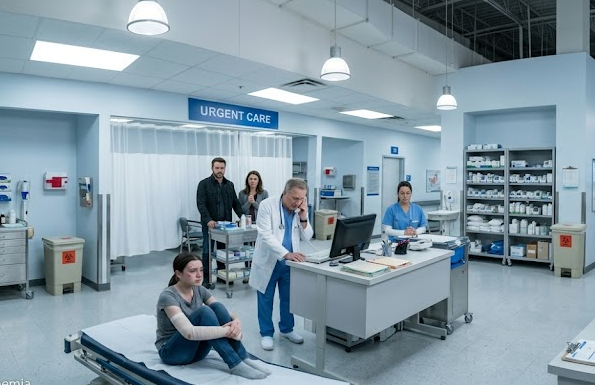
More officers arrived. A social worker stood near the doorway. A report was being filed in real time while Dr. Hayes supervised my condition and occasionally asked me simple questions like my name, my pain level, whether I felt safe.
The irony almost made me laugh.
Safe.
Victor was no longer speaking. He had shifted into something colder—watching, calculating, waiting for a gap in the situation where he could regain control.
My mother sat in a chair near the wall, hands clenched in her lap. She hadn’t looked at me in over ten minutes.
A detective stepped forward. “Mr. Payne, you are being detained pending investigation for assault and domestic abuse allegations. You will come with us.”
For the first time, Victor moved toward me.
Not the officers.
Me.
He leaned close enough that only I could hear him.
“You think this ends with me gone?” he whispered.
My pulse didn’t rise. Not anymore.
“I think it ends with you not being able to hurt anyone again,” I replied.
Something flickered in his eyes—rage, maybe, or panic disguised as rage.
Then the officers pulled him back.
As he was escorted out of the room, he didn’t struggle. That was what made it worse. He looked back once, locking eyes with my mother.
And she finally broke.
“I didn’t know what to do,” she whispered, but no one was really listening anymore.
The door closed behind him.
And for the first time in years, the air felt different.
Not safe yet.
But possible.
Part 4
Two weeks later, I was discharged.
My body still ached, but it was the kind of pain that had a direction forward instead of inward. The hospital connected me with a domestic violence advocate who helped me secure temporary housing.
Victor’s recordings were no longer just on my phone—they were part of an official investigation. Multiple neighbors came forward after hearing about the case. Patterns emerged. Stories matched. The silence around our home finally cracked open.
My mother didn’t come with me when I left the hospital.
She called once.
“I didn’t think it was that bad,” she said.
I didn’t respond for a long moment.
“You didn’t want it to be that bad,” I finally said.
She cried. I could hear it through the phone. But for the first time, I didn’t bend toward it.
“I hope you understand one day,” she whispered.
“I hope I don’t have to,” I replied.
Then I ended the call.
Months passed.
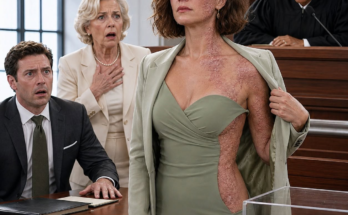
Victor’s trial began quietly, without the dramatic confidence he once carried. The recordings played in court. So did the testimonies. So did the medical reports that could no longer be explained away.
He was convicted.
When the verdict was read, I didn’t feel joy.
I felt something simpler.
Stillness.
After everything, I moved into a small apartment across town. Nothing fancy. Just quiet walls, a lock that only I controlled, and mornings that didn’t begin with fear.
Sometimes, I still wake up expecting footsteps outside my door.
But then I remember something important:
Silence is no longer something I survive.
It is something I own.
And for the first time in my life, that is enough.
For a while, life didn’t suddenly become “good.”
It became quiet in a strange, unfamiliar way—like after a storm when you’re not sure if the wind is really gone or just resting.
The first night in my new apartment, I slept on a thin mattress on the floor because I didn’t have a bed yet. No footsteps. No yelling. No “come here.”
Just silence.
And for a long time, that silence kept waking me up more than fear ever did.
A month later, I received a letter.
No return address. Just my name written in handwriting I knew too well.
My mother.
I didn’t open it immediately. I left it on the table for three days.
On the fourth day, I finally did.
Inside was only a few lines:
“I see it now. I don’t expect forgiveness. I just wanted you to know I’m leaving too. I should have left sooner. I’m sorry.”
No excuses. No explanations dressed as justification.
Just that.
I folded the letter and placed it back in the envelope. I didn’t cry. I didn’t smile either.
But something inside me loosened—not healed, not fully—but loosened.
Because for the first time, she had admitted what I had known all along:
She had seen it. She just chose not to look directly at it.
I started working again.
Not at anything big. Not a dramatic new life.
Just a small office job answering support tickets for a tech company downtown.
Simple things. Password resets. Account recoveries. Basic problems people thought were urgent but weren’t dangerous.
Strangely, I liked it.
Because nothing there could hit me.
Nothing there could scream at me.
Nothing there could turn silence into punishment.
My coworkers never asked about my past. And I never offered it.
That felt like freedom too.
One afternoon, I was leaving work when I noticed a man standing across the street.
My body reacted before my mind did.
Freeze.
Heart drop.
Breath shallow.
For half a second, I was back in that kitchen.
But then the man turned his head.
Not Victor.
Just someone waiting for a bus.
Nothing happened.
No danger.
No voice.
No control.
Just a memory trying—and failing—to become real again.
I kept walking.
Final Chapter
A year after the trial, I was asked to speak at a local support center for survivors.
I almost said no.
I didn’t want to be “a story.” I didn’t want to relive anything. I didn’t want pity dressed up as applause.
But I went anyway.
The room wasn’t big. Maybe twenty people. Some older, some younger. Some staring at the floor. Some pretending they weren’t listening.
I stood at the front holding a piece of paper I never ended up reading.
And I said something different instead.
“I used to think surviving meant waiting for someone to save me,” I said.
“But I learned something else.”
I paused.
Not because I forgot—but because I finally understood.
“Surviving is when you realize no one is coming. And you still choose to stay.”
Silence filled the room.
Not heavy this time.
Soft.
Understanding.
After I finished, no one clapped immediately. A few people just nodded. One woman wiped her eyes quickly like she was angry at them for leaking.
That was enough.
That night, I went home and sat by the window.
The city was loud in the distance, but my room stayed calm.
I thought about Victor. About my mother. About everything that had broken and everything that had somehow rebuilt itself into something livable.
And I realized something I hadn’t expected:
My life wasn’t defined by what he did anymore.
It was defined by what I refused to let continue.
I closed the window. Turned off the light.
And in the dark, for the first time, I didn’t feel like I was waiting for anything to end.
Because it already had.
And what came after… was mine.