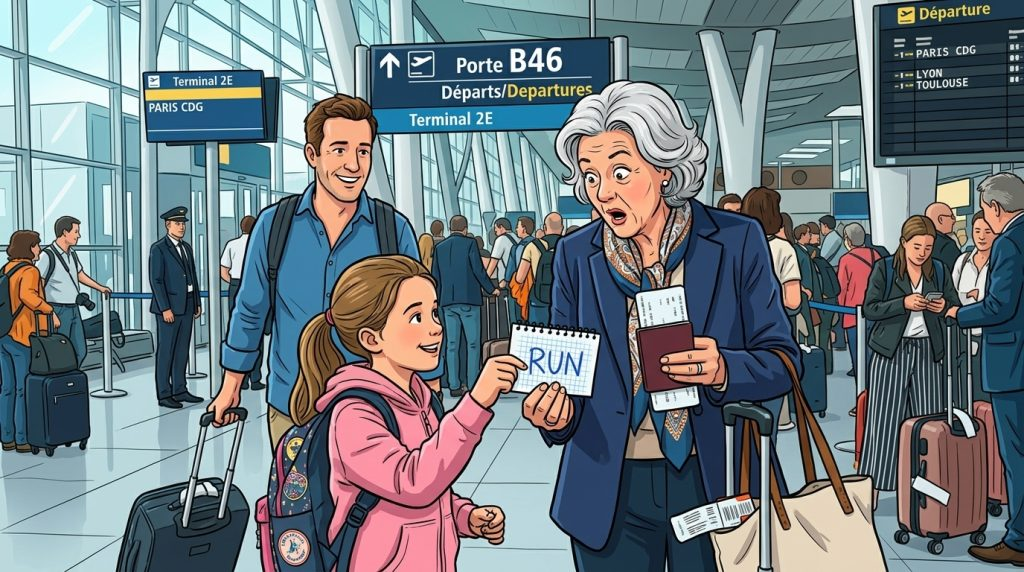
RUN. DO NOT GET ON THE PLANE. LOOK FOR THE BLACK SQUARE. I stopped under a concrete pillar and finally unfolded it properly again. The drawing was worse the second time I looked at it. A house. One window crossed out. And a black square drawn next to the entrance like a warning sign that had been erased too many times to remain clean.
PART1
One window crossed out.
And a black square drawn next to the entrance like a warning sign that had been erased too many times to remain clean.
My phone vibrated again.
Matthew.
Mom, this is ridiculous. Come back now.
Then another message, sharper.
You are embarrassing me in public.
I stared at those words.
Not fear.
Not confusion.
Something colder.
Recognition.
Because embarrassment is not what you say when someone you love is “missing.”
It’s what you say when they stop cooperating.
I looked up slowly.
The airport wasn’t the problem.
The plane wasn’t the problem.
Matthew was not even the full problem.
It was something behind him.
Something Lily was trying to point at without saying it directly.
The black square.
I typed into my phone: “JFK black square meaning.”
Nothing useful.
I tried again: “black square symbol airport NYC.”
Still nothing.
But my eyes caught something across the street.
A small transport van parked near the curb.
No markings.
Just a matte black square sticker on the rear door.
Perfect shape.
Too intentional to be random.
I stepped back slightly.
And that’s when I saw him.
A man in a gray jacket standing near the van, looking directly at me.
Not like a stranger noticing a traveler.
Like someone confirming a location.
He pressed something in his ear.
Then turned away.
PART 2
My phone rang.
Matthew.
This time, I answered.
“Mom,” he said immediately, voice controlled now, “you are making a scene. Where are you?”
“I needed air,” I said carefully.
A pause.
Then a softer tone.
“Listen to me,” he said. “You’re tired. You’re confused. That’s why I wanted to take you to France. Fresh start. Doctors. Safety.”
Safety.
The word landed wrong.
Because Lily didn’t write safety.
She wrote RUN.
“Where is Lily?” I asked.
Another pause.
Too long.
“She’s with me,” he said finally.
But I had just seen her.
Ten minutes ago.
He continued quickly, almost rehearsed.
“She’s upset you walked away. Please don’t scare her.”
My chest tightened—but I forced my voice steady.
“I just need a moment.”
“Mom,” he said, slower now, “come back to Gate 42. Everything is fine.”
And then, quieter:
“Don’t make this difficult.”
That last sentence changed everything.
Because it wasn’t concern.
It was control slipping into irritation.
I looked back toward the terminal.
And saw something I wish I hadn’t seen.
The gray-jacket man was no longer alone.
There were two more now.
They were not security.
Not airport staff.
They were positioned.
Waiting.
Like the exit was being measured.
I slowly stepped backward.
Not toward the terminal.
Away from it.
And then I turned and walked fast.
Not running.
Not yet.
Because I needed to understand something first.
If Matthew was telling the truth, I should be terrified for no reason.
But Lily’s handwriting didn’t feel like imagination.
It felt like survival.
I crossed the street into a small row of shops near the airport perimeter.
A café.
A pharmacy.
A closed travel agency.
I stopped inside the café and sat near the window without ordering anything.
My hands were shaking now.
Not from fear.
From calculation.
Because I was starting to see the shape of it.
The documents.
The sudden urgency to “move me.”
The house I sold.
The silence Lily was breaking.
And Matthew’s increasing frustration whenever I resisted.
My phone vibrated again.
A new message.
Not from Matthew.
Unknown number.
DON’T TRUST HIM. THEY ARE ALREADY INSIDE THE PLAN.
I stared at it.
Then looked up slowly.
The café window reflected the street outside.
And there he was again.
The gray jacket man.
Standing across the road.
Watching the café.
But now he wasn’t alone.
A second figure joined him.
Then a third.
All spaced apart.
All facing the same direction.
Toward me.
My breath slowed.
Because I finally understood Lily’s drawing.
The crossed-out window wasn’t random.
It was me.
And the black square wasn’t a place.
It was a system.
A network.
A containment plan disguised as care.
My phone rang again.
Matthew.
I didn’t answer.
Instead, I stood up.
Walked toward the back exit of the café.
And as I pushed the door open into the alley, I finally did the one thing Lily had been asking me to do from the very beginning.
I ran.
Not because I was lost.
But because I had finally been found.
FINAL — The Truth Behind the Black Square
The alley behind the café smelled like wet metal and old grease, the kind of place airports quietly ignore even though they depend on them.
I didn’t stop running until my lungs forced me to.
My phone kept vibrating in my pocket.
Matthew.
Unknown number.
Matthew again.
Then something new: a text with no name, just a single message.
“Good. You’re moving correctly now.”
That stopped me more than anything else.
Because it wasn’t panic.
It wasn’t confusion.
It was confirmation.
Someone was tracking the pattern, not the person.
I turned a corner and pressed myself against a brick wall, trying to steady my breathing.
Think.
Not as a mother.
Not as someone being chased.
As someone who had signed documents without reading them closely enough.
The house sale.
The “retirement plan.”
The sudden urgency to relocate me across the ocean.
France.
A country I had never even agreed to visit.
It wasn’t a trip.
It was placement.
And Lily…
Lily hadn’t been warning me about danger in general.
She had been warning me about direction.
A van door.
A symbol.
A system of coordination.
The black square wasn’t just a mark.
It was an instruction.
A designation.
A way of saying: contained asset in motion.
My stomach turned cold.
Because I had seen that same “efficiency” once before—years ago—when my husband died and Matthew suddenly took over “helping me manage everything.”
At the time, I called it care.
Now it felt like preparation.
The Call That Changed Tone
My phone rang again.
I answered.
But I didn’t speak first.
Matthew did.
And his voice was different now.
Not pretending anymore.
“Where are you?” he asked.
I stayed silent.
He exhaled sharply. “You’re not supposed to be outside the perimeter.”
That word.
Perimeter.
Not “airport.”
Not “plan.”
Perimeter.
My voice came out low. “What is going on?”
A pause.
Then, carefully:
“You weren’t supposed to get confused, Mom.”
Confused.
Not worried.
Not missing.
Confused.
Like a malfunction.
My hands tightened around the phone.
“Where is Lily?” I asked again.
This time, he didn’t hesitate.
“She’s safe. She’s with people who understand the situation.”
Something inside me went still.
“People,” I repeated.
“Yes,” he said. “Professionals. You don’t need to worry about her.”
My throat went dry.
“You separated her from me,” I said.
Another pause.
Then, almost gently:
“We needed leverage.”
That word didn’t belong in a son’s voice.
It belonged in contracts.
In negotiations.
In systems that don’t see people as people.
The Exit Door
I turned slowly and looked down the alley.
At the far end, a service door sat slightly open.
Not locked.
Waiting.
And I understood something simple and terrifying:
This wasn’t a chase.
It was containment management.
They weren’t hunting me.
They were trying to guide me back into position.
My phone buzzed again.
Unknown number:
“Exit B17 is still open. Use it.”
I stared at it.
Because now there were two paths:
- Matthew telling me to return.
- A stranger telling me where to leave.
And Lily telling me only one truth:
RUN.
I chose the door.
ENDING
Exit B17 opened into a maintenance corridor behind the airport.
No travelers.
No announcements.
Only humming lights and distant machinery.
And at the end of it—
Lily.
Standing alone.
Small.
Still.
Holding her backpack with both hands like it was the only thing anchoring her to the floor.
When she saw me, she didn’t run.
She just whispered:
“I knew you’d come out this way.”
I dropped to my knees instantly.
“Are you okay?” I asked.
She nodded quickly.
Then shook her head.
Then nodded again—like she didn’t know which answer was allowed.
Behind us, a distant door slammed.
Footsteps echoed somewhere in the corridor.
Lily grabbed my hand.
“They don’t want us together,” she said.
“Who?” I asked.
She looked up at me.
And for the first time, her voice wasn’t scared.
It was certain.
“Dad,” she said.
“And the square people.”
The footsteps got closer.
I stood up slowly.
And for the first time since leaving the airport counter…
I stopped trying to understand the system.
Because understanding it was how it kept working.
Instead, I took Lily’s hand tightly.
And I did the only thing left that wasn’t part of their plan.
We ran together.