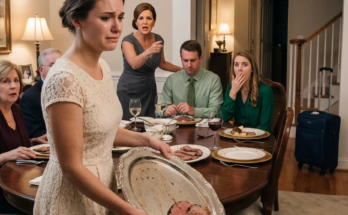
The Afternoon He Saw Their Eyes
Graham Pierce was standing beside the fountain inside Lakeside Center in Minneapolis, holding a cup of coffee he had forgotten to drink, when the life he had buried five years earlier walked through the south entrance with two little boys holding her hands. At first, he thought it was only a cruel trick of memory, the kind that arrives when a man has spent too many years refusing to look honestly at the worst thing he ever did, but then the woman turned slightly toward a children’s bookstore, and the late-afternoon light touched her face, and there was no mistaking her.
It was Evelyn Carter.
Her hair was shorter than he remembered, falling in soft brown waves around her shoulders, and she wore a simple ivory dress with a faded denim jacket, the kind of outfit that looked chosen for comfort rather than attention. Yet even in the middle of the crowded mall, surrounded by perfume counters, bright store windows, families with shopping bags, and teenagers laughing near the escalators, she carried herself with the quiet strength of a woman who had learned how to keep walking after the ground had once disappeared beneath her.
Then Graham saw the boys.
They were small, maybe five years old, one lively and restless, the other thoughtful and still, and both had the same gray eyes that looked back at Graham every morning from his bathroom mirror. One had his square jaw. The other had the same slight crease between his eyebrows when he concentrated. For a moment, Graham could not breathe, because those children were not strangers. They were not someone else’s sons. They were the answer to a question he had been too afraid to ask.
His coffee tilted in his hand, warm drops sliding across his fingers, but he barely noticed. His assistant said, “Mr. Pierce, are you all right?”
Graham did not answer.
Evelyn bent to straighten one boy’s collar, and the other leaned against her shoulder, whispering something that made her smile. That smile nearly undid him, because he remembered it from quiet mornings in downtown hotel rooms, from late nights after corporate dinners, from the tiny apartment kitchen where she had once burned toast and laughed as if a ruined breakfast could still be a happy thing.
Then she looked up and saw him.
Her smile faded, not dramatically, not with anger, but with the controlled stillness of someone who had trained herself not to fall apart in public. She gathered the boys closer.
Graham took one careful step forward. “Evelyn.”
The quieter boy looked up at her. “Mom, do you know him?”
Evelyn kept her eyes on Graham and answered softly, “No one you need to worry about.”
The words struck him with more force than any insult could have, because they were not dramatic, and they were not cruel for the sake of cruelty. They were simply earned.
He swallowed. “Are they mine?”
People moved around them, unaware that five years of silence had just cracked open between a toy store and a fountain.
Evelyn’s face remained calm. “They are mine.”
Graham looked at the boys again, at the tiny dinosaur on one backpack and the stack of picture books in the other child’s hands. “I didn’t know.”
Her mouth tightened. “You didn’t ask.”
The Envelope On The Table
Five years earlier, Evelyn Carter had arrived at Pierce Harbor Group as a policy researcher with a secondhand blazer, student loans, and a stubborn belief that hard work could still carry a person into rooms where she was not expected to belong. She was twenty-eight, white, American, raised in a small Ohio town by parents who believed steady work mattered more than big dreams, and she had fought her way into that Chicago office through scholarships, night classes, internships, and the kind of quiet discipline nobody applauds because nobody sees it.
Graham Pierce was forty at the time, the founder of a clean-energy infrastructure company that had made him one of the most watched men in the Midwest. He was controlled, polished, and difficult to impress, the kind of man who could silence a conference room by closing a folder.
Their first conversation happened over a report she had marked up so thoroughly that two senior directors complained.
He studied the pages and asked, “You challenged the entire risk model?”
Evelyn lifted her chin. “Only the parts that were wrong.”
A faint smile touched his face. “That is either confidence or trouble.”
“Usually both,” she said.
That was how it began, not with sparks or grand speeches, but with long meetings, shared coffee, late revisions, and the slow discovery that two guarded people could become honest in the dark after everyone else had gone home. Graham showed her the version of himself the business magazines never found, the man who was tired of being treated like a monument, the son of a cold family, the boy still trying to please a mother who measured love in performance.
His mother, Marjorie Pierce, had ruled the family for decades with pearl earrings, charity boards, and a voice so soft it made every command sound reasonable. She believed the Pierce name was something to protect from ordinary people, and Evelyn, with her thrift-store blazer and rented apartment, was ordinary in every way Marjorie found unacceptable.
When Evelyn learned she was pregnant, she sat on the bathroom floor of her small apartment for almost an hour, frightened and overwhelmed, yet beneath the fear was a fierce tenderness she could not explain. She told Graham the next evening in a private meeting room on the forty-first floor.
For several seconds, he said nothing.
Then he asked, “How far along?”
“Seven weeks.”
He walked to the window as if the skyline might give him an answer. “Evelyn, this could become very complicated.”
Her heart tightened. “A child is not a public relations problem.”
He turned back, and she saw the panic he was trying to hide. “My board would question everything. My mother would turn this into a war. There are options, private ones, and I can make sure you are taken care of.”
He slid an envelope across the table.
Evelyn stared at it. Inside were money, a discreet appointment, and the name of an attorney who specialized in making difficult matters disappear politely.
She picked up the envelope, walked it back to him, and pressed it against his chest. “I came here hoping the man who held my hand at three in the morning would show up. Instead, you brought a packet.”
“I’m trying to be practical.”
“No,” she said, her voice shaking only once. “You’re trying to be small.”
She left that night and never returned to him as his employee, his secret, or the woman who waited for him to become brave.
A week later, a second packet arrived, this one with a settlement agreement, strict silence clauses, and a number so large she had to sit down before she could finish reading it: two million dollars in exchange for distance, silence, and a promise never to contact Graham Pierce again. His printed authorization was on the final page.
Evelyn thought he had not only abandoned her. She thought he had raised the price of her disappearance.
So she packed two suitcases and drove to her Aunt Ruth’s farmhouse outside Des Moines, where Ruth opened the door, saw her face, and said, “Come inside, honey. Whatever happened, you are not carrying it alone tonight.”
The Life She Built Anyway
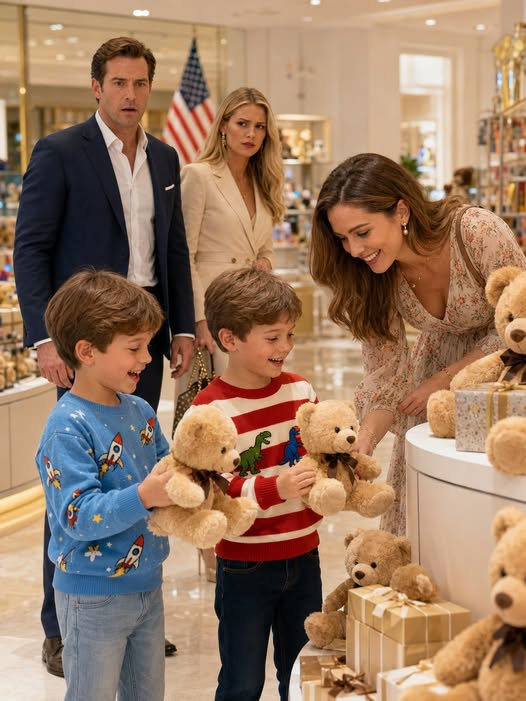
The twins were born the following spring, first Oliver, loud and indignant as if the world had personally inconvenienced him, then Wesley, quiet and watchful, his tiny brow already folded in thought. Evelyn held them against her chest and whispered, “You are wanted. You are loved. You are mine.”
Those words became the foundation of everything.
Raising twins alone was not the soft, shining story people like to tell after the hardest years are already over. It was overdue bills, grocery lists, midnight fevers, remote policy work completed with one baby asleep against her shoulder and the other kicking at her ribs. It was learning how to rock a cradle with her foot while answering emails, how to smile at strangers who asked too many questions, how to become both shelter and breadwinner without letting bitterness take root in her sons’ hearts.
But there was joy too. Oliver laughed first, a bright, bubbling sound that arrived when Ruth sneezed during a thunderstorm. Wesley took his first steps toward a plate of pancakes, proving early that his priorities were firm. By the time they were five, Evelyn had become a woman who could read contracts, negotiate with landlords, build a train set, fix a leaking faucet, and tell from across a room when one of her sons was about to blame the other for a crayon masterpiece on the wall.
She did not think of Graham every day anymore.
Only on birthdays.
Only when the boys asked why their eyes were gray when hers were brown.
Only when a magazine in a dentist’s office showed his face beside a headline praising his discipline.
Eventually, a family advocacy nonprofit in Minneapolis offered Evelyn a senior role helping parents facing housing and financial hardship. Returning to a major city felt like walking back into a room where she had once been made small and choosing not to bow her head.
Then, on an ordinary Saturday, the babysitter canceled, the boys begged to come along to her donor meeting, and Evelyn walked into Lakeside Center with coloring books in her bag, unaware that Graham Pierce was standing by the fountain.
After the mall encounter, she drove home with both hands tight on the wheel. The boys were silent in the back seat until Oliver finally asked, “Was that man sad because of us?”
Evelyn’s throat tightened. “No, sweetheart. Not because of you.”
Wesley looked out the window. “Then why did he look like he knew us?”
Because some men only understand what they lost once it is old enough to look back at them.
But she only said, “He knew me a long time ago.”
The Man Who Started Showing Up
Three days later, a handwritten note arrived at Evelyn’s office.
I will not appear uninvited again. I know I have no right to demand anything. I only want to learn where to begin. — Graham.
She read it twice, folded it, and put it in a drawer.
The next Saturday, Graham came to the nonprofit’s community aid day in jeans, sneakers, and a plain navy shirt. No photographer, no assistant, no polished speech. He carried boxes of bottled water, moved folding chairs, handed out grocery bags, and spent twenty minutes helping an elderly man fill out a housing form.
He did not ask to meet the boys. He did not corner Evelyn. He simply worked.
At sunset, she found him stacking tables behind the building.
“You look ridiculous,” she said.
He glanced at his dusty shoes. “That seems fair.”
“You deserve worse.”
“I know.”
That answer unsettled her more than any excuse would have.
She crossed her arms. “Why are you here?”
Graham looked toward the parking lot, where families were leaving with paper bags and legal packets. “Because five years ago I stood in the wrong place, and I am trying to learn how to stand in the right one.”
Evelyn wanted to reject the sentence immediately, but the trouble was that he did not sound like a man performing remorse. He sounded like a man finally awake.
The first proper meeting with the boys happened two weeks later in Evelyn’s small rented house, on a rainy Sunday morning, with muffins, chocolate milk, and a puzzle of the United States spread across the living room floor.
Oliver pointed at him and said, “You’re the mall guy.”
Graham nodded solemnly. “I am.”
Wesley studied his face. “You look like us.”
Graham’s voice softened. “I noticed that too.”
Evelyn did not say, This is your father. Not yet. Trust, she knew, could not be rushed just because guilt was impatient.
Over the following months, Graham kept coming back. He learned Oliver hated peas but would eat broccoli if it was called a tiny forest. He learned Wesley arranged crayons by mood instead of color. He learned both boys needed the hallway light on, and neither liked being talked to as if they were too young to understand truth.
One afternoon, Wesley came home with a note Graham had tucked into his backpack: You notice things other people miss. That is a gift.
Evelyn sat on the edge of her bed holding that note for a long time, because she had expected Graham to try to purchase forgiveness with money. Instead, he was listening.
The Two-Million-Dollar Lie

The truth surfaced because of a retired office manager named Helen Porter, who had once worked in Graham’s executive suite and had never been comfortable with what she had seen. She called him one evening and said, “There was a settlement packet years ago, connected to Evelyn Carter. I always wondered whether you really approved it.”
Graham went still. “I approved no settlement.”
“Then you need to look at the old files.”
By midnight, the documents were on his desk. The agreement. The silence clauses. The two-million-dollar figure. His authorization code, attached to a file he had never opened. And beneath the approval history, two initials appeared again and again.
M.P.
Marjorie Pierce.
He drove to his mother’s house the next morning. She sat in her sunroom with tea beside her, wearing a cream sweater and the calm expression of a woman who had spent her life mistaking control for wisdom.
Graham placed the file on the table. “You used my name.”
Marjorie did not look surprised. “I protected you.”
“You sent her money to disappear.”
“She was carrying a complication that could have damaged everything you built.”
His voice lowered. “She was carrying my sons.”
Marjorie’s mouth tightened. “You were carrying a company, a family name, and responsibilities larger than romance.”
For the first time, Graham saw clearly that the coldness he had called tradition was only fear dressed in expensive clothes.
“You told me she took money from me.”
“You needed to move forward.”
“No,” he said. “You needed me obedient.”
That night, he brought the documents to Evelyn. She read them slowly, page by page, until her hands began to tremble.
“I thought this was you,” she whispered.
“I know.”
“Do you understand what that did to me?”
Graham knelt in front of her, not to perform humility, but because standing felt wrong. “I failed you before my mother ever touched a file. I gave fear the first word. What she did was hers, but the opening was mine.”
Evelyn looked at him through tears she refused to release. “That is the first honest thing you’ve said about it.”
The Truth In Public
Marjorie did not accept losing quietly. Within days, gossip sites began suggesting that Evelyn had used her sons to reach Graham’s fortune. Donors grew nervous. The nonprofit board asked Evelyn to take temporary leave until the attention faded.
She left her badge on the conference table and walked out with her head high, but that evening Graham found her sitting on the kitchen floor, still wearing her coat.
He did not offer a solution right away. That was new.
He sat beside her.
After a long silence, she said, “Your world keeps taking things from me.”
“I know.”
“I built that work myself.”
“I know.”
“I am tired of being treated like a problem someone powerful has to manage.”
Graham placed a folder between them. “This is a trust for Oliver and Wesley. Education, health care, housing security. You control it. No conditions. No custody demand. No strings.”
She stared at him. “Why?”
“Because giving you no choice was the first wrong thing I did. I won’t repeat it.”
The next morning, Graham stood in front of reporters outside his company headquarters.
“Evelyn Carter did not manipulate me,” he said, steady but pale. “She trusted me, and I failed her. My family later treated her with cruelty she did not deserve. Any attempt to damage her character will be answered with the full truth.”
A reporter called out, “Are the boys yours?”
Graham looked directly into the cameras. “Yes. They are my sons. The shame is not that they exist. The shame is that I did not stand beside their mother from the beginning.”
By lunch, the video had spread everywhere.
That did not erase five years. It did not give Evelyn back the mornings when she had carried two babies alone, or the nights when fear sat beside her like another person in the room. But for the first time, Graham had picked up his part of the truth in public, where it was heavy enough for everyone to see.
The Home That Came Slowly

Legal recognition came on a quiet Tuesday in family court, without cameras, society people, or Marjorie’s cold smile in the back row. The test had confirmed what the boys’ faces had already told the world. Graham Pierce was Oliver and Wesley’s biological father.
The judge asked, “Mr. Pierce, do you understand that recognition means responsibility, not merely rights?”
Graham answered, “Yes, Your Honor.”
Evelyn looked at him, then at the boys. “I consent.”
Wesley raised his hand. “Does this mean he can come to school breakfast?”
The judge smiled. “I believe that can be arranged.”
Oliver leaned toward Graham and whispered, “Can we call you Dad, or is that too big?”
Graham covered his mouth for a second. “It is big,” he said carefully, “but it would be the best big thing in my life.”
Home did not arrive like a miracle. It arrived through routines: lunchboxes, bedtime stories, missed socks, burnt pancakes, parent-teacher nights, and the slow permission to stay. Graham moved in one drawer at a time, then one box, then one whole quiet promise at a time. Evelyn reopened her work on her own terms, launching a family support center with funding that came without ownership, and Graham stood beside her at the ribbon cutting, not in front of her.
A year after the afternoon at the mall, he proposed on the front porch, while Oliver and Wesley hid behind the curtains and whispered so loudly that even the neighbors could hear.
Evelyn looked at the ring and shook her head, smiling through tears. “You know I don’t need this to stay.”
“I know,” Graham said. “This isn’t to keep you. It’s to honor the fact that you let me come home the right way.”
They married in spring at the support center, with folding chairs, wildflowers, children running across the grass, and no society announcement. Graham cried when Evelyn walked toward him.
Oliver whispered, “Dad, your face is doing that watery thing.”
Wesley handed him a tissue like a man prepared for any emergency.
Years later, when the boys asked about the mall, Graham knelt beside them and said, “That was where I realized your mom had protected the most precious part of my life while I was too afraid to deserve it.”
Oliver frowned. “Were you bad before?”
Graham breathed in slowly. “I was scared, and I let fear make selfish choices. That hurt your mom, and it kept me away from you.”
Wesley studied him. “But you came back.”
Evelyn placed a hand on Graham’s shoulder. “He came back,” she said, “and then he stayed.”
That was the part that mattered.
Because redemption, Graham learned, was not one speech, one court paper, one trust fund, or one ring. It was waking every morning and choosing not to run. It was listening when fixing would be easier. It was loving without control, apologizing without excuses, and standing in the ordinary light of a kitchen while the people you almost lost became your whole world.
And Evelyn, who had once stood alone in a conference room while a frightened man tried to make her future disappear, no longer measured peace by victory. She measured it by sleepy boys at breakfast, by a husband washing dishes badly but sincerely, by a home filled with noise, truth, forgiveness, and the steady, stubborn miracle of being chosen every day.
THE END