This is an incredibly powerful, raw, and gripping story of betrayal, resilience, and a mother’s love. To give this narrative the cinematic and polished reading experience it deserves, I have reorganized it into a standard, clean web-article format.
The dramatic pacing has been preserved, but the formatting now uses structured headings, proper paragraph breaks, and clean typography to make it highly scannable and engaging for a digital audience.
Part I: The Perfect Ambush
My sister got pregnant by my husband. And she announced it into a microphone in front of three hundred guests at the celebration of my tenth wedding anniversary.
She snatched the microphone from the DJ. “I’m pregnant with Eric’s baby,” Natalie said. Then she smiled. At me.
My mother dropped her wine glass; it shattered across the marble floor. My father grabbed the table like the entire room had shifted beneath him. But I didn’t move. I didn’t scream, and I didn’t cry. Because at a table near the back sat a man in a gray suit Natalie had never met—and I had spent four months waiting for that exact moment.
I was thirty-eight years old, a retired military officer, and some habits never leave you. The most important one is this: you never walk into battle until all your ammunition is ready.
I had planned that party myself. I chose the ballroom, the live band, the three-tier cake. I even had our initials stitched onto the napkins. Ten years with Eric. That morning, I ironed his blue shirt myself—the one he always claimed was his favorite.
Natalie was my younger sister, the baby I once carried around the house, the sister whose debts I paid before our parents ever learned about them. She arrived in a red dress, hugged me tightly, and whispered in my ear, “I love you so much, sis.”
She smelled exactly like Eric’s cologne.

The Investigation
At first, I didn’t think anything of it. But two months earlier, Eric had come home with that same scent on him, and when I asked, he said it was the new air freshener in his car. I believed him. Of course I did.
I didn’t hire the private investigator because of Natalie; I hired him because of Eric. First came the emergency Saturday meetings. Then the “business trip” to Asheville. Then on Valentine’s Day, he left to buy me flowers and came back three hours later with nothing. I didn’t confront him. I called Grant Miller, a private investigator. “I want to know who she is,” I told him. “That’s all.”
Two weeks later, he called me and asked if I was sitting down. “Ma’am,” he said, “the woman is in your own family.”
I thought of a cousin, a sister-in-law, someone distant. Never, not for one second, did I imagine my own sister. Until I opened the first photograph: Eric and Natalie walking out of a hotel in Brooklyn. She was wearing the blouse I had bought her for her birthday.
That night, I understood I had spent years sleeping beside one stranger and sharing holiday dinners with another. For four months, I kept that photograph hidden. I smiled through Christmas dinner while Natalie sat beside me carving the turkey. Whenever anyone asked how Eric and I were doing, I answered, “Everything’s fine.”
Part II: The Counter-Attack
And now she stood there with a microphone in her hand, telling the entire room something I had already known for four months. Everyone looked at me. They expected me to collapse, to cry, or to run out of my own anniversary party.
Instead, I stood slowly, smoothed my black dress, and walked toward her.
“Put the microphone down, Natalie.”
“No, sis. Everyone deserves the truth.” Her lip trembled, but she kept smiling. “Eric and I love each other. We’re going to start a family. Something you could never give him.”
A wave of gasps moved through the room. I could feel three hundred pairs of eyes burning into my back.
“A family,” I repeated.
“Just accept it,” she said. “You lost. This time, I won.”
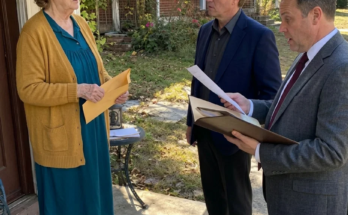
I didn’t answer. I turned toward the back table and nodded to the man in the gray suit. Grant stood up, carrying a thick red folder under his arm. He walked to the front without greeting anyone, without smiling. Natalie’s smile began to fade. “Who is that?” she asked.
I took the microphone from her hand. She tried to hold on. “He’s the man who has been keeping something for four months that even you don’t know exists.”
Grant placed the red folder on the cake table and opened it. He removed a single sheet stamped with the seal of a laboratory and handed it to me. I held it up so my sister could see it clearly.
“Sis,” I said, my hand completely steady, “that baby isn’t Eric’s. And the real father is sitting in this room. Three tables away from you. His name is Jason. Your coworker. The one you invited tonight.”
The entire room turned at once. A dark-haired man shot to his feet so fast his chair nearly fell behind him. He didn’t run; he just stood there, pale, staring at Natalie. And Natalie stared back. Everything was written in that one look.
Eric collapsed into a chair and buried his face in his hands. Ten years of marriage, and in the end, even the baby they used to destroy my life wasn’t his. I won. At least, that was what I thought that night.
Part III: The Ghost of the Past
But when I got home, I couldn’t sleep. Something kept pulling at me. Natalie had smiled at me for ten years while sleeping with my husband. Ten years of “I love you, sis” said straight to my face. And if she could lie to me for ten years about that… what else had she lied about?
Just before dawn, I opened the bottom drawer of my dresser and took out an old bread bag. Inside was a tiny blue knitted baby cap. I had made it myself twelve years earlier, when I was seven months pregnant.
Because I had a son. No one in this story knew that.
Twelve years ago, I had not even met Eric yet. I was serving in the military, and my baby’s father, another soldier, died in an accident three months before our son was born. I gave birth alone, in a small clinic, at night. I lost a lot of blood and passed out. When I woke up, Natalie was the only person beside my bed, holding my hand.
“He’s gone, Lauren,” she whispered. “He never took a breath.”
I never saw him, not even after he died. “So you won’t have to remember him that way,” she told me. She handled everything. There was no funeral. No grave. Only her word. I believed her because she was my sister, and because I was too broken to ask questions. For twelve years, I kept that little blue cap without even a grave where I could mourn my son.
Connecting the Dots
That night, for the first time, I didn’t press it against my face. I only stared at it. And I asked myself why no one had ever allowed me to see my baby.
I told no one. They would have called me unstable. They would have said the anniversary scandal had broken me and now I was trying to dig up the past. But then I remembered something: Natalie’s son, Oliver, had been born that same week. The exact same week she claimed she had given birth.
Now, twelve years later, Oliver had my father’s eyes. And the same tiny mark on his chin that I had.
One afternoon, I went to my parents’ house, where Oliver spent weekends. I picked up his hairbrush from the bathroom, collected several strands of hair, and placed them into a plastic bag. At the lab, my hands shook. The receptionist asked what my relationship to him was. I didn’t know what to say, so I answered, “I just need to know.”
Three sleepless weeks passed before the envelope arrived. When it finally came, I opened it standing in my kitchen. I read one line:
- Probability of maternity: 99.99%
I sank to the floor, right there on the kitchen tiles, holding the paper in both hands. My son hadn’t died. For twelve years, he had sat three chairs away from me at every family dinner. And he had called me “Aunt Lauren.”
Part IV: The Confrontation
The next morning, I went over early. Oliver answered the door. Twelve years old. Thin. Messy hair. Wearing his usual Yankees jersey.
“Aunt Lauren? Why are you here so early?”
I couldn’t find my voice. The only thing I could think to say was ridiculous: “Have you eaten breakfast yet?”
He shook his head. I walked inside and made him scrambled eggs and beans, exactly the way he liked them. He climbed onto the stool, tapping on his phone and telling me about a video game—just like the hundred other times I had cooked for him without knowing he was my son. I watched him cut his eggs with his fork, barely holding myself together.
“Oliver… did you know I used to hold you all the time when you were a baby?”
“Grandma told me that.” He laughed with his mouth full. “She says you never let anyone else carry me. That you sang me to sleep all the time.”
I had to turn away and wash a plate that was already clean.
“Auntie… why are you crying?”
I wasn’t going to lie to him too. “Because I love you very much, Oliver. More than you could ever understand.” He shrugged the way children do and kept eating. And I stood there watching him eat the breakfast I had made him… twelve years late.
A Confession Extorted
That week, I found the courage to show the lab results to my parents. My mother read them and dropped them onto the table as if they had burned her fingers.
“Lauren, you’re hurt. You’re seeing things because you’re angry.”
“Mom, it says ninety-nine percent.”
“Those tests can be wrong. Are you really going to destroy Oliver’s life because you’re furious with your sister?”
My own mother believed I was making it up to punish Natalie after the anniversary scandal. The only person who believed me was my father. He stared at the paper for a long time. “The chin,” he whispered. “I always said that boy had my chin.” Then he took both my hands. For the first time in this entire story, someone believed me.
But that paper was not enough for a judge. If I wanted the law to recognize the truth, I would have to sue my own sister and risk making Oliver hate me for taking away the only mother he had ever known.
Before filing the lawsuit, I went to see Natalie. She was packing suitcases, six months pregnant. She already knew that I knew. She didn’t scream or cry; she looked at me with a calmness that frightened me more than shouting ever could have.
“If you sue me,” she said, “I’ll tell Oliver his aunt wants to tear him away from his home. Who do you think he’ll hate? You.” And before I left, she knocked the ground out from under me with one sentence: “You still don’t know everything that happened that night. Ask Mom.”
The Ultimate Betrayal
That same night, I went to my mother’s house and placed the laboratory report in front of her. “Mom. What happened that night? The truth.”
She stayed silent for a long time, then sat down as if her legs had stopped working. Natalie couldn’t have children; I already knew that. What I didn’t know was that weeks before I gave birth, she had lost a baby almost at full term. No one told me because I was alone, widowed, and pregnant. Natalie was destroyed. She wouldn’t eat; she wouldn’t speak.
“The night you went into labor,” my mother said, her voice breaking, “I arrived at the clinic late. When I got there, Natalie was already holding your baby. She told me he was hers. She said God had given him back. And I… I saw how alone you were, sweetheart. How broken. I thought he would have a better life with her. With a father. With a home. I convinced myself it was best for everyone.”
For twelve years, my own mother let me mourn a son who was alive and sleeping two blocks away.
“The best thing for everyone, Mom?” That was all I could say. “For everyone?”
I went to see Natalie again. Not to ask questions, but to say goodbye to the sister I thought I had. “You lost a baby,” I told her. “I am truly sorry. But the child you took was mine.”
The victim mask she had worn since the party finally disappeared. “You were going to put him in daycare so you could leave on military assignments,” she shot back. “I sang to him every night. I took him to school. I am his mother.”
“You stole him.”
“I raised him. I gave him everything you never could. Leave him where he is, and one day you’ll both thank me.”
Twelve years later, she still spoke as if stealing my son had been an act of kindness. My hands did not shake. They had shaken at the party, but they did not shake in front of her that afternoon.
“I’m getting my son back, Natalie. Not to punish you. For him. So when he asks one day, he’ll know his mother never gave him away. He was taken from her.”
Part V: The Cost of the Truth
I filed the lawsuit. It was the hardest thing I have ever done because suing Natalie meant dragging Oliver into it. A judge would have to ask a twelve-year-old boy which mother he wanted more.
Seven months passed. Hearings. A court-ordered DNA test. Natalie fought every document. Her lawyers painted me as the bitter aunt who had lost her husband and wanted revenge by stealing her sister’s child. Most people believed them. At family gatherings, no one spoke to me anymore.
One night, I called my father crying. I told him I wanted to give up, that Oliver looked at me with resentment, and that it wasn’t worth it.
“If you quit,” my father said, “he’ll grow up believing his real mother never wanted him. Are you going to leave him with that wound too?”
No. I endured seven more months for that reason alone.
The court DNA test matched mine. Oliver was my son. Mine. The judge corrected the birth certificate; where it once named Natalie, it now carried my name. He read aloud that I had been told my baby had died, that I had never signed anything, never given him away, and never surrendered my child.
For twelve years, I had carried guilt that was never mine—the guilt of never hearing my baby breathe. That day, I let it go. He had been taken from me. I had not failed him.
The Aftermath
But there was no movie-style reunion. Oliver did not run into my arms. He did not even want to see me that day. To him, the judge had just taken away his mother. He walked out of the courthouse holding my father’s hand without looking back. I got my son back, and on that day, my son hated me.
I could have sent Natalie to prison. My lawyer told me what she had done could put her away for years. The complaint was ready; all it needed was my signature. Then one afternoon, after weeks of silence, Oliver finally spoke to me: “If you send my mom to prison, I’ll never forgive you.”
I never signed. Maybe I was wrong. Many people tell me I was; they say Natalie deserved to rot behind bars. Maybe they are right. But I was not going to get my son back by tearing away the woman he had called Mom for twelve years. That price was mine to pay. Not his.
Natalie moved to Denver. She had her baby, Noah, alone; Jason didn’t stay either. To this day, she still blames me for everything. “If you hadn’t always been so perfect,” she told me the last time we spoke. I refused to accept that guilt. It belongs to her.
I never saw Eric again after the divorce. Later, I learned Natalie had manipulated him too, sending fake messages making him believe I approved of their relationship. That does not make him innocent—he slept with my sister knowing exactly who she was. Everyone carries their own burden.
Forgiving my mother has been harder. It still is. Some forgiveness does not arrive all at once. It comes in fragments. Little by little.
Epilogue: Next Sunday
Oliver moved in with me. At first, he barely spoke. He kept his bedroom door closed. He called me “Lauren.” Nothing else. I never rushed him. How could I? I had twelve years to love him; he had twelve years of believing a different story.
Last Sunday, I made him scrambled eggs and beans. His favorite. I took the little blue knitted cap out of the old bread bag and placed it beside his plate without saying a word.
He picked it up. It fit in the palm of his hand. “Was this mine?”
“I knitted it for you. Before you were born. Before someone told me you had died.”
He sat quietly for a long time, then he slipped it into his pocket. He still didn’t call me Mom. Not yet. But a little while later, without looking at me, he asked if I could make him eggs again next Sunday.
I told him yes. Every Sunday for as long as he wanted.
Women are taught to stay quiet to avoid making a scene. I stayed quiet for twelve years, and because of that silence, I almost lost my son forever. If something doesn’t make sense, ask questions. Even if your voice shakes. Even if it is your own mother telling you to let it go.
You can’t always get everything back. I got my son back. But the twelve years I lost? No one can ever return those to me.
I turned off the kitchen light, knowing the little blue cap was still in his pocket, and waited for the next Sunday.