The phone did not ring. It screamed.
At exactly 5:03 on a Tuesday morning, the sound ripped through the darkness of my bedroom like a warning from another world. I shot upright, my heart pounding so hard it felt like it might crack my ribs. No good news comes before sunrise.
I grabbed blindly for my phone and knocked a glass of water off the nightstand. The screen lit up with two words that made my stomach drop.
Unknown Number.
“Hello?” I answered, my voice thick with sleep and fear.
“Is this Anna Brooks?” a man asked. His tone was controlled, official, but urgent enough to turn my blood cold.
“Yes. Who is this?”
“This is Officer Grant with the County Sheriff’s Department. I need you to come to the bus stop at the corner of Parker Road and Highway 17. Immediately.”
My body was already moving before my mind caught up. I threw on jeans with shaking hands. “Why? Is it Emma? Is it my daughter?”
“Just come, ma’am. Drive carefully. The roads are dangerous.”
The drive was a blur of rain, panic, and headlights smeared across wet asphalt. My old Ford truck slipped twice on the road, but I kept going. All I could think about was Emma.
My beautiful twenty-four-year-old daughter had married into the Whitmore family three years earlier. The Whitmores were the kind of old-money people who owned half the state and behaved as if they owned the souls inside it too. I had never trusted them. I hated the way Carter Whitmore looked at Emma, like she was a decorative object instead of a person. I hated his mother, Victoria, who treated my daughter like dirt on an expensive rug.
But Emma loved him. Or maybe she had simply been taught to fear the cost of leaving.
And now she was five months pregnant.
When I saw the red and blue lights flashing through the rain, I slammed on the brakes. The bus stop was a lonely concrete slab with a rusted shelter, miles from any neighborhood. It was the kind of place people forgot existed.
I jumped from the truck, leaving the engine running.
“Ma’am, stay back!” an officer shouted.
I pushed past him.
Then I saw her.
Emma was curled on the muddy concrete, her hands protectively covering her pregnant belly. Her blonde hair was tangled with rain and mud. Her face was swollen and bruised beyond recognition. One eye was completely shut. She wore only a thin, torn nightgown soaked through by the storm.
“Emma!” I dropped to my knees beside her.
Her one open eye fluttered. For a second, she didn’t know me. She flinched, raising one arm as if expecting another blow.
“It’s me, baby. It’s Mom,” I sobbed. “Who did this to you?”
Her lips trembled.
“The silver,” she whispered.
“What?”
“I didn’t polish the tea set right,” she gasped. “Victoria held me down. Carter hurt me. I begged them to stop. I told them about the baby.”
The world disappeared.
The rain, the sirens, the shouting—all of it became a distant roar.
They had done this to my daughter over a silver tea set. Then instead of calling for help, they had left her on the side of the road in the freezing rain.
“Paramedics!” I screamed. “She’s pregnant! Help her!”
The medics rushed in. As they lifted Emma onto the stretcher, her hand slipped from my wrist. Her eyes rolled back.
“She’s crashing!” one medic shouted. “Move, now!”
The ambulance doors slammed shut, and the siren rose into the storm.
For a full minute, I stood in the rain staring at the mud on my hands. Something inside me changed. Something soft withered, and something cold took its place.
Then my phone vibrated.
“Anna Brooks?” a hospital voice said. “Get to St. Catherine’s immediately. We’re losing them both.”
The waiting room at St. Catherine’s was a cold, sterile nightmare of fluorescent lights and antiseptic. I paced the floor for hours, my muddy boots leaving faint tracks behind me. I didn’t wash my hands. I needed to remember exactly where I had found my child.
Three hours later, Dr. Reed came through the surgical doors. His face told me everything before he spoke.
“Anna,” he said gently.
“Tell me.”
“She’s in a deep coma. The head trauma is severe. There is dangerous swelling in the brain. She has internal bleeding, a ruptured spleen, and broken ribs.”
“And the baby?” I asked.
His eyes lowered.
“The placenta was damaged by the trauma. The heartbeat is still there, but very weak. I need to be honest. Emma’s neurological condition is catastrophic. Even if her body survives, we don’t know what she will wake up to. And the pregnancy may not survive this. You should prepare yourself.”
Prepare myself.
A polite way of saying goodbye.
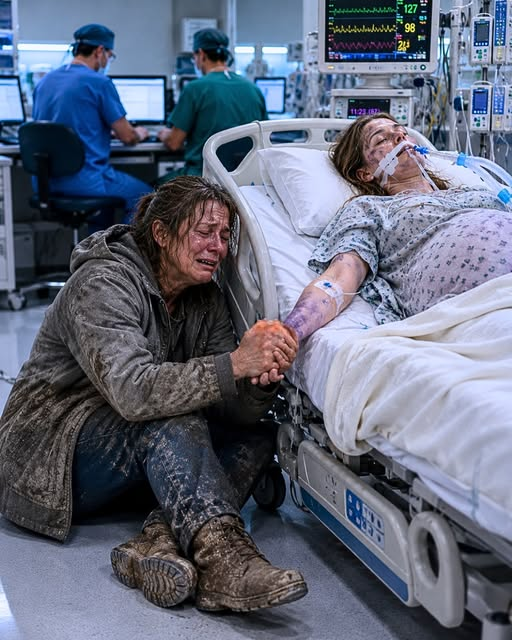
I went into the ICU.
Emma lay beneath tubes, bandages, and machines. She looked impossibly small. I sat beside her and took the only hand not wrapped in gauze.
“I remember when you were seven,” I whispered. “You fell off your bike and scraped your knee. I put a butterfly bandage on it, kissed it, and bought you chocolate ice cream. You were better by dinner.”
Tears fell onto the bed rail.
“I can’t kiss this better, baby. I can’t fix this.”
I sat there for an hour, listening to the machines breathe for her.
Then I thought of the Whitmore estate. Warm rooms. Soft lights. Gas fireplaces. Carter probably sleeping in luxury. Victoria probably drinking tea from the same silver service that had started this horror.
They were not in jail. Not yet. The officers were still “gathering statements.” The Whitmores had lawyers, judges, money, and friends in places ordinary people could never reach.
They would turn this into an accident. A fall. A breakdown. A tragedy with no villain.
They would sleep peacefully while my daughter and grandchild fought to live.
I gripped the hospital chair so hard the plastic cracked beneath my hand.
“I won’t let them live comfortably while you die,” I whispered.
I left the hospital.
I did not drive to the police station. I drove to the construction site where I worked as a senior site manager. I opened the supply shed and took what I thought I needed to make the Whitmore estate burn the way my world had burned.
By late afternoon, I was outside their mansion.
The sky was dark purple with storm clouds. The house glowed with warm golden light. Through the glass doors, I saw Carter sitting on the sofa with a drink in his hand, watching television like nothing had happened. Victoria walked into the room, said something to him, and he laughed.
That laugh almost ended everything.
I stood on their manicured lawn with a match in my hand and revenge screaming through my body. One small movement, and their perfect world would go up in flames.
Then my phone buzzed.
I ignored it.
It buzzed again.
And again.
I looked down.
Dr. Reed.
My heart stopped.
I answered with a broken whisper. “Is she gone?”
“No,” he said quickly. “Anna, listen to me. She’s awake.”
The world tilted.
“What?”
“She opened her eyes. Her vitals stabilized. She squeezed the nurse’s hand. She’s asking for you. And the baby’s heartbeat is stronger. It’s fragile, but they’re fighting. You need to come back right now.”
I dropped to my knees in the wet grass.
Emma was awake.
The baby was alive.
And I suddenly saw the truth clearly. If I chose revenge that night, Emma would wake up alone. She would face the Whitmores, their lawyers, her trauma, and her pregnancy without me.
I let the match die in the grass.
“I’m coming,” I sobbed. “Tell her Mom is coming.”
I drove away from the mansion.
I did not burn their world down that night.
Not with fire.
Instead, I called the most ruthless civil rights attorney in the state.
Fire is fast. But the law, when sharpened correctly, can destroy much more completely.
When I returned to the ICU, Emma’s eyes found mine instantly. Her jaw was wired, and she could barely move, but she knew me. I held her hand and promised her she was safe. I promised the baby was safe. I promised I would never leave her again.
An hour later, Detective Grant entered quietly.
“Mrs. Brooks,” he said, “the doctor says she can communicate?”
I looked at Emma. “Can you tell him, baby?”
She nodded weakly.
The nurse handed her a whiteboard. With shaking hands, Emma wrote:
CARTER. VICTORIA. GOLF CLUB.
Then, after a painful pause, she wrote one more line.
THEY SAID THE BABY WAS A MISTAKE.
I handed the board to the detective.
“I want them arrested,” I said. “All of it. Assault. Kidnapping. Attempted murder. Conspiracy.”
Detective Grant looked at the board, his jaw tight.
“I have enough for a warrant,” he said. “More than enough.”
Two days later, at six in the morning, I parked at the end of the Whitmore driveway with a cup of black coffee in my hand.
This time, I did not hide.
I watched armored police vehicles roar through their iron gates. Officers surrounded the grand front porch.
“Police! Search warrant!”
The doors were forced open.
A few minutes later, Carter was dragged outside in silk pajamas, crying and pleading. He saw me by my truck and shouted something about a misunderstanding.
I only stared at him.
Then Victoria came out, screaming about lawyers, politicians, and her rights. No one cared. She was placed in the back of a cruiser like anyone else.
For the first time, they looked ordinary.
Not untouchable.
Just guilty.
My attorney moved fast. While Carter and Victoria sat in jail without bail, she filed a civil suit and secured an emergency order freezing the Whitmore family’s liquid assets.
Their accounts were frozen.
Their investments were frozen.
The house was locked in litigation.
They could not hire the legal army they expected. Their credit cards stopped working. Their expensive protection cracked.
Six months later, the criminal trial was brutal.
The photos of Emma at the bus stop were shown to the jury in silence. No amount of money could soften what they had done.
The judge looked down at Carter with disgust.
“You treated your wife and unborn child like garbage,” she said. “Now the state will decide what to do with you.”
Guilty on all counts.
Carter received thirty years in prison. Victoria received twenty years for conspiracy and aiding the attack.
As Carter was led away, he looked back at me and mouthed, Please.
I did not smile.
I mouthed back two words.
Bus stop.
Beside me, Emma squeezed my hand.
One year later, autumn returned.
I sat on the front porch of my little house, drinking tea as red and gold leaves moved in the wind.
A car pulled into the driveway. Emma stepped out carefully, using a sleek black cane. Her leg would never fully heal, and a thin scar remained along her jaw. But she was smiling.
Against her chest, in a baby carrier, slept my six-month-old grandson, Noah.
Emma walked up the path, holding a thick envelope.
“I got it,” she said, smiling.
“The acceptance letter?”
“Nursing school,” she said proudly. “I start in January. I want to work in trauma ICU. I want to hold the hands of people who can’t speak for themselves.”
I stood and hugged my daughter and grandson.
“I’m so proud of you.”
She sat carefully on the porch swing.
“The Whitmore estate finally sold,” she added. “The civil settlement came through. It’s more money than I know what to do with.”
“You’ll know what to do,” I said. “What about your idea?”
“Noah’s House,” she said softly, looking down at her sleeping son. “A shelter. A safe place where no one ever gets thrown away.”
We sat together in the golden evening light.
I thought about that night outside the Whitmore mansion. The match in my hand. The rage in my chest. How close I had come to becoming something I could never return from.
If I had chosen fire, Carter and Victoria might have died. But Emma would have woken up without me. Noah might have grown up with his grandmother behind bars.
Instead, the monsters were locked away, stripped of their money, power, and name. And my daughter was here, holding the future in her arms.
The law had been slower than fire.
But it burned deeper.
“Mom?” Emma asked.
“Yeah, baby?”
“Do you ever think about Carter and Victoria?”
I took a sip of tea and looked at my daughter, who had walked through hell and come out carrying light for others.
“Who?” I asked.
And as the sun disappeared behind the trees, we both began to laugh.