PART 1
They called me a liar in front of an entire courtroom.
My name is Nora Vance, and at thirty-four years old, I never imagined my greatest battle would be against my own family.
For years, I had survived things most people only see in movies. I spent eight grueling years serving as a combat medic in the U.S. Army. I carried wounded soldiers through gunfire. I watched friends take their final breaths in my arms. I earned a Purple Heart and brought home scars that still woke me in the middle of the night.
Yet none of that mattered to my mother, Evelyn Vance.
To her, I was simply standing in the way of something she wanted.
The trouble began after my grandfather, Arthur Vance, passed away. His final will left me the family farm and a modest investment account. It wasn’t a fortune, but it was enough to ignite greed.
Less than two weeks later, a lawsuit arrived.
Fraud.
Defamation.
Theft of value.
My own mother and brother, Derek, were demanding that a judge officially declare me a fake veteran so they could strip away everything Grandpa had left me.
The morning of the hearing felt surreal.
My mother entered the courthouse wearing a triumphant smile, as though victory had already been handed to her. Derek followed behind, wearing a cheap camouflage jacket he had bought specifically to mock my service.
Every step he took made the fabric rustle loudly.
Every grin he flashed carried the same message:
You’re finished.
What neither of them knew was that I possessed military records proving Derek had been thrown out of boot camp after only eight weeks for theft.
But I stayed silent.
The Army had taught me something important: when people are desperate to expose themselves, don’t interrupt them.
So I listened.
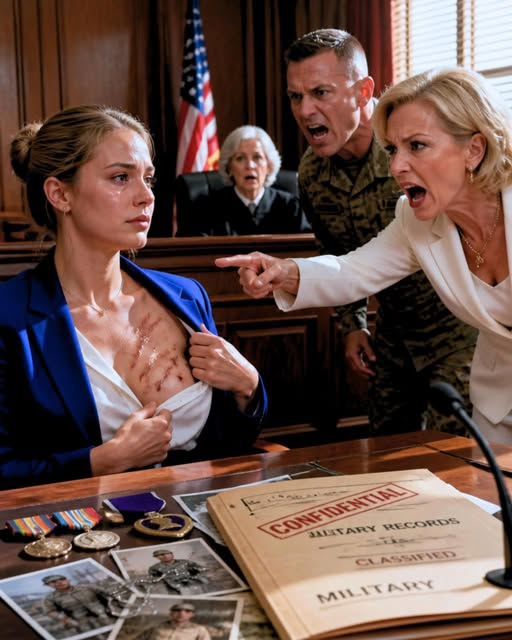
I listened as my mother pointed at me from the witness stand.
“She never served in the military!” she shouted dramatically. “She’s been lying for years. We have records showing she was in Ohio collecting checks while claiming she was overseas.”
Murmurs spread through the courtroom.
Several people glanced at me suspiciously.
I didn’t react.
I didn’t cry.
I didn’t defend myself.
I simply kept my eyes on Judge Marian Sterling and waited.
The judge listened carefully, taking notes while my mother continued her performance.
Finally, the courtroom fell silent.
Judge Sterling looked directly at me.
“Miss Vance,” she said. “These are serious accusations. Do you have proof of your military service?”
“Yes, Your Honor.”
My voice was calm.
Steady.
Certain.
“And I have something else I’d like to present.”
A ripple of curiosity swept through the room.
My mother’s confident smile widened.
She thought I was bluffing.
Slowly, I stood.
The sound of my chair scraping against the floor echoed through the courtroom.
I removed my navy blazer.
Then I reached for the collar of my blouse.
My fingers stopped at my left shoulder.
“Permission to show the court?” I asked.
Judge Sterling nodded once.
“Proceed.”
The room held its breath.
With deliberate calm, I pulled the fabric aside just enough to reveal the massive jagged scar carved across my shoulder—a scar left by an explosion thousands of miles from home.
Gasps erupted instantly.
Faces turned pale.
My mother’s smile vanished.
But the scar wasn’t the real reason I had stood up.
The real evidence was still hidden inside the folder resting on my attorney’s table.
And when Judge Sterling opened it, my mother and brother were about to discover a truth far more devastating than anything they had imagined…
The courtroom fell into stunned silence.
Judge Sterling stared at the scar for several seconds before returning her attention to the thick folder my attorney handed to the bailiff.
“Your Honor,” my attorney said calmly, “inside that folder are certified military records obtained directly from the Department of Defense, deployment records, medical treatment reports, commendations, and a sworn affidavit from Colonel James Whitaker, Nora Vance’s commanding officer.”
The judge opened the file.
Page after page.
Stamp after stamp.
Official seal after official seal.
The confidence slowly drained from my mother’s face.
Derek shifted uncomfortably in his chair.
Then Judge Sterling stopped on one particular document.
Her expression changed.
“Interesting,” she murmured.
My attorney nodded.
“Yes, Your Honor. Please continue to page thirty-two.”
The judge turned the page.
Suddenly her eyebrows rose.
“Mrs. Vance,” she said sharply, looking toward my mother, “would you explain why your signature appears on this military dependent-benefits document?”
The room froze.
My mother blinked.
“What?”
“You signed this form eight years ago acknowledging your daughter’s deployment to Afghanistan.”
The color vanished from Evelyn’s face.
My attorney stood.
“Not only did Mrs. Vance know her daughter was serving overseas, Your Honor, she personally received military family assistance payments and emergency-contact notifications during those deployments.”
Whispers exploded throughout the gallery.
The judge flipped through several more pages.
“There are six additional documents bearing your signature.”
My mother’s mouth opened.
No words came out.
The courtroom had just witnessed the first crack.
But the real collapse was still coming.
My attorney walked to the evidence table and retrieved another folder.
“This,” he said, “is the reason we requested a forensic investigation.”
Derek suddenly sat upright.
The smirk disappeared from his face.
“What investigation?” he blurted.
My attorney ignored him.
Instead, he handed the second folder to the judge.
“Three months ago, shortly after Arthur Vance passed away, someone attempted to access Nora Vance’s military compensation account.”
Judge Sterling began reading.
Her eyes narrowed.
“Someone forged electronic authorization forms.”
“Yes, Your Honor.”
“Using Nora Vance’s personal information.”
“Yes.”
The judge looked up.
“And the IP address was traced?”
My attorney nodded.
“Directly to Derek Vance’s residence.”
The courtroom erupted.
“Objection!” Derek shouted.
Judge Sterling slammed her gavel.
“Order!”
But it was already too late.
People were staring at him now.
Not me.
Him.
My attorney continued.
“The defendants were not attempting to expose fraud. They were attempting to create it.”
Derek’s face turned white.
My mother looked horrified.
Then came the final blow.
“Your Honor,” my attorney said, “we have a witness waiting outside.”
Judge Sterling nodded.
“Bring them in.”
The side door opened.
A tall man in dress uniform entered the courtroom.
Rows of ribbons covered his chest.
Silver hair.
Commanding posture.
The entire room instinctively sat straighter.
I immediately recognized him.
Colonel James Whitaker.
My former commanding officer.
The man who had personally pinned my Purple Heart onto my uniform.
The colonel took the stand.
After being sworn in, he looked directly at the judge.
“I served with Sergeant Nora Vance for eight years.”
His voice carried effortlessly through the courtroom.
“She saved thirty-one lives during her deployments.”
The gallery became silent.
“On one occasion,” he continued, “she carried two wounded soldiers nearly half a mile after an IED attack despite suffering severe injuries herself.”
The colonel paused.
Then he looked directly at my mother.
“Sergeant Vance is one of the bravest people I have ever commanded.”
My mother lowered her eyes.
For the first time all day, she could not look at me.
But Colonel Whitaker wasn’t finished.
“There is another matter the court should know.”
My attorney smiled slightly.
The colonel reached into his briefcase.
He removed a small envelope.
“Several years ago, Sergeant Vance designated her mother as temporary beneficiary while deployed overseas.”
Judge Sterling accepted the document.
“What relevance does this have?”
The colonel answered immediately.
“During that deployment, Mrs. Vance repeatedly contacted military offices requesting information about death benefits.”
The room went silent.
Dead silent.
“She called seven times in six weeks.”
My stomach tightened.
Even I had never known that.
The colonel continued.
“She specifically asked how quickly compensation would be paid if her daughter were killed in action.”
A woman in the gallery gasped.
Someone else whispered, “Oh my God.”
My mother looked as though all the air had been sucked from the room.
Judge Sterling’s face hardened.
“Mrs. Vance,” she said slowly, “is that true?”
Evelyn began shaking.
“I—I was worried—”
“Answer the question.”
Tears suddenly appeared in her eyes.
“Yes.”
The word barely escaped her lips.
The courtroom erupted again.
Everything suddenly made sense.
The lawsuit.
The lies.
The obsession with the inheritance.
The desperate attempt to erase my military record.
It had never been about the farm.
The farm was simply the last thing she wanted.
For eight years, she had viewed me not as a daughter but as an insurance policy that stubbornly refused to die.
The realization hurt more than any battlefield wound I had ever suffered.
Judge Sterling stared at her for several moments.
Then she turned to Derek.
“Mr. Vance, are you aware that forging federal military documents constitutes a felony?”
Derek said nothing.
“Are you aware that attempting to obtain benefits through fraudulent means may result in criminal prosecution?”
Still nothing.
The judge closed the folder.
Her voice became ice.
“This court finds the plaintiffs’ claims entirely without merit.”
She paused.
“Furthermore, evidence presented today strongly suggests intentional fraud, perjury, and attempted theft.”
My mother started crying.
Derek looked like he might faint.
“I am dismissing this lawsuit with prejudice.”
The gavel struck.
“Effective immediately, all evidence will be forwarded to the district attorney and federal investigators.”
The second strike echoed even louder.
“Court is adjourned.”
Chaos followed.
Reporters rushed toward the exits.
Spectators stood talking excitedly.
My mother collapsed into her chair.
Derek stared blankly at the floor.
Neither one looked victorious anymore.
Neither one looked at me.
As people filed out, Judge Sterling called my name.
“Miss Vance.”
I turned.
The judge offered a small nod.
“Thank you for your service.”
Simple words.
But somehow they carried more weight than everything else that had happened that day.
I nodded back.
“Thank you, Your Honor.”
Outside the courthouse, sunlight spilled across the steps.
For the first time in years, I felt lighter.
Not because I had won.
Not because the inheritance was safe.
Not because my mother and brother might face criminal charges.
I felt lighter because the truth no longer needed defending.
It was standing on its own.
A few minutes later, Colonel Whitaker joined me on the courthouse steps.
“You okay, Sergeant?”
I looked toward the horizon.
The family farm waited there.
Grandpa’s farm.
The place he had trusted me to protect.
“I think so.”
The colonel smiled.
“Arthur Vance would be proud of you.”
I swallowed hard.
“Yeah,” I whispered. “I hope so.”
Three months later, federal prosecutors formally charged Derek with fraud, identity theft, and document forgery.
He accepted a plea deal.
My mother avoided prison because of her age and cooperation, but she lost nearly everything she had spent years trying to take from me.
The farm remained mine.
I renovated the old barn.
Then I did something Grandpa would have loved.
I turned part of the property into a rehabilitation retreat for wounded veterans struggling to rebuild their lives after service.
The first group arrived that autumn.
Watching them walk across those fields felt like watching purpose return to a place that had nearly been destroyed by greed.
One evening, as the sun set over the property, I stood beside Grandpa’s grave.
A gentle breeze moved through the trees.
“We kept it,” I told him quietly.
The fields stretched golden beneath the fading sky.
The farm was safe.
The truth was safe.
And after years of fighting battles overseas and one final battle at home, I finally understood something important:
The strongest victory isn’t defeating your enemies.
It’s refusing to become like them.