Because the one thing he still didn’t know was that a man who handles other people’s numbers for thirty-five years never leaves his own future to chance.
My hand didn’t shake as I pulled out a heavy, cream-colored envelope from my breast pocket. It wasn’t a check. It wasn’t a bank statement. It was a formal legal notice from Vance & Sterling Attorneys at Law, stamped with a red wax seal that looked entirely out of place next to a half-eaten ribeye steak. I laid it flat on the mahogany table, right between Michael’s wineglass and Sarah’s folded napkin.
“What’s that?” Sarah asked, her voice dropping an octave, the sharpness returning but this time laced with a sudden, defensive caution.
“Your new reality,” I said softly.
Michael snorted, though his eyes lingered on the red seal a fraction of a second too long. “Don’t tell me you’re writing us a chore list, old man. Because let me be clear—”
“Michael,” I interrupted, my voice perfectly level, carrying the exact weight I used when telling a corporate CEO that the IRS was about to audit his entire life. “Read the header.”
He leaned forward, squinting through the dim candlelight. His smirk didn’t just fade; it curdled. His fingers tightened around the stem of his wineglass so hard I thought the crystal would snap.
“A Seven-Day Notice to Quit Co-Occupancy and Vacate Premises,” Michael read aloud, the words tasting like ash in his mouth. He looked up, his jaw tightening. “What kind of sick joke is this? You can’t evict us. We live here. We’ve been helping you with the utilities for six months!”
“You’ve been paying one-third of the electric bill, Michael, while consuming three-thirds of the peace in this house,” I replied, taking a slow sip of my Pinot Noir. “And if you look at the deed of this property—which is fully paid off and entirely in my name—you are legal occupants under a tenancy-at-will agreement. Or rather, you were.”
Sarah slammed her fork down. It clattered against the blue-rimmed plate, leaving a greasy smear across the ceramic. “Dad! Are you insane? You’re throwing your own daughter out on the street because Michael made a joke? We’re trying to look out for you! Twelve hundred dollars a month won’t even cover the property taxes on this neighborhood next year! We were offering you a way to stay in your own home!”
“No, Sarah,” I said, leaning back, letting the leather of my chair creak comfortably. “You were offering me a position as an unpaid butler in a house I bought before you knew how to spell your own name. There’s a distinct difference.”
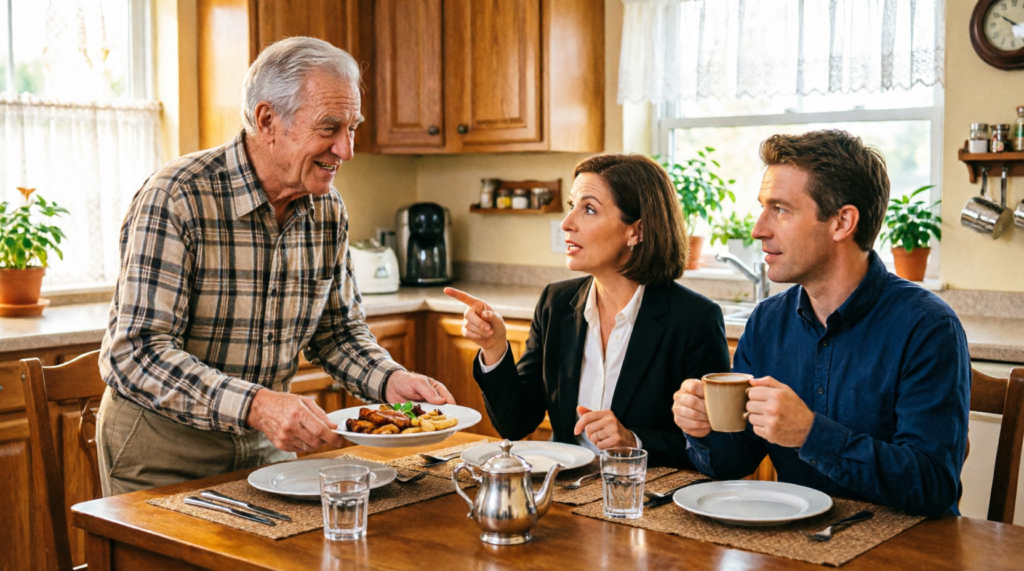
“You can’t do this,” Michael snarled, his face flush red now, the arrogant prince losing his crown in real-time. “We have rights. The courts take months to process evictions in this city. We’ll sit right here in these bedrooms, and there isn’t a damn thing your twelve-hundred-dollar pension can do to hire a lawyer to push us out.”
“You’re entirely right about one thing, Michael,” I said, tilting my head. “Evictions do take time. If this were my only house.”
The room went dead silent again. The refrigerator hummed. The candle flickered, casting long, monstrous shadows against the dining room wall.
“What do you mean, your only house?” Sarah asked. Her voice was barely a whisper now. She knew me. She knew that in thirty-five years of accounting, I had never once miscalculated a number, a risk, or a human asset.
“I mean that at 8:00 a.m. on Monday morning, a moving crew from Premier Relocation will arrive at this front door,” I said, pulling a second document from my pocket—this one a signed corporate contract. “They have been paid exactly eight thousand dollars to pack every single item in this house that belongs to me. The furniture, the art, the television, the appliances, even these blue-rimmed plates you’re eating off of. By noon on Monday, this house will be an empty shell of drywall and floorboards.”
“You’re going to live in an empty house?” Michael mocked, but his voice lacked its previous venom. He was scrambling, looking for the trapdoor.
“Oh, I won’t be living here,” I smiled. “I sold this house three weeks ago to a private equity firm specializing in high-density rental redevelopments. The closing funds cleared my account yesterday afternoon. The new owners take full possession on Tuesday morning at 12:01 a.m. They don’t handle evictions through the standard civil court, Michael. They have a commercial litigation team that handles unlawful holdovers with federal injunctions. If you are still inside this perimeter when their security team arrives to change the locks, you won’t be dealing with an ‘old man’ with a pension. You’ll be dealing with a multi-billion-dollar corporation with a trespass warrant.”
Sarah gasped, her hands flying to her mouth. “You sold the house? Our childhood home? Without telling me?”
“You stopped treating it like a home the moment you started measuring my worth by the size of a government check,” I said.
“Where are you going to go?” she cried, tears finally springing to her eyes—not tears of sorrow, I knew, but the panicked tears of a child realizing the safety net had been shredded. “You can’t afford rent anywhere on twelve hundred dollars! Dad, please, think about what you’re doing! You’re ruining your life to spite us!”
“I’m not spiting you, Sarah. I’m simply balancing the ledger,” I said, standing up from the table. I picked up my plate, entirely untouched, and walked it over to the kitchen sink. “As for where I’m going… well, I have options. Quite a few of them, actually.”
I reached into the kitchen drawer and pulled out a heavy steel ring holding six identical brass keys, each tagged with a neat, typed label bearing an address. I walked back to the dining room and dropped them onto the table with a heavy, metallic clink.
Michael’s eyes darted to the tags. He leaned in closer, reading the locations out loud under his breath. “The Heights… Oakridge Luxury Condos… The Waterfront Plaza… No. No, this is impossible. These are prime commercial and residential zones. These units are worth millions.”
“Six units, to be exact,” I said, adjusting my watch. “Purchased through various holding companies over the last two decades using the surplus capital from my practice. I didn’t spend my weekends golfing or buying sports cars, Michael. I bought brick and mortar. And as for my ‘barely a thousand dollars’ retirement…”
I pulled out my phone, unlocked it, and pulled up the institutional portal for Vanguard Trust Management. I placed the screen directly in front of Michael’s face.
The digital dashboard showed a single, eight-figure balance, followed by a monthly disbursement schedule that didn’t just eclipse my Social Security check—it eclipsed Michael’s annual salary three times over every single month.
$10,245,611.82.
Michael’s eyes went completely round. He looked like a man who had just stepped off a cliff and hadn’t hit the bottom yet. He looked at the phone, then at the keys, then at the eviction notice, and finally up at me, his mouth opening and closing like a fish out of water.
“Ten… ten million?” Sarah stammered, her face turning an ash-gray color that matched the candle smoke. “Dad… you… you have ten million dollars?”
“I do,” I said. “And until 2:40 p.m. today, you were the sole primary beneficiary of the Peterson Family Trust. But as I mentioned, my attorney finalized an amendment this afternoon. Effective immediately, the trust has been restructured. Upon my death, the entire balance will be donated to the Children’s Hospital Foundation. And as for my current liquid wealth…”
I took a deep breath, looking around the room one last time. “I have decided to spend my retirement traveling between my properties, enjoying the fruits of my labor, and ensuring that not a single penny of my wealth ever trickles down to people who value a man only by what they can squeeze out of him.”
Sarah scrambled out of her chair, throwing herself toward me, her hands reaching for my arm. “Dad, wait! Please! Michael didn’t mean it, he was just being stupid! We love you! We were just worried about your future, we swear! You can’t just cut us off like this! We’re family!”
“Family doesn’t tell a father to go out and beg on the street, Sarah,” I said, stepping back so her hands missed my sleeve. “Family doesn’t look at a man’s thirty-five years of hard work and call it a private joke.”
Michael stood up too, his anger completely gone, replaced by a desperate, sickening sycophancy. “Look, Mr. Peterson… Robert… let’s talk about this. We can help you move. We can rent one of your places! We can pay full market rate! Just give us a chance to fix this—”
“The time for fixing things passed when you swirled my wine and called me an old man who needed to make himself useful,” I said.
I walked over to the front door, grabbing my coat from the rack. I didn’t need to pack a bag tonight. The keys in my pocket belonged to a fully furnished penthouse overlooking the river—a place I had kept ready for the day I finally closed the office doors for good.
“You have until Monday morning at 8:00 a.m. to get your things out,” I said, my hand on the doorknob. “If anything belonging to me is missing, the moving company will report it directly to the police, and I will press charges. Have a wonderful weekend, children.”
I opened the door, the cool night air rushing in to replace the heavy, suffocating scent of the dining room. I stepped out onto the porch, feeling lighter than I had in decades.
But just as I reached the first step of the walkway, the headlights of a dark sedan pulled into my driveway, blocking my path. The engine cut out, and a man in a sharp black suit stepped out of the vehicle, holding a thick leather folder under his arm.
He didn’t look like a mover. He didn’t look like my attorney.
He looked at me, then at the house, and then pulled a high-grade digital badge from his pocket, flashing it under the streetlamp.
“Robert Peterson?” the man asked, his voice completely devoid of emotion.
“Yes,” I said, my hand instinctively tightening around my car keys. “Who are you?”
“My name is Agent Miller, Internal Revenue Service, Criminal Investigation Division,” the man said, opening the folder to reveal a document bearing a federal court seal. “We’ve been monitoring the offshore transfers from Peterson and Associates into your private trust for the last eighteen months. I have a federal warrant for the immediate freezing of all assets associated with your name, including six residential properties, and a warrant for your arrest regarding grand larceny and corporate tax evasion.”
From behind me, I heard the front door click open. Michael and Sarah were standing on the porch, watching the flashing lights of two more unmarked government SUVs turn the corner into our quiet street.
Michael looked at the federal agent, then looked at me, and a slow, twisted smile began to spread across his face once more.
PART ONE: THE GEOMETRY OF AN IMPOSSIBILITY
The morning Brittany left for Napa began with the same careful choreography that had governed our household for the past six years: a life organized not around what we could do, but around what we were told we could not. She kissed Noah on the forehead, pulled her suitcase behind her, and gave me that easy, practiced smile from the doorway. The kind of smile that says I have earned this without ever having to explain what she had sacrificed to earn it.
“Three days in Napa,” she said. “Try not to burn the place down while I’m gone.”
Then she climbed into her white SUV and backed down the driveway in the unhurried way of someone whose plans are entirely in order. I stood in the kitchen holding my coffee, watching her brake lights fade at the end of our quiet Columbus street. The house felt empty the moment she left. The television murmured to no one in the living room. The refrigerator hummed. The morning light fell across the tile in long, pale rectangles that made the space feel larger than it actually was.
Then I heard a scrape behind me.
Not the soft roll of a wheelchair. Not the squeak of a brake. The sharp, metallic drag of wood against ceramic.
I turned.
Noah was standing beside the kitchen island.
For one impossible second, my mind refused to process it. My son had not walked since he was twelve. After the interstate crash on a gray November morning, there had been doctors, tests, probabilities, surgical interventions, rehabilitation protocols, and eventually the quiet, heavy acceptance of a new reality. Six years of ramps, specialized vans, insurance battles, medication schedules, and a kind of hope we had all learned to hold carefully at a distance, because hope that grew too large had a way of making the crashes worse when they came.
The mug slipped from my hand and shattered across the tile. Hot coffee splashed against my ankles. I did not look down.
“Noah?”
His legs trembled. One hand gripped the counter hard enough to turn his knuckles white. His chest rose and fell in rapid, shallow pulls. But his eyes stayed locked on mine with a fixed, terrifying intensity that had nothing to do with panic and everything to do with urgency.
“Dad,” he whispered. “Don’t yell. Don’t call anyone. Just listen.”
I rushed toward him, my hands out, afraid he would collapse, afraid his spine would betray him, afraid I would have to catch him the way I had been catching him for years. But he caught my wrist before I could touch him. His fingers were damp. His grip was weak but deliberate.
“We need to leave this house. Now.”
He said it so quietly it sent a chill through me. Not a request. Not a plea. A statement of fact delivered by someone who had been waiting for the exact right conditions to finally speak it aloud.
“What are you talking about?” I asked. My voice sounded foreign. “How are you even standing?”
“There’s no time,” he said. “Please. Just trust me. She’s gone. This is our chance.”
She. Not Mom. Not your mother. The pronoun carried a weight that hit me in the chest before I understood why.
His eyes flicked toward the hallway camera Brittany had installed last year after insisting someone had been near the back door. The red recording light blinked softly in the dim morning light. Then he leaned closer, close enough that I could see the sweat gathering at his hairline and the effort it was costing him to keep his knees from buckling.
“She lied to you,” he whispered. “About me. For years.”
I stared at him, stunned. The kitchen felt suddenly smaller, the air thicker, the shattered mug on the floor a minor detail in a room that had just tilted on its axis.
He forced one shaky step forward. Then another. His legs shook with a violent, uncoordinated tremor, but he did not stop.
“It will make sense,” he said, “when you see what’s hidden in the garage.”
That was all I needed.
I grabbed my keys from the hook, wrapped my arm around his waist to support his weight, and helped him move through the mudroom. His body was light, too light, the way bodies become when they are kept sedentary for too long. We stumbled into the garage, and he pointed to a shelf buried behind paint cans, old storage bins, and a folded camping chair I hadn’t moved since the accident. I shoved the items aside with my forearm. Behind them was a loose panel in the drywall. He pressed the edge with his palm. It popped inward.
Inside was a metal lockbox and a pharmacy bag with his name printed on the label.
I grabbed both. He leaned against me, breathing hard, his forehead pressed to my shoulder. I got him into the passenger seat of my SUV, fastened his seatbelt with trembling fingers, and started the engine.
Then the interior garage door slammed open.
Brittany stood in the doorway, her suitcase still in one hand, her phone in the other. The camera on her device had sent an alert. She had been gone less than ten minutes. Her eyes showed something I had not seen in seventeen years of knowing her face. First panic. Then calculation. Then the sharp, cold focus of someone who realizes the story she has been telling is about to slip out of her hands.
She hit the interior door hard enough to rattle the glass, screaming my name, telling me he was confused, that he needed to sit down before he hurt himself, that he was having an episode. I threw the car in reverse. She ran into the garage and when she saw the lockbox in Noah’s lap, something in her expression stopped being frightened and became something else entirely.
“Don’t be stupid,” she said. Very quietly. The voice she used when she wanted compliance without making a scene.
I backed out hard enough that the tires barked on the driveway. She hit the hood with both hands. Then we were in the street and I drove to a church parking lot three miles away because it was the first place I could think of that was empty, quiet, and required nothing from me except to stop moving.
I killed the engine. Noah got his breathing under control. Then he looked at the lockbox resting on his knees.
“Open it,” he said.
I popped the latch. The blue folder on top held rehabilitation reports I had never seen. Cleveland, dated nineteen months ago. Indiana. Michigan. Each one in some version of the same clinical language: measurable recovery, guarded optimism, assisted standing potential, gait training evaluation recommended, reduction of sedating medication advised when medically appropriate. Each one had Brittany’s email address or phone number listed as the primary contact. Not mine. Never mine.
I sat with the papers shaking in my hands and understood what I was looking at, which was the shape of six years of my own life from an angle I had never been permitted to see. I had told myself that Brittany managing the medical logistics was division of labor, the survival strategy of a family dealing with more than any family should have to handle at once. Sitting in that empty parking lot, with the morning light cutting across the dashboard and my son’s breathing finally steadying beside me, it looked less like division and more like a door she had locked from the inside.
Noah stared at the dashboard when he started talking. He told me about the winter storm, the year he turned thirteen, when sensation had come back into his toes and he had gone to tell her because he thought she would be happy. She had sat on the edge of his bed and cried and told him spinal injuries can trick people, that moving too fast could make the damage permanent, that he needed to promise not to tell me until the doctors were entirely certain. He had made the promise because he was thirteen and frightened and because she was his mother and he believed that the people who love you know what is safe.
Then she had started giving him more medication before therapy. She told me he was having pain days. When he tried to stand one night and she caught him, she told him that if anyone saw evidence of mobility before the lawsuit against the trucking company was settled, the insurance company would claim the disability wasn’t genuine and we would lose the van and the house and everything we had been holding onto. She told him I would blame him.
I had to look at the window while he talked. I could see him at thirteen, medicated and scared in the dark, listening to the sound of his mother’s voice making a cage out of words that sounded like care. I could see myself downstairs at the kitchen table, paying the bills that kept arriving, believing we were enduring this together. Believing that love meant trusting the person holding the other half of the load.
“Why didn’t you tell me when you were older?” I asked, and I hated myself before the sentence finished.
He flinched. “Because every time I pushed further, she adjusted his meds. And she made it sound like you were barely keeping it together. She said one wrong move would collapse everything.” He rubbed his hands together, the habit he’d had since he was small. “I thought maybe wanting to get better was selfish.”
I had no answer for that. There is no answer. You sit with it. You let it burn. You let it carve out the space where the old version of you used to live.
He told me about the substitute therapist on a telehealth check-in the previous week who had asked, casually, why he had never started the standing program Dr. Levin recommended. Noah had looked at the screen and said: What standing program? That night, while Brittany was in the shower, he had rolled to the garage and found a spare key taped behind an old wall clock and opened the lockbox, and had spent a week waiting for her to leave long enough for him to reach me.
The pharmacy bag held a receipt showing his muscle relaxant dosage had been increased months earlier than I knew, and refill dates that didn’t match what I thought he was taking, and notes in Brittany’s handwriting clipped to the outside. Keep afternoon dose consistent. Heavy legs after dinner expected. No standing if Mark home. I held the paper for a long time. The letters kept rearranging themselves into something I didn’t want them to say.
The notebook was worse. Donation totals and password reminders and draft captions for the caregiver blog and sponsorship notes for adaptive equipment brands. A countdown to the mediation hearing. And in the margin of a highlighted legal document, in Brittany’s neat, characteristic handwriting: Do not document independent standing before mediation.
I stared at that line until it stopped looking like language.
My phone buzzed. Brittany. Calling. Again. I silenced it. The lockbox sat open on Noah’s lap. The reports spread across my thighs like a map I had been carrying blindfolded for six years. The parking lot was completely quiet except for the distant hum of a highway and the soft, rhythmic sound of my son’s breathing, which was finally settling into something steady.
I looked at him. “What do we do now?”
He didn’t hesitate. “We go to Riverside Methodist. We ask for Dr. Levin. We let them see everything.”
I nodded. I put the car in drive. The engine turned over. The morning sun broke through the trees, casting long, golden shadows across the cracked asphalt. For the first time in six years, I was not driving toward a routine. I was not driving toward a schedule. I was not driving toward a life organized around what my son could not do.
I was driving toward the truth.
And truth, I was learning, does not ask for permission. It just arrives.
PART TWO: THE GEOMETRY OF NEW GROUND
The Sunday dinner ended with tears, apologies, and a fragile truce that felt less like a resolution and more like the first careful steps across a frozen lake. I stood at the kitchen sink that evening, washing the roasted chicken pan while Marlo helped dry the plates and Theo played quietly on the living room rug with a box of colored pencils. The house was quiet. Not the heavy, suffocating quiet of holding my breath before a storm, but the lighter, tentative quiet of a space finally allowed to exhale. I had spent thirty-four years believing that peace was something you purchased with your own dignity, something you earned by absorbing insults, writing checks, and swallowing the sharp edges of other people’s cruelty until they dulled into routine. I was learning, slowly and painfully, that peace was not a transaction. It was a boundary. And boundaries, once drawn, required constant maintenance.
The first week after the dinner was not a montage of healing. It was a series of small, unglamorous tests. Patrice did not transform into a suddenly self-aware matriarch. Therapy does not work like a light switch. It works like excavation: slow, messy, and full of things you would rather leave buried. On Tuesday, my phone buzzed with a text from an unknown number. Karen, it’s your mother. Dr. Evans says I need to practice direct communication. I am having trouble with the water bill this month. I know you said no, but I was hoping you could just cover half while I figure things out. I will pay you back. Love, Mom.
I stared at the message. The old reflexes fired instantly: the tightness in my chest, the immediate mental calculation of whether I could afford it, the familiar guilt whispering that saying no would make me the villain again, that family meant showing up even when it hurt, that her asking was proof she was trying. But then I looked at the counter where I had left the notebook Marlo had started using to track her own boundaries. I looked at Theo, who was carefully coloring a T-Rex, his tongue poking out the corner of his mouth in concentration. I remembered the way he had looked at me in the car after Easter, asking if he was bad. I remembered the weight of thirty-four years spent being useful instead of being seen.
I typed back: I love you, Mom. I am proud of you for starting therapy and for practicing direct communication. I am not able to cover the water bill. I recommend calling the utility company to ask about payment plans or assistance programs. I hope your session with Dr. Evans goes well.
I hit send. I did not add a smiley. I did not soften it with an apology. I did not leave the door open for negotiation. I simply held the line. The phone stayed silent for three hours. Then: Thank you for the advice. I will try that. It was not an apology. It was not a reconciliation. It was a crack in the dam. And cracks, when left alone, sometimes widen into rivers.
Gil called me that same evening. His voice was different. Not the weary, defeated tone of a man who had spent decades walking on eggshells, but something steadier. Something that sounded like a man who had finally remembered how to stand on his own two feet. “I talked to her about the water bill,” he said. “I told her we’re going to sit down together, look at the numbers, and figure out a budget. No more hiding it. No more hoping someone else will fix it.” I closed my eyes. “How did she take it?” He exhaled. “She cried. She called me cold. She said I was changing the rules. But then she stopped talking and just listened. It’s the first time in years she hasn’t tried to argue her way out of a consequence.” I felt something unclench in my ribs. “That’s huge, Dad.” “It’s terrifying,” he admitted. “But it’s also the only way forward. I’m done being a hostage to her peace, Karen. I should have done this when you were twelve.”
We sat on the phone in silence for a while, not the heavy silence of avoidance, but the quiet of two people finally speaking the same language. When we hung up, I realized I had not felt guilty once during the conversation. That, more than anything, was the true measure of the shift. Guilt had been the currency of my family for so long that its absence felt almost foreign, like walking into a room and realizing the gravity had changed.
Marlo noticed the change too. She had spent years learning to read the weather of our family, to anticipate storms before they broke, to position herself as a shield between me and the adults who thought children were invisible. But shields are heavy. And children were never meant to carry them. One afternoon, she came into the kitchen while I was chopping vegetables for dinner. She leaned against the counter, arms crossed, watching me with that sharp, perceptive gaze that had always made me proud and slightly terrified. “You’re not checking your phone like you’re waiting for a bomb to go off anymore,” she said. It wasn’t a question. It was an observation. I set the knife down. “I used to,” I admitted. “I used to think if I just stayed ready, I could catch the pieces before they hit the floor.” She tilted her head. “Does it feel weird? Not being on guard?” “Yeah,” I said. “But it’s a good weird. It’s like taking off a backpack you didn’t realize you were wearing.” She nodded slowly. Then she did something she hadn’t done in years: she asked for help with her homework without apologizing first. “Can you look over my history essay? I don’t want to mess up the citations.” I smiled. “Absolutely.” It was a small thing. But small things, when repeated, become architecture.
Theo’s healing moved at the pace of a child’s nervous system: incremental, non-linear, deeply tied to routine and predictability. He still had moments where he would hesitate before asking for something, where he would scan my face for approval before speaking, where he would apologize for spilling water or dropping a crayon as if he had committed a crime. But the frequency of those moments was decreasing. The new rhythm of our home was teaching his body that it was safe to exist without calculating the cost. One evening, he woke up from a nightmare. I went to his room, sat on the edge of his bed, and rubbed his back until his breathing evened out. “I dreamed Grandma was yelling,” he whispered. “I know,” I said. “Dreams are just memories trying to figure out where they belong.” He looked at me. “Are you still mad at her?” “I’m not mad,” I said carefully. “I’m just done letting her hurt us. There’s a difference.” He thought about that for a long time. “Do you think she’ll get better?” “I think she’s trying,” I said. “But trying doesn’t mean I have to let her back in until she’s safe. Safety isn’t a feeling, Theo. It’s a practice. And we’re practicing it every day.” He nodded, closed his eyes, and fell asleep. I stayed in his room until the nightlight cast long, quiet shadows on the walls. I did not need to fix him. I just needed to be there while he fixed himself.
The financial cutoff had real, unglamorous consequences for Patrice. Without my money acting as a buffer, she was forced to confront the reality of her own choices. The water bill was paid on time, but barely. The grocery budget shrank. The country club membership was quietly let go. The credit cards that had been floating on my co-signature began to show their true balances. She did not collapse. She adapted. But adaptation is not the same as transformation. There were days when she texted me things that felt like tests: Saw Marlo’s school photo. She looks so grown. Hope you’re keeping her humble. Or: Gil bought a new tool set. He’s finally taking responsibility. Funny how things change. Each message was a carefully wrapped package of old habits: subtle judgment, implied guilt, the quiet expectation that I would engage, defend, or soften. I stopped answering them. Not out of spite. Out of discipline. In my new life, I was learning that engagement is not always connection. Sometimes it’s just a door left open for someone to walk back into the room you finally closed.
Marlo’s role in the family was shifting too. For years, she had been the unofficial peacekeeper, the one who noticed when I was exhausted, who stepped in when Theo was scared, who absorbed the tension so the rest of the house could pretend it was fine. But peacekeeping is a heavy burden for a thirteen-year-old. And I had finally given her permission to put it down. One Saturday, she came home from a friend’s house and dropped her backpack by the door. “I told Chloe’s mom no when she asked me to babysit next weekend,” she said. I looked up from my book. “Why?” “Because I have a volleyball tournament. And because I realized I don’t actually want to. I just thought I should.” I smiled. “That’s a boundary, kid.” She sat on the couch, pulling her knees to her chest. “It felt weird. Like I was being selfish.” “It’s not selfish,” I said. “It’s honesty. Selfishness is taking what isn’t yours. Honesty is keeping what is.” She thought about that. Then she laughed, a short, bright sound that felt like sunlight breaking through clouds. “Deanna says I’m turning into you.” “God help us all,” I said, and she laughed harder.
The hardest part of the new dynamic was not the boundaries themselves. It was the guilt that lingered after them. Guilt does not disappear just because you’ve made a healthy choice. It lingers like smoke in a room after a fire has been put out. Some nights, I would sit on the balcony after the kids were asleep, drinking tea, wondering if I had been too harsh, too cold, too final. I wondered if Patrice’s tears at the dinner had been genuine, or just another performance. I wondered if Gil’s newfound strength would last, or if he would eventually fold back into the comfortable silence of compliance. I wondered if I had broken something that could never be put back together. But then I would look at the notebook Marlo had left on the coffee table, filled with her own rules: 1. I don’t have to fix other people’s problems. 2. My worth isn’t tied to how useful I am. 3. I get to choose who gets access to me. And I would remember that healing is not a straight line. It is a spiral. You revisit the same lessons, but from a higher vantage point each time. The guilt was just the old pattern trying to reassert itself. And patterns, when seen clearly, lose their power.
By late spring, the family dynamic had settled into a new rhythm. It was not perfect. It was not seamless. But it was honest. Patrice continued therapy. She missed a session. She complained about the cost. She had a breakthrough about her own mother, a woman who had taught her that love meant control and that vulnerability was weakness. She wrote me a letter, not a text, not a call, but an actual handwritten note. Karen, I am learning that I spent my life building walls and calling them fences. I am sorry I tried to make you live inside them. I am still learning how to knock them down. I won’t ask for forgiveness. I am just trying to be better. I kept it in the same drawer as the first letter she had written after the dinner. Not because I trusted her completely. Because I respected the effort. And effort, when it is consistent, eventually becomes change.
Gil called me one evening to tell me he had enrolled in a weekend woodworking class. “Never too late to learn something with your hands,” he said. “Something you can actually see when it’s finished.” I smiled. “Proud of you, Dad.” “Me too,” he said. And for the first time, I believed him.
Marlo’s confidence grew. She started speaking up in class. She made the varsity volleyball team as a freshman. She stopped apologizing for taking up space. She stopped trying to read my face before she spoke. She just spoke. And I learned to listen without fixing, without worrying, without preparing for the storm. I just listened. It was the most radical thing I had ever done.
Theo started kindergarten. He walked into the classroom with his backpack slightly too big for his shoulders, his shoes untied, his eyes wide but not afraid. He waved goodbye. I waved back. I did not cry. I just watched him disappear into a world where he would learn to be himself, without calculating the cost.
The quiet of that afternoon was not empty. It was full. Full of every boundary I had finally drawn. Every guilt I had finally let go of. Every child I had finally allowed to be just a child. Full of the terrifying, beautiful realization that I did not have to earn my place in my own life. I just had to claim it.
I stood on the porch as the sun dipped below the tree line. The air was warm. The street was quiet. Somewhere down the block, a dog barked. A neighbor watered their lawn. The world kept moving, entirely indifferent to the quiet revolution that had taken place inside my chest. I did not need it to care. I only needed to keep breathing.
And for the first time in thirty-four years, I finally knew how.
But the true test of a new architecture is not how it stands in calm weather. It is how it holds when the wind returns.
It came in September. Not as a crisis. As a request. Patrice called on a rainy Thursday evening. Her voice was steady, but I could hear the effort in it. “Karen,” she said, “your father and I would like to host Thanksgiving this year. Not at the old house. We’ve downsized to the apartment near the park. It’s smaller. Fewer stairs. I want to do it right this time. No crowds. No performances. Just the four of us. If you’re willing.” She paused. “If you’re not, I understand. The boundary stands. I just wanted to ask.”
I looked at the calendar. I looked at the rain against the window. I looked at the framed drawing on my refrigerator: three stick figures holding hands beside a yellow house, a sun in the corner with long rays, a tiny flag beside the front door because seven-year-olds know that houses feel safer with flags. I remembered the folding table in my sister’s backyard. The plastic spoons. The broth on Megan’s dress. The twenty-three adults who looked away. The weight of a word spoken like it was nothing. Technically. The word adults use when they want permission to be cruel to a child.
“I’ll be there,” I said. “But we’re bringing the food. And we’re leaving at two.”
“Understood,” she said. No negotiation. No sigh. Just acceptance.
Thanksgiving arrived pale and crisp. Patrice’s apartment was small, bright, and entirely her own. No borrowed folding tables. No hidden expectations. Just a wooden dining table set for four, with real plates, real silverware, and a vase of yellow tulips in the center. Gil greeted us at the door with a genuine smile, his hands clean, his posture open. He took Marlo’s coat. He knelt to hug Theo. He didn’t perform. He just welcomed.
We ate. We talked. Not about money. Not about obligations. Not about who owed what to whom. We talked about Marlo’s debate tournament. About Theo’s new geology book. About Gil’s woodworking class. About the way the light hit the park trees in early autumn. Patrice listened. Really listened. She didn’t interrupt. She didn’t redirect. She didn’t try to steer the conversation toward herself. She just sat in the quiet spaces and let them be.
Halfway through dessert, Theo looked up from his plate. “Grandma,” he said, “do you like dinosaurs too?”
Patrice didn’t laugh. She didn’t sigh. She didn’t tell him he was too old for questions or too loud for dessert. She leaned forward. “I don’t know much about them,” she said honestly. “But I’d love to learn. Could you show me your book later?”
Theo’s face lit up. “Yeah. It’s got a T-Rex that’s bigger than our car.”
“I’d like to see that,” she said.
And just like that, the room exhaled. Not because the past was erased. Because the present was finally honest.
On the drive home, Marlo sat in the backseat, quiet for a long time. Then she said, “It was different.”
“Yes,” I said.
“Do you think it’ll stay that way?”
“I don’t know,” I said. “But it doesn’t have to be perfect to be real. It just has to be chosen. Every time.”
She nodded. She didn’t look away. She didn’t flinch. She just absorbed the truth the way children do when they’re finally given room to grow.
That night, I stood on the balcony of my apartment, wrapped in a thick sweater, watching the city lights blur through the mist. My phone buzzed. A message from Deanna. Day 214. Still standing? I typed back: Still breathing. She replied instantly: Good. That’s the only metric that matters.
I put the phone away. I looked down at my hands. They were no longer clenched. They were open. They had spent decades catching falling plates, wiping spilled broth, holding back tears, signing checks, swallowing words, absorbing blows, making myself small so other people could feel tall. But hands are not meant to catch what isn’t theirs to carry. They are meant to hold what is. To build. To reach. To rest.
I thought of the Easter picnic. Not with bitterness. With clarity. That day had not broken me. It had revealed me. It had shown me exactly where my loyalty had been misplaced, exactly where my silence had become complicity, exactly where my love had been mistaken for permission. And it had given me the exact moment I needed to finally stand up. Not with a shout. With a choice. A quiet, unshakable, irreversible choice to stop funding people who ranked my children like inventory. To stop translating other people’s cruelty into my own guilt. To stop believing that peace required my disappearance.
I am not the family’s shock absorber anymore. I am its architect. I build tables that fit the people who sit at them. I set boundaries that hold. I love without conditions that cost me my dignity. I protect without apologies that erase my truth. I am Karen. I am a mother. I am a daughter who finally learned that blood does not grant ownership. It only grants the opportunity to choose. And I have chosen well.
Inside, Marlo’s door clicked shut. Theo’s steady breathing drifted down the hall. The apartment was quiet. The rain had stopped. The air was still. I did not look back at the folding tables of my past. I did not wait for apologies that would never be perfect. I did not measure my worth against the expectations of people who had spent decades teaching me how to shrink.
I just stood. And breathed. And let the quiet do what it does best. It holds. It settles. It reminds you that you are still here. And that is all that has ever been required.
And for the first time in my life, I finally believed it.