PART 1
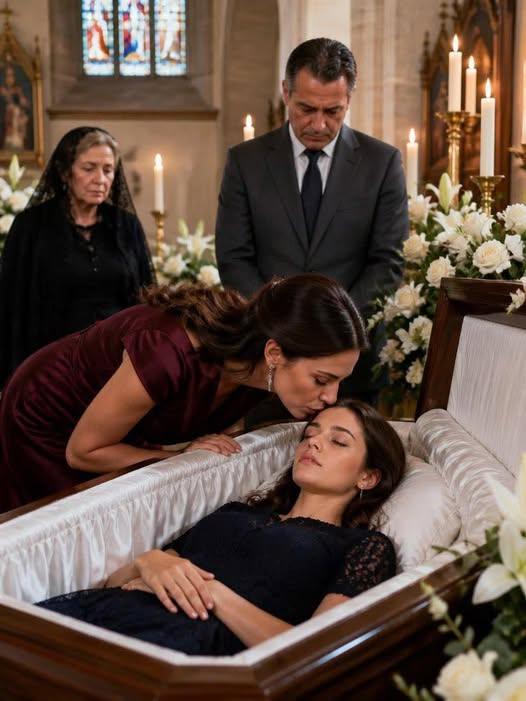
The church was so quiet I could hear the soft crackle of candle flames.
Rows of white lilies surrounded the casket.
The scent was overwhelming.
Beautiful.
Cruel.
My daughter had always loved lilies.
Now they stood around her coffin like silent witnesses.
I sat in the front pew with trembling hands folded in my lap, staring at the polished oak casket that held everything I could never get back.
My name is Diane Walker.
I am sixty-one years old.
And three days ago, I buried my only child.
Her name was Olivia Walker.
She was thirty-four.
She should have had decades ahead of her.
Instead, I was sitting in a church trying to understand how a mother survives the unimaginable.
The priest spoke softly from the altar.
Friends dabbed tears from their eyes.
Coworkers sat with bowed heads.
Every face in the room reflected grief.
Every face except one.
The church doors suddenly swung open.
The sharp click of high heels echoed across the marble floor.
The sound shattered the silence.
Every head turned.
My stomach dropped.
There he was.
My son-in-law.
Nathan Bennett.
And he wasn’t alone.
A young blonde woman clung to his arm.
She wore a tight crimson dress completely inappropriate for a funeral.
Her makeup was flawless.
Her smile was confident.
Almost excited.
Nathan looked equally untouched by grief.
His charcoal suit was perfectly tailored.
His hair was styled.
His expression carried the casual irritation of a man arriving late to dinner.
Not a widower attending his wife’s funeral.
He walked straight down the center aisle.
No apology.
No shame.
No sorrow.
“Oh, thank God we made it,” he said loudly.
“Traffic was ridiculous.”
Several guests exchanged horrified looks.
A woman near the back gasped.
Nathan didn’t seem to notice.
Or care.
The blonde woman scanned the church curiously.
Like she was touring a property.
When they reached my row, she slowed.
For one brief second, I thought she might offer condolences.
Instead she leaned close enough for me to smell her perfume.
Then she whispered:
“Looks like I won.”
The words struck harder than any slap.
My fingers tightened around the funeral program.
Every muscle in my body screamed at me to stand up.
To throw her out.
To scream.
To expose them both.
But grief has a strange way of draining your strength.
So I stayed seated.
Silent.
Frozen.
And stared at my daughter’s coffin.
Because if I looked at either of them any longer, I might lose control.
A month earlier, Olivia had sat across from me in my kitchen.
She wore a long-sleeved sweater despite the summer heat.
I noticed immediately.
“Sweetheart,” I said carefully, “aren’t you warm?”
She smiled too quickly.
Too brightly.
“I’m fine, Mom.”
The lie was obvious.
When she reached for her coffee, her sleeve slipped slightly.
Just enough.
A bruise darkened her wrist.
My heart nearly stopped.
“What happened?”
She immediately pulled the sleeve down.
“Nothing.”
“Olivia.”
She looked away.
“Nathan and I argued.”
My chest tightened.
“Did he do that?”
“No.”
Too fast.
Too rehearsed.
I wanted to push harder.
I wanted to drag her home.
But she shook her head.
“It’ll get better.”
The words sounded practiced.
Like she’d repeated them a hundred times.
“We’re trying.”
I remember reaching across the table and taking her hand.
“You don’t have to stay.”
Her eyes filled with tears.
For a moment, I thought she might finally tell me everything.
Instead she smiled.
A broken smile.
And whispered:
“I know.”
Back in the church, the priest continued speaking.
Nathan dropped into the front pew with the blonde woman beside him.
Then he wrapped his arm around her shoulders.
At his wife’s funeral.
I heard someone behind me mutter:
“Unbelievable.”
Another person stood and quietly moved to another row.
Nathan remained oblivious.
Or arrogant enough not to care.
Then something changed.
A man rose from a side pew.
Tall.
Gray-haired.
Serious.
Michael Harper.
Olivia’s attorney.
I’d only met him twice.
But Olivia trusted him completely.
He carried a large sealed envelope.
And the moment I saw it, I remembered something.
Three months earlier, Olivia had called unexpectedly.
“Mom,” she’d asked, “if something happened to me… would you promise to keep going?”
At the time, I’d laughed nervously.
“Don’t talk like that.”
Now those words echoed through my mind.
Michael approached the front of the church.
The priest stepped aside.
The room fell silent.
Michael cleared his throat.
“Before the burial proceeds, I have been instructed to fulfill a direct legal request made by Olivia Bennett.”
Confused whispers spread through the church.
Nathan rolled his eyes.
“What now?”
Michael ignored him.
“Mrs. Bennett requested that her final will and testament be read publicly in the presence of specific witnesses.”
The room became perfectly still.
Nathan laughed.
“A will?”
He looked at his girlfriend.
“That’s ridiculous.”
Then he glanced toward me.
“My wife didn’t own anything.”
Michael finally looked directly at him.
The attorney’s voice remained calm.
Controlled.
Certain.
“Actually, she did.”
Nathan’s smile faded.
Michael opened the envelope.
The rustle of paper sounded thunderous in the silence.
“I’ll begin with the primary beneficiary.”
He looked up.
“Diane Walker.”
My breath caught.
The room blurred.
For a moment, I thought I’d misheard.
Michael continued.
“Olivia Bennett leaves her residence, investment accounts, savings, personal assets, and life insurance proceeds to her mother, Diane Walker.”
Gasps erupted across the church.
Nathan shot to his feet.
“What?”
His voice echoed.
“What did you just say?”
Michael calmly continued reading.
Every asset.
Every account.
Every possession.
Everything went to me.
Nothing went to Nathan.
Nothing.
His face turned bright red.
“This is impossible!”
Michael turned another page.
“It is entirely legal.”
“I’m her husband!”
“No,” Michael replied calmly.
“You were her husband.”
The church fell silent again.
Nathan stared.
Confused.
Angry.
Then Michael delivered the first devastating blow.
“Six months ago, Olivia filed legal separation paperwork.”
The room exploded with whispers.
Nathan looked genuinely stunned.
“What?”
The blonde woman stepped backward.
“What does that mean?”
Michael continued.
“It means Olivia had already initiated steps to end the marriage.”
Nathan looked like someone had punched him.
“No.”
“Furthermore,” Michael said, “Olivia submitted extensive documentation supporting her request.”
My heart pounded.
I already knew what came next.
But hearing it aloud still hurt.
Medical records.
Photographs.
Witness statements.
Journal entries.
Audio recordings.
Years of evidence.
Evidence of abuse.
The room grew deathly quiet.
One woman began crying.
A man shook his head in disgust.
Nathan’s confidence evaporated.
“This is a lie.”
“No,” Michael said.
“It isn’t.”
Then came the final revelation.
The one Olivia had protected until now.
Michael opened a second envelope.
“Olivia also requested disclosure of information currently under investigation.”
Nathan’s face turned pale.
“What investigation?”
Michael looked directly at him.
“The financial crimes unit.”
The church erupted.
“What?”
Nathan stumbled backward.
Michael continued.
“Olivia discovered unauthorized withdrawals from joint accounts.”
My stomach dropped.
I hadn’t known this part.
Neither had anyone else.
“Over four hundred thousand dollars.”
The blonde woman looked horrified.
Nathan opened his mouth.
Nothing came out.
Michael’s voice remained steady.
“The evidence was provided to federal investigators three weeks before Olivia’s death.”
The room fell silent.
Nathan looked trapped.
Cornered.
Exposed.
Then the blonde woman slowly stepped away from him.
“I didn’t know.”
No one answered.
Because nobody cared what she knew anymore.
Truth had arrived.
And truth doesn’t negotiate.
Michael finished reading.
Closed the documents.
“The reading is complete.”
For several seconds nobody moved.
Then something remarkable happened.
People began standing.
One by one.
Friends.
Neighbors.
Coworkers.
Not for Nathan.
For Olivia.
To honor the courage she’d found before she died.
To honor the truth she’d protected.
To honor the voice she refused to let disappear.
Nathan sat down heavily.
Smaller somehow.
Like the man who had entered the church no longer existed.
Three months later, criminal charges were filed.
Financial fraud.
Embezzlement.
Forgery.
Investigators uncovered years of deception.
The evidence Olivia had collected became the foundation of the case.
Nathan lost everything.
His career.
His reputation.
His freedom.
The blonde woman disappeared almost immediately.
As for me?
I inherited more than money.
I inherited responsibility.
Purpose.
And a promise.
Using Olivia’s estate, I transformed her home into a support center for women escaping abusive relationships.
Nothing extravagant.
Just a safe place.
A place where someone could walk through the door carrying fear and hear the words my daughter needed years earlier:
“You are safe here.”
Sometimes I sit in the garden outside the center and think about Olivia.
Her laugh.
Her kindness.
The dreams she never got to finish.
The grandchildren I never got to meet.
The future that was stolen.
The grief never disappears.
I don’t think it ever will.
But alongside the grief now lives something else.
Determination.
Because my daughter’s final act wasn’t revenge.
It was protection.
Even after death, she found a way to shield others.
And every woman who walks through those doors reminds me that her voice is still being heard.
The last thing Olivia ever wrote in her journal was discovered after the funeral.
A single sentence.
A sentence framed today in the entrance hall of the center that bears her name.
It reads:
“Silence protects the wrong people.”
Every day, I read those words.
And every day, I remember that even from a coffin, my daughter found the courage to tell the truth.
And in the end, the truth spoke louder than everyone who tried to bury it.
The silence that followed the final echo of those words was not the heavy, suffocating kind that Nathan used to enforce with a sharp look or a raised hand. It was the vast, clearing silence that follows a thunderstorm—the kind that leaves the air sharp, clean, and impossible to mistake for anything other than a new beginning.
I stood up from my seat at the front of the sanctuary, my knees stiff from the hours of tension, but my spine straighter than it had been since the day the hospital called to tell me my only child was gone. I didn’t look at Nathan as I walked past him. I didn’t need to. The man who had spent a decade masquerading as the perfect, grieving son-in-law, the pillar of the community who had graciously allowed me to mourn in his shadow, was gone. In his place sat a hollowed-out shell, staring at a stack of legal-sized paper as if it were a mirror reflecting his true face for the very first time.
Michael met me at the base of the altar, his leather briefcase already zipped. His face was a mixture of professional solemnity and deep, personal exhaustion. He had been Olivia’s attorney for less than six months before she died, a secret alliance forged in the hushed corners of suburban coffee shops and through encrypted emails sent in the dead of night while Nathan slept off his expensive scotch.
“We’re ready, Martha,” Michael said quietly, his hand resting briefly on my forearm. “The federal team is waiting in the administrative office behind the choir loft. They’ve already intercepted Nathan’s vehicle keys. They aren’t letting him leave the property.”
I nodded, the numbness that had carried me through the funeral finally beginning to crack, allowing a steady, focused heat to take its place. “Did they get the bank records from the offshore account?”
“They got everything,” Michael replied, a grim smile touching the corners of his mouth. “Olivia didn’t just find the trail, Martha. She mapped the entire system. She left breadcrumbs that a blind auditor could follow. He thought he was skimming from the marital accounts to fund his real estate investments, but he was actually drawing from the church’s building fund that he managed. That’s why the feds are here. It’s not just grand larceny; it’s a systematic institutional fraud.”
As we walked toward the side exit, the murmurs behind us swelled into a deafening roar. The crowd of five hundred people—people who had spent the last week bringing casseroles to Nathan’s house, comforting him on his porch, and whispering pitying comments about how hard it must be for a young widower to lose his beautiful wife so suddenly—were now turning on him like a pack of wolves.
I caught sight of Pastor Thomas, the man who had delivered a eulogy less than an hour ago praising Nathan’s devotion and faith. He was standing near the second row, his face flushed a deep, furious crimson, staring down at Nathan with an expression that looked remarkably like fear. Pastor Thomas knew that if Nathan went down for the building fund, the entire church board would be dragged into the light of a federal audit. The hypocrisy was so thick it was nearly tactile, a choking dust settling over the velvet pews and stained-glass windows.
The Architecture of a Ghost
To understand the depth of Olivia’s victory, you have to understand the prison Nathan had built for her while she was still alive.
Nathan didn’t use his fists—not at first. He was a master of the invisible bruise, the kind of psychological violence that leaves a woman checking her own sanity before she checks her reflection in the mirror. He began by correcting her tone in front of friends, a soft, patronizing chuckle accompanied by, “Oh, honey, you don’t really mean that, you’re just tired.” Then came the financial isolation. He convinced her to leave her position at the design firm, promising that he wanted nothing more than to provide for her, to let her focus on her painting and the family they hoped to start.
By the third year of their marriage, Olivia didn’t have a personal bank account. She didn’t have her name on the deed of the house I had helped them secure. She had an allowance—a strictly monitored digital ledger where every gallon of gas and every gallon of milk had to be justified to a man who spent thousands on custom-tailored suits and private club memberships.
I remember visiting them for Thanksgiving two years ago. The house was immaculate, smelling of cinnamon and expensive wood polish, looking exactly like the holiday spreads Olivia used to clip from magazines. But when I reached out to touch her shoulder as she stood at the stove, she flinched so violently she dropped the silver serving spoon onto the tile.
“I’m fine, Mom,” she had whispered, her eyes darting toward the hallway where Nathan’s laughter echoed as he watched football with his brothers. “I’m just clumsy today. Please don’t say anything to Nathan. He gets so stressed when things aren’t perfect.”
I let myself be comforted by her excuses because the alternative was too terrifying to contemplate. I didn’t want to believe that the bright, fierce girl who had graduated top of her class, the girl who used to laugh until her stomach hurt at the kitchen table, was being systematically erased by the man who had promised to cherish her. My compliance was my own sin, a heavy debt I will spend the rest of my life paying down.
But Olivia hadn’t given up. While I was busy pretending everything was fine, she was beginning to fight back in the only way she had left: with a pen and a digital camera.
The Hidden Ledger
The day after the funeral, after the federal agents had sealed Nathan’s office and escorted him from the house in handcuffs, I went back to Olivia’s home to pack away her personal belongings. The house felt different without her—cold, sterile, like a model home that had never been lived in. Nathan had already cleared out her closet, throwing her clothes into black garbage bags as if he couldn’t wait to erase the evidence of her existence.
But he had missed the studio.
Olivia’s painting studio was a small, sunlit room above the detached garage. Nathan rarely went up there; he considered her art a “cute hobby” that kept her occupied while he was at the office. In the corner of the room sat her heavy oak easel, holding an unfinished canvas of a stormy coastline, the paint thick and dark.
Beneath the floorboards under the easel, wrapped in a oilcloth to protect it from moisture, I found the real legacy my daughter had left behind.
It wasn’t a standard diary. It was a ledger of survival.
Inside were copies of bank statements from accounts I didn’t recognize, domestic shell companies registered under Nathan’s initials, and a series of audio transcripts. Olivia had used a small voice recorder hidden inside her canvas bag to capture their arguments. As I read through the pages, her voice came alive again—not the timid, broken whisper she used in public, but a sharp, defensive clarity that made my heart ache with pride and sorrow.
“I know about the four hundred thousand, Nathan,” one entry read, transcribing a conversation from three months prior. “I know you used the church’s construction line of credit to pay off the margin calls on your personal trading account. I have the wire transfers.”
Nathan’s recorded response was chilling in its arrogance: “Who are they going to believe, Olivia? A housewife who hasn’t earned a dollar in five years, or the man who brought in three million in donations this quarter? You say a word to anyone, and I’ll have you committed. I’ve already talked to Dr. Aris about your ‘anxiety issues.’ You won’t leave this house with a single cent, let alone your dignity.”
He had truly believed he was untouchable. He had built his fortresses out of institutions, titles, and social standing, confident that a lonely woman with a history of treated depression would never be able to pierce the armor.
He didn’t realize that the Department of Justice doesn’t care about social standing. They care about the math.
The Genesis of Olivia’s House
The transformation of Olivia’s childhood home into the support center wasn’t an easy process. Nathan’s defense attorneys tried for months to tie up her estate in probate, claiming that the evidence she had gathered was obtained illegally and that her intent was malicious. They tried to paint her as a vengeful, unstable spouse who had fabricated the financial records out of spite.
But Ms. Sterling, working alongside Michael, dismantled their arguments with the precision of a surgeon. The fact that the federal government had already indicted Nathan based on independent bank records meant that his civil claims were essentially dead on arrival. By the following spring, the title of the house was cleared, and the funds from Olivia’s personal life insurance policy—the one Nathan had forgotten he signed over to her estate before their relationship soured—were released to my control.
We took down the heavy iron gates that Nathan had installed around the perimeter to keep people out. We painted the dark, heavy walls a bright, soft cream that caught the morning light. We replaced the expensive, sterile furniture with long oak tables, comfortable couches, and shelves filled with books on legal rights, financial independence, and trauma recovery.
We didn’t put up a sign that read “Shelter.” We didn’t want these women to feel like they were hiding. Instead, we carved her name into a small limestone plaque beside the front door: The Olivia Mercer Center for Creative Recovery.
The center operates on a simple principle that Olivia discovered too late: abusers do not thrive in isolation; they thrive in the silence of their victims. We don’t just provide a bed and a warm meal; we provide forensic accounting assistance, legal advocates who understand the intricacies of coercive control, and tech specialists who can scrub a woman’s digital footprint before her abuser can trace her location.
The Last Confrontation
Two years after the reading of the will, I received a letter from the federal correctional institution in Jessup, Maryland. It was a standard, computer-generated form notifying me that Nathan Vale’s application for early parole had been scheduled for a hearing. His lawyers had submitted a packet claiming he was a “model prisoner” who had shown deep remorse and was suffering from failing health due to the stress of his confinement.
Michael offered to go in my place, but I refused. I packed Olivia’s journal into my bag, wore the same navy suit I had worn to her funeral, and drove the three hours to the facility.
The prison visiting room smelled of industrial disinfectant and old floor wax, a gray, flat environment that stripped away any illusion of grandeur. When Nathan was led in by the guard, I had to look twice to ensure it was actually him. The pristine hair was gone, replaced by a thin, unwashed gray fringe. The sharp, tailored posture had collapsed into the shuffle of a man who spent his days staring at concrete.
He sat down across from me behind the plexiglass, his hands resting on the counter. He didn’t look angry anymore; he looked desperate, a salesman who had run out of products to sell.
“Martha,” he said, his voice raspy against the small speaker grid. “Thank you for coming. I didn’t think you would.”
“I didn’t come for you, Nathan,” I said, keeping my tone flat, refusing to give him the satisfaction of seeing my anger. “I came to ensure you stay exactly where you belong.”
He closed his eyes, a theatrical sigh escaping his lips. “I made mistakes, Martha. I know that. The money… the stress of the firm… it got away from me. But Olivia… Olivia knew I loved her. She would never want me to rot in a place like this. She was a gentle soul. She believed in forgiveness.”
Hearing her name in his mouth felt like a physical stain on the air. I reached into my bag, pulled out a photocopy of the journal page I had found beneath the floorboards, and pressed it against the plexiglass. It was the entry from the night she realized he had changed the locks on her personal safety deposit box.
“Read the bottom line, Nathan,” I commanded.
He squinted through the scratched plastic at her neat, architectural handwriting.
“He thinks he can buy my silence with the threat of my own ruin,” she had written. “But he doesn’t understand that I would rather be ruined and free than whole and captive. If I die in this house, let the walls speak for me.”
Nathan looked up from the paper, his face completely blank, the old calculation flickering behind his eyes before dying out completely. He realized then that there was no bargain to be made, no old memory he could weaponize to make me soften.
“The board denied your parole this morning, Nathan,” I told him, folding the paper and returning it to my bag. “They will deny it next year, and the year after that. You spent ten years trying to make my daughter invisible. For the rest of your life, you are going to be the one who doesn’t exist.”
I stood up and walked out of the room before the guard could even open the door for him. As the heavy steel sliders clanged shut behind me, the sound didn’t make me flinch. It sounded like a gavel falling, thousands of miles away, closing a case that had finally reached its true conclusion.
The Garden at Dusk
It is June now, the exact anniversary of the day Michael opened those envelopes in the church. The garden behind the center is in full bloom, the white hydrangeas and blue irises Olivia loved creating a thick, vibrant carpet against the old stone walls.
A young woman named Elena is sitting on the stone bench near the bird bath. She arrived three weeks ago from Savannah, carrying nothing but a diaper bag, her small daughter asleep on her shoulder, and a black eye that she kept trying to hide behind her long dark hair. Today, the hair is pulled back. She is holding a sketchpad we provided, her pencil moving quickly across the page, capturing the way the late afternoon sun filters through the oak leaves.
Her daughter is playing in the grass nearby, chasing a yellow butterfly, her laughter light and unburdened by the terror that had defined her home just twenty days prior.
I watch them from the kitchen window, a cup of tea cooling in my hands. The grief of losing Olivia doesn’t get smaller over time; it just becomes a permanent part of the landscape, like a mountain range you live beside. You learn where the shadows fall, you learn how the weather changes on the peaks, and you learn to walk through the valleys without losing your breath.
But the house is no longer silent. It is filled with the sound of running water, the click of typewriters as women update their resumes, the murmur of legal counsel, and the steady, quiet rhythm of lives being rebuilt from the foundations up.
Olivia didn’t get to see the children she wanted. She didn’t get to grow old, her hands stained with oil paint, her hair graying as she sat by a window overlooking the sea. Her story was cut short by the cruelty of a man who thought he could own a human spirit by controlling her assets.
But as I look down at the plaque by the door, the words “Silence protects the wrong people” gleaming in the twilight, I know that Nathan didn’t win. He thought he was burying her in the dirt of that churchyard, but he was actually planting a seed. And every woman who finds her voice inside these walls is a branch of the tree that grew from her courage—a tree whose roots are too deep for any monster to ever tear down.