My husband had a vasectomy, and two months later, I discovered I was pregnant. He accused me of ch3ating, left me for another woman, and still, I had no idea the worst shock was waiting at the ultrasound.
When I saw the two lines on the test, I cried because I was happy.
I thought it was a miracle.
My hands were shaking as I ran to show Diego.
He was in the kitchen drinking coffee, looking as calm as if nothing in the world could touch him.
“I’m pregnant,” I told him.
He did not smile.
He did not hug me.
He did not ask if I felt okay.
He simply set his cup on the table and stared at me like I had brought something filthy into our home.
“That’s impossible.”
My throat tightened.
“What do you mean, impossible?”
Diego gave a cold laugh.
“I had a vasectomy two months ago, Laura. I’m not stupid.”
That word hit me like a slap.
Stupid.
That was what the man I had loved for eight years called me.
The same man who had said the surgery was “for us,” because money was tight, because we could “decide later.”
I reminded him the doctor had said it was not immediate.
That follow-up testing was necessary.
That pregnancy could still happen.
But Diego had already stopped listening.
His verdict was already written across his face.
“Who is he?” he asked.
I froze.
“What?”
“The father. Tell me who he is.”
I felt sick.
Not because of the baby.
Because of him.
That night, he packed a suitcase.
Not many clothes.
Just enough to let me know another place was already waiting.
“I’m going to Paola,” he said, without shame.
Paola.
His coworker.
The woman who used to text me for recipes.
The woman who once told me, “Lauri, your marriage is so beautiful.”
The woman who had apparently been waiting for a chance to take my place.
The next day, my mother-in-law arrived with two black bags.
Not to comfort me.
To collect Diego’s belongings.
“How shameful, Laura,” she said, looking at my stomach as if it were already evidence against me. “Diego didn’t deserve this.”
“I didn’t cheat on him.”
She gave me a pitying smile.
“They all say that.”
Within a week, half the neighborhood knew.
The cheating wife.
The shameless woman.
The one who got pregnant after her husband’s vasectomy.
Then Diego posted a photo with Paola at a restaurant in Polanco. She was holding his arm.
The caption said:
“Sometimes life removes a lie to give you peace.”
I read it while sitting on the bathroom floor, crying and vomiting at the same time.
I had no peace.
I was terrified.
Terrified of losing my home.
Terrified of raising a child alone.
Terrified that my baby would carry the name of a man who already rejected him before even seeing his face.
Two weeks later, Diego asked me to meet him at a café.
He came with Paola.
And a folder.
“I want a quick divorce,” he said. “And when the baby is born, a DNA test.”
Paola touched her flat stomach and smiled faintly.
“It’s the healthiest choice for everyone.”
I looked at her.
“For everyone, or for you?”
Diego slammed his hand on the table.
“Stop acting like the victim. You destroyed this family.”
I opened the folder.
Give up the house.
Minimum support.
Conditional custody.
Then one clause made my blood run cold: if the baby was not his, I would have to repay him for “all marital expenses.”
I laughed.
A dry, broken laugh.
“Marital expenses? Are you going to charge me for the years I washed your clothes too?”
Paola looked away.
Diego clenched his jaw.
“Sign it, Laura. Don’t make this more embarrassing.”
“Embarrassing was you leaving with your lover instead of coming with me to one appointment.”
I did not sign.
That night, I slept with a chair pushed against the door.
I did not even know why.
Maybe because when a woman has been humiliated enough, every sound starts to feel dangerous.
The next day, I went to the ultrasound alone.
I wore a loose dress.
I brushed my hair.
I put on lipstick, even though my mouth was trembling.
Not for Diego.
For me.
For the baby who had done nothing wrong.
The clinic smelled of alcohol, baby powder, and fear.
Dr. Salinas greeted me gently.
“Did someone come with you?”
I shook my head.
“My husband says this baby isn’t his.”
The doctor did not judge me.
She did not make a face.
She simply asked me to lie down.
The gel was cold.
The screen lit up.
I held my breath.
First, there was a shadow.
Then a tiny moving dot.
Then a heartbeat.
Strong.
Fast.
Alive.
I covered my mouth and cried.
“Hello, my love,” I whispered.
Dr. Salinas smiled softly.
Then she moved the transducer again.
Her smile faded.
She frowned.
She zoomed in.
She checked the date of my last period.
Then she looked at my chart.
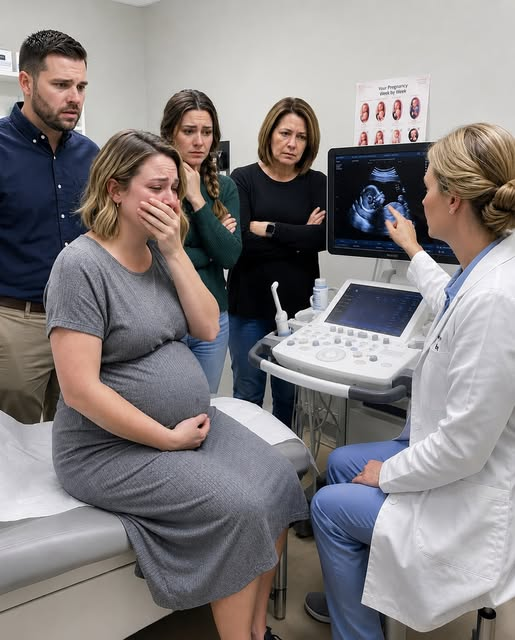
“Mrs. Laura… when did you say your husband had the vasectomy?”
I went cold.
“Two months ago.”
She did not answer right away.
She zoomed in again.
The heartbeat was still there.
But there was something else too.
Something that made the doctor stop and turn serious.
“What’s wrong?” I asked, trying to sit up. “Is my baby okay?”
The doctor lowered her voice.
“Your baby is fine. But I need you to listen calmly.”
At that moment, the door opened without permission.
Diego walked in, with Paola right behind him.
“Perfect,” he said. “Now the doctor can finally tell me how far along this other man’s baby is.”
Dr. Salinas turned slowly toward him.
She looked at Paola.
Then she looked back at the screen.
And then she said:
“Mr. Diego, before you accuse your wife again… you need to see what is on this screen.”
The silence that fell over the examination room was heavy, thick with the chemical tang of rubbing alcohol and the steady, rhythmic whoosh-whoosh-whoosh of the fetal monitor. Diego stood just inside the threshold, his fingers still wrapped around the silver door handle, his chest heaving with the exertion of his unannounced entry. Behind him, Paola’s eyes darted around the room, her small, tight smile faltering as she took in the clinical, unyielding atmosphere.
Dr. Salinas did not lower the transducer. She remained perfectly still, her eyes fixed on the gray-and-white landscape flickering across the high-resolution monitor.
“This is a private medical procedure, sir,” Dr. Salinas said, her voice dropping into a professional register that was colder than the gel on my stomach. “You and your companion need to step outside immediately.”
“I’m not going anywhere,” Diego said, stepping fully into the room, his boots clicking sharply against the linoleum. He pointed a finger at the screen, his face twisted into that familiar expression of righteous irritation—the same look he had given me across the kitchen table two weeks prior. “That’s my legal right. We’re in the middle of divorce proceedings, and I need the official gestational age documented by a third party. I’m not letting her fake the dates to match my surgery.”
Paola reached out, her manicured hand touching his elbow in a gesture that was meant to look supportive but felt entirely performative. “Diego, honey, let’s just let the doctor speak. The truth is on the screen anyway.”
I pulled the paper sheet tighter across my chest, my knuckles turning white. The humiliation was a physical weight, pressing into my throat until I could barely draw a shallow breath. I wanted to scream at them, to demand they leave, but my voice felt locked behind the sheer terror of what Dr. Salinas had seen moments before they interrupted.
“Mr. Flores,” Dr. Salinas said, reading his name directly off the digital chart before looking up. She didn’t blink. She didn’t look intimidated by his posture. “Since you have chosen to violate your wife’s privacy and demand an immediate accounting, you are going to sit down and look at these markers. Both of you.”
Diego scoffed, folding his arms. “I don’t need to look at markers. I know how biology works. Two months ago, I was clipped. A baby doesn’t just appear out of thin air unless someone else was in our bed.”
“Diego,” I whispered, my voice trembling but clear. “Just look at the screen.”
Dr. Salinas tapped the control panel, freezing the image. She used the digital caliper to measure the tiny, translucent shape on the left side of the screen. “As you can see, the crown-rump length indicates a gestational age of precisely eight weeks and three days. That places the date of conception roughly six weeks ago—well after your procedure.”
Diego turned to me, a look of smug satisfaction spreading across his face. “There it is. Six weeks ago. I had the surgery eight weeks ago. The doctor told me to wait twelve weeks before testing my sample. You couldn’t even wait a month, Laura.”
“Let me finish, Mr. Flores,” Dr. Salinas interrupted, her tone sharp enough to cut through his triumph. She moved the transducer a fraction of an inch to the right. The image shifted, revealing a second, distinct gestational sac, identical in size and development to the first. Inside it, another tiny dot was pulsing with rapid, frantic life.
A second heartbeat filled the room. Whoosh-whoosh-whoosh.
Diego’s mouth opened slightly. “Twins?”
“Yes, twins,” Dr. Salinas said. “But that is not what you need to look at. Look here, at the embryonic structure.” She pointed to a subtle, anatomical anomaly visible only to a trained specialist—a specific genetic variance in the twin sac development that was highly unusual, but unmistakable. She pulled up a second file on her secondary monitor—a file that had been transferred from the hospital’s urology archive when my intake forms were processed.
“Two years ago, Mr. Flores, you underwent a comprehensive genetic screening here at the center when you were being evaluated for a chronic kidney condition,” Dr. Salinas said, her voice steady and deliberate. “That profile is on my screen right now. The embryos in Laura’s womb possess a very rare chromosomal inversion on the ninth pair—a benign but distinct genetic marker that occurs in less than zero point five percent of the population. It is a marker you carry, Mr. Flores.”
The room went completely, terrifyingly silent. The only sound was the dual rhythm of the monitors, playing in a staggered, chaotic counterpoint.
“What?” Diego muttered, his arms dropping to his sides. “What does that mean?”
“It means,” Dr. Salinas said, turning her chair to face him fully, “that unless Laura managed to find a stranger with the exact same rare genetic anomaly within a four-week window in this specific neighborhood, these children are biologically yours. Your vasectomy failed, Mr. Flores. Or, more accurately, recanalization occurred before the twelve-week clearance window, which is a known, documented medical risk that you were warned about in your surgical consent forms.”
I looked from the screen to Diego’s face. The color was draining out of his cheeks, leaving him a dull, pasty gray. The righteous fury that had sustained him for weeks, the absolute certainty that had allowed him to humiliate me in front of our neighbors, our families, and his mistress, was evaporating in the cold light of the medical monitor.
Beside him, Paola stepped back. Her hand dropped from his arm as if his skin had suddenly turned scalding hot. “Diego? You said… you said it was impossible.”
“It is,” Diego stammered, his eyes darting between the two monitors. “Doctor, that can’t be right. The lab… the doctor said the surgery went perfectly.”
“The surgery may have been performed correctly, but the human body is capable of spontaneous re-connection in the early weeks of healing,” Dr. Salinas said, her fingers clicking across the keyboard as she finalized the report. “I am printing this diagnostic summary now, including the genetic marker match. It will be uploaded to your electronic health record within the hour. You are the biological father of these twins, Mr. Flores. And given the legal document Laura mentioned earlier, I suggest you take this paperwork straight to your attorney.”
I didn’t laugh. I didn’t cry. I just lay there on the paper sheet, feeling the cold air from the vent hit my face, watching the man who had torn my life apart look at me with a sudden, sickening expression of absolute panic.
The Parking Lot Verdict
The exit from the clinic was a blur of bright sunlight and the heavy smell of exhaust from the busy avenue outside. I walked slowly, my hand automatically resting against the fabric of my dress, protecting the two tiny lives that had just rewritten my entire future.
Diego followed me out, his boots loud against the concrete. Paola was three paces behind him, her phone already out, her thumb flying across the screen with a frantic, desperate energy.
“Laura! Wait,” Diego called out, his voice stripped of its previous authority. It sounded thin, ragged, like a child who had realized the door was locked from the outside. “Laura, please. We need to talk about this.”
I stopped next to a silver sedan that belonged to someone else and turned to face him. The contrast between the man who had shoved a folder across a café table yesterday and the man standing before me now was pathetic. His jaw was slack, his eyes wide and bloodshot.
“There’s nothing to talk about, Diego,” I said, my voice shockingly calm. “The doctor was very clear. You can read the report on your phone if you’ve forgotten the details.”
“But twins…” he whispered, his eyes dropping to my stomach. “Laura, I didn’t know. If I had known there was a medical explanation, I wouldn’t have—”
“You wouldn’t have what?” I interrupted, stepping closer to him. “You wouldn’t have called me stupid? You wouldn’t have packed your bags within an hour? You wouldn’t have moved into Paola’s apartment while the sheets on our bed were still warm?”
Paola looked up from her phone, her expression hardening into something defensive as she realized her own position was shifting beneath her feet. “Diego, we need to go. The office is calling about the afternoon shift. We can’t be late for the meeting with management.”
Diego didn’t look at her. He didn’t even acknowledge her voice. He kept his eyes on me, his hands reaching out slightly as if he wanted to touch my shoulder, then drawing back when he saw the absolute lack of compromise in my expression.
“Laura, the neighborhood… my mother… they think—”
“They think exactly what you told them to think,” I said. “You gave them the story, Diego. You posted the pictures in Polanco. You wrote the caption about life removing a lie. You made sure everyone from the grocer to our landlord looked at me like I was garbage.”
“We can fix it,” he said, his voice rising in panic. “I’ll tell them. I’ll explain about the recanalization. I’ll tell my mother she was wrong.”
“Your mother came to my house with trash bags, Diego,” I said, the memory of her pitying smile flashing through my mind like a hot wire. “She told me I was a shame to your family name. You don’t get to fix that with an explanation. You chose your side the minute you assumed I was a liar instead of checking your own medical charts.”
I turned away from him and opened the door of the taxi that had just pulled up to the curb.
“Laura, please!” he yelled as the door swung shut.
Through the glass, I watched Paola grab his arm—not gently this time, but with a sharp, possessive jerk, her mouth moving rapidly as she argued with him on the sidewalk. Diego didn’t answer her. He just stood there, looking at the retreating yellow car, holding the printed medical report in his right hand like a piece of evidence from his own execution.
The Return of the Mother-in-Law
By five o’clock that evening, the news had already traveled the short, gossipy distance between the clinic and Diego’s family home. I was in the kitchen, trying to force myself to eat a bowl of simple chicken broth, when the front gate rattled.
I didn’t push a chair against the door this time. The fear was gone, replaced by a cold, crystalline anger that felt like armor.
When I opened the door, my mother-in-law, Doña Elena, was standing on the porch. She didn’t have the black plastic bags this time. She had a container of sweet bread from the bakery down the street and an expression that was so carefully arranged into sweetness it made me want to cover my face.
“Laurita,” she said, her voice dropping into that soft, maternal trill she used when she wanted to ask for a favor. “My poor girl. I came as soon as Diego called me from the office.”
She tried to step past me into the hallway, but I didn’t move from the center of the frame. I stood there, my hand resting on the doorknob, my eyes fixed on her face.
“You’re not welcome in this house, Elena,” I said.
She blinked, her smile faltering for a second before she forced it back into place. “Oh, Laurita, don’t be like that. We were all under a terrible misunderstanding. Diego was so distraught over the surgery… you have to understand how it looked to a mother. A man goes through a procedure like that, and then… well, it was a medical miracle, wasn’t it? Twins! Praise God, our family is growing.”
“Our family?” I asked. “Two weeks ago, you looked at my stomach and called me shameful. You told me Diego didn’t deserve a woman like me. You helped him pack his shirts into garbage bags.”
“We were confused, mija,” she said, her hand reaching out to touch my arm. “The doctors… they make mistakes. Diego is a good boy, he was just hurt. He wants to come home tonight. He’s outside in the car. He’s very ashamed, Laura. He’s been crying.”
I looked past her shoulder toward the street. Diego’s car was parked near the curb, the headlights off, the shadow of his head visible through the windshield. He was sitting there, waiting for his mother to clear the path for him, just as she had done his entire life.
“Tell him to stay in the car,” I said.
“Laura, don’t be stubborn,” Elena’s tone shifted slightly, the old authority creeping back into her voice. “A marriage is about forgiveness. You can’t raise two babies by yourself in this neighborhood. What will people say if you keep him out now that the truth is known? The scandal will only get worse.”
“The scandal belongs to him now, Elena,” I said, leaning forward so she could see the absolute lack of fear in my face. “I have an appointment with a new attorney tomorrow morning at nine. The folder Diego gave me at the café? The one where he wanted me to give up the house and pay him back for marital expenses? I’m giving that to her. And I’m going to make sure the judge sees the genetic screening report alongside the date he moved in with Paola.”
Elena dropped the container of bread. It hit the porch floor with a soft, dull thud, the paper tearing to reveal the sugar-crusted conchas inside. “You’re going to divorce him? Over a mistake?”
“Over the fact that he didn’t respect me enough to wait for a lab test,” I said. “Goodbye, Elena.”
I closed the door and turned the deadbolt. The sound of the lock clicking into place was the most satisfying thing I had heard in eight years. Through the small window in the hall, I watched Elena walk back down the steps, her shoulders hunched, her hands waving wildly as she reached the car and began to shout at Diego through the open passenger window.
The Architecture of the Counter-Attack
The next morning, the office of Sofia Ramirez smelled of old paper and expensive espresso. Sofia was a family law specialist known in the city for her relentless handling of asset concealment cases. She didn’t look like the attorneys Diego’s firm used; she wore her gray hair in a sharp, geometric bob and didn’t look up from her tablet when I walked in.
“Sit down, Laura,” she said, gesturing to a leather chair. “I’ve already reviewed the electronic filing from Dr. Salinas’s office. The genetic marker match is an absolute gift. It completely eliminates the paternity dispute before the child support parameters are even calculated.”
I set the folder Diego had given me onto her desk. “He wanted me to sign this.”
Sofia opened the folder, her eyes scanning the pages with professional speed. She gave a short, sharp laugh that sounded like a bark. “Conditional custody based on a behavior clause? Repayment of marital expenses? This isn’t a legal proposal; this is an eviction notice disguised as a divorce agreement. Who drafted this? Ortega’s office?”
“Yes,” I said. “Diego said if I didn’t sign it, it would be more embarrassing for me.”
“Well, Mr. Flores is about to learn the difference between embarrassment and legal liability,” Sofia said, pulling a yellow legal pad toward her and picking up a heavy fountain pen. “Let’s look at the assets. The house on Calle Miraflores—whose name is on the primary deed?”
“Both of us,” I said. “But his father gave us the down payment as a wedding gift. Diego’s lawyer says that makes it separate property under our marriage regime.”
“Did his father give the gift to Diego, or to the marriage?” Sofia asked, her pen hovering over the paper.
“The check was made out to both of our names,” I said. “I still have the copy of the deposit slip from our old account ledger in the basement.”
“Perfect,” Sofia said, a thin, satisfied smile appearing on her face. “That makes it a marital asset. And since he has voluntarily vacated the property to reside with a third party—which we can document through his own social media posts and neighborhood testimony—we are going to file for exclusive use of the marital home during the pendency of the divorce. He will continue to pay the mortgage, by court order, while you remain in the house with the children.”
“Can he force me to sell it?” I asked, remembering Paola’s flat stomach and her amused smile at the café.
“Not while you are pregnant with twins whose paternity he publicly disputed,” Sofia said. “A judge in this district will look at his conduct—the public defamation, the abandonment, the immediate cohabitation with a coworker—and they will treat him like a hazardous material. We aren’t just going for standard support, Laura. We are going for interim spousal maintenance due to medical vulnerability, full coverage of all delivery and neo-natal costs, and sole legal custody.”
She leaned back, capping her pen with a loud click.
“He wanted a quick divorce because he thought he was holding all the cards,” Sofia said. “Now he’s realized he’s holding a live grenade. Do not answer his calls. Do not speak to his mother. If he shows up at the house, you call the police immediately and get the report number. We are building a wall around you, Laura. Let him talk to the brickwork.”
The Unraveling in Polanco
The social shift in our neighborhood happened with the speed of a sudden storm. By Thursday, the copy of the medical report—which Sofia had attached to our initial court petition for emergency support—had been leaked through the neighborhood grapevine.
The same women who had turned their faces away when I passed them at the market were suddenly dropping off containers of soup and calling my phone with long, breathless apologies.
“Laurita, we didn’t know,” said Carmen, our next-door neighbor, over the garden fence. “Diego looked so sure. He was telling everyone at the dry cleaner that you had ruined his life. We feel so terrible.”
“You should feel terrible, Carmen,” I said, not leaning over the fence, keeping my hands in my apron pockets. “You watched me vomit on my porch for two weeks and didn’t even offer to bring me a bottle of water. Don’t bring me soup now because you’re curious about the court papers.”
I left her standing there, her face red, her bowl of broth cooling in her hands.
But the real collapse was happening at Diego’s office. Flores & Associates was a mid-sized logistics firm that relied heavily on municipal contracts and corporate reputation. Diego’s manager, a traditional man named Engineer Sandoval, was a close friend of my father before my father passed away.
On Friday afternoon, my phone rang from a number I didn’t recognize. When I answered, it was Diego. His voice didn’t sound like it belonged to the man from the café. It was raw, cracking at the edges, the background noise full of the sound of passing cars and city buses.
“Laura, please, you have to tell your lawyer to drop the public filing,” he begged, his voice dropping into a desperate whisper. “Sandoval called me into his office this morning. Someone sent the court petition to the HR department. They’re looking into Paola and me for violation of the corporate conduct policy regarding subordinate relationships.”
“Is that my problem, Diego?” I asked, sitting on the edge of our sofa, looking at the empty spot where his favorite armchair used to be.
“They’re going to pass me over for the director position, Laura!” he shouted, his panic breaking through his whisper. “If I don’t get that promotion, I can’t pay the support Sofia is asking for. The mortgage on the house… it’s more than half my current salary. Paola is talking about moving back to her parents’ house in Puebla because the environment at the office is toxic. You’re destroying everything.”
“You did this, Diego,” I said, keeping my voice down to that steady, clinical rhythm Dr. Salinas had used. “You wanted a public show. You wanted the neighborhood to know you were the victim. You posted the photo in Polanco with the caption about life removing a lie. Did you think the internet only worked for people who were right?”
“I was angry!” he cried. “The surgery… the doctor told me it was a hundred percent effective. I was in shock. Anyone would have thought what I thought.”
“A good man would have asked for a second test before he called his mother to bring the trash bags,” I said. “A good man would have come to the ultrasound with me instead of bringing his mistress to a café to threaten me with a lawsuit. You didn’t want the truth, Diego. You wanted an excuse to leave.”
“That’s not true,” he whimpered.
“Don’t call this number again,” I said. “Sofia told me to tell you that if you call me directly one more time, she will file for a temporary restraining order based on harassment during a high-risk pregnancy. Talk to the brickwork, Diego.”
The Café, Part Two
Three weeks later, the court ordered a mandatory mediation session before the formal temporary support hearing could take place. The venue was a neutral conference room in a building near the monument in the city center.
Diego sat on the opposite side of the long glass table. He didn’t have his leather folder this time. He sat with his hands tucked between his knees, his shoulders hunched forward under a jacket that looked slightly too large for him. His attorney, an associate from Ortega’s office named Luis, looked bored, his fingers tapping against his phone.
Paola was not there. Her absence was a loud, physical presence in the room.
“Mrs. Flores,” Luis said, clearing his throat and looking at Sofia Ramirez. “My client is prepared to make a substantial concession. He is willing to drop the demand for the property division and allow you to maintain exclusive use of the Calle Miraflores house until the children reach the age of majority. In return, we are asking for standard joint custody with a rotating weekend schedule and a reduction in the interim spousal maintenance request.”
Sofia didn’t look at him. She was busy organizing her files into neat, perpendicular piles on the table. “The custody request is denied,” she said flatly. “Mr. Flores has demonstrated a complete lack of parental stability. He publicly denied paternity of these children, attempted to use financial coercion to strip them of their home before they were even born, and is currently residing in a one-bedroom apartment with a co-respondent in a fault-based divorce action.”
“It was a medical misunderstanding!” Luis argued, his voice rising. “The genetic screening proved he is the father. He wants to be involved. He has a right to be a father to his children.”
“He had a right to be a husband during a high-risk pregnancy, too,” Sofia said, leaning forward and placing her hands flat on the glass. “But he spent that time posting restaurant photos and trying to force his wife to sign away her custody under threat of public embarrassment. We have the printouts, Luis. We have the neighborhood affidavits regarding Doña Elena’s behavior on the porch. We have the workplace HR log from Flores & Associates.”
Diego looked up, his face pale, lines of deep fatigue etched around his eyes. “Laura… please. I don’t want to be a stranger to them. They’re my boys. The doctor said they’re twins… identical. They’re going to look like me.”
I looked at him across the wide expanse of the table. For eight years, I had adjusted my schedule to match his. I had cooked the meals his mother liked, I had saved money by cutting my own hair, I had listened to him explain why my family wasn’t sophisticated enough for his career path. I had been small so he could feel large.
“They will look like you, Diego,” I said, my voice cutting through the legal argument between the attorneys. “But they won’t think like you. Because I am going to raise them to understand that a man’s word isn’t something he changes when the math gets complicated. I am going to raise them to know that their father left them before he even saw their heartbeat because he didn’t have the courage to wait for a lab report.”
“Laura,” he whispered, a tear finally spilling over his lower lid and tracing a dark path through the stubble on his cheek.
“We will agree to supervised visitation,” Sofia said, sliding a new contract across the glass—one that was three times as thick as the folder Diego had given me at the café. “Two hours every Saturday at the regional family center. No overnights. No contact with Paola or Doña Elena during the visitation period. And you will pay the full maintenance amount requested, plus Sofia’s fee, by the first of every month. If you miss one payment, we go straight to an asset attachment order on your salary.”
Luis looked at the document, then looked at Diego. He gave a short, helpless shrug. “Diego… given the evidence regarding the public statements and the genetic confirmation, if we go to a judge on Tuesday, it will be worse. The judge will look at the Polanco post and consider it intentional emotional distress during pregnancy. You should take the settlement.”
Diego took the silver pen from his pocket—the same pen he had used to sign the lease on Paola’s apartment—and held it over the paper. His hand was shaking so badly the tip of the pen made a small, irregular scratch against the white margins.
“Sign it, Diego,” I said. “Don’t make this more embarrassing.”
He signed.
The Quiet Room
The second ultrasound took place in the middle of a rainy afternoon in late July. The clinic was quiet, the sound of the water against the window pane providing a soft, steady backdrop to the clinical routine.
Dr. Salinas adjusted the lights, turning the room into a cave of soft, blue shadows. “Alright, Laura, let’s see how our boys are doing today.”
The gel was warm this time—she had left the bottle in the heater for me. The transducer moved across my skin, and the screen instantly filled with the clear, sharp images of two distinct forms. They were much larger now, their small arms and legs clearly visible, moving in slow, rhythmic loops through the amniotic fluid.
The heartbeats came through the speaker together—a double rhythm, fast and strong, like horses running across dry ground. Whoosh-whoosh-whoosh-whoosh.
“Look at that,” Dr. Salinas said, her finger tracing the screen. “Twin A is measuring perfectly. Twin B is tucked right behind him, holding onto the cord. Everything is structurally normal, Laura. Your body is doing exactly what it was designed to do.”
I looked at the monitor, my eyes filling with tears that didn’t feel like the ones I had cried on the bathroom floor three months ago. These tears were clear, light, and left no burning taste in my mouth.
“They’re safe,” I whispered.
“They are very safe,” Dr. Salinas said, wiping the gel from my stomach with a clean white towel and handing me the printed strips of images. “And so are you.”
I walked out of the clinic into the cool summer rain, holding the small plastic umbrella over my head. Across the street, the lights of the shops were coming on, casting long, yellow reflections across the wet asphalt.
My phone buzzed in my bag. It was a notification from the bank—the first emergency spousal maintenance payment had been deposited into my account from Diego’s salary attachment order.
I didn’t open the message. I didn’t need to check the numbers. The money was just money—it would pay the utility bills and buy the cribs from the store near the plaza.
I walked down the avenue toward the station, my feet steady on the concrete, my hand resting over the two small heartbeats that had saved my life by refusing to let a lie stand in the dark. The neighborhood was quiet around me, the windows of the houses closed against the rain, but I didn’t feel the need to look at the doors or see who was watching through the blinds.
The truth had arrived, not with a shout or an argument, but in the gray lines of a medical screen, and it had cleared a space large enough for three people to live without ever having to ask for permission again.