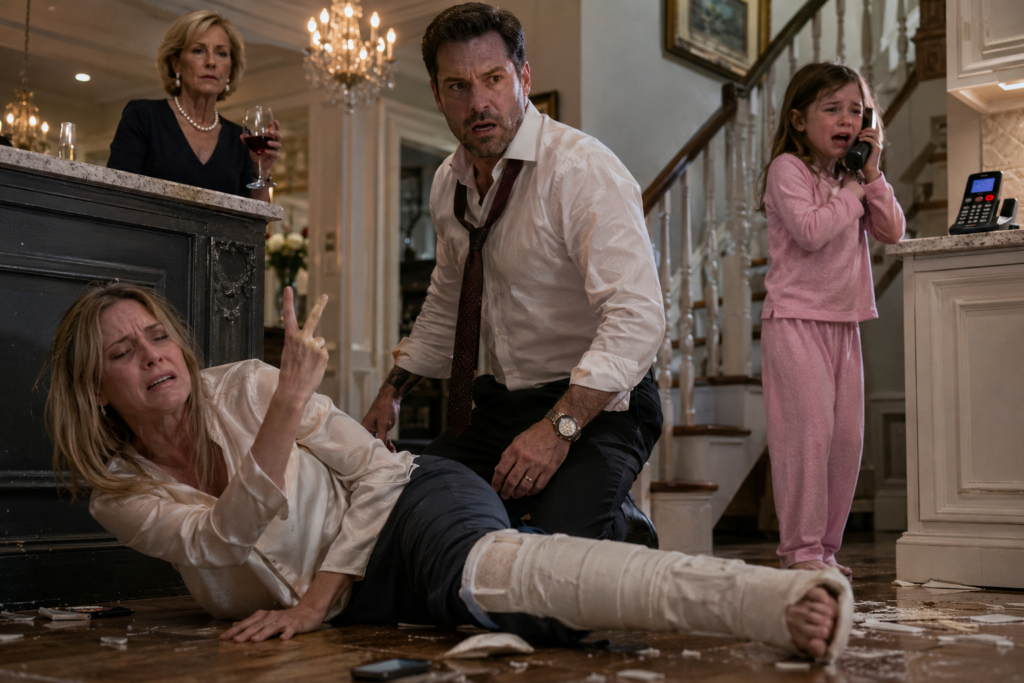
My husband broke my leg on a Tuesday night, with our four-year-old daughter watching from the stairs.
The kitchen still smelled like lemon cleaner, expensive cologne, and the bourbon on David’s breath. The bank alert glowed on my phone like a tiny blue wound in the dark.
TRANSFER COMPLETE.
Forty-eight thousand dollars.
My inheritance.
Somewhere above us, Emma’s pajama sleeve brushed against the wooden railing as she hid between the banisters, trying not to make a sound. The chandelier hummed overhead. The dishwasher clicked softly in the silence.
David stood across from me in his gray suit pants, sleeves rolled to his elbows, looking irritated—not guilty. Never guilty.
“Why did you move my mother’s money?” I asked.
He laughed once through his nose and reached for his whiskey glass.
“Your mother’s money?” he repeated. “That’s funny.”
“My father left that to me.”
“To us,” he corrected sharply.
“No,” I whispered.
His face changed then. Tiny shift. Tiny hardening. Like a door locking.
For three years I had watched those changes happen.
Marriage taught me something ugly: abuse rarely begins with violence. First it arrives as protection. Then concern. Then isolation dressed up as love. Then paperwork. Passwords. Questions. Permission.
Then one day you realize every piece of your life has quietly been placed in someone else’s hands.
David monitored our accounts because he was “better with finances.”
David answered questions for me at parties because I was “too emotional.”
David picked fights before family visits so I would cancel them myself.
And Margaret—his mother—stood beside him through all of it like a queen protecting her spoiled prince.
“She’s unstable,” she’d whisper while I stood three feet away.
“She cries too much.”
“She doesn’t appreciate what you provide.”
Sometimes David would smile while she said those things. Like they were sharing a private joke.
I should have left years earlier.
But people always ask that question without understanding what fear actually does to a person. Fear doesn’t scream all the time. Sometimes it settles into your bones quietly enough that you stop recognizing it.
And once children are involved, fear changes shape completely.
You stop wondering whether you can survive.
You start wondering whether they can.
David stepped closer to me.
“You went through my phone,” he said.
“You stole from me.”
“I transferred money between accounts.”
“You forged my signature.”
His jaw tightened.
I saw it happen too late.
He slammed the whiskey glass onto the counter so hard amber liquid splashed onto the marble. Then he grabbed my wrist.
Hard.
“Lower your voice,” he hissed.
Emma made a tiny sound upstairs.
David’s eyes flicked toward the staircase.
That terrified me more than his grip.
“Go to your room, Emma,” I said quickly.
She didn’t move.
David released my wrist and walked toward the stairs slowly, dangerously calm.
“You know,” he said without turning around, “other men wouldn’t tolerate this kind of disrespect.”
I stood frozen.
Emma’s small face appeared between the railings. Blonde curls. Wide terrified eyes.
And suddenly I remembered the signal.
The game.
Six months earlier, after David punched a hole through the pantry door beside my head, I had started teaching Emma little “safety games.” Quietly. Carefully. Never when he was home.
If Mommy says red light?
Go to your room.
If Mommy says blue sky?
Hide in the closet.
If Mommy says call Grandpa?
Run.
Children remember games better than warnings.
David took another step toward the staircase.
“Come down here,” he ordered Emma.
She shrank backward.
“David, stop.”
He turned toward me sharply. “Don’t tell me how to speak to my daughter.”
Our daughter.
But he only used that word when it benefited him.
I grabbed my phone from the counter. “I’m calling my dad.”
That was the mistake.
David moved so fast I barely saw it.
His hand hit the phone first, sending it skidding across the tile. Then both hands slammed against my shoulders.
The world tilted.
For one suspended second, all I could see was the chandelier light splintering across the ceiling.
Then pain exploded through my leg.
A sickening crack.
I hit the floor screaming.
I will never forget that sound.
Not the bone.
Emma.
The scream that came out of my child’s mouth.
David stared down at me breathing hard, almost shocked by what he’d done. Then his expression hardened again immediately, cold survival replacing panic.
“You slipped,” he said.
I couldn’t breathe.
My leg twisted beneath me at the wrong angle. White-hot nausea surged through my stomach.
Emma flew down the stairs.
“Mommy!”
“Go back upstairs!” David barked.
She froze.
I looked directly at her through tears.
“Call Grandpa.”
Her little face changed instantly.
The game.
She ran.
David cursed and lunged toward the stairs, but I grabbed his ankle with both hands.
Pain detonated through my body so violently I nearly blacked out.
“Let go of me!”
He kicked free.
Too late.
Upstairs, I heard Emma’s bedroom door slam.
Then silence.
Then tiny footsteps.
Then—
“Grandpa?” Emma’s trembling voice floated through the vent above the kitchen. “Mommy looks like she’s going to die.”
David went pale.
There was one phone in the house he didn’t know about.
An old pink flip phone my father had hidden inside Emma’s dollhouse during Christmas.
For emergencies.
Because deep down, my father knew.
Even before I admitted it to myself.
David stormed upstairs.
I dragged myself across the kitchen floor toward my shattered phone, my broken leg trailing behind me like dead weight. Every movement felt like knives grinding into bone.
Upstairs, doors slammed open.
“Emma!”
Silence.
Then my daughter’s terrified crying.
Then my father’s voice.
Faint.
Tinny.
Roaring through the tiny phone speaker.
“Emma? EMMA?!”
David ripped the dollhouse apart. I could hear plastic crashing against walls.
“You little brat!”
“No!” Emma screamed.
Something inside me snapped.
Not bone.
Something older.
Something final.
I dragged myself upright using the kitchen island and screamed with every ounce of air left in my lungs:
“DON’T TOUCH HER!”
David came charging down the stairs carrying the pink flip phone in one hand.
And suddenly we all heard it.
Sirens.
Far away.
But coming closer.
My father had called the police before David could hang up.
David stared toward the front window.
For the first time in years, he looked afraid.
“You did this,” he whispered.
Blood pounded in my ears.
He paced once across the kitchen, thinking fast, calculating.
That was David’s real talent—not rage.
Recovery.
Spin.
Excuses.
By morning he would have a story ready.
She fell.
She’s emotional.
She takes medication.
She exaggerates.
But he hadn’t counted on Emma.
Children tell the truth with horrifying precision.
The sirens grew louder.
David suddenly knelt beside me.
His entire face changed.
Soft concern. Gentle eyes.
Performance mode.
“Oh my God, baby,” he said loudly. “Why did you try to go downstairs alone?”
I stared at him in disbelief.
Even now.
Even now he was acting.
The pounding on the front door came seconds later.
“POLICE!”
David squeezed my shoulder hard enough to hurt.
“Remember what happened,” he whispered.
Then he opened the door smiling.
Two officers entered first.
Then my father.
I broke apart the second I saw him.
At seventy-one years old, Frank Bennett still looked solid enough to hold buildings upright. Gray hair. Work jacket. Calloused hands.
And eyes full of absolute murder.
He saw my leg.
Then Emma.
Then David.
Everything in his face changed.
One officer stepped between them immediately.
“What happened here?”
David opened his mouth.
Emma answered first.
“Daddy pushed Mommy down.”
Silence.
Pure silence.
Children don’t understand strategy.
Only truth.
David laughed nervously. “She’s confused—”
“She said she was gonna die,” Emma sobbed.
The female officer crouched beside her gently. “Sweetheart, where were you when Mommy got hurt?”
“On the stairs.”
“What did you see?”
Emma looked at David.
Then at me.
Then whispered:
“Daddy pushed hard.”
The officer stood slowly.
David’s mask finally cracked.
“You’re really going to trust a child?” he snapped.
“Yes,” she said flatly. “Tonight we are.”
Everything after that moved like fractured glass.
Paramedics.
Questions.
Morphine.
A stretcher.
I remember my father walking beside me while they wheeled me outside. Cold night air hit my face. Red and blue lights painted the neighborhood in violent colors.
David stood in handcuffs near the patrol car screaming my name.
Margaret arrived just in time to see it happen.
Her pearls crooked. Fur coat half-buttoned.
“This is ridiculous!” she shouted at the officers. “She’s manipulating everyone!”
My father turned toward her with a calmness so deadly it silenced the entire driveway.
“You helped him do this,” he said quietly.
Margaret actually recoiled.
Because some truths sound different when spoken aloud.
At the hospital, Emma refused to leave my side.
She sat curled against me in the bed while doctors reset my leg and nurses whispered apologies with their eyes.
Around 3 a.m., after Emma finally fell asleep against my shoulder, my father stood near the window holding a paper cup of stale coffee.
“I’m sorry,” he said.
“For what?”
“I knew he was wrong.”
I looked at him.
“I should’ve pushed harder.”
“No,” I whispered. “He pushed everyone away slowly. That’s how men like him survive.”
My father nodded once, eyes shining.
Then he asked the question that changed everything.
“Are you ready to leave him now?”
I looked down at my sleeping daughter.
At her tiny fingers wrapped around the hospital blanket.
At the child who had saved my life because I turned survival into a game she could understand.
And for the first time in years, the answer came without fear.
“Yes.”
David was charged that night.
Not just for assault.
Financial investigators uncovered forged transfers, hidden accounts, and debt under my name. Turns out men who believe they own people usually believe they own laws too.
Margaret spent months calling lawyers, family friends, anyone willing to listen.
She still claimed I ruined her son’s life.
But here’s the thing nobody tells you about surviving someone like David:
They ruin themselves eventually.
You just have to stay alive long enough to watch it happen.
A year later, Emma and I moved into a small yellow house near my father’s place.
Nothing fancy.
The floors creak.
The faucet leaks sometimes.
The kitchen is tiny.
But every door opens from the inside.
And nobody lowers their voice when footsteps approach.
Sometimes Emma still wakes from nightmares.
Sometimes I still flinch when glasses hit counters too hard.
Healing is strange like that. Your body remembers danger long after your mind understands you escaped.
But every Tuesday night, Emma and I make pancakes for dinner.
Blueberry for her.
Chocolate chip for me.
And before bed, she checks the little pink flip phone we still keep in the kitchen drawer.
Just in case.
Not because we’re afraid anymore.
Because surviving taught us something important:
Safety is not paranoia.
It’s peace earned the hard way.