“It can’t be,” I said.
The voice rang out again from the back. “Andrew… don’t take another step if you’re coming here to hurt her.” My body went limp. It was my father. Ralph. The man whose photograph my mother had kept face down for thirty years. The man she only ever spoke of by saying, “He died because he didn’t know how to be responsible.” The man I brought flowers to every Veterans Day at a nameless grave in the city cemetery, because my mother swore there was nothing left of him. But there was his voice. Older. Hoarser. Alive.
I shoved some boxes aside and moved down the narrow passage. The walls were damp, made of old stone—like those hidden tunnels in Savannah people mention in hushed tones, saying they connected old mansions, churches, and family secrets that no one ever wanted to face in a mirror. My mother grabbed my arm. “Don’t go in, son.” For the first time, her hand didn’t feel protective. It felt like a claw. “Let go of me.” “Andrew, please. That man destroyed us.” “I heard his voice.” She started to cry. But this time, her tears arrived too late. I broke free and kept going.
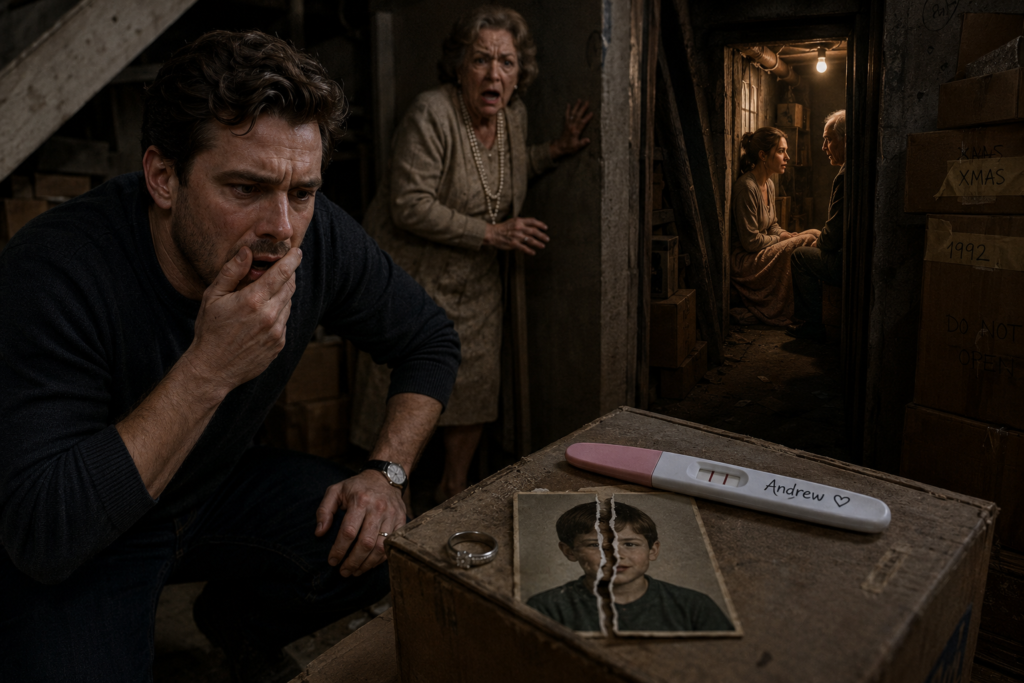
At the end was a wooden door swollen from the humidity. It was cracked open. On the other side, Sarah was sitting on the floor, wrapped in an old blanket, her face ghostly white and one hand pressed hard against her stomach. Beside her was my father. Thin. Grey-haired. With a hunched back. But with my exact same eyes.
For a second, no one spoke. I looked at Sarah, then at him, then back at Sarah. Her lips were chapped and there were red marks on her arms where I had gripped her the night before. That was the first true evidence against me. Not the pregnancy test. Not the passage. Her arms.
“Sarah,” I whispered. She didn’t move. My father raised a hand, as if he still had the right to stop me. “Don’t come any closer if you’re with her.” “Her.” He didn’t say “your mother.” He said “her.” It hurt more than I could understand.
“Dad,” I said, and the word came out as if I were learning to speak for the first time. He closed his eyes. His face crumpled. “I thought I’d never hear you call me that.”
My mother appeared behind me, breathing with rage. “What a lovely performance. Hidden for thirty years and now you come to poison my son.” My father stood up with difficulty. “I didn’t come for him. I came for Sarah. She called me last night.”
I looked at her. Sarah lowered her eyes. “I didn’t call you because I knew you wouldn’t believe me.” I wanted to say that I would. That of course I would. That I would have run to her. But the lie died before it was born. The night before, she had asked me “not today.” And I had locked the door.
“How do you know him?” I asked. My father pulled an old, yellowed hospital bracelet from his pocket, kept like a relic. It had my name on it: Andrew Ralph Morales. “Sarah found me three months ago,” he said. “She was looking for answers about your mother.”
My mother let out a dry laugh. “She was looking to separate us. That’s what she was looking for.” Sarah raised her face. She had tears, but no fear. “I was looking to understand why every time I tried to set a boundary, you made me look like I was crazy.”
My mother pointed at her. “Because you are!” “No,” Sarah said. “Because you’ve been doing that to everyone for years.”
The room turned ice cold. My father walked to a box sealed with yellow tape. He opened it. Inside were letters, photos, documents, clippings, a birth certificate, envelopes with old postmarks, and a black leather notebook. “Your mother told you I died,” he said. “But I didn’t die. She erased me.” I felt something snap behind my ribs. “She told me you had an accident.” “I left one night because Catherine threatened to report me for things I didn’t do if I tried to take you with me. I wanted to separate. I wanted to file for custody. Your mother had already locked me in here before, just like you locked Sarah in last night.”
I turned to look at her. Mrs. Catherine wasn’t crying anymore. Now, her mouth was set in a hard line. “Liar.” My father opened the notebook. “Here are the letters I sent you. They were all returned. Others never even left. Sarah found them in the upstairs wardrobe, behind the Christmas blankets.”
I remembered that wardrobe. I remembered my mother saying no one should touch her things. I remembered Sarah asking me once why there were no photos of my father in the house. I had answered her: “Because my mother suffered a lot.” How easy it had been to repeat someone else’s pain without checking if it was true.
“I couldn’t look for you anymore,” my father said. “Your uncles threatened me. They told me if I came back, Catherine would swear I beat her and you’d grow up visiting me in prison. It was a different time. I had no money, no powerful family, no strength. That was my cowardice. And I’ve paid for it every single day.”
My mother stepped forward. “I protected you, Andrew! That man was going to abandon us!” “No,” Sarah said. “You didn’t protect anyone. You were lonely, and you wanted Andrew to be lonely too.” My mother looked at her with pure hatred. “You shut up.”
Sarah tried to stand, but doubled over in pain. I rushed toward her. My father pushed against my chest. “Careful.” That phrase humiliated me more than a blow. Careful. I no longer knew how to touch my own wife without someone warning me.
I knelt in front of Sarah. “Does it hurt?” She was breathing fast. “Yes.” “The baby?” She didn’t answer. She looked at me the way one looks at a stranger who once slept beside you.
Then I remembered the pregnancy test. The last name written on the back. I went back to the storage room and picked it up from the floor with trembling hands. On the back, in blue ink, Sarah had written: “Morales. Seven weeks. May they not grow up learning to obey Catherine’s tears.”
I lost my breath. My mother tried to snatch it from me. “That’s a trap.” I pushed her aside. “Don’t touch it.” Mrs. Catherine looked at me as if I had just spat in her face. “You’re talking to me like that?” “Yes.” The word came out small. But it came out.
My father wrapped Sarah better and helped me lift her. “We have to get her to the hospital.” “No,” my mother said. “First we’re going to talk as a family.” I looked at her. For the first time, I saw the whole table. I saw the cold soup. I saw the reheated roast. I saw the calculated tears. I saw all the times Sarah had kept quiet so as not to “provoke” my mother. All the times I told her “be patient, that’s just how she is.” All the times I confused respect with submission. “My family is bleeding,” I said. “Move.”
My mother stood motionless. “If you walk out that door with her, don’t come back.” I picked Sarah up. She weighed so little. Far too little. “Then I’m not coming back.”
We went up through the passage to the storage room. The morning light was coming through the small window. Everything looked the same, and yet, I was no longer the same man who had turned the key the night before. In the living room, the house smelled of cinnamon, cold tea, and lies. On the table sat the cup my mother had given me at midnight. My father picked it up, smelled it, and looked at Catherine. “Again.” She turned pale. “Don’t start.” “What was in it?” I asked. My mother lifted her chin. “A sedative. You were agitated.”
I felt nauseous. Not because of the tea. Because of me. Because I didn’t even need to be drugged to become her accomplice. She only had to cry and I obeyed.
We went to the hospital. I don’t remember the whole drive. I remember the streets of Savannah waking up, the shops opening, the smell of sweet bread, a bell ringing in the distance, the traffic near downtown. I remember Sarah gripping my shirt when a pain crossed her body. I kept repeating: “Forgive me.” She didn’t respond. My father was in the front, staring ahead, like a man also carrying an old guilt. Every so often he turned toward me and then toward her, not knowing which of the two he had lost more.
In the ER, they took her away. I was left with empty hands. I had blood on my fingers. Very little, but enough for the whole world to accuse me. My father sat beside me. For a while, he said nothing. Neither did I. Then he spoke: “You aren’t guilty of what your mother did to me.” I swallowed hard. “But I am guilty of what I did to Sarah.” “Yes.” I was grateful he didn’t comfort me. I needed the truth.
Half an hour later, a doctor came out. “She’s stable. There’s a risk of miscarriage, but the pregnancy is still viable. She needs rest, quiet, and zero stress.” “Zero stress.” I almost laughed. As if my house wasn’t a fear factory. “Can I see her?” I asked. The doctor looked at me harshly. “She asked to see Mr. Ralph first.”
My father stood up. I didn’t complain. I stayed seated. Learning what it was like not to be chosen.
Twenty minutes passed. Then my father came out. “She wants to talk to you.” I went in. Sarah was in a bed, hooked up to an IV. Her hair was matted to her face and her eyes were tired. Seeing her like that, I realized that asking for forgiveness was far too little—almost an insult. Even so, I said it. “Forgive me.”
She looked toward the window. “I don’t know if I can.” I nodded. “I know.” “It wasn’t just last night, Andrew. Last night was the door. But you’ve been locking me out of your life for years every time you chose your mom.” I sat far away, so as not to invade her space. “I’m going to report what happened.” She turned her head. “Against your mother?” “Against her and myself. I locked you in.” Her eyes filled with tears. “Are you saying that because you’re afraid of losing me?” “Yes,” I said. “But also because I’ve already lost myself.”
Sarah closed her eyes. “I’m not going back to that house.” “I’m not going to ask you to.” “And my child is not going to grow up where a grandmother rules by crying and a father obeys by shouting.” That sentence pierced me. “Our child,” I wanted to say. But I kept quiet. I didn’t have the right to that word yet. She opened her eyes again. “I need time.” “I’ll give it to you.” “I need distance.” “That too.” “And I need you to understand something, Andrew. If I stay alive, if this baby lives, it won’t be thanks to your regret. It will be because I found an exit where you put a key.”
I couldn’t hold her gaze. “Yes.”
That afternoon, I went to the District Attorney’s office. My mother arrived before I finished my statement. She walked in furious, with her black shawl and her martyr’s face. She tried to hug me. I didn’t let her. “Tell them it was a misunderstanding,” she ordered me in a low voice. I looked at her. It was unbelievable. She still believed I was an extension of her will. “No.” Her face changed. “I am your mother.” “Sarah is my wife.” “Wives come and go.” “That’s why you ended up alone.”
She slapped me. In front of everyone. A stinging blow, filled with thirty years of control. I didn’t raise my hand. I only said: “That goes in the statement too.”
Mrs. Catherine started to cry. But no one rushed to comfort her. That was her first punishment. Not jail. Not shame. The silence of a room where her tears no longer commanded anything.
The following weeks were a collapse. My father recovered the deeds to the house and proved that part of the property was still in his name. My mother had lived for years on a borrowed throne. The neighbors—the ones who always said “Mrs. Catherine has suffered so much”—started to lower their voices when she passed.
I didn’t sleep there again. I rented a small room near Midtown, with a window that looked out onto a peeling blue wall. The first night I couldn’t close my eyes. Every time I heard a door shut, I thought of Sarah inside the storage room, asking me “please.”
I went to therapy because Sarah asked it as a condition for any future conversation. I went to anger management classes because I requested them myself. I signed an agreement where I accepted not to approach her without permission. My mother called me every day. I didn’t answer. Then she started leaving messages. First crying. Then insulting. Finally begging. “I made you a man,” she said. I deleted the message and thought: “No. You made me obedient.”
My father and I started seeing each other on Sundays. It wasn’t easy. There were no miraculous hugs or background music. There were too many dead years between us. But he told me small things: that as a baby I slept with my hand clenched, that I liked to bite wooden spoons, that the embroidered blanket was something he had ordered from a local market before I was born. One day I asked him why he didn’t hate me. He thought for a moment. “Because hating you would have been finishing Catherine’s job.” I didn’t know how to respond.
Sarah went to live with her aunt in Tybee Island. For months, I only heard from her through brief messages. “The baby is fine.” “I have an appointment Thursday.” “Don’t come.” I obeyed. For the first time in my life, obeying a woman didn’t feel like losing authority. It felt like regaining humanity.
When she was five months pregnant, Sarah agreed to let me accompany her to a check-up. I sat in a corner of the office, hands on my knees, without speaking too much. Then I heard the heartbeat. Fast. Strong. Stubborn. Like a little horse racing inside a cave. I covered my mouth and cried. Sarah looked at me, but she didn’t comfort me. That, too, was a gift. She let me feel without trying to “save” me from it.
The baby was born on a rainy dawn. A girl. Sarah named her Lucy. Not Morales first. Not as a prize for my last name. Lucy Sarah Torres. Later, with time, she said we could talk about the full registration. I didn’t argue. That girl had already survived too many heavy last names before she even opened her eyes.
When I saw her, she was red, small, furious. She cried with her whole body. My father was outside the hospital, praying without quite knowing to whom. Mrs. Catherine was not invited. She sent white flowers. Sarah returned them without a note.
I held Lucy only when Sarah allowed me to. I held her with fear. With care. With all the care I should have learned before. “Hi,” I told her. “I’m Andrew.” I didn’t say “I’m your dad.” I felt like that word had to be earned every single day.
A year later, we sold the house. Before handing it over, Sarah agreed to go one last time. We went in together, with Lucy asleep against her chest and my father walking slowly behind us. The storage room was open. Empty. No boxes. No wardrobe. No lock. The false wall had been torn down and the passage was exposed, lit by a bare bulb. It no longer looked like a secret. It looked like a clean wound.
Sarah took a chain from around her neck. From it hung her ring. The same one she left on the floor that morning. She held it in her palm. I thought she was going to give it back to me forever. Instead, she placed it on the doorframe. “It stays here,” she said. “Not as a symbol of marriage. As proof that I did get out.”
I looked at her. “Thank you for surviving me.” She took a deep breath. “I didn’t survive for you, Andrew.” I nodded. “I know.” Sarah looked at Lucy. Then she looked at me. “But you’re learning not to be like her.”
It wasn’t complete forgiveness. It wasn’t a “back to normal.” It wasn’t a happy ending of the kind that erases violence with a kiss. It was something harder. An opportunity watched over by memory.
We walked out of the house and my father closed the door without locking it. On the sidewalk, the air smelled of rain and fresh biscuits. The city still sounded the same, with bells, cars, vendors, and life. But I no longer heard my mother’s voice inside my head telling me what I should believe.
Sarah walked toward the car with Lucy in her arms. I carried the diaper bag. Nothing more. Nothing less. And as we moved forward, I understood that that morning I didn’t lose my wife in a locked room. I found her coming out of it. The one who almost stayed locked in was my entire life. And the key, finally, was no longer in my mother’s hand.


