he message came while Emma Lawson was lying on a hospital gurney in St. Vincent Medical Center in Chicago, staring at the ceiling tiles and trying not to think about the consent forms she had just signed.
I want a divorce. I don’t need a sick wife.
For a second, she thought the anesthesia nurse had already pushed something into her IV and her mind was misreading the screen. But then another message arrived from her husband, Greg.
Your sister can pick up your things after surgery. Don’t come back to the condo.
Emma read both texts three times. She was thirty-four years old, about to undergo a complicated bowel resection after months of tests, emergency admissions, and worsening pain, and her husband had chosen the fifteen minutes before they wheeled her into the operating room to leave her.
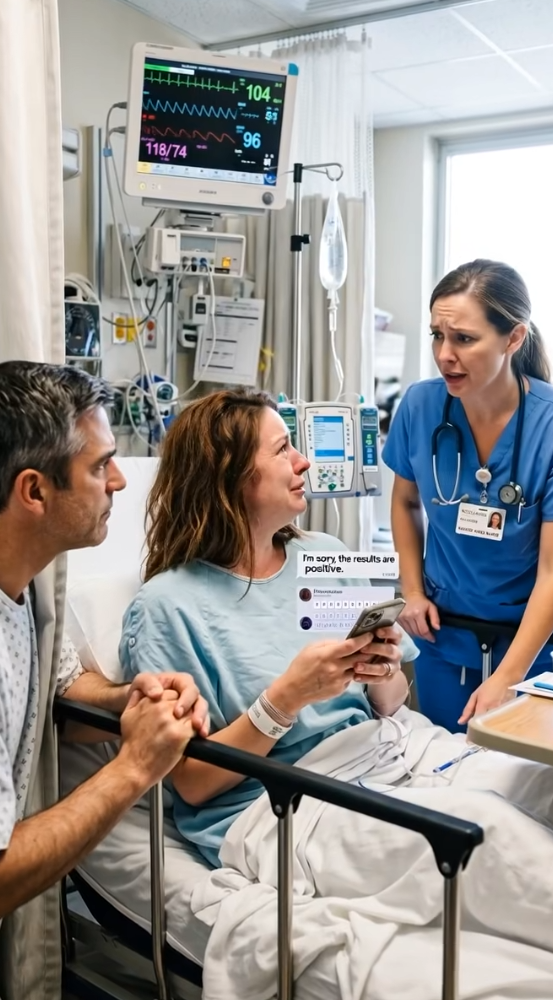
Her fingers went cold. She typed, deleted, typed again.
Are you serious?
The reply came instantly.
You’ve been sick for almost a year. I’m done living like this.
A sob escaped her before she could stop it. She turned her face toward the curtain separating her bed from the next patient, trying to hide the sound, but hospitals were made of thin fabric, thin walls, and no privacy.
A man’s voice spoke from the other side, low and careful.
“Hey. I know we’re strangers, but don’t read any more messages right now.”
Emma laughed once through tears. “A little late for that.”
The curtain shifted slightly. She could see only part of him at first: broad hand, hospital wristband, the edge of a gray blanket. He sounded older than her, maybe early forties.
“Then listen to me instead,” he said. “Anyone who sends that text before surgery is doing you a favor by leaving.”
She wiped her cheeks angrily. “That’s a terrible pep talk.”
“It’s an honest one.”
She finally looked over when a nurse stepped away from his bed. He had tired eyes, a healing bruise near his temple, and the kind of face that looked composed even under fluorescent lights. His own chart hung at the foot of the bed; he was waiting for surgery too.
“You’re in here for something serious too,” Emma said.
He gave a small nod. “Liver resection. They found a mass after a car accident scan. Lucky timing, apparently.”
She stared at him. “And you’re comforting me?”
“Seems like the better use of the next ten minutes.”
That broke something open in her, and she cried harder, not prettily, not quietly. He did not interrupt. He just let her breathe until the worst of it passed.
When she could finally speak, she said, “My husband just divorced me by text before they cut me open. If I survive this, I should probably make better life choices.”
“You should,” he said.
She managed a shaky smile. “Fine. If I survive this, we should get married.”
He studied her for a second, then, with a straight face, nodded once. “All right.”
A nurse passing between the beds stopped so suddenly her shoes squeaked. She looked from Emma to the man in the next bed and went pale.
“Oh my God,” she whispered. “Ma’am… do you have any idea who you just asked?”
Emma frowned, exhausted and confused.
The nurse lowered her voice. “That is Daniel Whitmore.”
The name hit a second later.
Daniel Whitmore. Former federal prosecutor. National news figure. Widower. The man half the country recognized from corruption trials, Senate hearings, and magazine covers.
Emma stared at the patient in the next bed.
He just gave her the faintest shrug and said, “Technically, you asked. I only accepted.”
Emma woke in intensive care with a throat like sandpaper, a fire spreading across her abdomen, and one clear memory cutting through the morphine haze: Daniel Whitmore had said yes.
For several minutes she thought she might have dreamed it. Then she turned her head and saw her older sister, Nina, sitting by the bed with swollen eyes and a paper cup of vending machine coffee.
“You’re okay,” Nina said, standing so fast the chair scraped the floor. “Surgery went well. They got the diseased section out. No perforation. The doctor said recovery will be rough, but you’re okay.”
Emma tried to speak. It came out as a croak. Nina leaned in, helped her sip water, then hesitated.
“There’s more.”
Emma closed her eyes. “Greg?”
Nina’s silence answered for her.
“He changed the locks,” Nina said quietly. “He had his brother there. They packed your clothes into trash bags and left them with the doorman. I got what I could.”
Emma stared at the ceiling. The pain in her stomach was clean and medical. The pain in her chest felt humiliating.
“He filed?” she whispered.
“This morning.”
Of course he had. Greg was an advertising executive who liked efficiency, polished shoes, and the appearance of kindness more than the work of it. Illness had ruined the image of marriage he enjoyed displaying. Emma, who once ran half-marathons and taught high school history with loud enthusiasm, had become a woman who canceled dinners, threw up after meals, and spent weekends in waiting rooms. He had stayed just long enough to resent her properly.
Late that evening, after transfer out of ICU, Emma learned Daniel Whitmore had also survived surgery. The nurse who adjusted her pain pump asked gently, “Would you like me to tell him you’re awake?”
Emma blinked. “He asked?”
The nurse smiled. “Twice.”
The next afternoon Daniel appeared in her doorway, moving slowly, one hand pressed to his side. Without the hospital gown and monitors, he looked exactly like the man from television—silver at the temples, steady-eyed, self-contained—but illness had stripped away the distance that fame usually created. He looked like what he was: a tired man in pain, carrying his own fear carefully.
“You’re supposed to be resting,” Emma said.
“So are you.”
He sat in the chair beside her bed with a controlled exhale. For a moment neither of them spoke. Then he held up a small plastic cup of orange ice.
“Peace offering,” he said. “Hospital cuisine at its finest.”
She laughed despite herself.
Over the next week, their conversations became the odd rhythm of recovery. He came by when he was able. Sometimes they talked for ten minutes; sometimes for an hour. He told her he was forty-six, lived in Boston, had left the U.S. Attorney’s Office three years earlier, and now ran a legal nonprofit focused on public corruption and procurement fraud. He had been married once. His wife, Claire, had died of leukemia four years earlier. They had no children. He said this flatly, like a fact he had learned to carry without touching too hard.
Emma told him about teaching, about growing up in Indiana, about her father’s auto shop, about Greg’s talent for sounding charming while saying cruel things softly enough that other people missed it. She admitted she was embarrassed that she had not seen him clearly sooner.
“You saw him,” Daniel said one evening. “You explained him away. That’s different.”
When she was discharged, Nina drove her to the small apartment she had hurriedly sublet for Emma near her own neighborhood. Daniel sent flowers the next morning. Not roses. White tulips and eucalyptus, restrained and clean. The card read:
You survived. Contract still under review. —Daniel
Emma laughed so hard she had to hold her stitches.
Then the story leaked.
Not the proposal itself at first. A photo surfaced online of Daniel entering St. Vincent with no suit jacket, no security detail, no polished public armor. Political blogs speculated about his health. A local reporter connected the hospitalization to a private surgical floor. Within days, someone on staff talked. By the time Emma attended her first post-op follow-up, a tabloid site had posted: MYSTERY WOMAN PROPOSED TO DANIEL WHITMORE BEFORE SURGERY.
Her phone filled with unknown numbers. Former colleagues texted links. Greg called for the first time since the divorce texts.
She did not answer.
He left a voicemail. Then another. Then he sent: We need to talk. This has gotten out of hand.
Out of hand. As if betrayal were a scheduling problem.
Daniel called that night. “Do you want help?”
“With what?”
“With the press. With legal referrals. With making sure your husband doesn’t use this to intimidate you.”
She leaned back against her pillows. “Are you always like this?”
“Like what?”
“Calm while the room is on fire.”
There was a pause. “No. I’m just practiced.”
Greg escalated when Emma didn’t respond. Through his attorney he requested a “reasonable division of shared marital property,” despite the condo lease being in his name and most savings having been moved, suspiciously, over the prior three months. Nina’s friend referred Emma to a sharp divorce attorney named Carla Ruiz, who took one look at the timeline, the financial transfers, and the pre-surgery texts and said, “He thinks you’re too weak to fight.”
Emma’s jaw tightened. “I’m not.”
“I know. That’s why we’re going to make this expensive for him.”
Meanwhile Daniel kept his distance publicly, but not personally. He called every few days. He mailed books. When Emma was strong enough to walk outside, he met her in a quiet lakeside park while wearing a baseball cap that fooled nobody. He never treated her like a charity project, never turned gentle into pity. He asked direct questions and listened to the answers.
One cold afternoon, as they sat on a bench overlooking gray water and gulls drifting over the pier, Emma said, “When I asked you to marry me, I was half delirious.”
“Half?”
She smiled. “Maybe three-quarters.”
“And now?”
She looked at him. “Now I’m curious why you said yes.”
Daniel watched the lake before answering. “Because you were honest in a moment when most people perform. Because you were terrified and still funny. Because I was terrified too.”
She felt the air change between them.
Not a promise yet. Not romance in a movie sense. Something more dangerous because it was real: recognition.
And for the first time since her diagnosis, Emma thought her life might not be ending.
It might just be starting in a way she had never planned.
By the time the divorce hearing arrived six months later, Emma Lawson no longer looked like a woman Greg had abandoned on a hospital bed.
She had gained back some weight. The shadows beneath her eyes had faded. Her scar was still tender in bad weather, and certain foods remained impossible, but she was teaching two classes again, walking every morning, and laughing without effort. Recovery had not been graceful. There had been setbacks, infections, a terrifying ER visit in August, and days when anger carried her farther than hope. But she was standing.
Greg saw that the second she entered the courthouse.
He was waiting near the elevators in a navy suit, expensive watch visible, expression arranged into concern. It was the face he used in client meetings and neighborhood fundraisers, the one that had once fooled Emma into believing composure meant character.
“Emma,” he said softly. “You look good.”
She kept walking until Carla Ruiz stopped beside her like a human warning sign. Daniel was not there; that had been deliberate. Emma did not want Greg or the court turning this into a spectacle involving a public figure. She wanted the truth to stand on its own.
Greg glanced at Carla, then back at Emma. “Can we talk privately?”
“No.”
His jaw twitched. “I made mistakes.”
“You sent divorce texts before surgery.”
“I was overwhelmed.”
“You changed the locks while I was in recovery.”
His voice lowered. “I panicked.”
Emma had once spent years translating Greg’s language into kinder meanings. Now she heard it plainly.
You were sick. I left. I thought I could get away with it.
Inside the hearing room, the facts landed hard. Carla presented the messages, the timeline of the asset transfers, the records showing Greg had moved funds into an account opened solely under his name while Emma was undergoing medical testing. Greg’s attorney tried to frame it as marital strain under unusual circumstances. The judge, a gray-haired woman with no patience for polished cruelty, asked Greg directly whether he had informed his wife of the filing before her operation.
He said yes.
The judge looked over her glasses. “By text?”
He said nothing.
That silence did more damage than any speech.
The settlement was not cinematic, but it was decisive. Emma received her fair share of the liquid assets, a portion of Greg’s bonus compensation due to the timing, reimbursement for expenses improperly shifted to her, and strong language in the record about bad-faith conduct. Greg walked out pale and furious. Emma walked out shaking, then sat on a bench in the courthouse hallway and cried from sheer release.
Carla handed her a tissue. “That,” she said, “is what consequences look like.”
When Emma turned on her phone, there was one text from Daniel.
Done?
She replied:
Done. Still alive. Still not great at courthouse drama.
His answer came almost immediately.
Good. Meet me on the river if you have the energy.
Chicago in late autumn had a hard, metallic light. Emma reached the riverwalk in a camel coat, hands buried in her pockets, and found Daniel near the railing, the wind tugging at his scarf. He looked healthier too, though the surgery had left him leaner. The pathology after his operation had been favorable; follow-up scans remained clear. He had returned to work part-time, turning down television appearances, choosing quieter cases.
“You didn’t have to stay away,” Emma said as she approached.
“Yes, I did. Today was yours.”
She stood beside him, watching the water move under the bridges. “It’s over.”
“I know.”
“I thought I’d feel triumphant.”
“And?”
She considered it. “Lighter. Sadder than I expected. Not about losing him. About how long I tried to keep something dead alive.”
Daniel nodded. “That feeling lasts a while. Then it doesn’t.”
She turned toward him. “You sound annoyingly experienced.”
“I am annoyingly experienced.”
For a moment they simply looked at each other, two people who had met under fluorescent lights and bad odds, who had witnessed each other at humiliating, frightened, unguarded moments and kept showing up anyway.
Emma smiled first. “So. About our pre-op engagement.”
“Ah yes,” he said gravely. “Legally questionable. Medically unsound. Memorable.”
“I believe you accepted.”
“I did.”
She stepped closer. “I’m not asking out of fear now.”
His expression changed, something warmer breaking through the discipline he wore so naturally.
“Emma.”
“I’m asking because you were kind when you didn’t need to be. Because you never tried to rescue me, just stand next to me. Because when my life split open, somehow you were the most honest thing in it.” Her voice shook once, then steadied. “So I’m asking again. Not today, not recklessly, not because we survived surgery. But eventually, if this keeps being what it has become… would you want that?”
Daniel exhaled slowly, as though the answer mattered enough to handle carefully.
“Yes,” he said. “Eventually, yes.”
She laughed through sudden tears. “That is the least dramatic proposal acceptance in history.”
“I’m forty-six and had abdominal surgery. You’re getting measured sincerity.”
A year later, they married in a small civil ceremony in Boston with Nina, Carla, two of Emma’s colleagues, and Daniel’s younger brother present. No magazine exclusives. No televised interest. No reinvention into a fairy tale. Emma kept her own last name. Daniel cried during the vows and looked faintly offended when Emma noticed. They went to dinner afterward at a quiet Italian restaurant where nobody bothered them.
The story that had once sounded unbelievable became, with time, ordinary in the best way. Shared groceries. Follow-up appointments. Work stress. Sunday coffee. Scar tissue. Trust built slowly enough to last.
Emma sometimes thought back to the curtained hospital bay, the sting of betrayal, the absurdity of what she had blurted out to a stranger because pain had burned her life down to the truth.
It had not saved her because he was famous.
It had saved her because he was there, and he answered with decency.
Sometimes a life changed in a grand speech.
Sometimes it changed with a nod from the next bed over.