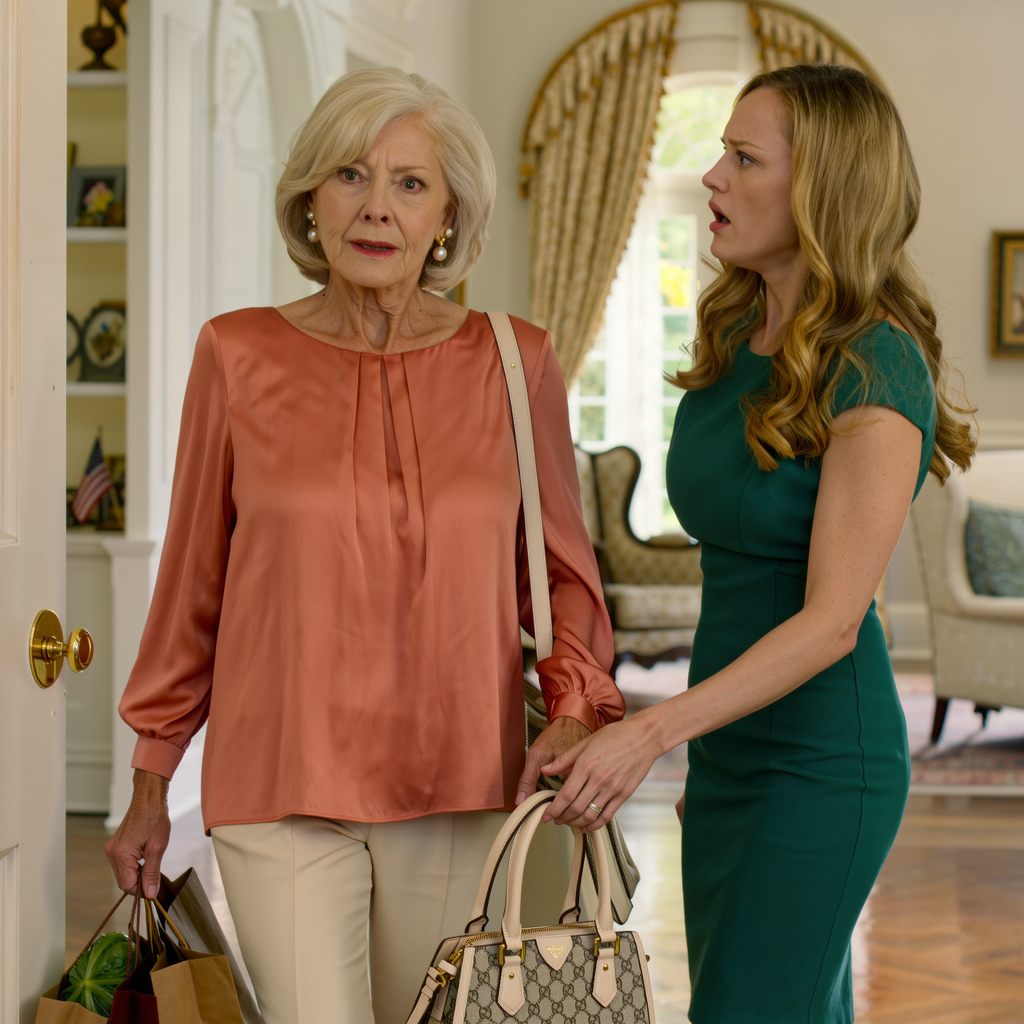
“My purse isn’t yours,” I told her.
But Ava had already slipped the strap from my shoulder the way someone takes a coat off a rack that no longer belongs in the room. “You don’t need this anymore, Mom,” she said, her voice neat as a receipt, her eyes moving over my living room the way appraisers look at a house—measured, impersonal, already assigning value.
The purse hung from her hand, soft with years of use, the leather warmed by my skin. I watched her thumb the clasp open. It clicked with such a small sound, but it felt like a door giving way inside my chest.
“Mom, I’m simplifying things,” she went on. “You get confused with bills. I’ll handle the household spending.”
She said handle the household spending as if we were in a boardroom and not in the little house my late husband and I painted together one humid July, the house where the kettle still seemed to know when to whistle for two.
She sifted through my wallet. Cards. Folded grocery lists. A photograph of Adam in his marching-band uniform. A pharmacy punch card with one square left unstamped. She didn’t see any of it. She saw numbers. Access. Leverage. The inconvenience of me.
“Give it back,” I said.
My voice was calm. I learned a long time ago that calm is not weakness. Calm is control.
She slid my debit card into her phone case anyway, as casually as if she were tucking away a coupon. “We’re done with the old system,” she said. “I’ve already spoken to the bank. They know I’m family.”
A small lie wears perfume. A bigger one has the sharp smell of solvent.
This one stung.
I moved toward the kitchen because when your balance is being taken from you in plain sight, your body starts looking for motion, for a handle, for anything that still belongs to you. The kettle gave a soft pop on the stove, a little sigh. I poured water over the tea leaves with steady hands—hands that had folded a thousand donated shirts for a church laundry fundraiser back when Ava was thirteen and complained the whole drive there.
Funny what stays with you.
She followed me, the purse tucked under her arm like a trophy.
“Coffee for me,” she said, as if we were in some little café and I was anyone but her mother. “We’ll go by the bank after this. I’ll get the limits raised, set alerts, make sure everything is streamlined. I can’t keep fixing things every time you forget a password.”
“I don’t forget,” I said. “I choose.”
She didn’t hear it. People only hear the pitch they’re already tuned to.
“I’m only doing this because I care,” she said.
And there it was—the cushion wrapped around the shove.
“You’ll thank me when everything is simpler.”
“When water is forced through a narrow pipe,” I said, “it screams.”
The kettle made a thin little sound just then, as if it had decided to agree with me.
I set a cup in front of her. She didn’t touch it. She was all movement. Her phone kept lighting up with notifications—messages from Michael, a photo of a lamp she wanted for their dining room, some promotion from a home store in the mall two towns over.
My purse sat between us on the table, small and faithful.
I sat down and took in my own house as if I had not really seen it in weeks. The threadbare rug by the back door. The spider plant that refused to die. The picture of Adam with his first car, grinning at a dent in the fender as if it were a medal. Outside, a bird tested a few notes on the gutter.
Life kept moving in its humble gears while my daughter counted the teeth.
“Ava,” I said, and she looked up.
My girl was forty-eight and still could not hold a gaze for more than three seconds when she was doing something she should not be doing.
“We are not going to the bank together.”
She blinked at me, then smiled in the slow, patient way adults smile at stubborn children. “We are,” she said. “Don’t make this difficult.”
“Difficult,” I said, “is the word people use when their plan meets a spine.”
Her smile twitched and vanished.
“Mom, enough.”
She stood, impatience drumming through her hands. “You keep the house. I’ll take the logistics. I’m signing on to everything. It’s safer that way. You’ll have an allowance. I’ll make sure your prescriptions are filled. You can just…” She fluttered her fingers, searching for a polite word. “Rest.”
I looked at those fingers—polished, quick, expensive. They had held diplomas and steering wheels and the hands of men she later left with clean breakups and tidy text messages. They had not, in a very long time, held mine.
“You can leave my purse on the table,” I said. “We’ll finish tea.”
She gave a short, sharp laugh. “You think I’m asking?”
Then she tucked the purse under her arm again, the way someone conceals something they already consider taken. “I’ll be back at three. Be ready.”
The door closed behind her with the flat sound of a stamp.
Through the window, I watched her cross my little patch of lawn—heels that made her taller than apologies, hair I used to braid before dance recitals, shoulders set with the confidence of someone who thought the matter had already been decided. She got into her car, answered a call without looking, and drove away.
Silence sat down across from me.
The tea had gone the color of old amber. I picked up my cup and drank it steadily. Heat in the mouth wakes the rest of you. On the table, the pale ring from her untouched saucer looked like chalk around something dead.
Then I noticed she had left the purse she’d brought over the week before, slung over the back of the chair by the window. I took it down and emptied it carefully. Coins. Keys. A half-empty pack of gum. The peppermints Adam was always stealing when he thought I wasn’t looking. My debit card was gone, of course.
But tucked into the lining was one envelope she had missed.
Inside was the list of questions I had written for the bank the night I woke up unable to swallow around the air in my own throat: beneficiaries, transfer limits, account authorizations, what to do if someone decided you were easier to manage than to hear.
The clock on the stove said 10:17.
Morning light lay over the rug like washed linen. People think change arrives like fireworks. At my age, it feels more like folding a shirt—corners square, fabric smoothed flat, intention obvious.
I put on my coat. I took the envelope. I left the cup in the sink, the spoon in the saucer, the kettle on its base. I locked the front door, tested the handle, felt the click like a vow.
Then I walked to the bus stop with my shoulder oddly light where a purse used to hang and my hands freer than they had felt in a long time.
The August air had that sharp edge it gets in a Midwestern town when summer knows it is running out. I rode past the library, past the bakery with its chalkboard sign for scones, past the hardware store with the old elm in front where Adam once climbed too high and froze halfway down until George coaxed him with a licorice rope and a promise not to tell his mother.
Inside the bank, it smelled faintly of printer ink, hand lotion, and lemon polish. A young teller with perfect eyeliner gave me the kind of smile trained to be polite without being intimate.
“How can I help you today, ma’am?”
“I need to close my checking account,” I said, “and move the funds somewhere safer.”
“Of course. Do you have your ID?”
I handed over my driver’s license. She typed for a moment, nails clicking against the keys, and then her expression altered almost imperceptibly.
“It’s a joint account with Ava Kent.”
I nodded once.
“There have been two withdrawals this week,” she said carefully. “One yesterday for three hundred dollars. One this morning for eight hundred.”
So that explained her confidence.
“Freeze it now,” I said, “and remove her authorization.”
The teller straightened. “We’ll need your signature for that.”
“I’m ready.”
Ten minutes later, I was sitting across from Mr. Calder, the branch manager, a silver-haired man in his fifties whose face still carried traces of the boy who used to run around Little League fields in this town. He had known George back when my husband came in smelling of sawdust and deposited cash from side carpentry jobs into a plain envelope account we called the roof fund.
“I can move the balance into an individual account immediately,” Mr. Calder said. “But if you’re worried about future access, there are stronger protections. We could place the funds into a trust in your name with a designated beneficiary.”
“Beneficiary,” I repeated.
“Someone you choose. The money remains yours while you’re living. It simply prevents interference from anyone else.”
I thought of Adam, who still came by on Sundays without asking for anything more than pie and tea. I thought of the way his hands shook when he got excited, just like George’s used to when he was building something he loved.
“I want Adam Lane as the beneficiary,” I said. “And I want it airtight.”
Mr. Calder nodded. “We’ll have legal prepare the paperwork. Do you want to include your house in the trust?”
I nearly said no.
Then I remembered Ava’s offhand comments over the years. How big houses were wasted on one person. How maybe we should think about downsizing you before you trip over a rug and break a hip. How convenient it would be if things were more centralized.
“Yes,” I said. “The house too.”
An hour later, I walked out with a temporary debit card, a folder of documents, and an appointment with their lawyer for the following Tuesday. My balance was safe. My home was moving toward safe. For the first time in months, I felt my shoulders lower from where they had been living up near my ears.
On the bus ride home, the city slid past in familiar fragments—the diner with the red stools, the feed store sign that had not changed in twenty years, the park where school bands practiced in September. I thought about Ava. She would be furious when she found out. Maybe she already was.
The house was quiet when I came in. My purse sat on the hall table, emptied of nearly everything except a crumpled receipt for milk. She had even taken the coins.
At two, the phone rang.
“Mom. Hi.” Ava’s voice was bright and false. “I went ahead and paid some bills for you this morning just to help out.”
“Thank you,” I said evenly. “Though I took care of my banking today. Everything is in order.”
There was a pause. I could almost hear her blinking.
“Oh. What do you mean?”
“I mean,” I said, “I’ve arranged things so no one has to worry about my finances anymore. No one at all.”
Her voice cooled by degrees. “Mom, I wish you’d talk to me before making big decisions. It’s not safe.”
“I know exactly what is safe for me,” I said, and cut her off before she could wrap that sentence in guilt.
Then I made tea and let it steep until the water went nearly black.
Out the window, the neighbor’s cat walked the fence with its tail high, moving as if the whole day belonged to it. I decided I would move that way too.
I did not tell Adam what had happened.
When he came by that Sunday afternoon carrying a paper bag that smelled faintly of cinnamon rolls, I smiled as if nothing had changed. He sat at the kitchen table in that awkward stretched-out way tall boys do, talking about a group project nobody else seemed interested in finishing.
“It’s like herding cats,” he said. “No one answers messages till midnight, then they want to meet at seven in the morning, and somehow I’m doing all the work.”
“Sounds like you’re learning an important adult skill,” I said, pouring his tea. “Carrying more than your share.”
He grinned. “Guess I got that from you.”
I did not want to harden his afternoon with the ugliness of Ava’s visit, the withdrawals, the bank, the panic I had swallowed whole and turned into paperwork. That would come later, when it was time. For now, I wanted to keep our Sunday ritual intact—pie, tea, small talk, the kind of ordinary tenderness that should be allowed to stay ordinary.
After he left, the house felt quieter than usual.
I wandered into my bedroom and opened the top drawer of my dresser. Under a stack of scarves lay the brown envelope from the bank. I slid it out and looked again at the preliminary trust paperwork. My name. Adam’s name. The house and funds clearly listed. It felt solid in my hands, like the click of a lock that had finally found its door.
That night I dreamed of George—not the George from the hospital bed, not the one thinned by pain and careful breathing, but the one with strong hands and a sunburn across the back of his neck. In the dream, we were painting the kitchen. He stood on a chair telling me to keep the brush wet while I pretended not to notice the green paint already dripping onto the floor.
I woke smiling, and then came the small hollow ache of remembering that the person you miss most is still gone.
The next morning I called the lawyer Mr. Calder had recommended. Her name was Ruth Meyers. Her voice was brisk but kind in the way Midwestern women can be kind—no fuss, no softness wasted, but dependable all the same.
“We can see you Tuesday at eleven,” she said. “Bring your identification, proof of property ownership, and any documents relating to your existing accounts.”
“I have them,” I said.
After I hung up, I made myself a list. I have always believed lists are a kind of armor. If you can see a task on paper, it loses some of its teeth.
Around noon, Ava called again.
“Mom, I’ve been thinking,” she began in that careful voice she uses when she is trying to sound reasonable instead of controlling. “Managing money is stressful. You’ve got enough on your plate without keeping track of due dates and balances. Why don’t we just set up an automatic transfer? I can handle the household stuff and you can relax.”
I let her talk.
It is extraordinary what people reveal when you don’t interrupt them.
She went on about convenience, peace of mind, modern banking, streamlining, all of it dressed up to look like concern.
When she finally paused, I said, “Ava, you’ve made it very clear that you think I’m not capable of handling my own affairs.”
“That’s not what I—”
“It is,” I said gently. “But here is the thing. My affairs are mine, and they are handled. There is nothing for you to manage.”
The silence that followed was thick enough to chew.
“Well,” she said at last, “I just hope you don’t regret shutting out the people who care about you.”
I smiled to myself and looked out the window at the wind chimes on the porch next door barely stirring.
“If anyone cares about me,” I said, “they can do it without needing my bank card.”
After she hung up, I underlined the next item on my list: make copies of all documents.
The copier at the library wheezed and complained like an old farm truck, but it gave me two neat sets, one for me and one for Ruth. On the walk home, I passed the bakery and glanced in the window. A young woman sat bent over a laptop, her hair falling forward in a curtain. For one startling second, she looked so much like Ava at nineteen that my breath caught.
Back then, Ava would sit at my kitchen table working through algebra, muttering at numbers, accepting a plate of cookies without ever lifting her eyes. Somewhere between that girl and the woman who had taken my purse, the space between us had filled with ledgers and conditions.
At home, I put the documents in the desk drawer beneath the address book and made tea. I sat by the window and watched the late sun catch in the neighbor’s wind chimes. They made almost no sound, just a faint shift, as if something was deciding whether to speak.
I decided I would wait until after the lawyer visit to tell Adam. When I did, I wanted to be able to explain everything clearly, without fear, and with the facts settled.
I heard the front door click open before the bell rang.
Garrett had never been patient.
“Mom, we need to talk,” he said, stepping inside without waiting for an answer. His jaw was tight, his face pinched with the strain of someone already losing an argument in his head. “Marissa’s furious. Toby’s stranded in the city without gas money. Do you understand what kind of mess you’ve made?”
I stayed seated at the kitchen table with my hands folded around my teacup.
“I understand perfectly,” I said. “For once, I’m not the one cleaning it up.”
He tossed his keys on the counter. “You can’t just pull the rug out from under your own family. We have responsibilities. Payments.”
“You have payments,” I corrected. “I had them too, until yesterday. Now they’re yours again.”
He paced once across the kitchen. “This isn’t like you. What happened? Is this about the dinner? Marissa said you cut them off over one bad moment.”
“Don’t you dare soften it.” My voice stayed quiet, but it stopped him in place. “You sent me that message. You told me your wife didn’t want me there. You let me be the easy sacrifice for the sake of keeping peace in your house. And then you showed up here with a list of needs before you ever offered an apology.”
His face changed then, not into shame exactly, but into the expression of someone who realizes the old arrangement is gone.
“It was a bad moment,” he said more quietly. “I was trying to keep the peace.”
“By sacrificing me.”
He sat down heavily and rubbed a hand across his forehead. “We’re in over our heads. Without your help, we could lose the house. Do you want that on your conscience?”
“No, Garrett. I don’t want a house I paid for to become my leash. And if losing it is what it takes for you to remember how to stand on your own two feet, then perhaps it’s a lesson worth learning.”
He stared at me for a long time. Then he tried a softer tone.
“Mom, we’re family.”
“We are,” I said. “Which is why I hoped respect might come with it. But apparently it doesn’t.”
Behind me the kettle clicked off. I poured hot water into my cup, and steam rose between us like a curtain.
“Tea?” I asked.
He shook his head. “I can’t believe you’re doing this.”
“I can’t believe it took me this long.”
Neither of us spoke for a while after that. He drummed his fingers on the table. I sipped my tea. The silence settled the way it does in this house before a storm decides whether to break or pass by.
Finally he stood. “Fine. But when things fall apart, don’t expect us to come running back here with smiles.”
“You’ve made your choice.”
I looked him in the eye. “Yes, Garrett. I finally have.”
He left without slamming the door, but the sound of his car pulling away felt louder than any shouting ever could.
The house went still again.
I rinsed my cup, dried it, and put it back where it belonged. Through the window, late-afternoon light slanted across the garden and caught on the old roses George planted decades ago. They had bloomed this year with almost no tending—stubborn, beautiful, unapologetic.
For the first time in a very long while, I realized I wanted to be like those roses.
By the next morning, the air in the house felt different. Quiet, but not heavy. The kind of quiet that lets a person think without feeling watched. I made coffee instead of tea, a small rebellion against my own habits. I left the phone face down on the counter and did not turn it on again until after my meeting.
At the bank, Mr. Calder greeted me in the lobby with a folder under his arm.
“Morning, Mrs. Lane. We’ve prepared the trust paperwork for review.”
He led me into his office, and for the next hour we went through each page. The language was clean—no loopholes, no vague phrases, nothing that could be interpreted kindly by people who had no intention of being kind. My house, my savings, and the small parcel of land George bought years ago outside town were now secured in a trust with Adam as sole beneficiary.
“This means,” Mr. Calder said, tapping the last page, “that no one else can touch these assets without your explicit consent. Even in an emergency.”
“Especially in an emergency,” I said. “That’s when people stop asking and start taking.”
He gave me the faintest smile and nodded as if I had said something he wished more clients understood.
When I left the bank, I did not go straight home. I walked down Main Street and stopped at the stationery shop. I bought a small lockbox, fresh envelopes, and a ledger book. At the pharmacy, I picked up my prescription and a tin of peppermints for Adam. It felt good to spend my own money without the ghost of someone else’s wish list hovering over the purchase.
Back at the house, I set the lockbox on the kitchen table.
Inside went the trust documents, the deed to the house, and the spare key to the safe-deposit box. I labeled envelopes in neat handwriting: utilities, property taxes, personal savings. Then I slid them into place and closed the lid.
The phone buzzed where I had left it.
When it stopped, a voicemail notification appeared. Seven new messages. I deleted them without listening.
By midafternoon I was sitting on the porch with a book when a familiar car turned into the drive. Not Garrett’s. Adam’s.
He got out holding a grocery bag and smiling as if the day had not spent hours waiting for bad news.
“Grandma, I brought that bread you like. The bakery still had it fresh.”
I took the bag and inhaled the warm yeasty smell. “You didn’t have to.”
“I wanted to.”
We made sandwiches and ate at the kitchen table. He talked about classes, a friend’s car that broke down, the way the track smelled like metal and leaves after practice. Not once did he bring up Ava or Garrett. When he left, I stood at the door and understood the difference as clearly as if someone had written it down for me.
Adam came to me as I was, not as a source of something to be extracted.
At sunset I finally turned the phone back on. A text from Ava appeared almost immediately.
I can’t believe you’re doing this to your own daughter. We’ll see about getting the bank to reverse it.
I looked at the message for a moment and typed back: They won’t. And you should stop trying.
A few minutes later she replied: You’re making a mistake you’ll regret.
Some mistakes, I thought, are worth making—especially when they are not mistakes at all.
That night I slept with the lockbox on the dresser beside my bed. It was not the money that comforted me. It was the knowledge that, for the first time in years, what was mine was not sitting open on the table for anyone else to claim.
Tuesday came crisp and bright. Ruth Meyers’ office smelled faintly of paper, coffee, and lemon polish. She was a small woman in her sixties with close-cropped hair and the kind of eyes that did not waste time.
“Mrs. Lane,” she said, standing to shake my hand. “Mr. Calder filled me in. I understand we’re finalizing your trust today.”
“Yes,” I said. “And I want it secure enough that no one can lean on it from the outside.”
“That,” she said, settling into her chair, “is exactly what we’re here to do.”
We went through every detail. My house. My savings. The parcel of land George had held onto for thirty years because he swore someday he would build a shed there and never did. Ruth explained how the trust would bypass probate, how it would stand even if a relative tried to challenge it, how any amendment would require my physical signature and a notary witness.
“No phone pressure. No assumptions. No shortcuts,” she said.
“Good.”
By the time I left her office, the documents were signed, stamped, and sealed. Adam’s name sat clearly on the beneficiary line. No room for confusion. No room for performance. No room for anyone to step in and translate my life into something easier for themselves.
I walked home slowly, taking the long way past the park. Children shrieked from the swings. Dogs chased one another across the grass. A man sat on a bench feeding breadcrumbs to pigeons that barely bothered to move. The world looked exactly as it had looked the day before. But I did not.
When I got home, the answering machine light blinked at me.
I played the messages while I hung up my coat.
First Ava, voice tight and bright with contained anger. “Mom, you can’t just lock me out like this. It’s not safe. You’re being influenced by someone at the bank. Call me back.”
Then Garrett. “This is ridiculous. You’re cutting off your own family. Do you want us to stop coming around? Because that’s where this is headed.”
Then Ava again. “I’ve spoken to a lawyer friend. We can challenge this if we have to. You’re not thinking clearly.”
The fourth message was Michael. “Margaret, this isn’t right. You need to reconsider.”
The fifth was Ava once more, colder now. “If you don’t call me, I’m coming over.”
I erased them all.
That evening, while I was chopping vegetables for soup, headlights swept across the living-room wall. A knock followed, hard enough to rattle the glass.
I opened the door to find Ava standing there, coat unbuttoned, hair mussed by the wind, eyes already scanning the room beyond me as if she were searching for evidence.
“We need to talk,” she said, stepping inside without waiting.
“No,” I said. “You need to listen.”
She stopped mid-step, caught off guard less by the words than by the fact that I said them before she could take over the room.
“I know why you came last week. I know about the withdrawals, and I know you’ve been calling the bank.”
Her face flushed. “I was trying to keep things from falling apart. You’re seventy-eight, Mom.”
“And I am still in charge of my own life.” My voice was even, which seemed to bother her more than anger would have.
“This isn’t about control,” she said, lowering her voice like we were co-conspirators. “It’s about safety. What if something happens to you? How are we supposed to handle things then?”
“You will handle them when they happen,” I said. “Not before. Not while I’m here, breathing, capable, and perfectly able to write my own checks.”
Her mouth tightened. “You’re making this harder than it needs to be.”
“I’m making it as hard as it should be.”
The space between us drew taut.
Then she reached into her bag and pulled out a folder. “These are bills you’ve been ignoring. If you won’t let me manage things, at least let me pay them.”
I did not move to take it.
“Leave them on the table,” I said. “I’ll decide what to do with them.”
She set the folder down like it was a dare. “Don’t say I didn’t try.”
Then she turned, yanked the door open, and left.
Cold wind rushed in around the frame before the house settled back into quiet.
I stood there looking at the folder for a long moment. Then I took it to the bedroom and slid it unopened into the lockbox.
Some things are more powerful untouched.
For two days after Ava’s visit, the house was undisturbed. No calls. No knocks. No headlights sweeping across the curtains. It was almost enough to make me believe she had given up.
Almost.
On the third day, I opened the mailbox and found three envelopes. The electric bill. A postcard from an old friend in Maine. And a glossy flyer from a financial-planning firm with Ava’s name scrawled across a sticky note: Thought this might help you get organized.
I dropped the flyer into the trash, put the postcard on the refrigerator with a magnet shaped like a strawberry, and filed the electric bill into the utilities envelope in the lockbox.
That afternoon, the phone rang.
I let the machine answer.
“Hi, Grandma.” Adam’s voice came through warm as always. “Mom said you might need a ride to the grocery store. I’m free this weekend if you want company.”
I picked up.
“Adam, I appreciate it, but I can get there myself. And you don’t need to run errands for me because your mother thinks you should.”
He hesitated. “She just said she was worried.”
I laughed softly. “She’s worried about the wrong things.”
We talked a little longer about his classes and his roommate’s tragic attempts at cooking. When I hung up, I could not quite decide whether Ava had sent him as a scout or whether he really wanted to help.
Probably both.
The next morning my neighbor Mrs. Ortega came over carrying a container of tamales and a puzzled look.
“Your daughter called me yesterday,” she said, lowering her voice as if the hydrangeas might overhear. “Asked if I’d check in on you more often. Make sure you’re managing all right.”
Heat rose up my neck.
“Did she now?”
Mrs. Ortega set the tamales on the counter. “I told her you’ve been managing just fine since I moved in across the street ten years ago. But I thought you should know.”
After she left, I sat at the kitchen table for a long time.
It was not only that Ava was talking about me. It was who she was talking to. Quiet interference. Planting small doubts in other people’s minds so they might bloom later into permission.
By evening, I had had enough.
I called her.
“I hear you’ve been asking the neighbors to keep an eye on me,” I said.
There was a pause. Then her voice smoothed itself out. “I just want to make sure you’re safe. What is wrong with that?”
“What’s wrong is doing it behind my back. If you have concerns, speak to me. Not everyone else in town.”
“I didn’t think you’d listen.”
“That’s because what you’re selling isn’t worth buying.”
She gave a long sigh, the kind people use when they want to sound burdened by someone else’s unfairness. “I’m trying, Mom. You make it impossible.”
“You’re not trying to help,” I said. “You’re trying to get back something you lost.”
Then I hung up.
That night, I ate Mrs. Ortega’s tamales slowly at the table while the house settled around me. The folder of bills still sat untouched in the lockbox. I considered shredding it. Instead I left it where it was. Sometimes it matters to keep a thing you refused, just to remind yourself what you refused it from.
Before bed, I wrote Adam a short note inviting him for pie on Sunday.
I thought it might be time to start telling him the things that mattered before someone else tried to tell them for me.
Sunday came with the smell of rain.
I had just taken the pie from the oven when I heard tires crunching on the gravel. Two car doors slammed—too sharp to be Adam’s easy arrival.
When I opened the front door, Ava stood there with her chin set and eyes narrowed. Behind her was Michael in his usual navy jacket, hands shoved deep into his pockets as if he were trying to keep them from revealing too much.
“We’re coming in,” Ava said, brushing past me without waiting.
Michael followed more quietly, but his eyes were busy. The desk in the corner. The side table. The shelf by the window.
I closed the door.
“What is this about?”
“You know what it’s about,” Ava said, turning to face me. “You’ve made decisions that affect the whole family without talking to anyone. You’ve frozen me out. For what? To make some point?”
“No,” I said. “To protect what’s mine.”
“That’s selfish.”
“You’ve been taking from me, Ava. That’s different.”
Michael stepped forward. “Margaret, no one is saying you’re irresponsible. But the way things are set up now is impractical. If something happens to you—”
“Something will happen to me one day,” I said. “That is how life works. But until then, I’ll decide what happens to my house and my accounts.”
Ava crossed her arms. “You’re acting like we’re strangers.”
“Family does not mean unquestioned access,” I said. “Family means trust. And you broke that when you took my purse and my card without asking.”
“You’re exaggerating.”
“Am I? The bank records say otherwise.”
Michael tried a different angle. “Maybe we can compromise. Keep Ava on the account for emergencies.”
“There is no compromise on boundaries,” I said. “Once they’re crossed, the only fix is to rebuild them higher.”
Ava’s voice rose. “Do you even hear yourself? This is insane. You’ve been influenced by that banker, that lawyer—”
“I’ve been influenced by you,” I said. “By watching exactly how far you’ll go if I let you.”
Silence dropped into the room.
Then Ava’s gaze landed on the folder she had left weeks earlier.
“Have you even looked at those bills?” she demanded.
“They are where they belong,” I said. “In my keeping. Not yours.”
She took a step toward the table. I moved before she could reach it.
“Don’t.”
Something in my tone must have reached her in a place words had not. She stopped.
Michael shifted and said quietly, “Ava, let’s go.”
She looked at him, then at me. “You’re going to regret this.”
“Maybe,” I said. “But it will be my regret to live with.”
They left together, the front door clicking shut behind them. Through the window I watched their car back out too quickly, gravel spitting beneath the tires.
The house felt warmer after they were gone.
I sat at the kitchen table with a slice of pie, the crust still warm, the filling sweet with summer apples and cinnamon. Halfway through, Adam’s car pulled into the drive. He came in holding a carton of ice cream and smiling like the day had arrived exactly as he hoped it would.
“Perfect timing,” he said.
We ate together and talked about nothing urgent. That was what I loved most about him.
But after he left, while I washed the dishes one by one, I knew this was not over. Ava was not the sort of woman who walked away simply because a door had been closed. Some people do not stop when they hit a boundary. They only change the angle of approach.
Two days passed without a word.
That should have been a relief. Instead it felt like the still air before a storm.
I filled the time with domestic things—washing curtains, trimming dead blooms from the roses, baking a loaf of bread I did not really need. On Thursday morning, the phone rang and I let it go to the machine.
Ava’s voice floated through the kitchen speaker, softer than before, almost trembling.
“Mom, I hate that we’re fighting. I’ve been thinking about Dad. He wouldn’t want us like this. We’re family. I miss just sitting and talking with you. Can we meet for lunch? My treat.”
I did not answer.
An hour later she called again.
“I know I handled things badly. I was trying to help, even if it didn’t come out right. Please don’t shut me out. I love you.”
It might have been easier to believe if she had not put a financial-planning flyer in my mailbox the week before.
That evening she called a third time, and this time I answered.
“Hello, Ava.”
Her voice brightened so quickly it sounded rehearsed. “Mom, thank you for picking up. I’ve been so worried about you.”
“I’m fine.”
“I don’t think you are,” she said gently. “You’re alone in that big house, managing bills, keeping track of everything. That’s a lot, even for someone younger. I just want to make things easier for you.”
I listened to her trade her sharp edges for soft ones.
“Easier for me,” I asked, “or easier for you?”
“For both of us,” she said quickly. “If I handled the accounts, you wouldn’t have to stress over paperwork. You could enjoy your time. I could take you out more. We could travel.”
“Travel?” I said, smiling to myself. “And who would be paying for that?”
She laughed lightly. “Between us, it wouldn’t matter. It’s all family money.”
“That’s where you’re wrong. It’s mine. And I’ll decide where it goes.”
Warmth drained from her voice at once. “Why are you being so stubborn?”
“Because stubbornness is what remains when trust runs out.”
She went quiet, then tried once more. “I don’t want to fight. Please think about it. I’ll drop by tomorrow with lunch. We can talk in person.”
“No,” I said. “If you want to see me, come on Sunday. Adam will be here too. And we will not be discussing my finances.”
There was a pause. Then: “Fine.”
On Sunday she arrived with a salad in a plastic container and a smile that was bright but too tight around the mouth. Adam was already there helping me set the table. The three of us ate together, keeping to safe topics—his classes, the cat Mrs. Ortega had adopted, the heat, the roses, the county fair.
But every so often I caught Ava glancing toward the desk where the lockbox sat hidden beneath a stack of newspapers.
She never asked.
I never offered.
After lunch, Adam helped me wash the dishes while Ava drifted into the living room. I heard her moving around, but too quietly for it to be casual. When I went in, she was standing by the bookshelf, running a finger along the spines.
“Looking for something?” I asked.
She smiled, but her eyes slid toward the desk. “Just admiring how organized you are.”
I walked past her and rested my hand on the lid. “Everything important is exactly where it belongs.”
She gave a little shrug and sat down on the couch as if nothing at all had happened.
When they left, I moved the lockbox into the bedroom closet anyway.
That night, I lay in bed thinking about how Ava had changed tactics. She had traded force for sweetness, blunt taking for soft pressure, but the destination was the same. Some people push on a locked door harder. Others try the windows. Ava, I realized, was doing both.
Late the next afternoon, while I was trimming lavender in the garden, the phone rang inside. By the time I reached it, Ava’s voice was already spilling from the answering machine.
“I don’t understand you anymore, Mom,” she said, a tremor in her words. “I’ve done nothing but try to help, and you treat me like I’m some kind of threat. Do you know how that feels? Garrett and I have been talking. He thinks you’ve been influenced by people who don’t have your best interests at heart. This isn’t like you. You used to trust me. I just want things to be the way they were.”
The machine clicked off.
I did not call back.
Instead I made tea and took it out to the porch. I knew that game too—the story turned inside out until the person who reached becomes the wounded one. It may have worked before. It did not work on me now.
The next morning she showed up without calling. No knock, just the front door opening and her voice calling down the hallway.
“Mom, we need to talk.”
I met her near the hall closet.
“You need to call before coming over,” I said.
She ignored it. “I can’t sleep. I’m worried sick about you. You’ve shut me out of everything. Do you have any idea what that’s doing to me?”
Her voice cracked in exactly the right place. Her hands were clasped in front of her as if she were standing in church. I looked at her face the way I used to when she was little and claimed she had not taken cookies from the cooling rack. The tells were all still there—the tight fingers, the quick dart of her eyes, the fraction of a second too much before the tears arrived.
“What I want,” I said slowly, “is for you to respect my boundaries. That’s all. The rest is in your hands.”
“That’s not fair. We’re family. We share. We help each other.”
“Help is offered, Ava. Not taken.”
Her lip trembled. “You make it sound like I’ve done something terrible. I was trying to protect you. You’re not as sharp as you used to be.”
I lifted my hand.
“Stop there.”
My voice was calm, but there was a line of steel in it that she had not heard from me often enough in her life.
“Do not confuse age with weakness. I know exactly what I’m doing.”
Her eyes filled, and for a second I remembered the little girl who once scraped both knees and wept over the unfairness of gravel. But that little girl was not in my hallway now.
“I’m your daughter,” she said softly. “If you can’t trust me, who can you trust?”
“Myself,” I said.
The clock in the kitchen ticked once into the silence.
Then she turned away, wiping at her cheek. “Fine. Keep pushing me out. Don’t come to me when you need something.”
“I won’t.”
She froze, perhaps expecting me to soften. When I did not, she left without another word.
Later that afternoon I found Adam’s number in my address book and called him.
“Pie on Sunday,” I said when he answered. “Bring your appetite.”
He laughed. “Always.”
I still did not tell him everything. But I knew the day was coming when I would need to.
Sunday arrived under a clean blue sky. The pie was cooling on the counter when Adam came in carrying a brown paper bag that smelled of fresh coffee beans.
“Figured you could use a refill,” he said.
We sat down with plates and forks and for a while talked only about ordinary things—his midterms, a concert he had gone to, the neighbor’s new dog that barked at everything but birds.
But the longer we sat there, the stronger the pull in my chest became.
It was time.
“Adam,” I said, setting down my fork, “I need to tell you something. And I want you to listen until I’m done.”
His brows drew together. “Okay.”
So I told him everything.
Not the softened version. Not the edited one. Everything. Ava taking my purse. The withdrawals. The bank. The trust. The calls. The visits. The neighbors. The attempt to build a story around me that I had never agreed to live inside.
He did not interrupt once, but I watched his jaw tighten and his shoulders pull rigid.
When I finished, he let out a slow breath.
“I knew something was going on,” he said quietly. “She’s been asking weird questions. About whether you’ve seemed forgetful, whether you lose things, stuff like that.”
“She’s trying to gather agreement,” I said. “The more people who nod, the more permission she thinks she has.”
“That’s messed up.”
“She’s your mother.”
He rubbed the back of his neck. “Yeah. She is. And she’s also a grown woman who makes her own choices.”
“And she’s made them,” I said. “I’m telling you because if she tries to hand you a different story, I need one person in this family to know exactly where the line was drawn.”
He looked at me for a long moment.
“I believe you,” he said. “And I’m glad you told me.”
Relief moved through me so quietly it almost felt like sadness leaving.
“Thank you.”
“I didn’t want you caught in the middle without knowing it.”
He gave a rueful half smile. “I think I was already in the middle. But at least now I know where I’m standing.”
After pie, he helped me wash the dishes. His movements were slower than usual, thoughtful. When he dried the last plate, he turned to me.
“If she tries anything else—comes here, calls, whatever—you tell me. I’m not going to let her steamroll you.”
I smiled. “I can handle myself.”
“I know,” he said. “Still. It’s good to know you’re not by yourself.”
After he left, I stood in the doorway and watched him drive away. The lightness inside me was not joy exactly, but it was close. Not because the situation was fixed. It wasn’t. But because I was no longer the only keeper of the truth.
That night, I took the lockbox from the closet and checked it again. Everything was there. Before I put it back, I slipped in one handwritten note.
Adam knows.
I do not know exactly why I wrote it. Maybe to remind myself that the truth had already been carried somewhere safer than silence. Maybe so that if anyone ever tried to twist the story after I was gone, there would be a record that it had not gone unwitnessed.
Three days later, I heard tires on the gravel again.
This time Ava did not come alone.
Michael stood beside her in the doorway, jacket zipped high against the wind, expression unreadable.
I opened the door just enough to stand in the gap.
“What do you want?”
Ava smiled tightly. “We’re here to talk, Mom. Not to argue.”
“That would be a first.”
But I stepped aside.
They came into the living room, Ava taking the couch like she was claiming territory. Michael stayed standing, hands in his pockets.
She began with a sigh, the sort used by people who are about to explain something to a child.
“This has gone far enough. You’ve made decisions based on fear, and you’ve cut me out without cause. That isn’t fair to me or to the family.”
“The family,” I repeated. “Meaning you.”
Michael spoke then, voice level. “We’re not here to fight. We just want to make sure things are being handled properly.”
“This trust is legal, binding, and none of your concern,” I said.
Ava’s eyes narrowed. “It is my concern if you’re being manipulated. That banker and that lawyer have filled your head with nonsense.”
“They’ve filled it with paperwork that protects me,” I said, “from anyone who thinks my age is an excuse to take over.”
Michael’s tone sharpened. “You know we’d never want to hurt you.”
I looked at him steadily. “Hurt doesn’t only come with raised voices, Michael. Sometimes it comes with a pen. Sometimes with a withdrawal slip. Sometimes with the assumption that fear can be dressed up as care.”
Ava’s jaw clenched. “You’re making me sound like some kind of criminal. I’m your daughter.”
“And I’m your mother,” I said. “Which means I am not here to be managed by you. I am here to live my life until I can’t anymore. And I will decide when that line is reached.”
Her eyes flicked toward the corner where the desk sat. Beneath the newspapers, the outline of nothing at all showed. But I knew what she was looking for.
Michael shifted as if considering the same direction.
“We’re not asking for much,” he said.
“You’re asking for everything,” I answered. “And I’ve already told you no.”
Ava stood abruptly, face flushed. “This is ridiculous. You’ve chosen Adam over me. You’ve made it clear who you trust.”
“I’ve chosen the person who doesn’t treat me like a vault with legs.”
Michael stepped forward once more. “Think about what you’re doing. Once you’re gone, all this will leave is bitterness. Is that what you want your legacy to be?”
“My legacy,” I said, “will be that I kept control of my own life to the end. Bitterness is someone else’s problem.”
Ava’s voice fell almost to a whisper. “You’ll regret this.”
I held her gaze. “I’ve regretted being too generous. I have never regretted being careful.”
The room went very still.
At last Michael put a hand on her arm. He guided her toward the door. She let him, though not before sending one last unreadable look through the room, as if measuring what she could not have.
When they were gone, I locked the door and stood at the window. Their car idled at the end of the drive for a long moment before turning out onto the road.
I made tea and sat at the kitchen table, letting the steam rise between my hands.
They had not come to persuade me. They had come to apply pressure together, as if numbers might make me fold.
But they had left with nothing. Not my money. Not my house. Not even a splinter of doubt.
The following Tuesday I returned to Ruth Meyers for the final signing.
Her office was warm, orderly, and filled with the quiet confidence of things done properly. A neat stack of documents waited on the conference table, each marked with a yellow tab where I needed to sign.
“This,” Ruth said, tapping the first page, “is the finalized trust agreement. It lists your home, your savings, and the parcel of land with Adam Lane as sole beneficiary. It is secure. No one, including relatives, can override it without your consent.”
I took the pen she handed me.
The ink moved smoothly across the paper, my name settling into every line where it belonged. With each signature, something knotted in my shoulders loosened a little more.
We moved on to the deed transfer, placing the house into the trust.
“This will prevent probate,” Ruth explained. “When the time comes, Adam will inherit directly, without delay or interference.”
I signed again.
When the last page was complete, Ruth gathered the stack into a large manila envelope. “You’ll receive certified copies within the week. The originals will be stored securely. I recommend you keep one copy in your lockbox at home.”
“I will.”
She leaned back slightly in her chair. “You know, most people your age come in here with their children. Sometimes the children do most of the talking. You’ve handled all of this on your own.”
“I’ve learned that if you want your voice heard,” I said, “you have to be the one using it.”
Ruth smiled. “That is wiser than most people discover.”
I left her office and walked down Main Street under a high sun. I stopped at the bakery for a loaf of sourdough and a coffee. The girl behind the counter knew me by name and slipped a cinnamon bun into the bag for free.
By the time I reached the bus stop, I felt lighter than I had in months. Not because Ava would stop trying. She wouldn’t. But because the matter was no longer open for argument. The papers were signed, sealed, and filed. Done.
At home, I unlocked the lockbox, placed the manila envelope inside, and closed it with a firm click. Then I slid it back into the closet under a folded quilt George’s sister had made in 1989.
The phone rang. Then rang again.
The machine picked up.
Ava’s voice filled the kitchen, smooth and practiced. “Mom, I heard you’ve been back to the lawyer. I wish you’d told me. We could have done this together as a family. I know you think I’m after your money. That isn’t true. I just want to make sure you’re safe. We can still fix this. Call me.”
I sat there with my tea after the message ended, thinking about how much time she must spend rehearsing those words.
Later that evening, Adam called.
“How did it go?”
“Done,” I said. “It’s all in writing.”
“That’s good,” he said, and I heard relief settle into his voice. “I’m glad you didn’t wait.”
“So am I.”
We talked a little longer, mostly about the cinnamon bun I had saved for him. When we hung up, the quiet in the house felt different. Not the heavy quiet of being observed, or judged, or cornered. The gentle quiet that comes when your decisions belong to you.
A week passed without storms.
I weeded the beans. Ironed pillowcases. Sent Adam home with the cinnamon bun and a jar of plum jam. The phone rang often, then less often. Silence, I have learned, is a kind of apology some people make only after they run out of arguments.
On Thursday, the bank called. A careful young voice informed me that someone had tried to use an old authorization at a branch across town. It had been declined, flagged, and documented.
“Would you like to speak to the manager, Mrs. Lane?”
“No, thank you,” I said. “I already know everything I need to know.”
By Saturday the sky had cleared into the bright blue of an enamel bowl. I baked a small chicken, set the table for one, and opened the windows.
The knock came just before four.
I knew it was Ava by the pause between taps, by the little intake of breath she always makes before entering a room she thinks she can still control.
I opened the door but did not step aside.
She held a bouquet from the supermarket. Tulips already past their prime, stems sweating in cloudy water.
“I don’t know how to stand here,” she said, her voice tight. “As your daughter. As a stranger. I brought flowers.”
“You can stand as you are,” I said. “The vase is full. Say what you came to say.”
She swallowed and pulled my old leather purse from a tote bag on her arm. She set it gently on the hall table as if it were something alive and sleeping.
“It’s yours,” she said. “It always was.”
I looked at the purse. Scuffed corners. Familiar clasp. The zipper catching the light where she had once tugged it open without asking.
“I was scared,” she said at last. “Money makes people do foolish things. I thought if I didn’t act, someone would take advantage of you. And then…” She stopped and let out a shaky breath. “Then I became the thing I said I was trying to protect you from.”
She looked smaller somehow, shoulders drawn in, face stripped of performance.
“I’m not asking for money,” she said. “I’m asking for a way back.”
I let the words sit between us.
“A way back is not a circle,” I said. “It’s a road with markers. If you want to walk it, you’ll know you’re on it by how you behave when no one is watching.”
She frowned slightly. “I don’t know what that means.”
“It means you call before you come over. You don’t raise your voice in my house. You don’t touch my mail, my keys, or my purse. You don’t speak about my mind as if I’m not in the room. We can have tea on Sundays. We can talk about the garden. We will not talk about my accounts.”
Her eyes lifted to mine.
“And Adam is off-limits,” I said. “He is not your messenger. He will not be pulled into sides. If you have words for me, use your own mouth.”
She nodded once, then again. “I can do that.”
For the first time in weeks, she did not sound like she was auditioning for forgiveness. She sounded tired. Human. Frightened of herself in a way I had not seen before.
“I don’t want to be the woman who barged in and grabbed her mother’s life because she was afraid of losing her own,” she whispered.
“You already were,” I said. “But you do not have to keep being her.”
We stood there in the hallway, two women who had loved each other badly for a while, both waiting to see whether the weather would break.
Finally her eyes drifted back to the purse.
“There’s nothing missing,” she said softly. Then, with a thin, embarrassed smile: “I checked. Old habit.”
“Old habits can retire.”
She asked if she could hug me.
“Not today,” I said.
I watched shame and relief cross her face together.
“Boundaries bruise when they’re new,” I told her. “Later, they hold you up.”
When she left, I put the flowers in the sink and my purse on the top shelf of the closet. Then I made tea—the good kind Adam brings—and carried my cup out to the porch.
The street breathed in its ordinary way. Children on bicycles. A dog with more bark than sense. Mr. Keegan watering his tomatoes as if expecting applause for every successful plant.
After a while, Adam arrived. I had called earlier and told him nothing urgent, only that there would be pie tomorrow if he was free. He sat on the step below mine, long legs sprawled out, the easy carelessness of youth in every angle.
“She come by?” he asked.
“She did.”
He glanced over. “Everything all right?”
“We have an understanding.”
He nodded, not pushing for details. That boy had always known the difference between curiosity and care.
We talked about his exam, the old Ford he wanted to keep alive another year, the lake he might drive to in summer. When he stood to leave, he leaned down and kissed my cheek.
“Proud of you,” he said.
Those words landed in a place that years of noise had never reached.
As the light faded, I wrote two notes.
The first I tucked into the lockbox with the trust documents: Home placed in trust. Choices made clear. Love does not require proof of funds.
The second I slipped inside the purse on the closet shelf: If you are opening this without asking, close it. Then try again with the doorbell.
I washed my dinner plate, turned the key in the front door, and stood for a moment in the quiet house that had held my best and worst days.
I am not a martyr. I am not a judge. I am an old woman who finally learned that dignity is not a gift people hand you when they feel moved enough. It is a line you draw and hold, even when your hand trembles.
I loved my daughter when she crossed that line. I will love her if she learns to see it. And if she doesn’t, I will still sleep well, because I chose myself without shouting. I did not let fear dress itself up as care and walk away wearing my name.
Tomorrow there will be coffee and pie. A phone that rings less often. A garden that insists on growing. If peace has a sound, it is the creak of a clean floor and a kettle coming slowly to a boil.


