She Called 911 on My Kids—Then Our Backyard Camera Told the Truth-aurelle
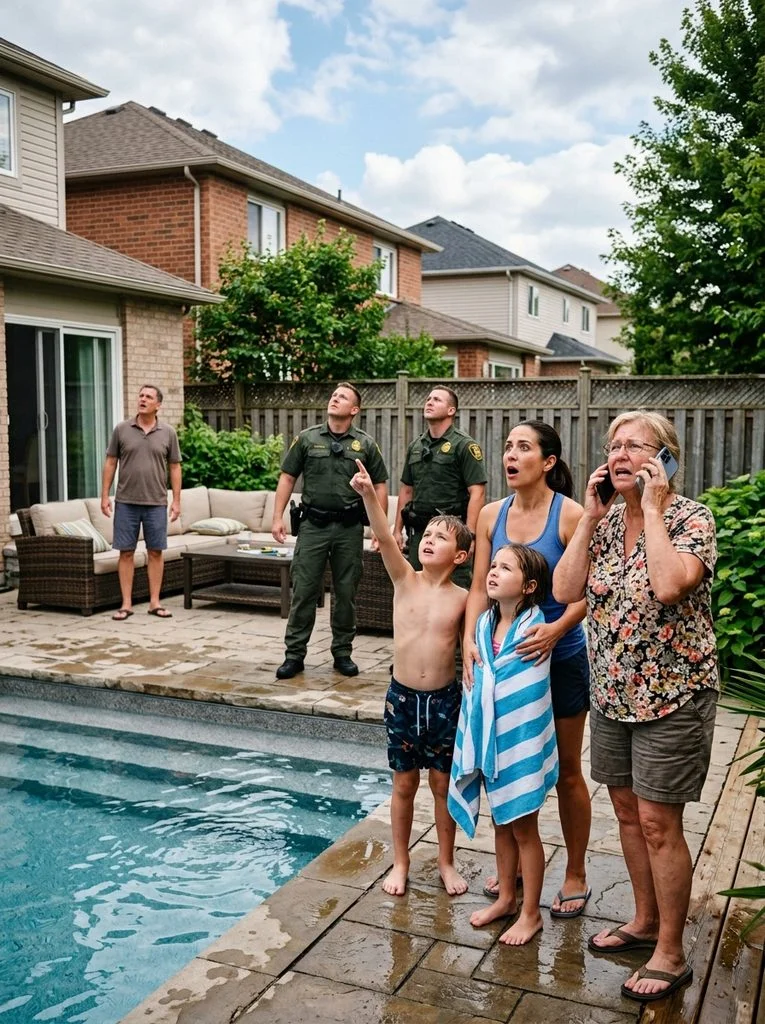
The first thing I saw when I came around the side of my house was my daughter’s red swimsuit twisted in Beverly Haskins’ fist.
For one second, my brain refused to understand what my eyes were showing me.
The patio stones were hot under my bare feet.
The air smelled like chlorine, sunscreen, and the raw burger patties I had left on the kitchen counter because lunch was supposed to go on the grill in a few minutes.
The pool water looked bright and ordinary.
That was almost the worst part.
Nothing about the backyard looked like a place where something terrible was happening.
The chairs were still where we had left them.
The towels were still draped over the backs.
The blue pool noodle Noah had been swinging like a sword floated near the shallow end.
But my nine-year-old daughter, Lily, was standing near the ladder with Beverly’s hand twisted into the fabric of her swimsuit.
My six-year-old son was frozen in the water.
Two minutes earlier, they had been laughing.
That was all I had been gone.
Two minutes.
I had stepped into the house to use the bathroom.
The patio door remained cracked open.
The kitchen timer was running.
I had raw burgers waiting on the counter.
This was not some afternoon when my children had been left alone for hours.
It was a Saturday at home.
Our home.
Our backyard.
Our pool.
Lily had been teaching Noah how to hold his breath underwater.
He was wearing ridiculous blue shark goggles he insisted made him faster.
Lily had told him goggles did not change swimming speed.
Noah disagreed.
Loudly.
They had spent ten minutes arguing about it and laughing.
That was the sound I expected to hear when I stepped back outside.
Instead, I heard Beverly.
“Get out!”
Her voice cut across the yard.
“I said get out of that pool right now!”
I turned the corner.
Lily’s face was white.
Noah stood chest-deep in the shallow water, gripping the pool noodle.
His mouth trembled underneath those shark goggles.
Then Lily saw me.
“Mom!”
There are sounds children make that parents recognize before language catches up.
That one word carried fear inside it.
I ran.
“What are you doing to my daughter?”
Beverly turned.
The way she looked at me still bothers me.
Not guilty.
Not startled.
Not like an adult caught doing something she suddenly understood was wrong.
Annoyed.
As though I had interrupted her.
Beverly Haskins was sixty-two.
She had spent years perfecting the kind of polished neighborhood presence people mistake for kindness.
White linen pants.
Gold sandals.
Pearls.
Silver hair cut neatly around her face.
At HOA meetings, she smiled before delivering bad news.
She called people “dear.”
She could reject a fence permit while making the homeowner feel as if they had somehow inconvenienced her by applying.
That afternoon, none of the polish was helping.
“These children are trespassing,” she snapped.
I stopped.
For a second, I genuinely wondered whether I had missed part of the sentence.
“Trespassing?”
She pointed toward my children.
“Beverly, this is my backyard.”
“They do not belong in this pool.”
“My children live here.”
That should have ended it.
Instead, Beverly looked at me with a level of certainty that made the air feel colder despite the heat.
“No,” she said. “This house belongs to the kind of family who understands this neighborhood.”
That was when I looked behind her.
The side gate was open.
I had locked it that morning.
I remembered doing it.
Daniel had asked whether I had checked it before the kids got into the pool.
I had pulled it shut.
Tested the latch.
Beverly had not stumbled into our backyard.
She had walked down the side path.
Opened the gate.
Entered our fenced property.
Then approached two children in the pool.
Some people break rules because they misunderstand them.
Others break rules because they have spent so long believing their status matters more than the rule itself that a boundary feels insulting.
Beverly belonged to the second group.
“Step away from them.”
My voice came out lower than I expected.
Lily tried to move toward the ladder.
Beverly blocked her.
“Don’t you dare.”
She threw one arm out.
“You stay right there until the police arrive.”
Noah started crying.
That sound reached somewhere deeper in me.
For one ugly heartbeat, I pictured grabbing Beverly’s wrist and pulling her out through the gate.
I did not.
I knew exactly how a scene like that could be retold.
Beverly would become frightened.
I would become aggressive.
The context would disappear.
So I kept my hands where they were.
“Beverly, if you touch either one of my children again, the police will be the least of your problems.”
She raised her phone.
Her expression changed.
“Oh, I’m already calling them.”
Then her voice changed too.
It became breathless.
Unsteady.
Concerned.
The performance was almost immediate.
“Yes, 911? I need officers at 1847 Magnolia Bend immediately.”
I stared at her.
“There are unsupervised children in a private pool, and I believe they are trespassing.”
She paused.
Then added the detail she had apparently been waiting to use.
“The mother is becoming aggressive.”
The mother is becoming aggressive.
I remember thinking about that sentence in a strangely detached way.
It sounded polished.
Useful.
It placed the fear where she wanted it.
Not on the woman standing inside a locked backyard holding someone else’s child.
On me.
I looked up.
That was when I remembered the camera.
A small black dome sat above the patio door.
Daniel had installed it three months earlier.
Packages had been disappearing from porches along the street.
We did not know whether it was teenagers, delivery mistakes, or somebody following trucks.
Daniel decided cameras were easier than guessing.
Beverly had mocked the idea at the next HOA meeting.
“What kind of person needs cameras in a friendly neighborhood?”
I remember that sentence because Daniel repeated it at dinner afterward.
Now the same camera had an unobstructed view of the patio.
The pool.
The side gate.
Beverly.
“Good,” I said.
She stopped talking long enough to look at me.
“Excuse me?”
“Call them.”
I nodded toward her phone.
“Please. Call everyone.”
That unsettled her.
Only slightly.
But enough that I saw it.
She expected resistance.
Maybe begging.
Maybe shouting.
Maybe she thought if I got angry enough, I would build the version of events she had already started describing.
Instead, I walked toward the pool ladder.
The time on the kitchen display inside would later show 2:14 p.m.
“Lily. Noah. Come here.”
Beverly snapped back immediately.
“They need to stay where they are.”
I turned.
“They are not evidence, Beverly. They are children.”
Lily came out first.
She was shaking.
I put a towel around her shoulders, then my arms around the towel.
Noah climbed next.
His foot slipped once on the wet ladder.
I grabbed him.
He wrapped himself around my waist with his face pressed against my shirt.
His hair was dripping.
“Are we going to jail?”
I felt something cold move through me.
Not the hot kind of anger that makes you yell.
Something quieter.
“No, baby.”
I smoothed his wet hair backward.
“You are not going anywhere.”
Beverly continued speaking to the dispatcher.
“Yes, I’m the HOA board secretary.”
As if that explained why she was inside my yard.
“I know what belongs here and what doesn’t.”
That sentence landed differently.
I looked at Lily.
She heard it too.
“No, I do not feel safe.”
Beverly looked toward me.
“She’s filming me.”
I had never touched my phone.
Then she said the sentence that would later become impossible to explain away.
“I want those children removed before this turns into a bigger problem for property values.”
The words seemed to hang over the pool.
Lily looked at me.
Noah stayed pressed against my stomach.
Property values.
My children were six and nine.
They had been swimming in their own backyard.
Yet Beverly was talking about them like an economic threat.
Above us, the camera continued recording.
At 2:18 p.m., a cruiser rolled into the driveway.
Then another.
Beverly saw them first.
Her body changed.
Shoulders back.
Chin lifted.
Relief.
Like reinforcements had arrived.
She stepped toward the officers before I said anything.
“Thank God.”
She moved quickly.
“I’m Beverly Haskins. I called.”
Officer Cole Ramsey looked toward her.
Then past her.
His eyes moved to me.
Then Lily.
Then Noah.
My children were standing near the patio chairs wrapped in towels.
“These children were in a pool that does not belong to them,” Beverly said.
Officer Ramsey looked around the yard.
“Ma’am, whose property are we standing on?”
Beverly pointed at me.
“That woman claims it’s hers.”
Claims.
I remember that word too.
I raised one hand.
“Sarah Whitaker. My husband and I bought this house last September. Those are my children.”
I pointed toward the open side gate.
“She entered our fenced backyard without permission and grabbed my daughter.”
Beverly laughed.
One short sound.
“Oh, please. I barely touched her.”
Everything in Officer Ramsey’s expression changed.
Not dramatically.
But enough.
He looked toward Beverly.
Then toward Lily.
His partner, Officer Dean Walker, crouched slightly so he was closer to my daughter’s eye level.
“Sweetheart, did this lady put her hands on you?”
Lily looked at me.
I nodded.
She swallowed.
“She pulled my swimsuit.”
Her voice was small.
“And she said we didn’t belong here.”
Beverly’s mouth tightened.
“Children exaggerate.”
Officer Walker did not answer her.
Noah wiped his nose against the corner of his towel.
Then he lifted one hand.
“Daddy’s camera saw it.”
He pointed above the patio door.
Everybody looked.
The black dome camera sat exactly where it had been all afternoon.
For the first time since I found Beverly inside the yard, she looked uncertain.
The color in her face changed.
Officer Ramsey followed Noah’s finger.
Then he looked back at Beverly.
“Mrs. Haskins,” he said, calm as a locked door, “before anyone says another word…”
He did not finish immediately.
His eyes moved from the camera to the open gate.
Then to Lily.
Then back to Beverly.
Beverly spoke first.
“That camera does not show context.”
That sentence told me she already knew what the camera might show.
Officer Ramsey raised one hand.
“Ma’am.”
She stopped.
It was the first time that afternoon anyone had stopped Beverly with one word.
Officer Walker looked at me.
“Can you access the footage?”
“Yes.”
Daniel had configured the system so we could review clips on the kitchen tablet.
I took both children with me.
I was not leaving them in the yard while Beverly continued explaining herself.
Inside, Noah stayed pressed against my side.
Lily sat at the kitchen island wrapped in her towel.
She looked down at her hands.
“Mom?”
“Yes?”
“Did I do something wrong?”
That question nearly broke me.
“No.”
I knelt beside her.
“You were swimming at home.”
“But she said—”
“I know what she said.”
I kept my voice steady.
“She was wrong.”
Officer Ramsey and Officer Walker came inside.
The kitchen still smelled faintly of raw meat from the burgers I had never put on the grill.
The timer had gone off while everything was happening.
I turned it off.
Then I opened the camera app.
The system had already marked the movement event.
2:12 p.m.
I tapped it.
The video loaded.
For a second, nobody spoke.
The frame showed the side of the patio.
The locked gate.
The pool.
The timestamp in the corner.
Then Beverly appeared.
She approached from outside the fence.
Stopped at the gate.
Put her hand on the latch.
Opened it.
Walked inside.
No confusion.
No emergency.
No children wandering onto someone else’s property.
Beverly entering ours.
The clip continued.
She moved toward the pool.
Lily turned.
Then Beverly reached for her.
The fabric of Lily’s swimsuit pulled.
Even without sound, the motion was clear.
Officer Ramsey leaned slightly closer.
Nobody said anything.
The footage did not need help.
Then the audio picked up Beverly’s voice.
“Get out!”
Noah moved toward the shallow end.
Lily tried to pull away.
“I said get out of that pool right now!”
I watched my own daughter flinch on a screen four feet away from me.
My hands curled against my knees.
I did not look at Beverly.
She was still outside.
Still talking.
Still trying to shape the story.
Inside, the camera was stripping away every layer she had added.
Officer Ramsey watched the entire sequence once.
Then he dragged the marker backward.
He played it again.
The second time, he focused on the gate.
Beverly touching the latch.
Entering.
Walking toward the pool.
Then Lily.
Her hand.
The swimsuit.
Her voice.
He paused.
Officer Walker looked toward me.
“Was she invited onto the property?”
“No.”
“Did she have permission to open that gate?”
“No.”
“Had you asked her to supervise the children?”
“No.”
Each answer made the scene simpler.
That was what Beverly had miscalculated.
Outside, she had built a complicated story.
Trespassing children.
Unsafe pool.
Aggressive mother.
HOA authority.
Property values.
Inside, the camera reduced everything.
A locked yard.
A woman entering.
Two children swimming.
A hand on a child.
Then a 911 call describing the opposite.
Officer Ramsey replayed another section.
This time, the clip reached the moment I came around the side of the house.
My own voice came through.
“What are you doing to my daughter?”
Then Beverly.
“These children are trespassing.”
Then me.
“This is my backyard.”
Officer Walker exhaled slowly through his nose.
Nobody commented.
The footage continued.
It reached the call.
Beverly’s voice shifted.
“Yes, 911?”
The difference in tone was obvious when heard against what had come before.
Breathless now.
Concerned.
“There are unsupervised children in a private pool, and I believe they are trespassing.”
I looked at Lily.
She was watching too.
I wished suddenly that she wasn’t.
Evidence was useful.
But evidence also meant seeing the moment again.
I put one arm around her.
The video kept playing.
“The mother is becoming aggressive.”
Officer Ramsey paused it.
He looked toward me.
“Were you physically threatening her at this point?”
“No.”
The clip itself answered before I needed to.
I was standing several feet away.
My hands were down.
My children were between the pool and me.
Beverly held the phone.
Then the part about property values played.
The kitchen went very quiet.
“I want those children removed before this turns into a bigger problem for property values.”
Noah looked at me.
I squeezed his shoulder.
The officers did not react theatrically.
No shocked speech.
No instant declaration.
They simply kept watching.
That calm made the moment feel more serious.
People imagine consequences arriving loudly.
Sometimes they arrive as an officer replaying the same fifteen seconds because the order matters.
Gate.
Entry.
Contact.
Call.
Claim.
The sequence was becoming the story.
Not Beverly’s description.
Not mine.
The sequence.
That was what the camera had preserved.
Beverly had assumed the first person to call 911 would control the narrative.
She had treated the emergency line like another HOA meeting.
Get there first.
Use the right words.
Describe yourself as concerned.
Describe everyone else as the problem.
Then let authority do the rest.
The camera changed that.
It did not argue.
It did not care who sat on the HOA board.
It did not know who Beverly was.
It simply recorded what happened.
That afternoon, that neutrality became more powerful than anything I could have said.
Officer Ramsey stopped the video.
“Can you save this clip?”
“Yes.”
Daniel had automatic backups enabled.
I saved it.
Then saved another copy.
Officer Walker asked whether there were earlier clips showing the gate closed before Beverly entered.
There were.
The system had recorded movement that morning when Daniel took out the trash bins.
The gate was shut afterward.
Another clip showed me checking it before the kids got into the pool.
The same latch.
Closed.
Officer Ramsey watched enough to establish the sequence.
Then he looked toward the backyard.
Through the patio glass, Beverly was still standing outside.
Her posture was no longer as confident.
She kept glancing toward the house.
Probably wondering how long it could take to watch a simple video.
What she did not understand was that every minute inside made her version weaker.
Lily shifted beside me.
“Can we go upstairs?”
“Yes.”
I took both kids out of the kitchen.
They had heard enough.
I got them dry clothes.
Noah left the shark goggles on the bathroom counter.
He usually fought me about taking them off.
That day he didn’t care.
Lily changed quietly.
She asked whether we could stay inside for the rest of the afternoon.
I said yes.
Of course.
The pool could wait.
Lunch could wait.
The burgers could go in the trash.
What mattered was getting them back to the feeling Beverly had taken from the yard.
Home.
Safety.
Ordinary.
When I returned downstairs, the officers were still speaking near the patio door.
Beverly saw me through the glass.
Her eyes narrowed.
I could almost see the calculation moving behind them.
Could she call someone from the board?
Could she invoke HOA rules?
Could she say the gate was open?
Could she say Lily pulled away and made the contact look worse?
Could she make the footage ambiguous enough that the afternoon became a disagreement?
But the clip had already answered the most important questions.
She entered.
She touched my daughter.
She called 911.
She made claims inconsistent with what the camera showed.
And she said exactly why she wanted my children removed.
Property values.
That phrase no longer belonged to a private conversation.
It existed on the recording.
I thought about Beverly mocking the camera months earlier.
What kind of person needs cameras in a friendly neighborhood?
At the time, I had rolled my eyes.
Now I understood something.
People who are comfortable controlling the story usually dislike records they cannot control.
Daniel had installed the camera because of missing packages.
He never imagined it would become the quiet witness to the worst afternoon our kids had experienced in that house.
I certainly hadn’t.
I would have preferred never needing it.
But needing evidence is not the same thing as wanting conflict.
That distinction mattered.
I had spent the first minutes of the confrontation forcing myself not to give Beverly anything she could use.
No shove.
No screaming fit.
No attempt to drag her out physically.
I had hated that restraint while Noah cried.
But now, watching the officers compare her call with the footage, I understood why it mattered.
The story did not need my anger.
It had actions.
Beverly had spent years inside the HOA learning how much power came from interpretation.
Who was reasonable.
Who was disruptive.
What belonged.
What lowered values.
What kind of family supposedly fit the neighborhood.
The camera had no category for any of that.
It recorded a woman opening a gate.
Walking onto private property.
Approaching children.
Putting a hand on one of them.
Then calling police.
That was enough to change the direction of the afternoon.
Officer Ramsey opened the patio door.
Beverly immediately began talking.
“I assume you saw that she became hostile.”
He stepped outside.
Officer Walker followed.
I stayed inside the doorway.
Not because I was afraid.
Because Lily and Noah were upstairs.
I wanted to remain close.
Beverly gestured toward me.
“She has been antagonistic since they moved in.”
Officer Ramsey asked a question I could not fully hear.
Her answer came louder.
“I was protecting the neighborhood.”
There it was again.
The neighborhood.
As though a neighborhood were a thing she owned.
As though children could be weighed against landscaping and resale prices.
As though a board title converted prejudice into stewardship.
The officers spoke to her for several minutes.
I did not interrupt.
I had already said what mattered.
My children live here.
She entered without permission.
She grabbed my daughter.
The camera saw it.
Everything else belonged to the record now.
And for the first time that afternoon, Beverly was no longer deciding what the record said.