My mother’s 78th birthday wish was simple.
She didn’t want a party.
She didn’t want an expensive gift.
She didn’t even want a big family gathering.
She wanted one quiet dinner at an Italian bistro her friends from church had been talking about for months.
They had told her about the homemade gnocchi, the warm bread, the old-fashioned atmosphere, and the recipes that supposedly tasted like something straight out of Italy.
For my mother, that was enough.
But when we arrived, the hostess took one look at my mother’s cane and worn handbag and decided we didn’t belong there.
She refused to seat us.
Then she called my mother “cheap” in front of a crowded dining room.
Ten minutes later, a crash came from the kitchen.
An elderly man in a white chef’s jacket came rushing through the doors with tears in his eyes.
And the moment he saw my mother, everything changed.
I drove through downtown with my mother humming softly in the passenger seat.
Seventy-eight years had done nothing to dull her excitement over life’s small pleasures.
Tonight, that small pleasure was a single dinner.
She had chosen her favorite dress for the occasion.
It was a vintage navy dress covered in tiny white flowers, the same dress she’d owned since I was a little girl.
I glanced over at her at a stoplight.
“You look beautiful, Mom.”
She waved me off.
“Oh, stop. I look like an old woman trying to remember what being young feels like.”
I smiled.
“You look like the prettiest woman I’ll see all night.”
She laughed.
“Thank you for doing this, Maria’s troublesome daughter.”
I laughed too.
It was an old nickname she’d given me when I was four.
Some things never changed.
And I was grateful for that.
We parked about half a block from the bistro.
I walked around to her side of the car and offered her my arm.
She gripped her cane with one hand and my elbow with the other.
Every step was slower than it used to be, but she was determined.
“The girls at church will not stop talking about this place,” she said.
“Sister Angela said the gnocchi made her cry.”
“Then we’ll get you the gnocchi.”
Mom smiled.
“Only if it’s not too expensive, cara.”
“It’s your birthday. Nothing is too expensive tonight.”
She squeezed my arm.
“You sound like your father when you say that.”
I didn’t answer immediately.
My father had been gone for nineteen years.
Mom rarely mentioned him without her voice softening into something distant.
But tonight, there was peace in her voice.
So I let the silence remain between us for a moment.
“Tell me again about Italy,” I said as we walked.
“The village. The hills.”
She smiled.
“Ah, you’ve heard it a hundred times.”
“I want to hear it a hundred and one.”
Her eyes developed that familiar wet shine whenever she talked about home.
“There was a little square with a fountain,” she began. “And the bakery on the corner where I bought bread every morning. And the boys would play soccer in the street.”
“Sounds perfect.”
“It was.”
She paused.
“Until it wasn’t. But that’s a long story for another night.”
I didn’t press her.
There were parts of my mother’s life she had folded away and tucked somewhere deep inside herself long before I was born.
I’d learned to respect the corners of her past she didn’t want to unfold.
We finally reached the bistro.
Heavy wooden doors stood beneath a warm golden light.
Through the frosted glass, I could see the soft glow of the dining room.
As another couple entered, the smell of garlic, butter, and slow-simmered tomato sauce drifted outside.
Mom stopped.
She inhaled deeply and closed her eyes.
“Oh,” she whispered.
Then she smiled.
“Oh, that smells like home.”
“Then let’s go home for a couple of hours.”
I pulled the door open for her.
She stepped inside, her cane tapping softly against the polished hardwood.
The dining room was beautiful.
Crisp white tablecloths.
Low golden lighting.
Candles flickering on the tables.
The gentle clink of silverware against porcelain.
Somewhere toward the back, a pianist played a soft, unhurried melody.
For a moment, Mom simply stood there.
She looked around.
She breathed in the familiar scent.
“Mom,” I said gently. “The hostess stand is right there.”
She nodded and squeezed my hand.
We walked toward the polished front desk.
And the warmth I had felt the moment we entered disappeared almost instantly.
A young hostess stood behind the desk in a sleek black dress.
Her name tag read Chloe.
She looked up from the reservation book.
Then she looked at us.
Not casually.
Deliberately.
Her eyes traveled from my mother’s orthopedic shoes to the cane in her hand.
Then they stopped on the worn handbag my mother held tightly against her chest.
Finally, Chloe smiled.
It was the kind of smile that looked polite until you noticed there was no warmth behind it.
“I’m so sorry,” she said, “but we’re completely booked tonight.”
I glanced over her shoulder.
There were at least seven empty tables in plain sight.
Candles were already lit.
Menus were already waiting.
“There are open tables right there,” I said, pointing.
“I can see them from here.”
Chloe’s smile became thinner.
She leaned slightly toward me and lowered her voice.
It was the kind of voice people use when they want to say something insulting while pretending they’re being helpful.
“Ma’am, our minimum spend per guest is quite high.”
She looked at my mother.
“I really don’t think this is the right fit for the two of you.”
I waited.
Then she said it.
“You look so… cheap.”
The word seemed to hang in the air.
My mother’s hand suddenly went limp inside mine.
I looked down.
She was shaking.
My mother, who had carried grocery bags up four flights of stairs well into her seventies.
My mother, who had never raised her voice at a stranger.
My mother, who had spent her entire life giving more than she ever had.
She lowered her eyes toward the floor.
“Sweetheart, please,” she whispered.
“Let’s just go. I don’t want a scene.”
I stared at her.
“Mom, no. We made a reservation. We have every right to be here.”
“It doesn’t matter, tesoro.”
Her voice was barely audible.
“It’s only dinner. We can go home. I’ll cook.”
That’s when something inside me cracked.
My mother was apologizing.
Not because she had done anything wrong.
She was apologizing for existing in a room she had been invited into.
“We made a reservation,” I said, turning back toward Chloe.
“I booked it three weeks ago. Could you please check?”
Chloe didn’t even look at the screen.
“I’m sure there’s been a mistake on your end.”
“There isn’t a mistake.”
I tried to remain calm.
“Please. Just look.”
“I don’t need to look.”
Her tone hardened.
“I’m telling you the table isn’t available.”
A couple behind us shifted awkwardly.
A man in a suit suddenly became very interested in the wine list hanging on the wall.
A woman nearby glanced at my mother, then quickly looked away.
That look somehow hurt more than Chloe’s words.
It was pity.
Embarrassment.
That silent assumption that we simply didn’t belong.
“Chloe,” I said again.
“It’s her birthday. We came because she misses Italy.”
I pointed toward the dining room.
“Please just find us a table. Any table. A bad one. By the kitchen. I don’t care.”
For a second, something flickered across Chloe’s face.
It wasn’t kindness.
It was calculation.
Then she tilted her head.
“Look, I’m trying to be nice about this,” she said.
“Honestly, there are some lovely diners a few blocks over. You’d probably be more comfortable there.”
She smiled.
“The portions are bigger too.”
My mother flinched.
“Please, sweetheart,” she whispered again.
“Let’s go.”
I felt her fingers tighten around mine.
She had raised three children.
She had stitched our school uniforms by hand.
She had skipped her own meals so that we could have second helpings.
And now, on her 78th birthday, she was begging me to let a stranger humiliate her without making a scene.
“Okay, Mom,” I whispered.
“Okay. We’ll go.”
I bent down and kissed the top of her head.
She still smelled faintly of the rosewater she’d worn since I was a child.
Then I turned back toward Chloe.
I kept my voice low so my mother wouldn’t hear the tremor in it.
“I hope someone treats your grandmother like this someday.”
Chloe stared at me.
“I really do.”
“I hope you remember tonight.”
She laughed.
It wasn’t a nervous laugh.
It was sharp.
Loud.
Ugly.
“My grandma isn’t some beggar who’d ever end up in a situation like that.”
My jaw tightened.
“Get your manager.”
“Right now.”
“The owner is busy in the kitchen,” Chloe replied.
Then she crossed her arms.
“And I am the manager on the floor tonight.”
She nodded toward the door.
“So unless you have a reservation, which you don’t, we’re done here.”
“You don’t get to talk to a 78-year-old woman like she’s nothing.”
“I didn’t say she was nothing.”
Chloe looked directly at my mother.
“I said this place isn’t for her.”
A couple at the nearest table glanced over.
Then they lowered their eyes toward their wine glasses.
Nobody wanted to become part of the confrontation.
My mother gently tugged at my sleeve.
“Please, tesoro.”
Her voice was breaking.
“I don’t want to remember my birthday like this.”
I looked down at her.
Her eyes were wet.
Yet she was still trying to smile.
That smile broke something inside me.
Not into pieces.
Into clarity.
I realized that every second I continued arguing with Chloe meant another second my mother had to stand there beneath that woman’s judgment.
My pride was costing my mother her peace.
“Okay, Mama,” I whispered.
“Okay. Let’s go.”
I bent down, picked up the edge of her shawl where it had slipped from her shoulder, and gently tucked it back into place.
Chloe gave a tiny satisfied nod.
As though she had won.
“Have a lovely evening,” she said sweetly.
I didn’t answer.
I slid my arm around my mother’s waist and turned us toward the heavy wooden doors.
We had taken maybe three steps.
Then we heard it.
A violent crash came from behind the hostess stand.
Not the sound of a wineglass being dropped.
Something heavier.
Glass shattered.
Metal clanged.
Everyone nearby turned.
I froze.
My mother flinched against me.
Behind Chloe was a small service window leading into the kitchen.
Through it, I could see steam rising and several line cooks looking toward the source of the noise.
And then I saw him.
An elderly man wearing a white chef’s jacket.
One hand was still suspended in the air.
His face had gone completely still.
He wasn’t looking at the cooks.
He was staring directly at my mother.
His mouth hung slightly open, as though a word had become trapped before he could say it.
“Sir?” one of the cooks called.
“Sir, are you okay?”
He didn’t answer.
He simply turned and disappeared from the window.
Chloe rolled her eyes.
She muttered something about clumsy kitchen staff and began straightening the menus on her stand.
Then she looked at me.
“Ma’am, the door is that way.”
My mother whispered something.
“Something’s wrong.”
I looked at her.
“That man.”
She swallowed.
“He looked at me like…”
She couldn’t finish.
Her fingers tightened around the handle of her cane until her knuckles turned white.
Then the kitchen doors suddenly slammed open.
The elderly chef came rushing out.
For a man his age, he moved remarkably fast.
His white jacket flared behind him as he crossed the dining room.
He nearly collided with a busser carrying a tray of water.
He didn’t even notice.
He walked straight toward us.
Chloe stepped forward.
“Chef, everything is under control.”
She put on her professional smile.
“These guests were just leaving.”
The man walked around her as if she weren’t even there.
Three feet from my mother, he stopped.
His eyes were filled with tears.
His hands trembled at his sides.
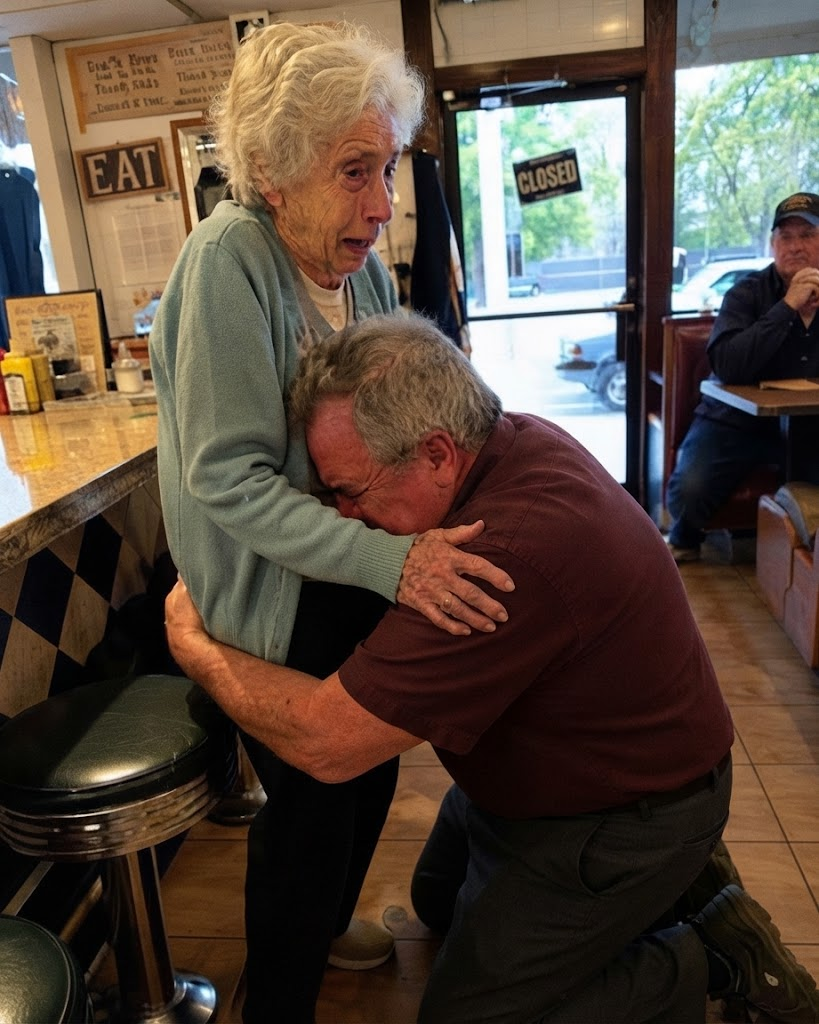
“Maria?”
My mother’s knees suddenly softened.
I caught her elbow.
And then the old chef slowly dropped to his knees in front of her.
“Cara mia,” he whispered.
“I have searched for you all these years.”
My mother’s cane slipped from her hand and clattered onto the floor.
Her lips trembled.
She stared at him as though she couldn’t trust her own eyes.
“Giovanni?”
Her voice was barely more than a breath.
“Is it really you?”
The man began to cry.
“It is me.”
He reached for her hand.
“I came to this country looking for you.”
He swallowed hard.
“I built this place hoping, praying, that one day you would walk through that door.”
Tears streamed down my mother’s face.
And suddenly, she looked younger.
Not seventy-eight.
Not tired.
Not fragile.
She looked like the woman she must have been before I was born.
“I thought you forgot me,” she whispered.
Giovanni shook his head.
“Never.”
His voice broke.
“Not one single day.”
The entire dining room had gone silent.
Every conversation had stopped.
Every face had turned toward them.
I looked toward the hostess stand.
Chloe was standing there, pale as a sheet.
Her hands were gripping the edge of the podium.
Giovanni slowly rose to his feet, still holding my mother’s hand.
Then he looked at Chloe.
His expression changed.
The warmth disappeared.
“You,” he said.
“I heard every word from the kitchen.”
Chloe swallowed.
“You told my first love—the woman I searched for—that she looked cheap.”
“Sir, I didn’t know.”
“You didn’t need to know anything about her.”
His voice was quiet, but everyone could hear it.
“You needed to be kind to every person who walks through that door.”
He walked to the hostess stand.
Then he looked at the computer screen.
His face reddened.
“Is that their reservation?”
He pointed toward the screen.
Chloe bit her lip.
Then nodded.
Giovanni didn’t hesitate.
“Collect your things.”
Chloe stared at him.
“You are finished here.”
She opened her mouth.
No words came out.
For the first time that night, she had nothing to say.
She gathered her things and walked away without another word.
Giovanni turned toward the dining room.
The staff had gathered nearby.
Several diners were still watching in stunned silence.
“No guest is ever to be treated this way again,” he said.
His voice carried across the room.
The staff nodded.
A few diners began applauding.
Then the applause spread.
Giovanni turned back toward my mother.
His face softened immediately.
He offered her his arm.
“Cara mia,” he said, smiling through his tears.
“Tonight, you sit at my table.”
He squeezed her hand.
“I will cook for you myself.”
He guided us toward the center of the dining room.
The applause grew louder.
My mother squeezed my hand beneath the tablecloth.
She was crying, but she was smiling now.
She leaned toward me.
“I told you, sweetheart,” she whispered.
“I just wanted to feel at home again.”
I looked around the room.
At the warm lights.
The white tablecloths.
The candles.
The old photographs hanging on the walls.
And at Giovanni, who had apparently spent years hoping the woman he once loved would somehow walk through his doors.
My mother had come looking for a birthday dinner.
Instead, she had found a piece of her past she thought was gone forever.
And finally, after all those years, she really was home.