I Silently Placed the Court Summons, His Messages, and Our Son’s Canceled Ticket on the Table. Then One of His Own Children Found a Note on the Fridge That Exposed the Lie He’d Told Them, Too…
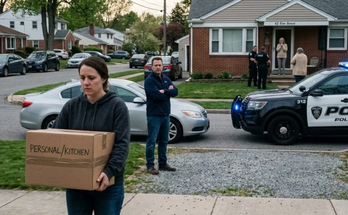
PART 1“Don’t pass out, ma’am… your son has been sitting outside our grocery store since four o’clock this afternoon, and he says there’s no adult at home.”
When I heard those words over the line, I felt the ground beneath my feet completely disappear.
I was in Chicago, having just buried my mother, and had spent nearly two weeks trying to sort through legal papers, clean out her house, and figure out what to do with a lifetime of memories packed into cardboard boxes. My eight-year-old son, Leo, was supposed to be back home in Columbus with my husband, Gideon.
Or at least, that was what I had been led to believe for days.
Gideon and I had been married for five years. It was my second marriage. Leo’s biological father had passed away when Leo was just two years old, and for a long time, I convinced myself that the best thing for my son was to grow up with a father figure in his life.
Gideon had two children from his previous relationship: Roger, eleven, and Camila, nine. Their mother lived out of state, so they spent long stretches of time living with us.
In the beginning, we seemed like a picture-perfect family: five people heading out on Sunday afternoons for dinner, road trips, birthday cakes, and smiling family photos.
But over the years, I began to notice subtle differences that I chose to rationalize.
Whenever Gideon took Roger fishing, Leo would ask, “Can I come too?”
“When you’re older, buddy,” Gideon would reply.
The problem was that Roger had started going on those trips at the exact age Leo was now.
At Christmas, Gideon bought roller skates for Roger and a tablet for Camila. For Leo, he bought… an electric shoe dryer.
“It’s practical,” Gideon had boasted proudly. “You always come home with soaked sneakers.”
My son had offered a polite smile. “Thanks, Gideon. I can warm my gloves on it, too.”
I should have understood so many things that day.
Back in March, Gideon showed up with brochures for a resort in Hilton Head and a preliminary reservation for all five of us. “As soon as school lets out, we’re heading down for a week.”
Leo had been thrilled.
Then, on May 24th, my mother died unexpectedly.
I took the first flight out to Chicago. Before leaving, I pleaded with Gideon: “Please don’t call me about household bills, water leaks, or minor chores while I’m gone. I’m going to be completely overwhelmed.”
He hugged me tightly. “You take care of your mother’s affairs. I’ll take care of the kids here.”
My stay stretched longer than planned. Every day, I asked about Leo.
“He’s doing great,” Gideon reassured me over the phone. “Playing, eating well, watching TV. Don’t worry about a thing.”
My son also sent short, reassuring text messages:
“I ate dinner, Mom.”
“Everything’s fine.”
“Love you.”
That night, the grocery store manager handed the phone back to Leo.
I listened to his soft breathing. “Sweetheart?”
“Mom… I’m sorry,” he whispered.
“Sorry for what, baby?”
“For bothering you. You’re busy dealing with Grandma’s things.”
My blood ran cold. “Where is Gideon, Leo?”
There was a long, painful pause. “At the beach… with Roger and Camila.”
“Since when?”
“Six days ago.”
I lost my voice completely. “And who are you with?”
“Nobody. I’m alone.”
Then my eight-year-old added something that completely broke my heart:
“Gideon told me not to call you because my stuff wasn’t important, and you already had enough problems.”
The grocery manager took the phone back. “Ma’am, I’ve already called the police.”
I gripped the phone until my fingers turned white.
Six days.
My son had been living alone for six days while my husband sent me daily text messages swearing that everything was completely fine.
And the worst part was that I didn’t yet know how Gideon had managed to deceive every single one of us at the same time.
PART 2
I booked a flight back to Columbus at dawn, but first, I needed to arrange a safe place for Leo to spend the night.
My mother-in-law was out of the question. My only close family member nearby was my Aunt Bernice, my father’s sister, whom Leo had called “Grandma Bernice” since he was small. She lived forty minutes away, and when the police finally reached her, she arrived at the store in a cab, still wearing her sweater over her pajamas.
The moment she saw Leo, she wrapped him tightly in her arms. “Who left this baby all alone?!”
Leo tried to smile. “It wasn’t that big of a deal, Grandma.”
That sentence hurt more than if he had burst into tears.
It wasn’t that big of a deal.
That was what my eight-year-old son had learned: that feeling afraid, hungry, or abandoned should be minimized so as not to inconvenience the adults in his life.
During my flight back, I re-read my text history with Gideon.
On Tuesday: “Everything’s quiet. Leo ate dinner and is sound asleep.”
On Wednesday: “Doing great here. You focus on your mom’s arrangements.”
On Thursday, right when my son had finished the last of the food in the fridge: “Your boy is happy as a clam. Doesn’t even miss us.”
While I was reading those messages, Leo had been reheating leftover chicken nuggets, making instant ramen, and climbing onto kitchen chairs to reach whatever was left on the high pantry shelves.
When the food ran out, he was left with a few stale crackers and thirty dollars in cash.
He tried calling Gideon twice. Gideon rejected both calls.
Desperate, my son walked over a mile down a busy road to a local grocery store. He bought a pre-made sandwich and a hot dog. Instead of walking back to the empty house, he sat down on a bench outside the entrance.
By eleven o’clock at night, he was still sitting there.
That was when the store manager, a woman named Teresa, approached him to ask whom he was waiting for.
“Nobody.”
“Where are your parents, honey?”
“My mom is burying my grandmother.”
“And your dad?”
“He’s not my dad. He’s at the beach.”
When I finally arrived at Aunt Bernice’s house, Leo threw his arms around my waist. “Are you going to yell at me for going outside alone, Mom?”
“Never, baby.”
“Gideon told me I had to stay inside.”
I knelt down in front of him. “Listen to me very carefully, Leo. Starting today, we have a new rule. If you ever need your mother, you call me. It doesn’t matter if I’m at work, sleeping, sick, or on the moon. You never have to decide whether your problem is ‘important enough’ to bother me. That decision belongs to me.”
Leo nodded quietly.
Then he revealed a detail that completely unraveled Gideon’s scheme.
“Gideon told me Grandma Bernice went to a cabin in the mountains with her friend for two weeks.”
I looked up at my aunt.
Aunt Bernice frowned. “What? I haven’t left Columbus all month.”
To me, Gideon had claimed Leo was with him at the beach.
To Leo, he had claimed Aunt Bernice was out of state.
And to my aunt…
“Gideon told me last week that he was taking Leo down to Hilton Head with the older kids!” Bernice declared, her voice trembling with indignation.
I realized then that this was no careless oversight. Gideon had constructed three distinct lies to ensure no one would go looking for my son.
I drove straight to our house.
The interior was spotless—unnaturally so.
On the refrigerator, I found a handwritten note left by Gideon:
“Reheat food maximum 3 minutes.”
“Wi-Fi password: Leo123.”
“Emergency money in drawer.”
And at the bottom, heavily underlined:
“DO NOT BOTHER MOM. SHE IS GOING THROUGH A VERY HARD TIME.”
A wave of nausea hit me.
My own heartfelt request to not be disturbed by minor home repairs had been weaponized to enforce a terrifying silence on an eight-year-old child.
In the study desk drawer, I found the original vacation booking receipts.
The original reservation was for five people: Gideon, Roger, Camila, myself, and Leo.
Two days after I flew out to Chicago for my mother’s funeral, my ticket had been canceled. That made administrative sense.
But Leo’s ticket had been canceled at the exact same time.
Using the refunded credit from both our tickets, Gideon had upgraded his hotel suite, booked first-class travel seats for himself and his two biological children, and paid for private boat charters.
He hadn’t forgotten my son. He had systematically erased him from the family vacation.
At that moment, my phone chimed with an incoming text from Gideon:
“Change of plans! Driving back tomorrow afternoon. Kids are excited to get home.”
Gideon still didn’t know I was back in town.
He didn’t know the police had interviewed Leo.
He didn’t know I had the cancellation receipts, the refrigerator note, and the text logs.
And he certainly didn’t know who would be waiting for him when he unlocked the front door.
PART 3
The afternoon Gideon returned, I chose not to involve the older children in the initial confrontation. Roger and Camila were innocent in this, and I had no desire to turn their return from vacation into a traumatic spectacle.
I had arranged for Leo to stay with Aunt Bernice.
“Can I stay another night with her, Mom?” Leo had asked that morning.
The hesitant way he asked proved he still didn’t feel safe in our house. “You can stay as long as you need, sweetheart.”
When I shut the door after he left, the house fell deathly silent.
I laid out the evidence on the dining table:
The refrigerator note.
The trip receipts.
The original reservation alongside the cancellation record.
Photographs of the empty pantry shelves.
Printed screenshots of our text conversations.
And the formal police report filed for child endangerment.
An attorney I consulted that morning advised me not to change the locks immediately, but to keep my composure. “You don’t need a shouting match,” he warned. “You need to decide how you want to live your life after today.”
At six o’clock, I heard keys jingling in the lock.
Camila ran in first, carrying a bag of sea shells. Roger followed behind her with a beach ball under his arm.
Gideon walked in last—tanned, wearing a polo shirt and shorts, wheeling two heavy suitcases, and holding an inflatable pool float. The image was sickeningly surreal. He walked in as if nothing out of the ordinary had happened.
“We’re home!” he called out.
At that exact second, a knock sounded at the door. An officer stood outside to deliver a court summons resulting from the store manager’s police report.
“Gideon Vance?” the officer asked, handing over the document.
Gideon looked at the official paper, then turned his gaze toward me. His smug, relaxed demeanor vanished instantly. “What is this, Celina?”
I waited until Roger and Camila took their bags upstairs to their rooms before gesturing toward a chair. “Sit down.”
“Celina, don’t start with the drama,” Gideon scoffed, leaning against the counter. “I’m exhausted from driving.”
“Who looked after Leo during the six days you were in South Carolina?”
His eyes flickered slightly. “The neighbor was keeping an eye on him.”
I pointed to a set of spare keys hanging by the entryway door. “The neighbor has been out of town on vacation since before you left. She left her keys so you could water her plants.”
Gideon blinked, his jaw working silently. “Well… Bernice was supposed to check in.”
“You told Aunt Bernice that Leo was in Hilton Head with you.”
Silence.
“I don’t recall saying that exactly…” he stammered.
“And you told Leo that Aunt Bernice was out of state.”
He rubbed a hand across his face, shifting uncomfortably. “Celina, you’re making a mountain out of a molehill.”
“My eight-year-old son was left completely alone for six days, Gideon.”
“He’s eight, not four!” Gideon fired back defensively. “He’s very independent!”
A profound, icy chill settled in my chest. “Do you know why he’s so independent, Gideon?”
Gideon threw his hands up. “Because he’s a smart kid!”
“Because he has spent the last five years trying his hardest not to be in your way!”
“That is absurd!”
“Absurd?” I asked, my voice rising slightly. “You bought him a shoe dryer for Christmas while your biological children got a tablet and roller skates.”
“It was a practical gift!”
“You took Roger fishing when he turned eight. You told Leo he was ‘too young’ at the exact same age.”
“You can’t keep a tally of every single interaction!”
“I didn’t keep a tally. That was my mistake.”
Gideon stood up, stepping closer. “Look, I left food! I left money! He had a phone! He had Wi-Fi!”
“The fresh food ran out on Wednesday,” I stated. “The rest was on high pantry shelves he had to drag a chair over to reach.”
“Well, he managed, didn’t he?!”
I stared at him, stunned by the sheer callousness of his words. He didn’t even realize how monstrous he sounded.
“On Thursday, he tried calling you twice,” I continued.
Gideon looked away. “It was loud on the beach. I didn’t hear it.”
“You manually rejected both calls.”
“I assumed it wasn’t an emergency!”
“How could you possibly know if you didn’t answer?”
He had no response.
“Then he walked over a mile by himself to a grocery store.”
“It’s down the street!”
“Over a mile, crossing two four-lane intersections.”
“Well, he made it there fine!”
“And he sat outside on a concrete bench from four in the afternoon until eleven at night because he was terrified of returning to an empty house!”
For the very first time, a flicker of genuine panic crossed his eyes. “I… I didn’t know that.”
“Of course you didn’t, Gideon. You were in Hilton Head.”
“You don’t have to talk to me like I’m a criminal for taking my kids on a planned vacation!”
And then, he uttered the sentence that permanently severed any remaining desire I had to save our marriage.
He said: “It was time I needed to spend alone with my real children.”
I didn’t scream. I didn’t raise my voice.
“Your real children?”
Gideon froze, realizing what he had just blurted out. “I didn’t mean it like that…”
“Leo has lived under your roof for five years.”
“He isn’t my biological son, Celina!”
“I know that, Gideon.”
“Then understand what I’m trying to say!”
“Oh, I understand completely,” I replied softly. “Finally.”
He exhaled loudly, frustrated. “Celina, don’t blow up a five-year marriage over one careless phrase.”
“I am not ending this marriage over a phrase.” I placed the original travel booking on the table between us. “Five passengers.”
Gideon looked down at the paper.
Then I placed the cancellation confirmation beside it. “Here is where you removed Leo.”
“Plans changed!”
“Two days after I flew out to my mother’s funeral,” I said. “You simplified your family so much that you left behind the child who didn’t share your blood.”
A noise sounded from the hallway archway.
Eleven-year-old Roger was standing there, holding his beach ball, staring at his father. “What?”
Gideon spun around. “Roger, I told you to stay upstairs!”
“You told us Leo didn’t want to come,” Roger said, his voice quiet.
Nine-year-old Camila stepped out from behind her brother, holding her bag of sea shells. “I brought these back for him because you said he wanted to stay with his grandmother…”
I looked at the two children. “Leo never even knew you were going to the beach.”
Camila’s mouth dropped open. “Never?”
“No, sweetheart.”
Roger glared at his father. “You lied to us.”
“Stay out of this, Roger! This is adult business!” Gideon snapped.
“You made us think he didn’t want to hang out with us!” Roger insisted, his voice shaking. “I told Camila not to text him photos so he wouldn’t feel left out!”
Camila began to cry silently.
Gideon threw his hands in the air, panicked. “Enough! Everything went wrong, okay?! I made a mistake! But nobody died!”
It was a hideous sentence to utter. And he realized it the second the words left his mouth.
Because my mother had just died.
And while I was laying my mother to rest, he had decided that my eight-year-old son could fend for himself in an empty house.
“Get out,” I told him flatly.
“What?”
“Pack a bag and go to a hotel.”
“This is my house too!”
“Legally, I can’t force you out tonight. I know that. But I am asking you to leave so Leo can come home tomorrow without having to look at you.”
Gideon let out a nervous, bitter laugh. “You’re really going to throw away a five-year marriage over six days?!”
“No,” I said, stepping right up to him. “Those six days simply gave me the clarity to see the previous five years for what they really were.”
He had no answer. He packed a small duffel bag and left.
Roger remained in the kitchen after the door shut. “Is Leo okay, Celina?”
“He’s going to be just fine, Roger.”
“I want to see him.”
“When he’s ready, buddy.”
Over the following week, Gideon tried calling me relentlessly.
First, he tried to “talk things through.”
Then he tried to rationalize his choices.
Then he turned angry.
“When the investigators ask you questions, I need you to explain that he had food!” Gideon argued over the phone.
“I will tell them the truth,” I replied.
“And that he had money!”
“Yes.”
“And a working phone!”
“Yes.”
His tone softened, becoming manipulative. “So you understand it wasn’t actual abandonment.”
“I will also explain that he was eight years old, that you left him alone for six days, that you lied to everyone about who was watching him, that you rejected his calls, and that you canceled his ticket to upgrade your hotel suite.”
Silence.
“You’ve always loved making me out to be the bad guy, Celina,” he spat.
I closed my eyes.
For five years, I had done the exact opposite. I had translated every act of dismissiveness:
“Gideon is just tired from work.”
“Gideon isn’t used to raising younger kids.”
“Gideon needs quality time with Roger and Camila.”
“Gideon didn’t mean it that way.”
I finally realized I had spent years acting as an interpreter for a man whose actions required no translation at all.
A week later, Gideon asked to see Leo. I didn’t force my son.
“Do you want to see him, Leo?” I asked gently.
“Only if Grandma Bernice is there,” Leo replied quietly.
We met at my aunt’s house. Roger and Camila came along as well.
Camila dumped her bag of sea shells onto the table in front of Leo. “These are for you.”
Leo picked one up, inspecting it. “It’s really pretty.”
“Dad told us you didn’t want to go to Hilton Head,” Camila offered softly.
Leo frowned. “Go where?”
Camila looked up at Gideon. Roger did, too.
“See?” Roger said to his father. “Another lie.”
Gideon looked smaller sitting in the armchair. “Yes… I lied to you guys.”
Leo didn’t yell. He didn’t cry. He simply sat in silence.
“I… I made a terrible choice, Leo,” Gideon stammered, looking at my son. “I thought you were responsible enough to stay home for a few days.”
My son looked at him with a serious, quiet maturity that no eight-year-old should have to possess. “Then why didn’t you leave Roger home, too?”
The room went dead silent.
Gideon bowed his head, unable to answer. Because that was the simplest, most devastating question of all—and there was no lie that could save him from it.
“Because I was unfair to you, Leo,” Gideon admitted quietly.
“Oh,” Leo murmured, looking back down at the sea shells.
That quiet, simple “oh” cut deeper than any shouting match ever could.
As we walked out to the car, Gideon caught up with me on the driveway. “I can change, Celina. Please.”
I handed him a manila envelope containing the divorce papers my attorney had drafted.
“Celina, please…”
“I hope you do change, Gideon,” I said softly.
He looked at me, a sudden spark of hope in his eyes. “Does that mean we have a chance?”
“No. I hope you change for Roger and Camila’s sake. They need a better father. And because you’ll have to live with what you did. But you changing doesn’t mean I will ever trust you with my son’s life again.”
EPILOGUE
The divorce took several difficult months to finalize.
We argued over property division, savings accounts, and shared assets. Eventually, the house was sold, and the proceeds were split per the court decree.
Leo and I moved into a sunlit two-bedroom apartment near his elementary school and the community sports facility where I worked.
On our first night in the new apartment, Leo explored every room. “We have a window in our bathroom, Mom!”
“We sure do, sweetie.”
“That’s fancy.”
“Why’s that?”
“You can take a bath and know if it’s raining outside!”
I smiled, hearing him joke and laugh again. I had forgotten how much I missed the lighthearted version of my son.
Over time, Roger and Camila came to visit us occasionally. Camila texted Leo often. I never asked the kids to take sides—they had been deceived by Gideon just as much as we had.
Gideon, meanwhile, spent months facing the legal and social fallout of the child endangerment charges. His custody arrangement with his biological children was reassigned, and he was required to complete parenting classes.
A year later, Leo and I walked back to the grocery store where manager Teresa had found him that night.
Leo had insisted on buying her a box of chocolates.
Teresa stepped out of her office the moment she saw us. “Look how much you’ve grown, big guy!”
“I didn’t grow that much,” Leo giggled.
“At your age, you grow every fifteen minutes!”
Leo laughed, wrapping his arms around her in a warm hug.
When we walked outside, Leo stopped to look at the wooden bench where he had sat waiting all those hours. The store had recently painted it a bright, cheerful blue.
He sat down on the blue bench, and I sat beside him.
For a long time, I had viewed that bench as the absolute symbol of my failure as a mother—proof that while my son sat alone in the dark, I was hundreds of miles away, oblivious to what was happening in my own home.
But over time, I came to view that bench differently.
That bench was the exact spot where Leo finally stopped trying to handle everything alone. It was the spot where a caring stranger looked at an eight-year-old boy and decided he mattered.
Leo swung his legs over the edge. “Mom?”
“Yes, baby?”
“Is Gideon a bad person?”
I took a deep breath. It would have been easy to say yes, but life is rarely that simple. “Gideon did a very terrible thing, Leo.”
“That’s not what I asked.”
I smiled sadly. “I know.”
Leo waited quietly.
“People can do awful things and later feel truly sorry for them,” I explained. “But feeling sorry doesn’t obligate the people they hurt to trust them ever again.”
“Did you forgive him?”
I thought about it for a moment. “I’m working on it.”
“Then why did you get a divorce?”
“Because forgiving someone and putting your safety back in their hands are two entirely different things.”
Leo swung his legs, looking at his sneakers. “If I ever need you again… will you really come?”
I wrapped my arm around his shoulders. “Even if I’m on the other side of the country.”
“What if I’m in another country?”
“That too.”
“What if I’m at the North Pole?”
“Well, then we’ll have to check flight prices first.”
He burst out laughing.
Then he pointed toward the store doors. “I want an ice cream cone.”
“We just walked out of there, Leo!”
“Exactly. It’s right here.”
We stood up together. Before walking inside, he reached up and took my hand—something he rarely did anymore. I squeezed his little fingers tightly.
I couldn’t erase those six terrible days. I couldn’t guarantee that no adult would ever disappoint him again in his life.
But I could promise him one thing: he would never again have to decide alone whether his pain was important enough to ask for help.
Because children should never have to earn their place in a family by staying quiet, eating scraps, or trying not to be a burden.
Real family begins the day a child can say “I need you” without ever fearing they are a burden.
And it ends the moment an adult hears those exact words… and decides they have more important places to be.