My Easter dinner ended with a shattered wine glass, blood on my face, and my son calling me selfish because I refused to let his wife’s parents move into my house. I quietly drove myself to the ER. While the doctors treated me, I texted my lawyer five words: “Phase one is complete.” Soon afterward, the police arrived.
Easter dinner was supposed to be the last peaceful meal before I gave my son the answer he didn’t want.
My name is Margaret Lawson. I’m sixty-two, widowed, and I own a four-bedroom house outside Columbus, Ohio. My husband, Richard, died six years ago. The mortgage had been paid off long before then, and the deed was entirely in my name.
For three months, my son Daniel, thirty-five, and his wife Vanessa, thirty-three, had been pressuring me to let Vanessa’s parents move in.
“It’s temporary,” Daniel kept saying.
Temporary became, “They can have the two upstairs bedrooms.”
Then Vanessa suggested her father could convert my garage into a workshop.
I had already said no seven times.
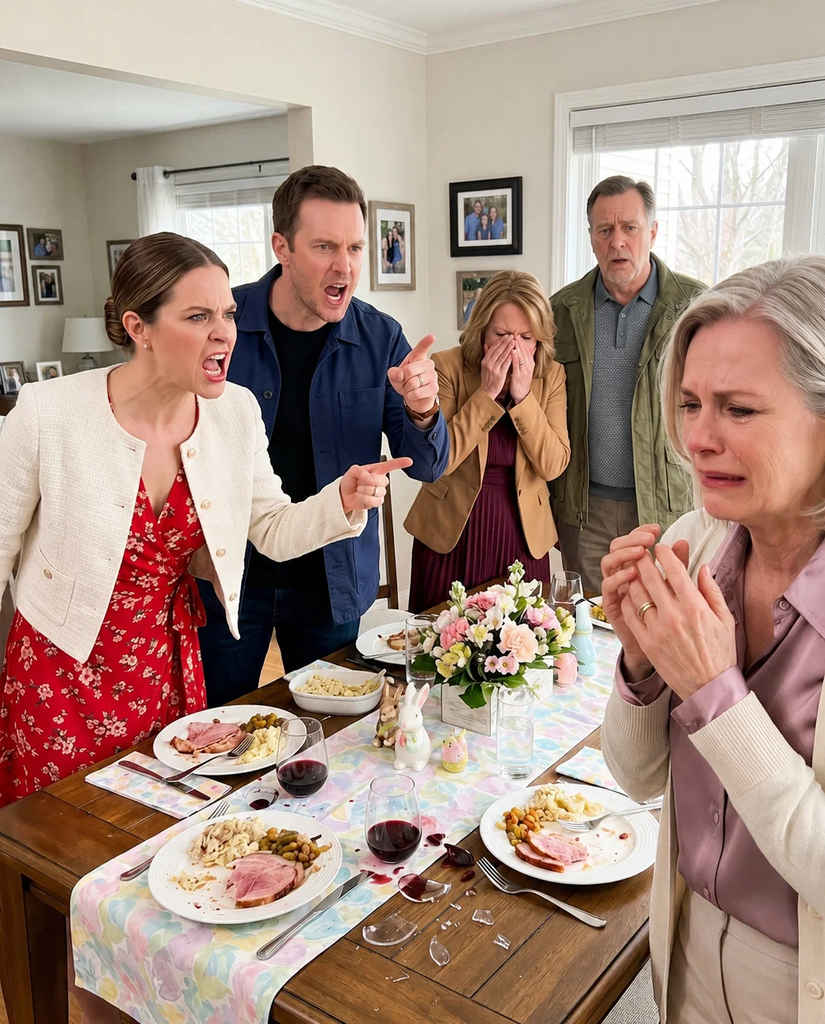
At Easter dinner, Vanessa’s parents, Frank and Linda Mercer, were sitting at my table when Daniel tried again.
“Mom,” he said, “Frank’s lease ends next month. They need somewhere affordable.”
“They need to find an apartment,” I replied.
Vanessa’s fork hit her plate.
“You have empty bedrooms!”
“They’re my bedrooms.”
“You’re being selfish!” Daniel snapped.
I looked at him.
“You don’t get to volunteer my house.”
Vanessa stood so quickly her chair scraped backward.
“My parents helped us for years! You sit here alone in this giant house and won’t inconvenience yourself for family?”
“I said no.”
That was when she grabbed her wine glass.
For half a second, I thought she was only gesturing with it.
Then she threw it.
The glass struck the side of my forehead and shattered against the cabinet behind me.
Linda screamed.
Blood immediately ran down my temple.
Daniel rushed toward me, but Vanessa shouted, “Oh, come on! I didn’t mean to hit her!”
I didn’t argue.
I didn’t cry.
I pressed a cloth napkin against my head, picked up my purse, and said, “Nobody leaves until I say otherwise.”
Daniel stared at me.
“Mom, you’re overreacting.”
That sentence settled something inside me.
I walked outside, got into my SUV, and drove myself to the emergency room.
At a red light, blood had already soaked through the napkin.
I took a photograph.
Then another.
At the hospital, while a nurse cleaned the cut and prepared four stitches, I opened my phone and texted Rachel Kim, my attorney.
Phase one is complete.
She replied thirty seconds later.
Do not discuss the house with them. Save everything. Police should be notified.
Minutes later, two Columbus police officers entered the treatment area.
One held a notebook.
The other asked, “Mrs. Lawson? We received a report of an assault at your residence.”
I looked at the bloodstained napkin beside me.
For the first time that evening, I smiled.
Because Vanessa thought she had thrown a wine glass.
What she had really thrown was the first domino.
The police report hadn’t come from me.
That was the first surprise.
My neighbor, Thomas Reed, a retired firefighter, had been walking his dog when he heard Linda screaming through my open dining-room window. Seconds later, he saw me leave the house with blood running down my face.
Thomas called 911.
That mattered because Daniel and Vanessa couldn’t claim I had invented the incident after getting angry about the house.
The officers photographed my injury, took my statement, and asked whether I wanted charges pursued.
“Yes,” I said.
The younger officer hesitated.
“You understand the alleged offender is your daughter-in-law?”
“I understand perfectly.”
Vanessa was cited that night and later charged with misdemeanor assault. She wasn’t hauled away in handcuffs, but officers ordered everyone out of my home except Daniel, who still technically had permission to stay there.
That permission was about to end.
The next morning, Rachel arrived carrying a leather folder.
She had been my attorney since Richard’s estate went through probate, and six weeks earlier I had told her something that sounded ridiculous at the time.
I believed Daniel and Vanessa were trying to gain control of my property.
Not steal it outright.
Something quieter.
First came comments that I was “too isolated.”
Then Daniel wanted access to my bank accounts “in case something happens.”
Vanessa brought me a power-of-attorney form she claimed was standard.
I refused to sign it.
Two weeks later, Daniel asked whether I had considered putting his name on the deed because it would “make inheritance easier.”
That was when I called Rachel.
She reviewed everything and told me something important.
Individually, the conversations proved little.
Together, they showed a pattern.
So we made a plan.
Phase one was simple: stop negotiating, clearly refuse the move-in request in front of witnesses, and document whatever happened afterward.
Neither Rachel nor I expected Vanessa to throw a glass.
But once she did, everything changed.
Rachel placed three documents on my kitchen table.
The first revoked the limited financial authorization I had given Daniel years earlier for emergencies.
The second formally notified him that he no longer had permission to live in my home after thirty days.
The third amended my estate plan.
Daniel had previously been the primary beneficiary.
Now most of my estate would eventually be divided between two charities Richard had supported and an education trust for any future grandchildren. Daniel could not control that trust.
I signed all three.
At 11:17 that morning, Daniel called.
“Mom, Vanessa’s freaking out. Tell the police it was an accident.”
“She threw a glass at my head.”
“She threw it toward you.”
“It required four stitches.”
Silence.
Then his voice turned cold.
“You’re really going to destroy the family over one mistake?”
“No, Daniel.”
I looked at Rachel across the table.
“I’m responding to a series of choices.”
He hung up.
Two hours later, Vanessa texted me.
You need to fix this before my job finds out.
She worked as an office administrator for a medical practice.
I didn’t answer.
Then another message arrived.
Also, my parents already gave notice on their apartment because Daniel said you would eventually agree.
That explained the desperation.
I forwarded the message to Rachel.
Her reply came immediately.
Excellent. Keep it. It confirms they made plans involving your property without your consent.
By Friday, Daniel had realized I wasn’t bluffing.
He came to my house alone.
I spoke to him through the security camera.
“Open the door, Mom.”
“No.”
“This is insane.”
“You have twenty-six days to collect your belongings.”
His face went pale.
“You can’t kick me out. I’m your son.”
“Being my son isn’t a lease.”
Then Daniel said something that confirmed every suspicion I’d carried for weeks.
He leaned closer to the camera.
“You have no idea what Vanessa and I already put in motion.”
He walked away before I could respond.
The camera recorded every word.
When Rachel heard it, she stopped smiling.
“Margaret,” she said, “phase two starts now.”
Rachel told me not to confront Daniel.
Instead, she asked one question.
“Has he had access to your personal documents?”
I thought about it.
For years, Daniel had known where I kept ordinary paperwork—insurance policies, property-tax records, utility bills. After Richard died, he helped me organize files in the study.
“He knows where everything is.”
Rachel’s expression hardened.
“Then we’re going to find out what he meant.”
The next morning, we ordered copies of my credit reports and checked county property records.
Nothing had been transferred from my name.
That was a relief.
But Rachel kept going.
She asked whether I had recently received mail from lenders.
I remembered two envelopes I had thrown into a drawer because I assumed they were advertisements.
They weren’t.
One confirmed an inquiry linked to a home-equity application I had never submitted.
The other thanked me for “beginning the lending process.”
I felt sick.
Rachel called the lender while I sat beside her.
After identity verification, the representative confirmed that an online application had been started three weeks earlier using my name, birth date, Social Security number, estimated property value, and annual income.
It had not been completed.
No money had been issued.
But someone had started the process.
“Can you tell us the email address?” Rachel asked.
The representative couldn’t disclose everything over the phone, but after I reported suspected identity fraud, the bank opened an investigation.
I filed another police report.
That evening, Daniel returned.
This time he didn’t knock.
He used his key.
Except the locks had been changed that morning.
He tried twice before noticing me behind the front window.
He raised both hands.
“Seriously?”
I opened the door but kept the storm door locked between us.
“You told me I had thirty days!”
“To retrieve your belongings by arrangement. Not unrestricted access.”
“Mom, I’m trying to talk to you.”
“Then talk.”
He glanced toward the driveway.
“I know about the bank.”
That surprised me.
He saw it.
“Vanessa started the application,” he said quickly. “She thought if we could show you how much equity you were sitting on, you’d understand.”
“You applied for a loan in my name to educate me?”
“We never finalized anything.”
“You used my Social Security number.”
His jaw tightened.
“She had a screenshot from one of your tax forms.”
“How?”
Daniel didn’t answer.
He didn’t need to.
“Did you give it to her?”
“It wasn’t supposed to become a big thing.”
I almost laughed.
My son was standing on my porch describing identity fraud as if someone had ordered the wrong dessert.
“Was the money for Frank and Linda?”
“We needed options.”
“For what?”
Daniel pressed both palms against the glass.
“They’re losing their apartment. Frank has medical debt. Vanessa has credit-card debt. We have debt. Everybody is drowning while you’re sitting on a paid-off house worth almost six hundred thousand dollars.”
There it was.
Not concern about my loneliness.
Not family unity.
Equity.
To Daniel, my stability had become an unused resource.
“You decided my house was the solution to four adults’ financial problems.”
“You don’t need all of it!”
“All of what?”
“The space. The money. Any of it!”
For several seconds, neither of us spoke.
Then I said, “Leave.”
“Mom—”
“Rachel has the lending documents. The police have the report.”
His face changed.
Fear.
“You called the police about that too?”
“I did.”
He stepped back.
“You’re trying to send Vanessa to jail.”
“No. I’m reporting what happened. What happens afterward isn’t mine to control.”
He left.
The investigation took several weeks.
The wine-glass case moved faster.
Vanessa’s attorney negotiated rather than take the matter toward trial. Because she had no prior criminal record and my injury was relatively minor, she ultimately received probation, community service, anger-management classes, court costs, and an order prohibiting hostile contact with me.
But the assault case created a second problem for her.
Her employer didn’t fire her simply because she had been charged. However, during its review, the medical practice discovered she had used an office scanner after hours to copy personal documents.
Mine.
Months earlier, I had given Daniel copies of tax paperwork while he helped resolve a question involving Richard’s old retirement account.
Daniel left them in his car.
Vanessa found them.
Then she scanned them at work.
That connected her directly to the home-equity application.
The bank’s fraud department preserved the digital records. The application had come from an IP address assigned to Daniel and Vanessa’s apartment.
Daniel insisted he hadn’t known she was submitting it.
Vanessa insisted he did.
Their united front broke almost immediately.
I didn’t have to manipulate either of them.
I simply stopped protecting them from the consequences of contradicting each other.
In early May, Daniel came to collect his belongings.
Rachel recommended that I have a witness present, so Thomas sat on my front porch drinking coffee while Daniel carried boxes from his upstairs room to a rented van.
He looked exhausted.
Vanessa wasn’t with him.
After the final box, he stopped in the foyer.
“She’s staying with her parents.”
“Where are they living?”
“Extended-stay hotel.”
I nodded.
He looked around the house where he had grown up.
Family photos still lined the hallway. His high-school graduation picture was there. So was a photo of Richard teaching him to ride a bicycle.
Daniel stared at that one for a long time.
“Dad wouldn’t have done this to me.”
That hurt.
He knew it would.
But I didn’t react immediately.
Finally I said, “Your father changed the locks on his own brother after Uncle Peter stole two thousand dollars from his workshop.”
Daniel looked at me.
“You remember that?”
“I was there.”
“This is different.”
“It always feels different when you’re the one outside the door.”
His eyes filled, but his voice stayed angry.
“So that’s it? You just cut off your only son?”
“No.”
I handed him an envelope.
Inside was a letter explaining that I was willing to have a relationship with him under specific conditions: no access to my finances, no discussions about ownership of my house, no pressure involving Vanessa’s parents, and no unannounced visits.
There was also one condition he hadn’t expected.
Counseling.
For himself.
“You think I’m crazy?”
“No. I think you’ve spent years believing that avoiding conflict is the same thing as keeping peace.”
He folded the letter.
“And Vanessa?”
“I won’t have contact with her while the protective order is active. After that, I’ll decide based on her behavior.”
He slipped the envelope into his jacket.
“I don’t know if our marriage survives this.”
“That’s between you and Vanessa.”
“You really don’t care?”
“I care very much. That’s why I’m not making the decision for you.”
Daniel left.
For the first time since Easter, the house became completely quiet.
I expected the silence to feel victorious.
It didn’t.
The upstairs room still had a dent in the carpet where Daniel’s dresser had stood. Scratches remained on the wall from when Richard and Daniel carried it upstairs seventeen years earlier.
I sat on the edge of the bed and cried.
Not because I regretted what I had done.
Because sometimes the right boundary still costs something.
The bank investigation produced enough evidence for authorities to pursue the attempted fraudulent application, but the eventual outcome was less dramatic than television justice.
There was no shocking courtroom confession.
Nobody was marched away for decades.
Vanessa entered an agreement involving restitution for investigative costs, financial-fraud counseling, additional probation conditions, and a formal acknowledgment that she had used my information without authorization.
Daniel was not charged because investigators found insufficient evidence that he had personally submitted the application.
But his marriage didn’t survive.
Three months after Easter, Daniel filed for separation.
I heard it from him directly.
He called one Sunday afternoon.
“Can I come over?”
“Are you alone?”
“Yes.”
“Then come at three.”
He arrived exactly at three carrying a bakery box.
“Lemon pie,” he said awkwardly.
“Bribery?”
“Peace offering.”
“Different legal category.”
He actually laughed.
It was the first time we had laughed together in months.
We sat at the kitchen table.
The cabinet damaged on Easter had been repaired, but I had deliberately kept one small piece of the shattered wine glass sealed inside an evidence bag in my desk.
Not as a trophy.
As a reminder of how quickly people reveal themselves when they decide your boundaries are negotiable.
Daniel rubbed his hands together.
“I owe you an apology.”
I waited.
“I kept telling myself Vanessa was the aggressive one. She wanted the house. She wanted the loan. She pushed the idea about her parents.”
He looked directly at me.
“But I gave her your paperwork.”
I said nothing.
“I told her you’d cave eventually.”
Still nothing.
“I told Frank and Linda they could move here before you agreed.”
That was the part I already knew but still needed to hear.
Daniel swallowed.
“I thought because I’m your son, I had some… claim.”
“Eventually, you might have inherited this house.”
“I know.”
“That’s not the same as owning it while I’m alive.”
“I know that now.”
We talked for nearly two hours.
Not everything was repaired.
I didn’t give him a key.
I didn’t restore him as my primary beneficiary.
I didn’t promise him the house.
Forgiveness, to me, didn’t mean resetting everything to the moment before the damage.
It meant deciding what relationship could exist after the truth was known.
By August, Daniel had his own apartment in Dublin, Ohio. He was seeing a therapist and paying down his debts instead of looking for someone else’s assets to rescue him.
Vanessa moved to Indiana after the separation and stayed with a cousin while completing the conditions of her probation.
Frank and Linda eventually found a smaller apartment outside Dayton.
They never moved into my house.
Not for one night.
One Saturday, Daniel came over to help me replace a broken fence board.
Afterward, we sat on the back deck drinking iced tea.
He looked toward the second-floor windows.
“Those rooms still empty?”
I glanced at him.
He immediately raised his hands.
“Not asking.”
I laughed.
“One is.”
“What happened to the other?”
“I converted it.”
“Into what?”
“A reading room.”
He shook his head.
“Dad would’ve said that’s a terrible use of square footage.”
“Your father owned twelve fishing rods.”
“Fair point.”
The following Easter, I hosted dinner again.
Smaller table.
Different atmosphere.
Daniel came alone.
Thomas joined us because his children lived out of state. Rachel came with her husband.
I made ham, roasted potatoes, green beans, and Richard’s favorite carrot cake.
At one point Daniel lifted his water glass.
Everyone stopped.
He noticed and smiled awkwardly.
“Relax. Plastic.”
We laughed.
Then he raised it toward me.
“To Mom’s house.”
I lifted mine.
“My house.”
He nodded.
“Exactly.”
Much later, after everyone left, I stood alone in the kitchen and remembered the previous Easter.
The blood on my hand.
Vanessa shouting.
Daniel accusing me of selfishness.
They had seen empty bedrooms.
I saw rooms Richard and I had paid for over thirty years.
They saw equity.
I saw security.
They saw a widow who would eventually give in because refusing family was uncomfortable.
That was their biggest mistake.
The police reports, changed locks, revised will, and fraud investigation were never about revenge.
“Phase one” had never meant I expected Vanessa to become violent.
It meant I had finally stopped allowing their pressure to remain invisible.
Rachel had told me weeks before Easter:
“If they believe they’re entitled to your property, don’t keep arguing privately. State your boundary clearly. Document what follows.”
I did.
What followed happened faster than either of us expected.
A thrown glass exposed the anger.
The anger exposed the entitlement.
The entitlement exposed the paperwork.
And the paperwork exposed everything else.
I turned off the kitchen lights and walked upstairs.
At the end of the hallway were two bedrooms.
One was now lined with bookshelves and a comfortable chair beside the window.
The other remained empty.
I could make it a sewing room.
A guest room.
A home gym.
Or leave it untouched for another ten years.
That was the point everyone had forgotten.
Empty didn’t mean available.
And family didn’t mean ownership.
The house was mine.
The choice was mine.
Finally, everyone understood that.