It held $6 million—and one message: “Don’t trust anyone. Wait for me.” That’s when I realized his betrayal had been an act, and my son was hiding something dangerous.
“My son just told the judge he wants to live with his father because I’m incapable of giving him a future.”
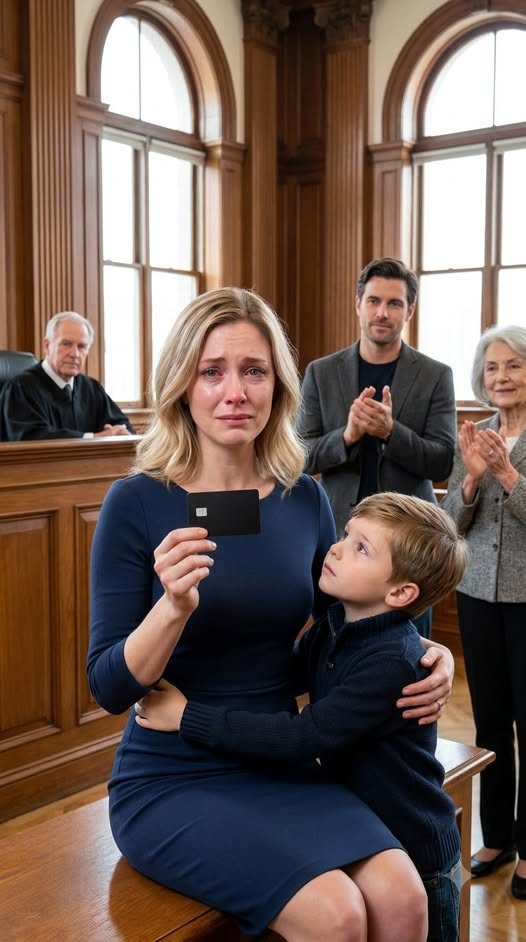
Those words shattered something inside me that Tuesday morning in Family Court in Columbus, Ohio.
I sat frozen at the table, my hands resting uselessly in front of me as I stared across the courtroom at my ex-husband, Ellis Chappell.
The man I had given fifteen years of my life to.
My youth.
My career.
And, somewhere along the way, even my voice.
Ellis looked immaculate.
He wore a tailored gray suit, an expensive watch, and the calm, confident expression of a man who already knew he had won.
Beside him stood Noah.
Our twelve-year-old son.
He was dressed in a navy blazer, his hair perfectly combed, his posture unusually stiff.
And his face…
His face was so cold that, for one terrifying moment, I barely recognized my own child.
Ellis’s attorney spoke first.
She described me as financially dependent.
She emphasized that I had no independent income.
She argued that I could not provide Noah with an international education or the kind of stable future his father could offer.
Every word sounded polished.
Reasonable.
Almost convincing.
But no one mentioned why I had left my career.
No one mentioned the day Ellis had looked at me and said, “You take care of the house. I’ll take care of the money.”
No one mentioned the nights I stayed awake beside Noah when he had a fever.
The birthdays I organized alone.
The school projects.
The endless dinners that went cold while I waited for a husband who was always “working late.”
Apparently, none of that counted as providing a future.
Then the judge asked Noah the question I had been dreading.
“Which parent would you prefer to live with?”
I turned toward my son.
I waited for hesitation.
A tremble in his voice.
A tear.
Anything.
Instead, Noah stood straight.
He looked ahead.
And said quietly:
“I want to live with my dad. My mom can’t give me anything.”
The courtroom seemed to disappear.
I couldn’t hear the judge.
Couldn’t hear the attorneys.
Couldn’t even hear my own breathing.
Something inside me broke without making a sound.
Across the room, Ellis barely smiled.
But I saw it.
That tiny movement at the corner of his mouth told me everything.
This wasn’t spontaneous.
This wasn’t simply a twelve-year-old choosing the parent with more money.
This had been planned.
Ellis had won custody with money, lawyers, and manipulation.
And my son had just been used to deliver the final blow.
After the hearing, Ellis caught up with me in the parking lot.
“Sabrina.”
I stopped.
He reached into his pocket and pulled out a bank card.
“I’m not that heartless.”
He held it toward me.
“There are two hundred thousand dollars on this. Rent a place. Start over. Stay out of my life and my son’s.”
I stared at the card.
Then at him.
I didn’t take it.
“Why are you doing this to me?”
Ellis gave a dry laugh.
“Because you don’t fit into my life anymore, Sabrina.”
His eyes moved over my clothes.
“You need someone who can keep up with me, not someone who’s spent fifteen years buried in dishes and school uniforms.”
The words hurt.
But somehow, the silence afterward hurt even more.
Noah stood several feet away with his suitcase.
He never looked at me.
Not once.
Then he walked away with his father as if I were a stranger.
That night, I left our house in Upper Arlington with one old suitcase and three shopping bags.
That was all.
Fifteen years of marriage reduced to what I could carry through a doorway.
I rented a tiny apartment in Franklinton.
The walls were damp.
The window looked directly into a narrow alley.
That first night, I sat on the edge of the bed and cried until I had nothing left.
For the first time in fifteen years, there was no husband beside me.
No child in the next room.
No family waiting for me.
Just silence.
A week later, Ellis called.
“I’m taking Noah to the airport tomorrow. He’s flying to Atlanta with me.”
My heart tightened.
Then he added:
“If you want to say goodbye, be at John Glenn Columbus International Airport early.”
I almost didn’t go.
Part of me thought Noah had already made his choice.
Another part of me knew something a mother understands even when everything else tells her to walk away.
A mother still goes.
So I went.
At the terminal, Ellis spoke casually with several business associates, looking completely relaxed.
Like a man celebrating a victory.
Noah stood nearby with his backpack.
Silent.
Watching.
When the time came for them to go through security, he finally walked toward me.
For a second, neither of us spoke.
Then he wrapped his arms around me.
He hugged me tightly.
So tightly that my heart nearly broke all over again.
I closed my eyes and held him.
Then I felt something slide into my coat pocket.
Noah pulled back.
His face remained carefully blank.
“Don’t cry, Mom,” he whispered.
Then, so quietly that only I could hear:
“Wait for me.”
Before I could ask what he meant, he turned and hurried after Ellis.
I stood there watching my son disappear into the crowd.
Only after I got into the taxi did I reach into my pocket.
My fingers touched something hard.
I pulled it out.
A plain black card.
No logo.
No name.
Nothing to explain what it was.
Then my phone buzzed.
An unknown number.
One message.
I opened it.
“Mom, there are six million dollars in that account. The PIN is your birthday. Don’t trust anyone. Wait for me until I come back.”
I read it once.
Then again.
And again.
My hands began to tremble.
Six million dollars.
From my twelve-year-old son.
The same son who had just stood before a judge and told the court I couldn’t give him a future.
I stared at the black card in my hand.
Then at the message on my phone.
And suddenly, the pieces of the past week no longer fit together the way I had believed they did.
Noah hadn’t betrayed me.
He hadn’t suddenly stopped loving me.
He had been pretending.
And whatever had forced my twelve-year-old son to turn against his own mother in a courtroom had to be serious enough that he couldn’t tell me the truth face-to-face.
I looked down at his final words.
Wait for me.
A cold realization settled over me.
My son wasn’t choosing his father.
He was trying to protect me.
And whatever he had gotten himself involved in was far more dangerous than I had ever imagined.
When you realize you are playing a game against monsters, you do not play by the rules of society. You rewrite the board.
I returned to my damp apartment, locking the deadbolt and sliding the chain into place. I did not turn on the main lights. I operated by the faint, orange glow of the streetlamp filtering through the blinds.
I knew I could not touch the six million dollars immediately. The black card was undoubtedly tied to an offshore account, and any massive, sudden withdrawal or wire transfer initiated from a local IP address would trigger an alert. It would draw the syndicate’s heavy hitters directly to my front door before I could secure a tactical advantage.
I had to use the two hundred thousand dollars Ellis had smugly handed me in the parking lot. His “pity” money would be the shovel I used to dig his grave.
The next morning, I purchased three untraceable burner phones with cash. I bought a high-end, encrypted laptop. I downloaded military-grade VPNs, bouncing my IP address through servers in Switzerland and Iceland.
I needed to understand the exact anatomy of the monster my son had robbed. I needed a mercenary.
Through a dark-web forum I accessed using protocols Noah had casually mentioned over dinner years ago, I located a man known only by the handle ‘Vance.’ Vance was a disgraced, formerly elite forensic accountant who had been stripped of his license for aggressive corporate espionage, but who possessed a legendary reputation in the shadow markets for cracking offshore shell companies.
I contacted him through an encrypted messaging app. I offered him fifty thousand dollars in untraceable cryptocurrency—purchased incrementally using Ellis’s payout money—for his services.
He accepted.
For fourteen days, the peeling walls of my Franklinton apartment became a war room.
Part 2
Vance worked with cold, terrifying efficiency. Every midnight upload to my encrypted server brought another piece of the puzzle into sharp, terrifying focus.
“Your ex-husband isn’t just an executive, Mrs. Vance,” Vance’s distorted voice rasped through a secure audio link on night eight. “He’s a high-level bagman for the Vane Syndicate—an international syndicate operating out of Chicago and Atlanta. They launder illicit cartel funds through commercial real estate acquisitions.”
“And the six million?” I asked, my knuckles white around the edge of the desk.
“That wasn’t Ellis’s personal wealth,” Vance said, tapping keys on his end. “That was the Vane Syndicate’s emergency operating capital—an offshore slush fund meant to buy political immunity in the Midwest. Three weeks before your divorce hearing, a cold-wallet cipher was extracted directly from Ellis’s primary encrypted server. Someone physically bypassed a double-biometric security vault inside Ellis’s home office.”
I stopped breathing.
A twelve-year-old boy. A quiet boy who spent his evenings quietly reading coding manuals while his father drank scotch in the study.
Noah hadn’t just taken money. He had stolen the nuclear launch codes to a criminal empire’s entire financial framework.
“If they figure out he has it…” I whispered.
“They won’t just kill him, Mrs. Vance,” Vance replied flatly. “They’ll make an example out of his entire lineage. But there’s a hitch. The syndicate believes Ellis lost the cipher through his own negligence. They think Ellis stole it to set up his own exit strategy. Right now, Ellis is under soft house arrest at his private estate in Atlanta, surrounded by syndicate enforcers who are quietly giving him forty-eight hours to produce the funds before they execute him.”
My heart hammered against my ribs. Ellis wasn’t a mastermind; he was a terrified pawn trapped in his own web. And Noah had deliberately walked straight into that lion’s den with him.
Why?
Why would a twelve-year-old boy put himself inside a guarded mansion surrounded by killers?
Because Noah knew that if he ran to me with six million dollars, the syndicate would hunt me down first. By making himself indispensable to Ellis—by holding the only key to the syndicate’s money while standing right beside the man they blamed—Noah was keeping the crosshairs entirely off my back.
He had sacrificed his freedom, his reputation, and his safety to become my living shield.
“Vance,” I said, my voice dropping into a register of cold, absolute calm I didn’t know I possessed. “How much to buy physical hardware? Tactical support, signal jammers, and an armored transport?”
“That takes real capital, Mrs. Vance. Millions.”
“I have six million,” I said. “And tonight, we’re taking it out.”
Part 3
Using Vance’s secure routing protocols, I executed a micro-burst transfer, drawing $1.5 million from the black card’s offshore account through three dozen decentralized crypto-mixers. The money hit an offshore escrow account within twenty minutes.
I didn’t buy designer clothes or luxury items. I bought survival.
I hired a three-man private security team—former specialized military contractors managed by a quiet woman named Miller who didn’t ask questions as long as the crypto cleared. I bought thermal imaging gear, signal-blackout bags, and two heavy-duty SUVs with reinforced plating.
By Thursday evening, three days before the syndicate’s deadline, our convoy was positioned on a dark ridge overlooking Ellis’s heavily guarded estate outside Atlanta.
Rain poured over the windshield in heavy sheets. Through night-vision binoculars, I surveyed the perimeter. Four armed guards in raincoats patrolled the stone walls. Inside the third-floor study, I could see two shadows: Ellis, pacing frantically with a glass in his hand, and a large, broad-shouldered man in a dark suit standing by the door.
Down on the main floor, in a small corner bedroom, a single desk lamp burned.
Noah.
“Sensors confirm five armed hostiles inside the main residence,” Miller whispered from the driver’s seat, checking her wrist tablet. “If we go in loud, the syndicate enforcers will execute everyone in the house, including your son, before we reach the second floor.”
“We don’t go in loud,” I said, pulling a dark tactical jacket over my clothes and zip-tying my hair back. “We cut the power grid, flood the estate with infrared smoke, and we go through the utility access behind the kitchen. I know the floor plan. Ellis built the exact same layout as our old house in Columbus.”
Miller looked back at me, a faint glint of approval in her eyes. “You’re a brave woman, Mrs. Vance.”
“I’m not brave,” I replied, adjusting the strap of a heavy blackout bag over my shoulder. “I’m his mother.”
At 2:14 AM, Vance remotely killed the local power grid. The estate plunged into pitch-black darkness.
Two seconds later, Miller’s team breached the rear perimeter fence with hydraulic cutters. We moved like ghosts through the rain-soaked gardens, bypassing the outer guards who were suddenly struggling with dead radios and failing backup generators.
Miller threw a thermal smoke canister through the kitchen window. Thick, opaque gray smoke billowed into the lower level, blinding the internal security cameras and suffocating the guards inside.
I didn’t wait for the team to clear the hall. I ran straight through the swirling smoke, keeping my hand against the wall, navigating purely by memory.
I reached the corner bedroom, shoved the heavy oak door open, and stepped inside.
Noah was standing by the window, a heavy brass desk lamp clutched in his hands like a weapon, his eyes wide with terrified determination in the dark.
“Noah!” I hissed.
He froze. The lamp slipped from his hands, thudding softly onto the carpet.
“Mom…?” he whispered, his voice cracking for the first time in weeks. “How… how did you find me?”
I rushed across the room, pulling him into my arms so hard we both nearly fell. He buried his face in my shoulder, his small body shaking uncontrollably as weeks of suppressed terror finally broke through his cold mask.
“You idiot,” I sobbed into his hair, kissing the side of his head. “You brilliant, terrifying idiot. Did you really think I was going to sit in Franklinton and let you do this alone?”
“They were going to kill you, Mom,” Noah wept quietly, clutching my jacket. “Dad owed them money. He was going to give them our house, your savings, everything. I found the ledger on his computer… I knew if I took the cipher, they’d look at him, not you.”
“I know, baby. I know,” I whispered, pulling back to look him in the eyes. “Now we’re leaving.”
Suddenly, the bedroom door flew open.
A tactical flashlight beam cut through the smoke, blinding us. Standing in the doorway was Ellis, his face bruised, his expensive shirt torn, accompanied by the massive syndicate enforcer I had seen from the ridge.
The enforcer raised a suppressed handgun directly at my chest.
“Sabrina…?” Ellis stammered, staring at me in shock. “What the hell are you doing here?!”
“Shut up, Ellis,” the enforcer growled, his finger tightening on the trigger. “So she’s the one who has the money. The quiet wife. Move away from the boy, lady.”
Before I could step in front of Noah, a loud, sharp pop-pop echoed from the hallway.
The enforcer’s eyes rolled back, and he collapsed heavily onto the floor. Miller stepped over his body, her weapon raised, her face completely calm behind her night-vision goggles.
Ellis let out a pathetic shriek, dropping to his knees with his hands over his head. “Don’t shoot! Don’t shoot! Take whatever you want!”
I looked down at my ex-husband. The man who had worn a tailored suit to court. The man who had offered me two hundred thousand dollars to stay out of his life. The man who was currently trembling in a pool of rainwater on his own bedroom floor.
“Get up, Ellis,” I said coldly.
He looked up, his eyes wide with frantic desperation. “Sabrina… please! Save me! They’re going to kill me! Tell your people to take me with you!”
I reached down, picked up the black card Noah had given me at the airport, and dropped it onto Ellis’s chest.
“The cipher is cleared,” I told him flatly. “The money is gone. The syndicate knows you failed them. You wanted a life without us, Ellis. You wanted to keep up with the big league.”
I took Noah’s hand, locking my fingers firmly through his.
“Now you can handle them yourself.”
Final
We didn’t look back as we walked out into the stormy night.
Miller’s team escorted us to the armored SUV, pulling out of the estate driveway just as the siren wails of approaching federal law enforcement vehicles echoed in the distance—an anonymous tip Vance had placed to ensure the Vane Syndicate’s local operations were raided before dawn.
Ellis was arrested that night on federal racketeering and money-laundering charges. Denied bail due to his connections to organized crime, he spent the next several months in a federal holding facility before entering a guilty plea that effectively ended his freedom for the next twenty years.
Noah and I didn’t stay in Georgia, and we didn’t return to Franklinton.
Using a portion of the offshore capital legally cleaned through Vance’s international channels, I hired a premier family law firm to formally overturn the custody agreement based on clear evidence of endangerment. The court granted me full, sole legal and physical custody, erasing Ellis’s name from my son’s life forever.
Six months later, the morning sun rose over a quiet, sun-drenched coastal town in Maine.
Our new house sat on a pine-covered cliff overlooking the Atlantic Ocean—a fortified, beautiful home protected by top-tier security systems Vance had personally designed for us.
I stood on the back porch, holding a steaming mug of coffee, watching the waves crash against the dark rocks below.
The kitchen door opened, and Noah stepped out onto the deck, wearing an oversized hoodie, a plate of pancakes in his hands. His hair was messy, his shoulders relaxed. The cold, lifeless expression he had worn in that Columbus courtroom was completely gone, replaced by the warm, bright eyes of a twelve-year-old boy who finally felt safe.
“Mom,” he said, sitting down at the wooden table. “Vance sent an email. The final trust setup for my college fund is completely locked in.”
I sat down across from him, smiling softly. “Good. No more offshore ciphers. No more dark-web forums. You’re going to school, getting good grades, and being a kid.”
Noah grinned, taking a bite of his breakfast. “Deal.”
He looked out over the ocean, the quiet wind blowing through his hair. He reached into his pocket and pulled out a small, metallic keychain—a tiny, harmless replica of a chess piece he had kept from our old life.
“I was really scared at the airport, Mom,” he admitted softly, his voice barely audible over the sound of the wind. “I thought… I thought I’d never see you again.”
I reached across the table and took his hand, squeezing it tight.
“A mother always finds her son, Noah,” I told him. “No matter what game they try to force us to play.”
He smiled, squeezing my hand back.
And as the morning sun broke fully through the clouds, bathing the coast in brilliant gold light, I knew that the monsters had lost—and we had finally won our freedom.