Part 1
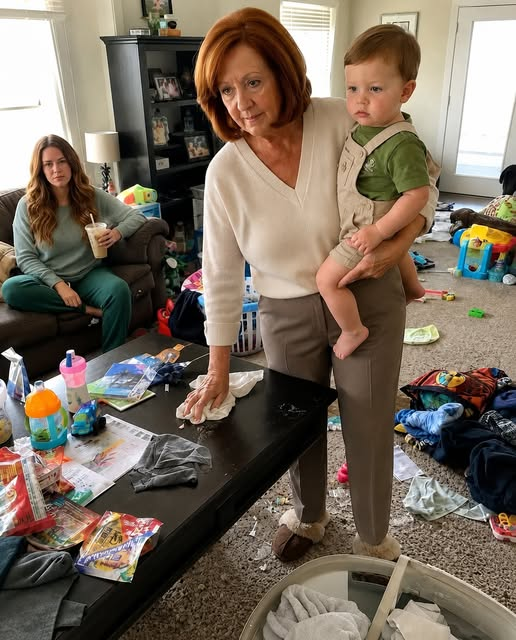
When Chloe called, her voice sounded unusually eager.
“Julian has to leave town for work,” she said. “The children have been asking about you. Why don’t you stay with us for the week?”
I accepted immediately.
My grandchildren, Maya and Lucas, were still young, and I had not seen them in months. I packed enough clothes for seven days, several jars of homemade strawberry jam, and a few presents I had been saving for them.
When I arrived, the children ran outside and threw their arms around me. For a few hours, I believed Chloe had genuinely invited me because the family missed me.
By the next morning, I understood the real reason.
The house had been neglected for weeks. Dirty dishes crowded the kitchen counters. Laundry spilled into the hallway. The floors needed vacuuming, and the bathrooms looked as though they had not been properly cleaned in a long time.
Chloe did not come downstairs until almost noon. She entered the kitchen holding her phone, glanced around, and began giving me instructions.
“The downstairs bathroom needs cleaning.” “The refrigerator should be organized.” “The children need lunches prepared.” “And could you make spaghetti for dinner?”
I was surprised, but I did not argue. I had come to spend time with Maya and Lucas. Helping around the house seemed like a small price to pay for that opportunity.
But Chloe’s requests quickly turned into an endless list. She asked me to wash clothes, clean bedrooms, organize the pantry, sort her walk-in closet, vacuum beneath the furniture, and prepare every meal. Meanwhile, she spent most of her time upstairs or scrolling through her phone.
One afternoon, she handed me another list and laughed.
“Try not to be such a lazy grandmother.”
I looked at her but remained silent. I had raised a child, worked for thirty years, maintained my own home, and lived independently since my husband, Arthur, passed away. I did not need to prove my work ethic to a woman who rarely came downstairs before lunchtime.
Still, I refused to create an argument in front of my grandchildren. So I continued.
I made breakfast with them each morning. I packed their school lunches. I took them to the park, read their favorite books, helped with puzzles, and listened carefully to every story they wanted to tell me.
I also cleaned nearly every room in the house. I washed several loads of laundry, paid for groceries, prepared dinner each evening, and cared for the children whenever Chloe wanted time alone.
By the end of the week, I was exhausted.
The afternoon before Julian was scheduled to return, Chloe entered the kitchen wearing a satisfied expression. She placed a neatly printed page beside my coffee.
It was an invoice.
- Guest-room accommodation: $900
- Food and household utilities: $650
- Use of household amenities: $450
- Total due: $2,000
I read it twice before looking up.
“Chloe, you invited me here.”
“And you stayed in our home,” she replied. “You used our electricity, water, internet, food, and air conditioning. Those things cost money.”
“I purchased groceries,” I reminded her. “I cooked every meal, cleaned the house, and cared for your children.”
Her expression tightened. “No one forced you to do any of that. You chose to help. The accommodation fee still applies.”
“You expect me to pay you before I leave?”
“Yes. The full amount.”
I could feel the anger rising inside me, but I refused to give her the reaction she expected. Instead, I folded the invoice carefully and placed it inside my purse.
“I don’t have two thousand dollars available tonight,” I said. “You’ll need to wait until tomorrow morning.”
Chloe leaned back in her chair. “That’s acceptable—as long as I receive the money.”
I smiled. “Of course.”
She had no idea that I had already begun forming a plan.
That evening, I called my son and told him everything. I explained the condition of the house, the daily instructions, the insulting remarks, and the invoice waiting beside my coffee.
Julian became very quiet. “She charged you two thousand dollars?”
“Yes. She even itemized it.”
I made it clear that I was not asking him to begin an argument with his wife. I only wanted him to understand what had happened inside his home while he was away. Then I explained exactly what I intended to do the following morning.
After a long silence, he moved his flight and promised to return early.
Next, I called a retired accountant who had been my friend for more than twenty years. Then I contacted my neighbor, who owned a truck. My final call was to my late husband’s brother, a licensed contractor who had been waiting for an opportunity to help Julian with a long-delayed household project.
Before going to bed, I prepared an invoice of my own.
- Seven days of childcare for two children: $1,400
- Full-house cleaning service: $800
- Meal preparation and packed lunches: $700
- Groceries, with receipts: $312
- Total due to me: $3,212
My accountant formatted it exactly like Chloe’s document. She even used the same font.
Before sunrise, my neighbor arrived with his truck and helped me load my belongings. I left the quilts I had made for Maya and Lucas on their beds. I also left one jar of strawberry jam because Lucas loved it. Those gifts belonged to my grandchildren. Everything else that belonged to me went into the truck.
My brother-in-law arrived shortly afterward with his tools and an assistant. For two years, Julian had wanted to build a deck behind the house. The materials had been sitting beneath a tarp in the yard for months because he never had enough time to begin. Julian had approved my plan during our phone call.
By seven-thirty, the workers had marked the yard and begun installing the first support posts.
At nine-fifteen, Chloe finally came downstairs. She heard the construction noise, opened the back door, and froze.
Workers were measuring the yard. Several posts were already in place. My belongings were packed. Julian’s truck had just pulled into the driveway.
“What have you done?” she screamed loudly enough for the neighbors to hear.
I remained calm. Then I placed my own itemized invoice beside her morning coffee.
Part 2
Chloe stood frozen in the kitchen doorway, staring at the typed paper resting beside her coffee cup.
The contrast between her two-thousand-dollar demand and my three-thousand-two-hundred-and-twelve-dollar statement was impossible to miss. Every hour of domestic labor, every meal prepared, every load of laundry, and every dollar spent on groceries had been meticulously documented.
“What is this?” Chloe hissed, her face turning crimson as she snatched up the paper. “Are you out of your mind? You’re their grandmother!”
“And you are my daughter-in-law,” I replied, my voice steady and unbothered. “Yet you placed a business price on my presence in your home. I simply applied your own logic.”
Before Chloe could scream again, the front door clicked open.
Julian walked into the house, carrying his travel bag. He looked exhausted from his early flight, but his eyes were hard as steel as he took in the scene: his mother standing calmly by her purse, his wife clutching an invoice, and the sound of heavy post-hole diggers echoing from the backyard.
“Julian!” Chloe cried out, immediately switching into a victimized posture. “Your mother has gone insane! She hired contractors to dig up our yard, packed all her things, and handed me this absurd bill!”
Julian set his bag down slowly. He didn’t rush to comfort her. Instead, he walked over to the kitchen island, picked up the original two-thousand-dollar invoice Chloe had given me the night before, and laid it side by side with mine.
“Did you write this, Chloe?” Julian asked, his voice deceptively quiet.
Chloe blinked, momentarily caught off guard. “Well—yes! She stayed here for a week, using our utilities, our guest room, eating our food—”
“Food that she bought with her own money,” Julian interrupted, pointing to the attached grocery receipts on my invoice. “And while you were sleeping until noon every day and handing her cleaning lists, she was taking care of our children and maintaining our house.”
“Julian, I was overwhelmed!” Chloe protested, her tone rising into a defensive screech. “I needed help!”
“You didn’t ask for help,” I chimed in softly. “You invited me under the guise of seeing my grandchildren, treated me like an unpaid domestic servant, called me lazy, and then attempted to extort two thousand dollars from me.”
The noise in the backyard lulled for a moment as my brother-in-law stepped up to the open patio door.
“Hey, Julian!” he called out cheerfully. “We’ve got the primary support posts set for the deck materials that have been rotting under that tarp for eight months. Your mom paid for the initial labor crew as a gift to you, but we’re ready for your sign-off.”
Julian looked at his wife, then turned to his uncle with a nod. “Keep digging. The deck is getting built today.”
Chloe gasped. “We can’t afford that right now!”
“We can,” Julian said, looking Chloe dead in the eye. “Because the money I’m using was set aside from my travel bonus—the bonus you assumed I’d use to cover your little two-thousand-dollar scam.”
Julian walked over to me, wrapped his arms around my shoulders, and kissed the top of my head.
“Mom, the truck is loaded,” he said softly. “Uncle Arthur’s assistant can drive your car back to your house so you don’t have to drive tired.”
“Thank you, son,” I said, picking up my purse.
Chloe stood in the center of the kitchen, watching her entire scheme unravel in a matter of minutes. The two-thousand-dollar profit she had planned to pocket for her personal spending had vanished, replaced by an official accounting of her own neglect, a newly begun construction project she couldn’t stop, and a husband who finally saw her true colors.
I stopped at the doorway, turning back to look at her one last time.
“The strawberry jam in the fridge is for Lucas,” I said gently. “Don’t charge him for it.”
With that, I walked out into the bright morning sun, leaving my son to handle his household, while I returned home with my dignity, my family’s respect, and my independence completely intact.
Final Part
The drive back to my house was quiet, peaceful, and blissfully ordinary.
My brother-in-law Arthur’s assistant drove my car behind my neighbor’s truck, following me down the winding suburban roads until we pulled into my driveway. Within twenty minutes, my suitcases were unpacked, my clothes were back in their drawers, and the jars of jam were lined up neatly in my pantry.
By one o’clock that afternoon, Arthur called me from his truck.
“The support posts are completely set, Evelyn,” he reported, chuckling into the phone. “Julian’s out there now with a hammer, working alongside my crew. He looks like a man who just laid down a heavy burden.”
“How is Chloe?” I asked softly.
“She’s upstairs,” Arthur said flatly. “Locked herself in the master bedroom after Julian transferred three thousand two hundred and twelve dollars directly into your bank account to cover your invoice. He made her watch him hit send.”
I closed my eyes, taking a slow, deep breath. “I didn’t want his money, Arthur.”
“I know you didn’t, Evelyn. But Julian needed to pay it. It was the only way he could regain his self-respect after what she did to you.”
Ten minutes later, my phone chimed with a bank notification confirming the direct deposit. Attached was a short text message from my son:
“Mom, the money is in your account. It doesn’t fix how you were treated, but it’s a start. I’m so sorry I let things get this far. Please come back next weekend—just you, me, and the kids. No invoices. No lists. Just family.”
I replied immediately: “I’ll bring the blueberry jam.”
Over the next two months, the shockwaves of that morning settled into permanent changes.
Julian didn’t sweep his wife’s behavior under the rug. Facing the stark reality of her domestic neglect and financial manipulation, he insisted on strict personal boundaries and marriage counseling. Chloe was forced to step up, take responsibility for her own household, and manage the daily care of Maya and Lucas without relying on manufactured crises or exploiting relatives.
The confidence she had displayed when handing me that two-thousand-dollar bill was completely gone, replaced by the quiet realization that her husband’s loyalty to his mother was backed by a firm, unbreakable line.
The deck behind their house was completed three weeks later—a wide, beautiful cedar space where Maya and Lucas could play safely in the afternoons.
On a warm Saturday evening in late autumn, I drove back to Julian’s house for dinner.
When I pulled up to the curb, Maya and Lucas ran out into the yard, screaming with joy as they threw their arms around my waist. The house was clean, the smell of roasted chicken drifted through the screen door, and the air felt light, open, and free of unspoken resentment.
Chloe came out onto the porch. She didn’t offer a dramatic apology, and I didn’t demand one. She simply offered a quiet, respectful nod, held the door open for me, and took my coat.
She had learned the hard way that respect is not something you demand through entitlement—it is something you earn through kindness.
As we sat out on the new cedar deck watching the sunset, Lucas leaned against my knee, eating a thick slice of bread covered in homemade strawberry jam.
Julian smiled across the table, holding my hand tightly in his.
I looked out over the yard, feeling the cool evening breeze against my cheek, and smiled to myself.
I had raised my son to be strong, I had defended my dignity without raising my voice, and I had reminded everyone in that house of a simple, eternal truth:
A grandmother’s love is a gift given freely from the heart—but it is never, ever for sale.