CONTINUE OF THE STROY
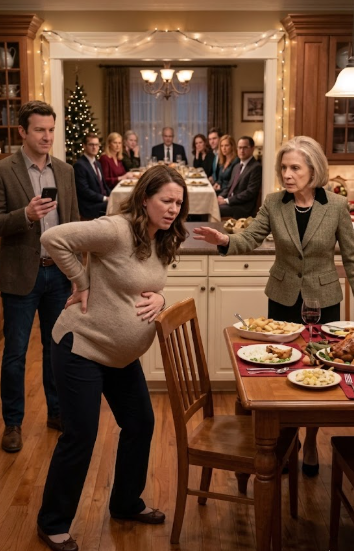
I swallowed hard.
“David’s mother pushed me. I fell. I think something is wrong with the baby.”
For the first time all evening, David’s confidence slipped.
“Anna, stop exaggerating—”
“Be silent.”
The command exploded through the speaker.
Not loud.
Not angry.
Worse.
Controlled.
The kind of voice that expected obedience.
David actually stopped talking.
My father continued.
“David Whitmore. Did you deny medical assistance to my pregnant daughter?”
No one moved.
No one breathed.
David forced a laugh.
“Sir, with all respect, this is a private family matter.”
“Answer the question.”
“I didn’t think an ambulance was necessary.”
“You destroyed her phone?”
David looked around the room.
Nobody was laughing anymore.
“How do you know that?”
My father’s voice became deadly calm.
“Because every word has been recorded for the last three minutes.”
The color drained from David’s face.
“What?”
“You placed this call on speaker. Several federal judges and two state investigators are sitting in my home for Christmas dinner. They have heard every word.”
Sylvia grabbed the edge of the counter.
“Who exactly are you?”
The answer came quietly.
“My name is Robert Hartwell.”
David frowned.
Then recognition hit him.
His mouth opened.
Then closed.
Then opened again.
Because every lawyer in the state knew that name.
Robert Hartwell.
Chief Justice of the Supreme Court.
The highest judicial authority in the state.
The man who signed off on judicial appointments.
The man whose legal opinions were taught in law schools.
The man David had quoted in court less than a month earlier.
The phone slipped from David’s hand.
It hit the floor.
Nobody picked it up.
“You lied,” Sylvia whispered.
I looked at her.
“No.”
“I simply never told you.”
My father continued speaking.
“An ambulance is already on the way. State police are also being dispatched.”
David’s face turned ghost white.
“State police?”
“Yes.”
“You can’t do that.”
“I can.”
The front doorbell rang.
Every head turned.
Then another knock.
Loud.
Authoritative.
Three sharp strikes.
The kind that doesn’t ask permission.
David ran toward the window.
Outside, flashing lights reflected across the snow-covered yard.
One ambulance.
Two police vehicles.
And a black government sedan.
His career began collapsing before the officers even entered the house.
The dining room guests were already pulling out their phones.
Some quietly gathered their coats.
Others stared at David as though they had never seen him before.
Because they hadn’t.
Not the real version.
Not the man who denied medical care to his pregnant wife.
Not the man who threatened her.
Not the man who believed power belonged only to him.
The front door opened.
A state trooper stepped inside.
“Mr. David Whitmore?”
David couldn’t answer.
The officer looked directly at me sitting on the kitchen floor.
“Ma’am, are you Anna Hartwell?”
For the first time in years, I smiled.
“Yes.”
“Your father asked us to bring you home.”
And for the first time that Christmas, I knew I wasn’t alone.
The ambulance lights still painted red and blue across the snow when they wheeled me out of that house.
I didn’t look back.
Not at David.
Not at Sylvia.
Not at the guests standing frozen in their Christmas outfits like mannequins in a collapsing dream.
I only held my stomach and focused on breathing.
At the hospital, everything became sharp and distant at the same time. Voices. Machines. Questions. My father arrived within hours, no longer just a voice on a phone, but a presence that made every doctor stand a little straighter.
“Mother and child are stable,” the doctor finally said.
That was the first time I cried.
Not from pain.
From relief.
David was arrested that same night.
Not for one charge.
For many.
Neglect of a pregnant spouse.
Obstruction of emergency medical care.
Destruction of evidence.
And what the investigators called, very carefully:
“Coercive domestic conduct under aggravated circumstances.”
He tried to talk his way out of it.
He always did.
But lawyers don’t talk their way out of federal surveillance footage.
They don’t argue with recorded emergency dispatch calls.
And they definitely don’t win against a Chief Justice who has already placed three federal judges on the case before sunrise.
Sylvia, however, was the surprise.
At first, she acted like a victim.
She told police I was “unstable.”
She said I “fell by accident.”
She insisted she had only “guided me gently.”
But then the investigation widened.
And things began to surface.
Old hospital records.
A restraining order from a previous incident—sealed but not erased.
A former neighbor who finally spoke.
Then another.
Then a pattern emerged.
Sylvia Whitmore had been removed from two prior care facilities investigations in different states.
Not criminal convictions.
Something worse.
Disappearances of complaints.
Patterns of intimidation.
People who stopped testifying after “family interventions.”
By the third day, detectives stopped calling her “a concerned mother-in-law.”
They started calling her what she actually was.
A repeat abuser with a carefully maintained public image.
The hearing was scheduled two weeks later.
I walked into the courthouse slowly, my hand resting on my still-healing stomach, my father beside me in a simple dark suit that somehow made the entire building feel quieter.
David was already there.
No longer the confident lawyer.
No longer the man who laughed while my phone shattered on the kitchen floor.
He avoided my eyes.
Sylvia sat behind him, perfectly still, lips tight, hair pinned like she was attending church instead of facing consequences.
The courtroom rose as the judge entered.
Then silence.
“Case of the State versus David Whitmore and Sylvia Whitmore,” the judge began.
The prosecutor stood.
“Your Honor, we will demonstrate a sustained pattern of coercion, medical neglect, and obstruction of emergency assistance against a pregnant victim, including actions taken on December 24th…”
As the evidence was presented, the room changed.
Slowly.
Irreversibly.
Photos.
Audio recordings.
Medical reports.
Witness testimony.
The moment the emergency dispatcher replayed David’s voice saying “there will be no ambulance”, Sylvia finally shifted in her seat.
The moment the broken phone audio played—my voice begging for help—David’s hands started shaking.
But the real silence fell when my father took the stand.
He did not raise his voice.
He did not need to.
“I am Robert Hartwell,” he said. “Chief Justice of this state’s Supreme Court. And I am also a father.”
The words landed heavier than any legal argument.
“I did not come here as an authority,” he continued. “I came here as a witness to what happens when power is mistaken for permission.”
David finally looked up.
For the first time, he looked small.
When it was my turn to testify, the courtroom felt like it was holding its breath.
I spoke about the kitchen.
The heat.
The fall.
The phone breaking.
The moment he chose his reputation over my life.
I did not cry while speaking.
I had already done that part.
When I finished, the judge asked only one question.
“Do you feel safe now, Ms. Hartwell?”
I looked at my father.
Then at the empty space where David’s certainty used to be.
“Yes,” I said. “For the first time in a long time.”
The verdict came quickly.
Too many facts.
Too many recordings.
Too many witnesses.
David Whitmore’s license was suspended pending disbarment proceedings.
He was taken into custody immediately after sentencing.
Sylvia was ordered into a separate investigation, with protective supervision and multiple pending charges.
As they were led out, she finally looked at me.
Not with anger.
Not with denial.
With something far more fragile.
Fear.
Outside the courthouse, snow had started falling again.
My father stood beside me as the doors closed behind everything that had broken me.
“You didn’t have to wait that long to call me,” he said quietly.
I smiled faintly.
“I didn’t want to be the daughter of the Chief Justice,” I said. “I wanted to be just a wife who was respected.”
He nodded.
“But sometimes,” he said, “the world only listens when it realizes who it’s been ignoring.”
I placed my hand on my stomach again.
“This time,” I said softly, “they’ll listen to me.”
And for the first time since that Christmas night…
I believed it.
Three months later, the snow was gone.
Spring came quietly that year, like it was afraid to interrupt what winter had started.
I stood in the hospital room holding my daughter for the first time.
She was small. Warm. Real.
And when she cried, it didn’t feel like pain anymore.
It felt like life returning to where it was almost taken away.
My father stood beside the window, hands folded behind his back, watching in silence.
For once, he wasn’t the Chief Justice.
He was just a grandfather.
David’s trial did not end with drama.
It ended with paperwork.
That was what surprised people the most.
No final speech.
No clever defense.
Just a man who once believed power meant control… realizing too late that the system he trusted was the same system that could undo him.
His disbarment was permanent.
His sentence followed.
The man who once said, “I play golf with the sheriff,” now sat in a courtroom where no one knew his name anymore.
Sylvia’s case took longer.
Because people like Sylvia rarely fall in one moment.
They unravel.
Piece by piece.
Former nurses testified.
A former neighbor who had once “moved away suddenly” returned to speak.
And then the sealed records finally opened.
What emerged was not just abuse inside a family.
It was a long pattern of controlling behavior stretching back decades—relationships ruined, accusations silenced, fear disguised as tradition.
By the time the final ruling came, Sylvia no longer argued innocence.
She argued misunderstanding.
But the court did not accept confusion as a defense for harm repeated too many times.
She was placed under long-term supervision and restricted contact orders.
And for the first time in her life, she could not simply intimidate her way out of consequence.
I never returned to that house.
It was sold.
Quietly.
Without ceremony.
Some places do not deserve memory.
One afternoon, I asked my father something I had carried in silence for years.
“Did you always know what kind of man David was?”
He thought for a moment.
“No,” he said honestly. “But I knew what kind of system would protect him.”
He looked at me.
“And I also knew you were strong enough to survive it until the system caught up.”
People sometimes ask me if justice felt satisfying.
The truth is simpler.
Justice did not feel like victory.
It felt like breathing without permission.
It felt like waking up without fear.
It felt like holding my daughter and knowing she will never confuse cruelty for love.
On the first day I brought her home, I stood at the doorway of my new apartment and looked at the world differently.
No shouting.
No orders.
No fear in the walls.
Just quiet.
My father placed a small folded piece of paper in my hand before leaving.
On it were three words:
You are believed.
I kept it in my wallet.
Not because I need it now.
But because I once did.
And when my daughter grows up and asks what happened that Christmas, I will tell her the truth.
Not about power.
Not about titles.
Not about who her grandfather is.
But this:
That no one is ever “too small” to be protected.
And no one is ever “too powerful” to be held accountable.
Even in a house filled with laughter, wine, and Christmas lights…
Truth still finds the door.
And sometimes…
It knocks louder than fear ever did.