“It’s not medical. It’s trackable.”
I read the message three times. The house was dark, but I felt like all the walls were watching me. In the study, Julian kept talking in a low voice, sure that I was asleep, sure that my body was still a place where he could hide things.
My baby moved. It wasn’t a gentle kick. It was a hard punch, as if he also wanted to get out of that lie.
I typed with freezing fingers: “What do I do?”
Dr. Morgan replied almost immediately. “Go to Mount Sinai Hospital. I’ll wait for you in the ER. Don’t drink anything. Don’t wear any clothes your husband laid out. If you can, leave without telling him.”
I looked toward the nursery. The white crib was set up. The diapers organized. The star mobile barely spinning from the breeze from the window. Everything I thought was love now seemed like a stage set monitored by Julian and Catherine.
I went in without turning on the light. I took a backpack from the closet, packed documents, my wallet, a change of clothes, the flash drive with the doctor’s images, and the papers I had found in Julian’s drawer weeks earlier without daring to read them.
Then I went down to the kitchen. Catherine’s tea was on the counter, in its dark bottle. I opened it and poured it down the sink. It didn’t make a sound. But to me, it sounded like a door closing.
I left through the back door in sandals, a long robe, and my heart pounding against my ribs. Outside, Park Slope was asleep with its lined-up trees, quiet brownstones, and bakeries still closed. A police cruiser drove slowly past the corner. A delivery guy on a scooter passed by without looking at me.
I was seven months pregnant, carrying a capsule inside my body, and the certainty that my husband planned to cut me open as part of a scheme.
I ordered a ride from a different app, using a card Julian didn’t know about. When I got in, the driver looked at me through the rearview mirror. “To the hospital, ma’am?” “Yes,” I said. “And please, hurry.”
I didn’t cry on the way. I couldn’t. We drove down Flatbush Avenue, then toward the Manhattan Bridge. The traffic lights fell on the windshield like red stains. New York City was still alive even at that hour: vendors setting up food carts, garbage trucks, nurses waiting for transit, bodegas brewing fresh coffee.
Mount Sinai Hospital appeared like a cold promise. Dr. Morgan was at the ER entrance in blue scrubs with her hair tied back. Next to her was an on-call doctor and a woman in a dark suit who didn’t look like a doctor.
“Audrey,” Dr. Morgan said. “Come with me.”
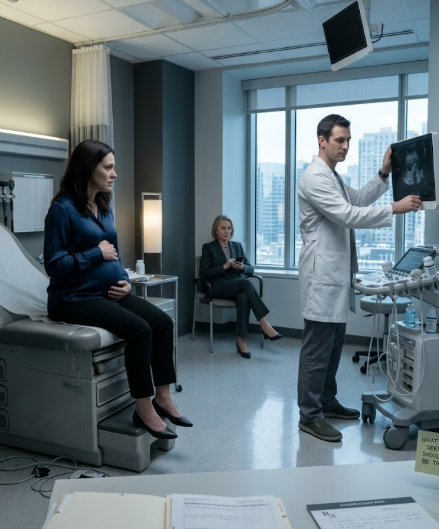
They took my vitals. Checked the baby. The heartbeat filled the room. Fast. Strong. Alive.
That’s when I almost broke down. “Your son is fine,” the doctor said. “But we need to confirm what this is and if it can be removed without inducing labor early.” “Julian said he would take it out during the delivery.”
The woman in the dark suit looked up. “Julian Rivers?” I nodded. “I’m Fiona Logan, hospital legal counsel and liaison with the District Attorney’s office when there’s suspicion of medical intervention without consent. Dr. Morgan called me because this is no longer just a clinical issue.”
The word “consent” broke me. Because everything Julian did to me was disguised as care.
They took me to imaging. The MRI was horrible. Not because of pain. Because of fear. Lying flat, motionless, listening to the noise of the machine, feeling my baby move while strangers looked for an object in my womb, was like living a nightmare in a hospital gown.
When I came out, Dr. Morgan’s face was unreadable. “It’s a small capsule. It’s not inside the baby. It’s lodged next to the external uterine tissue, placed surgically. It appears to have a metallic component and a passive transmitter.” “Transmitter?”
Fiona replied: “Something designed to be identified or tracked with a reader. It shouldn’t be in a human body. Much less a pregnant woman’s.”
I covered my mouth. “Did Julian put it inside me?”
No one answered. But the silence was an answer.
They admitted me for safety. The doctor said moving it without a plan could cause bleeding. They called a surgical team. Ran tests. Hooked me up to an IV. They took my phone for a moment to back up messages, audio, and location data. I only asked for one thing: “Don’t let my husband in.”
Fiona was clear. “It’s on record. No one comes in without your authorization.”
At seven in the morning, Julian called. Once. Again. Again. Then Catherine. Then Julian again.
Message: “Where are you? You’re worrying me.” Then: “Audrey, answer. My mom is anxious.” After that: “Don’t do anything stupid. Think about the baby.”
I showed the phone to Fiona. “Save everything,” she said. “Don’t reply.”
At nine, Julian arrived at the hospital. I knew before seeing him because I heard his voice in the hallway. “I am her husband and I’m a doctor. Let me through.”
Dr. Morgan went out to meet him. I was in bed, behind the curtain, with a hand on my belly. I heard every word.
“Dr. Rivers, the patient expressly requested that you do not enter.” “My wife is confused.” “Your wife is conscious, oriented, and in full possession of her faculties.” “You don’t know who you’re dealing with.” “With a pregnant patient who arrived with a foreign body implanted without medical explanation.”
Silence. Julian lowered his voice. “That is none of your business.” “Since it appeared in my patient, it is.”
Fiona intervened. “Dr. Rivers, everything you say can go on record. I recommend you leave until you are formally subpoenaed.”
Then I heard Catherine’s voice. “Audrey is fragile. She always has been. My son has only protected her.”
I couldn’t stay quiet. I pulled back the curtain. Julian saw me. For the first time since I met him, he didn’t have a smile ready.
Catherine wore a pearl necklace, an expensive handbag, and that posture of a lady who thinks elegance wipes away crimes. “Audrey,” she said. “My sweet girl, they scared you.” “You called me an asset.”
Her face didn’t change. “Because you are important.” “No. Because you were calculating my worth.”
Julian took a step. “Love, come with me. This has gotten out of hand.” “Don’t ever call me love again.”
The hallway stood still. A nurse stopped writing. An orderly looked at the floor.
Julian clenched his jaw. “You have no idea what you’re doing.” “Yes I do,” I said. “I’m stopping you from cutting me open during delivery to take out ‘the object’.”
His face drained of color. Catherine closed her eyes for a second. That gesture gave her away more than any confession.
Fiona looked at Julian. “Do you want to explain that phrase?”
He didn’t answer. Catherine spoke. “Richard Foster owed our family a great deal.”
My heart pounded once. Hard. “Richard Foster was my father.”
Catherine barely smiled. “He was a cruel man. And before he died, he hid something that belonged to us.” “What did you put inside me?”
Julian looked down. Catherine didn’t. “The key.”
No one spoke. “The access key to the Foster trust,” she continued. “A security capsule. Richard had it made so it could only be located with a specific reader. Your mother hid it before he died. Julian found it among your medical and family documents when the pregnancy paperwork started.”
I felt nauseous. “And you decided to put it in my body?”
Julian finally spoke. “It was temporary.”
Temporary. As if he had stored an earring in a purse. As if my womb weren’t holding my son.
“Why?” I asked.
Catherine leaned toward me. “Because the trust could only be opened under two conditions: the physical key and proof of blood continuity of the Foster line. You alone could claim a portion. Your son, all of it. Richard left a fortune for the first direct descendant born alive.”
The room felt small. “The Foster girl is worth more pregnant than alone.” The phrase came back in full.
I was the bridge. My baby was the door. And the capsule, the key.
Julian tried to soften his voice. “I was going to manage it for you both. You don’t understand these matters.”
I laughed. A broken laugh. I, who had spent years reviewing consulting contracts, client accounts, budgets, and financial statements, didn’t understand. They understood so well that they drugged me, cut me open, and used my pregnancy as a safe deposit box.
“Get out,” I said. Julian looked at me as if he could still give orders. “Audrey…” “Get out.”
Fiona called security. Catherine straightened up. “This doesn’t end here.” “No,” I replied. “It’s just beginning.”
That same afternoon, I filed the police report from the hospital. It wasn’t theatrical. It was a table, papers, uncomfortable questions, my voice trembling, and a folded napkin a nurse handed me without saying a word. The District Attorney’s office sent personnel. Fiona discussed restraining orders. Dr. Morgan handed over images and clinical notes. I handed over audio files, messages, and the papers Julian had kept.
It all came out there. Copies of Richard Foster’s certificates. Letters from an estate attorney. Statements from a trust managed for years. And a folder with my name: “Audrey Foster / descendants”.
I didn’t use that last name. My mother gave me hers to protect me. Julian had dug it up.
Two days later, with a careful procedure and a team that explained every step to me, they removed the capsule without inducing early labor. I was trembling so much that a nurse held my hand. “Look at the monitor,” she told me. “Listen to your baby.”
The heartbeat filled the room again. That sound was my anchor.
When they took the object out, they didn’t show it to me up close. It was small, metallic, sealed, cold inside a clear container. It didn’t look like it was worth a life. But it almost cost me two.
The capsule was secured as evidence. The trust was also frozen by court order while its origins were investigated. The law firm was notified. The County Clerk’s office was notified to prevent any property transfers regarding my house. My bank accounts were protected. My mother-in-law was served with a restraining order. Julian lost his hospital privileges and, shortly after, his medical license was suspended pending investigation.
But none of that restored my trust in my own body.
For weeks, every movement of my baby brought me relief and terror. I slept very little. I dreamed of operating rooms. Of Catherine touching my belly. Of Julian telling me “trust me” while hiding scalpels behind white roses.
My mother arrived from Connecticut when I told her. She didn’t ask me why I hadn’t suspected anything sooner. She didn’t say “I warned you.” She just sat next to my bed, brushed my hair like when I was a little girl, and said: “Your father tried to protect you in his own way. He failed by leaving you alone with such a massive truth.”
“Did you know about the trust?” She cried. “I knew something existed. I didn’t know where the key was. Richard distrusted even his own shadow. He told me that, if it ever turned up, you should be the one to decide. Not your husband. Not your mother-in-law. You.”
I stared out the window. Outside, the city remained enormous, broken, and alive. “Why did you tell me he died without leaving me anything?” “Because I didn’t want anyone seeking you out for money.”
I closed my eyes. “Well, they found me through my womb.”
My mother cried silently. I didn’t hug her that day. I couldn’t carry any more of other people’s pain.
At eight and a half months, my son decided to be born. Not in Julian’s clinic. Not with Catherine praying like an owner. He was born in an operating room at Mount Sinai, with Dr. Morgan leading, my mother by my side, and a nurse telling me to breathe even though I swore I didn’t know how to anymore.
When I heard the cry, the world broke open in a different way. “He’s fine,” Dr. Morgan said. “Your baby is fine.”
They placed him on my chest. He was small, warm, furious. My son. Not an asset. Not an heir. Not blood continuity. My son.
I named him Matthew. Not for anyone in the Foster family. Not for Julian. Because the name means gift, and after everything they tried to do to turn him into an instrument, I needed to remind the world that he was exactly that: a gift, not a key.
Julian tried to see him. He couldn’t. He sent letters. I didn’t read them. Catherine sent an acquaintance to ask if “the boy looked like a Foster.” My mother practically chased her out of the building.
I didn’t go back to the Park Slope house until two months later. I walked in with my sleeping baby in a carrier, accompanied by my lawyer, my mother, and two police officers to collect my belongings. The crib was still there. Catherine’s tonics too. The pillow where Julian used to position my body looked innocent on the bed.
I threw away everything she had brought over. Bottles. Frozen soups. Embroidered blankets. A rosary she left hanging on the crib. Not out of disrespect for faith. For hygiene.
I moved to Greenwich Village, near Washington Square Park, where the afternoons smell of coffee, roasted nuts, sweet pastries, and rain on brownstone. I walked with Matthew down cobblestone streets, among ivy-covered buildings, street musicians, and kids running around the fountain. Life started to feel less clinical.
One day, in front of Judson Memorial Church, my son laughed for the first time. A tiny laugh. Without history. Without inheritance. Without fear.
I cried right there, sitting on a bench, while a woman sold balloons and a busker played a sad song on an acoustic guitar.
Months later, the Foster trust was legally recognized under my name as the legitimate trustee until Matthew came of age. I accepted it with conditions. A portion was set aside for his future. Another for a foundation supporting women who are victims of obstetric violence and medical abuse. The capsule remained in judicial custody, not as a treasure, but as proof of how far greed can go when disguised as care.
Julian faced criminal, civil, and professional proceedings. Catherine lost her elegance in court hearings where there were no longer enough pearls to cover up the words: intervention without consent, abuse, financial abuse, maternal-fetal risk.
The last time I saw her, in a cold courthouse hallway, she glared at me with hatred. “That boy carries Foster blood,” she said.
I adjusted Matthew against my chest. “And my last name. And my history. And my decision.”
She didn’t reply. Because for the first time, she had no access to anything of mine.
Today Matthew is ten months old. He sleeps with his fist closed next to his face, just like in that ultrasound where Dr. Morgan saw what shouldn’t have been there. Sometimes I still wake up to check that he’s breathing. Sometimes my body still trembles when someone tells me to “trust.”
I don’t trust easily. But I trust myself. I trust the woman who left a house in a robe, seven months pregnant, with a poorly zipped backpack. I trust the doctor who turned off a screen to save me. I trust the heartbeat that held me up when everything else was a lie.
And when I walk through Greenwich Village with my son in my arms, under old trees and colorful facades, I understand something Julian and Catherine never understood.
My womb was not a safe deposit box. My baby was not an inheritance. My body was no one’s territory.
They hid an object inside me thinking they were turning me into an instrument. But all they did was force me to find, beneath the fear, the mother who was born before her son.
A mother who no longer asks for permission. A mother who learned that protecting can also mean saying no to the smile of the man sleeping next to you. A mother who carries Matthew through life not as an asset, nor a last name, nor a key.
But as what he always was. My son. My miracle. My living proof that sometimes a woman has to expel the lie first in order to give birth in peace.