“If you want to know who died in my place, go to the ranch in Querétaro and ask about the son that Carlos and Héctor thought they had buried when he was a newborn.”
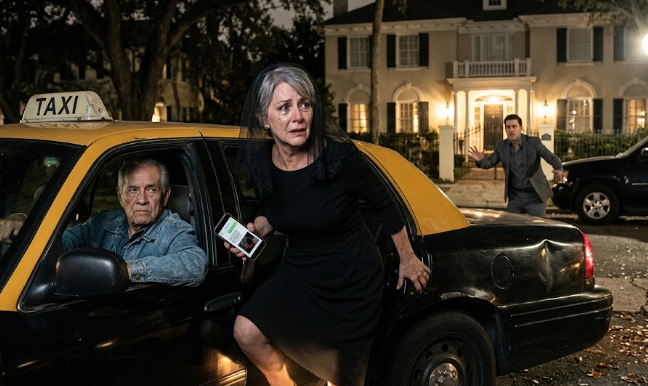
I read the message three times inside the taxi.
I didn’t understand.
No quise understand.
Don Aurelio drove without turning on the radio, with both hands firmly on the steering wheel. Gone was Las Lomas, my house, my children, the closed coffin and forty-three years of marriage turned into an impossible question.
“Don Aurelio,” I whispered, “is Ernesto alive?”
The old driver looked in the mirror.
“Yes, Mrs. Teresa.
I covered my mouth.
The crying came out strange.
It wasn’t clean relief.
It was anger, fear, love and betrayal mixed together.
“And the man in the coffin?”
Don Aurelio took too long to answer.
“He must tell you that.
We drove all night.
We left Mexico City as the drizzle hit the windshield. We passed Santa Fe, Constituyentes, the dark road, the trailers with red lights and the closed stalls where it still smelled of burnt coffee.
I had Ernesto’s letter, USB, empty bottle and revolver in my bag.
I had never felt so old.
Not so awake.
At dawn, Querétaro appeared with its clear sky, its dry hills and that earth that smells different after the rain. Don Aurelio took a dirt road between mesquites, nopales and old stone fences.
The ranch was not elegant.
It was a white, low house, with bougainvillea and a well in the center of the courtyard.
And there was Ernesto.
Alive.
Sitting in a wooden chair, with a beard of several days, a bandage on his arm and eyes full of guilt.
I got out of the taxi not knowing whether to run towards him or hit him.
He stood up.
“Teresita.”
I slapped him.
Not strong.
Enough for him to understand that a woman does not bury her husband as a strategy and then hugs him as if nothing had happened.
“I cried for you in front of your children,” I said. I cried for you in front of a coffin.
Ernesto lowered his head.
“Forgive me.”
“Don’t start with that. Speak.
We enter the kitchen.
A woman from the ranch served us coffee from the pot, but no one touched it. Ernesto put a folder on the table. His hands were shaking.
“Carlos and Héctor wanted to declare you incapable,” he said. They already had a doctor willing to say that the grief had upset you. They wanted to control your accounts, sell the house, and file a false will.
I felt nauseous.
“I heard them.
“They were also drugging me.
I looked at the jar in my bag.
“With that?”
He nodded.
—Small doses. Sedatives. Enough to make him look confused, clumsy, tired. They told me it was age. I became suspicious when Carlos insisted on bringing me coffee every night.
I remembered my son walking into the studio with a smile.
“Dad, rest. You can’t handle everything anymore.”
My eyes burned.
“And you faked your death?”
“Not from the beginning. I planned to leave the house, file a complaint, protect you. But then Rafael died.
The name pierced me.
Raphael.
My first child.
The baby who, according to everyone, died two days after birth.
I was told that he was born weak.
They sedated me.
When I woke up, Ernesto was crying by my bedside and my mother-in-law said that God knew why he did things.
I never saw the body.
Just a little white box.
“No,” I said.
Ernesto closed his eyes.
“Rafael did not die then.
I got up so fast that the chair fell.
“What did you say?”
“My mother handed him over.
The air turned to poison.
“Your mother?”
“He said that the child was sick, that we were going to spend our lives in hospitals, that you wouldn’t resist it. I was young. I was desperate. I believed death because they also told me. Eight months ago Rafael found me.
I grabbed the table.
“Did you know him for eight months and you didn’t tell me?”
Ernesto cried.
“He didn’t want to. He grew up believing that we abandoned him. When he learned the truth, he was already sick with his heart. He was afraid to show up only to die again in your arms.
I felt something ancient open inside me.
A pain that was not a widow’s.
It was from a stolen mother.
“I had the right to hug him.
“Yes.
“I had a right to know his voice.
“Yes.
“I had the right to say goodbye.”
Ernesto did not defend himself.
That angered me more.
He took me to a small room.
There was a bed spread, a candle, a folded shirt, and a portrait.
Raphael.
Almost forty years.
Ernesto’s eyes.
My mouth.
My very way of bowing my head.
I approached the portrait and broke.
“My child…
On the table was a letter.
“Mama Teresa.”
I opened it with useless hands.
“Sorry for being late. They told me that you didn’t love me because I was born sick. When I met dad Ernesto, I understood that we had also been robbed. I didn’t want to make you suffer, but I needed you to know that I lived. That I was afraid. That I dreamed of your voice even though I didn’t remember it. If you ever read this, don’t think that I died without a mother. I imagined you all my life.”
I bent over on the bed.
I cried for the baby I didn’t carry.
For the child I didn’t see walk.
For the man who died calling me mom on a sheet.
Ernesto stayed at the door.
He did well.
If he came close, I hated him.
If he left, too.
When I could breathe, I asked:
“How did you end up in the coffin?”
Ernesto sat down in front of me.
“Rafael died here, three days ago. The doctor signed her certificate with her real name. But Carlos and Héctor did not know that I had left the house. They entered the studio at night. They thought they found me dead on the stretcher because Rafael looked too much like me. Thin, bearded, covered. Don Aurelio let them get confused.
“Did you let them bury our son with your name?”
“They weren’t going to bury him. They were going to cremate him tomorrow. Fast. To clear evidence.
Anger wiped away my tears.
“We’ll be back today.
“Yes.
“And this time you don’t send me messages like a ghost.” This time you walk with me.
Ernesto nodded.
Mr. Montalvo, a notary from Querétaro and an old friend of Ernesto’s, arrived before noon. He brought certified copies, videos, DNA tests, the royal will and a memory with recordings.
“Mrs. Teresa,” he said, “your children didn’t just try to alter the succession. There are indications of the supply of substances and patrimonial violence. And with you, attempt at capacity control through deception.
I looked at Ernesto.
“The will?”
Montalvo opened the folder.
“The family home is for you in full use and control. The main accounts too. Carlos and Héctor would receive a share only if they respected her will and did not try to declare her incapable, pressure her or falsify documents. If they did, they are excluded.
“They did.
“So they lost more than money.
I kept Raphael’s letter to my chest.
“Come on.
We return to Mexico City before nightfall.
I was not hidden.
I was seated straight in the back seat, with the black veil inside the bag and my heart in firm ruin.
When he arrived at the funeral home, Carlos was arguing with the manager.
“My father wanted immediate cremation,” he said. My mother is not in a position to decide.
Héctor was talking on the phone.
“Yes, doctor. As soon as she returns, we will sedate her. He is delirious.
Entered.
“Delirium about what, son?”
Hector turned.
He turned white.
Carlos walked towards me with a face of rehearsed concern.
“Mom, where were you?” You had us dead of anguish.
Then Ernesto came in behind me.
Carlos’s face fell apart.
Hector recoiled until he collided with a wreath of flowers.
“Dad…
Ernesto looked at them as if he were seeing them for the first time.
“What a hurry they were to burn me.
Carlos opened his mouth, but nothing came out.
Montalvo’s lawyer spoke with the person in charge. Cremation was suspended. The funeral home, which used to obey my children with smiles, now asked for identification, documents, authorizations.
The police arrived without sirens.
The fake doctor tried to leave through a side corridor. Don Aurelio pointed it out. In his briefcase they found blank prescriptions, pills and an appraisal prepared with my name.
“Severe cognitive impairment.”
“Need for permanent supervision.”
“Risk for Asset Management.”
I almost laughed.
Not of grace.
Of horror.
“Even when I was old I was they wanted to fake,” I said.
Carlos approached.
“Mom, you don’t understand. Dad was going to leave us with nothing because of a stranger.
The of a bofetada.
The sound silenced everyone.
“Rafael was not a stranger. It was my son.
Hector put his hands to his head.
“That man was dead.
“No. He was hiding. Like the truth.
Ernesto took a step towards them.
“You chose money over your mother.
Carlos gritted his teeth.
“You chose a dead man over your living children.
Ernesto looked at him sadly.
“No. You chose to become dead to me.
Rafael was buried in Querétaro with his real name.
There was no large mass.
There were no businessmen or friends from Las Lomas or expensive crowns.
Only mesquites, damp earth, the doctor who took care of him, Don Aurelio, Montalvo, Ernesto and me.
I put white flowers on his grave.
“Forgive me for being late, son.
The wind moved the trees.
Nothing more.
But that time, at least, my son had his mother in front of his land.
Then the legal war began.
Carlos and Héctor became files.
Fraud.
Document forgery.
Attempted spoil.
Patrimonial violence.
Supply of substances.
An attempt to manipulate my legal capacity.
I learned words that no mother wants to learn from her children.
The royal will was read at a notary’s office in Polanco, with cameras, lawyers, and my two sons sitting across from me like men who still believed they could negotiate the truth.
Montalvo read:
“Any act aimed at pressuring, incapacitating, sedating, transferring, or administering against her will my wife Teresa Morales de Ramírez shall be cause for total exclusion from inheritance benefits.
Carlos clenched his jaw.
Hector began to cry.
“Mom, please…”
I didn’t answer.
The notary continued:
—A part of the patrimony is destined to the Rafael Ramírez Morales Foundation, for medical care of children with heart disease in rural communities of Querétaro.
I closed my eyes.
Rafael did not have our help in time.
Other children maybe.
When he finished reading, Carlos got up.
“You took everything from us.
Ernesto, sitting next to me, answered:
“No. You emptied yourselves.
Carlos never asked me for forgiveness.
He sent lawyers.
He sent threats.
He sent letters saying that Ernesto was manipulating me.
I kept everything in a folder without reading more than two lines.
Héctor did return.
Months later, he appeared in the garden of the house, skinnier, with an unkempt beard and a bouquet of flowers bought out of guilt.
I received it outside.
Not in the living room.
“Mom,” she said, “Carlos pressured me.
“You were an adult before your brother learned to lie better.
He lowered his head.
“Forgive me.”
I looked at him as one looks at a child that one still loves even though one can no longer save.
“Forgiveness doesn’t give back keys.
He cried.
“I know.
“Then start by really knowing.
I didn’t hug him.
I didn’t kick him out either.
Sometimes a mother doesn’t know if that’s mercy or tiredness.
Ernesto and I were never the same again.
How could we?
He saved me from my children.
He also hid my first child from me.
He made me cry him alive and bury Rafael under another name.
We slept in separate rooms for months.
The house in Las Lomas, with its high walls and jacarandas, no longer felt elegant. It smelled of poisoned coffee, of secrets, of drawers opened by greedy hands.
I had the locks changed.
I threw the cup where the jar was.
I kept the mahogany desk.
Every morning I pressed the molding of the secret compartment, even though it was already empty, to remind me that a woman must know where she keeps her truths.
One night I found Ernesto in the garden.
“I don’t deserve you to stay,” he said.
I sat down next to him.
“I didn’t stay because I deservedly stayed. I stayed because forty-three years do not fit into a single lie. But neither are they cured by a single truth.
He cried.
“Rafael had your mouth.
“I know.
“I should have taken you with him.
“Yes.
“I should have told you.
“Yes.
“Are you ever going to forgive me?”
I looked at the cold lights of Las Lomas behind the trees.
“Maybe the day I stop waking up burying you twice.
He said no more.
He did well.
The Rafael Foundation opened its first mobile clinic two years later.
We went to communities in the Sierra Gorda, where mothers walked for hours with babies wrapped in shawls. I watched a cardiologist check on a child while his mother prayed quietly.
Le tomé la mano.
“Here we are,” I said.
And I felt that Rafael was there too.
Ernesto really died five years later.
No closed coffin.
No theatre.
No messages from unknown numbers.
No children faking tears.
I said goodbye to him with a clean sadness.
Not perfect.
Clean.
On his grave I placed a flower and said to him:
“This time I do know where you are.
Then I went to Raphael’s grave and left another.
Mother of a stolen son.
Wife of a man who saved me and hurt me.
Survivor of two living children who learned too late that a mother is not a trembling signature.
Today I am eighty years old and I still live in my house.
In the studio, the mahogany desk is still in place.
Inside the secret compartment I no longer keep wills.
I keep letters.
Rafael’s.
One of Ernesto asking me for forgiveness.
And one of mine, written for when I’m gone.
It starts like this:
“To whoever tries to decide for me when I cannot speak: Teresa was not a confused widow, nor an easy mother to erase, nor an old woman waiting for permission to exist.”
Sometimes my cell phone vibrates in the afternoon and I still feel cold.
I remember the funeral.
The father praying.
Carlos and Héctor next to the coffin.
The message:
“I’m alive. Don’t trust them.”
I thought it was a sick joke.
It was a cruel resurrection.
But it was also the door.
I found out that my husband was not in that coffin.
I discovered that my lost son had indeed existed.
I discovered that my living children could act like strangers.
And I discovered something else:
A woman can cry in front of a closed box and still have the strength to open a desk, a will, a lie, and her own life.
Ernesto left me a warning.
Rafael left me a letter.
Carlos and Héctor left me with a scar.
But I left out something more important:
the decision not to obey those who called my confinement careful.
That’s why, when someone asks me how I survived that funeral, I always say the same thing:
it was not because Ernesto was alive.
It was because I woke up too.