He discovered his wife bleeding while their son was laughing in the kitchen.
I came home two days earlier than planned, a bottle of red wine and a box of pastries lying haphazardly on the passenger seat and the carpet.
That was the kind of surprise I thought I’d bring home.
A small one.
The husband walked into the house before dinner.
The wife rolled her eyes because her husband never kept a secret.
The transportation conference had ended earlier than expected, and instead of staying alone in the hotel room for two more nights, I changed my ticket and took the first flight home.
I didn’t call Sarah.
I didn’t text Michael.
I didn’t tell anyone, because after more than twenty years of marriage, I still loved the feeling of seeing my wife’s expression change when I walked into the room she thought would be empty until Sunday.
At 5:18 p.m. that Friday, I drove into the yard and saw Michael’s SUV parked by the curb.
That should have made me smile.
It didn’t.
There are little things you notice before your mind lets you grasp the bigger picture.
The porch lights were still on even though the sun hadn’t set.
The front door wasn’t fully latched.
The house smelled of lemon-scented floor cleaner, warm carpet, and something sharp underneath.
Copper.
I pushed the door open with my shoulder, one hand holding a bottle of wine, the other a box of pastries.
Then I saw my wife lying on the floor.
Sarah was sitting up in the beige sofa, one hand on her right eyebrow.
Blood had trickled down her temple and soaked into the collar of her cream-colored shirt.
It had dripped onto the rug we bought for our 20th wedding anniversary, the rug she always made me step over whenever my shoes got wet.
Her knees were pressed together.
Her shoulders were hunched forward.
She looked as if she were trying to take up as little space as possible in the living room she had spent half her adult life making cozy for everyone.
The bottle slipped from my hand onto the entryway table, but thankfully didn’t break.
The box of cookies fell to the floor.
Sarah looked at me, her mouth agape as if to explain before I could ask anything.
That was the first thing that broke my heart.
It wasn’t blood.
A look of remorse was etched on her face.
I knelt beside her.
“Sarah, what happened?”
She tried to shake her head, then grimaced.
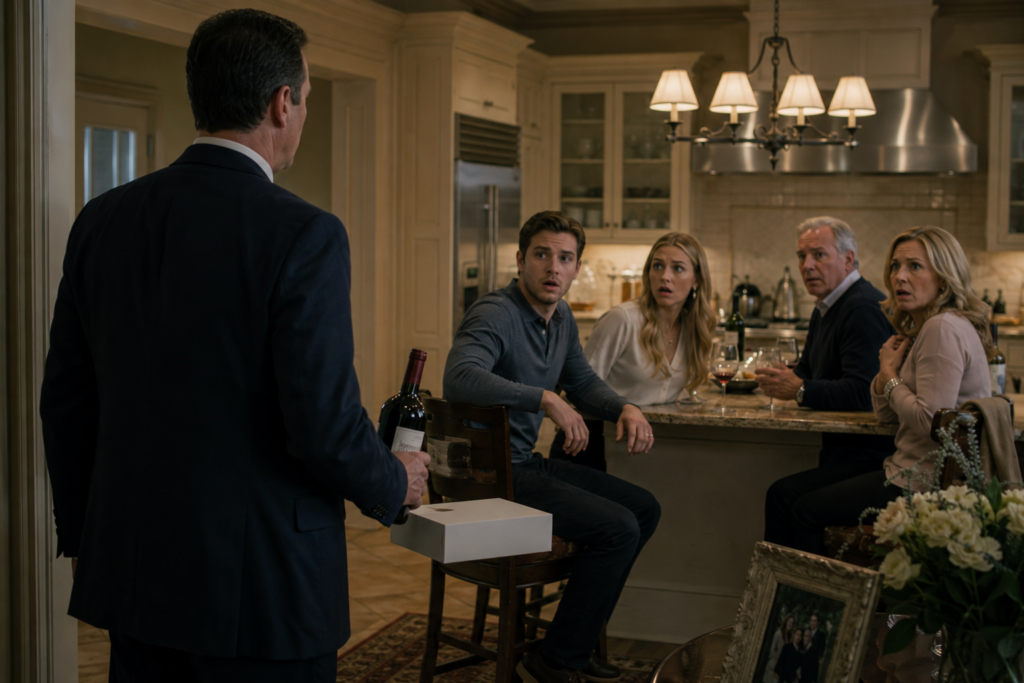
Laughter came from the kitchen.
My son’s laughter.
Michael had a loud laugh, the kind that echoed through our garage when he was sixteen and pretended to know more about carburetors than I did.
I heard Olivia’s soft chuckle beneath his.
Then David’s voice rang out, deep and satisfied.
Then Jessica said something I couldn’t quite make out, and then another noise came from the table.
That sound shouldn’t have been at the same time as my wife lying bleeding on the floor.
A house can hold two truths at once, and sometimes that’s what makes it unbearable.
In the same room, a woman can be hurt and humiliated.
And then, everyone can still laugh because they’ve decided her pain doesn’t matter.
I gently touched Sarah’s wrist.
“Who did this?”
She swallowed.
Her gaze drifted toward the kitchen.
That was all the answer I needed, but she still told me more.
“I tried to get rid of them,” she whispered.
Her voice was hoarse.
“I won’t sign.”
It was then that I noticed the stack of documents on the coffee table.
It was open beside a black pen.
These papers weren’t bills, family photos, or anything from a typical meeting.
They were ownership transfer forms.
A county recorder cover sheet.
A notary acknowledgment page.
A draft packet for the little beach house Sarah’s mother had left her.
That house had been a sore spot for weeks.
Michael had started by asking politely.
He said David’s restaurant only needed a little bridge money.
He said selling the beach house made more sense than letting it sit half the year.
He said Sarah was being emotional because the place had belonged to her mother.
I said no.
Sarah said no.
Michael acted wounded, as if a parent’s boundary were a betrayal.
After that, the calls got shorter.
The messages got colder.
Olivia stopped sending Sarah photos from Sunday dinners.
David began calling the house an “asset,” which told me everything I needed to know about how he saw my wife’s inheritance.
Sarah had given Michael more chances than he deserved because he was our son.
She remembered him as a boy with scraped knees and a crooked grin.
She remembered school pickup lines, baseball practices, late-night fevers, and the summer he slept on our floor after his first bad breakup because he didn’t want to be alone.
That was the trust signal he had counted on.
A mother’s memory.
He had walked into her living room with papers because he believed she would rather bleed
quietly than makes him feel ashamed.
I looked at the pen.
I looked at the blood on the rug.
Then I looked back at my wife.
“He grabbed my arm,” Sarah said.
She sounded like the words embarrassed her.
“I pulled away. I hit the table.”
I saw the corner of the coffee table then, a small smear where her eyebrow must have struck.
Behind me, the kitchen erupted again.
David laughed like a man who thought pressure was just negotiating with better posture.
For one ugly heartbeat, I wanted to become the kind of man who solved things with his hands.
I wanted to walk into that kitchen and make every person at that table feel one tenth of what Sarah had felt on the floor.
Instead, I took out my phone.
Anger is easy.
Evidence is harder.
Evidence is what stays when liars start practicing their voices.
I took three photos first.
Sarah’s injury.
The blood on the rug.
The open folder with the county recorder form and the notary page visible.
The phone recorded the time automatically.
5:20 p.m.
Then I called 911.
I keep my voice low.
I gave the dispatcher our address.
I said my wife had a head injury.
I said there had been an argument over property documents.
I said the people involved were still inside the house.
The dispatcher told me to stay on the line.
I said I would.
Sarah caught my sleeve when I started to stand.
For a second I thought she was trying to stop me.
Instead she whispered, “Don’t let them take it.”
Not “don’t let them hurt me.”
Not “don’t make a scene.”
“Don’t let them take it.”
That was when I understood how long they must have been wearing her down before I opened that door.
I squeezed her hand once.
“They won’t.”
Then I stood.
The doorway between the living room and kitchen was wide enough that I could see the edge of the table before they saw me.
There were plates out.
Glasses.
A twisted napkin near Michael’s elbow.
Olivia had her phone facedown beside her fork.
David sat in my chair.
That small detail almost sets me off more than it should have.
When I stepped into the kitchen, Michael looked up with a grin still on his face.
It disappeared slowly.
That was the moment I will remember longer than the blood.
Not because I enjoyed seeing fear in my son.
Because I saw recognition arrive.
He knew I was not supposed to be there.
He knew his mother was supposed to have time to clean herself up, or hide in the bedroom, or swallow the story they planned to tell me.
Olivia’s fork stopped halfway to her mouth.
Jessica’s fingers tightened around the stem of her glass.
David leaned back, trying to decide whether to be friendly or offended.
I put my phone faceup on the counter.
The active 911 call fills the screen.
“Nobody moves,” I said.
Nobody did.
David tried first, because men like that always mistake age and volume for authority.
“Now hold on,” he said. “This is family business.”
I looked at him.
“Sit down.”
Something in my voice made him obey before his pride could catch up.
Michael stood halfway.
“Dad, you’re overreacting.”
The dispatcher’s voice came through the phone and asked whether everyone was safe.
I didn’t take my eyes off Michael.
“My wife is injured,” I said. “The people who were pressing her to sign property papers are in front of me.”
Olivia started to cry then, but it was not the kind of crying that comes from compassion.
It was panic.
There is a difference.
Panic looks for exits.
Compassion looks toward the person on the floor.
Sarah’s voice came from the living room.
“Check the second page.”
The whole kitchen changed.
Michael’s eyes snap toward the folder.
Olivia said his name once under her breath.
I walked back to the coffee table slowly, because every part of me wanted to move fast.
Under the deed draft was a clipped witness page with Olivia’s name typed beside a blank signature line.
There was also a second page authorizing funds from the sale to be transferred into a business account.
No one had mentioned that to Sarah.
No one had mentioned it to me.
The restaurant was not asking for help.
It was waiting for my wife’s dead mother to fund its next mistake.
I carried the pages back into the kitchen.
Olivia saw her name first.
Her hand flew to her mouth.
“I didn’t know he brought that,” she whispered.
Michael turned on her so suddenly that his chair bumped the table.
“Stop talking.”
That was when the siren turned onto our street.
It didn’t sound like justice.
Justice is too big a word for those first few minutes.
It sounded like consequence.
It sounded like the outside world entering a house where everyone had been counting on silence.
The police arrived first.
The ambulance pulled in right behind them.
Our front porch looked suddenly too small for all the uniforms, radios, medical bags, and stunned neighbors pretending not to stare from their own driveways.
A small American flag on our porch moved in the evening air like nothing unusual was happening under it.
Inside, the officers sep
rated everyone.
That mattered.
It stopped Michael from performing sonhood in front of me.
It stopped David from turning the kitchen into a debate.
It gave Sarah room to speak without four people watching her mouth.
The EMT crouched beside her and asked questions in a calm voice.
Name.
Date.
Pain level.
Whether she felt dizzy.
Sarah answered them, but her eyes kept finding me.
I stayed where she could see me.
Michael tried to tell one officer that it had been an accident.
He said his mother was upset.
He said the papers were only there for discussion.
He said families argue.
The officer listened without expression, which only made Michael talk more.
Liars hate quiet because it gives their own words time to echo back at them.
David told another officer that he had never touched Sarah.
That was probably true.
Men like David rarely need to touch anyone themselves when they can convince someone else to do the reaching.
Jessica cried into a napkin.
Olivia sat at the table with both hands in her lap, staring at the witness page as if it had betrayed her by existing.
I gave the police the photos.
I showed them the timestamp.
I handed over copies of the papers, careful to keep the originals on the coffee table until an officer photographed them in place.
Process is boring until it saves you.
Then it becomes the only thing in the room that doesn’t shake.
At the hospital intake desk, Sarah gave her name in a voice that was still too small.
The nurse cleaned the cut and checked her pupils.
There was no life-threatening injury.
There was swelling, bruising, and a wound that needed closing.
The police report listed the injury, the property dispute, the documents, the 911 call, and the witness statements.
A case number was printed near the top.
Sarah stared at that number for a long time.
“What are you thinking?” I asked.
She said, “I’m thinking I almost let him make me feel rude for saying no.”
That broke me more than anything else she had said.
Not because she was weak.
She wasn’t.
Because she had been trained by love to make room for people who were crowding her out of her own life.
Michael came to the hospital later, but the officer at the desk would not let him back.
I saw him through the glass doors in the waiting area.
He looked younger than he had in the kitchen.
That didn’t soften me.
A grown man can look like somebody’s child and still be responsible for what he did.
The next morning, Sarah and I went through every paper in that folder at our dining table.
Not the kitchen table.
She said she didn’t want to sit there yet.
So we used the dining room, with coffee growing cold between us and the morning light falling across the pages.
The transfer was unsigned.
The authorization was unsigned.
The witness page was useless without Sarah’s signature.
The notary page had never been completed.
The beach house remained Sarah’s.
By Monday, we had called the county recorder’s office to confirm nothing had been filed.
We called the lawyer only to clarify our options, not to start a war.
War had come to our door, pen in hand.
We changed the locks.
We packed up Michael’s old garage key, the one he’d kept since college, and put it in a drawer instead of returning it.
That small act hurt Sarah.
I saw it.
She didn’t cry when the nurse cleaned the wound, but she did when I took the key out of his keyring.
“This is his house,” she said.
“No,” I said gently to her. “It’s where he’s always welcome. That’s not the same as ownership.”
Weeks went by before Michael sent a real message.
The first words were just excuses.
Then came anger.
Then accusations that we were destroying the family.
Finally, one night, he wrote that he was desperate.
That restaurant was worse than David had admitted.
Olivia was terrified.
He thought if Sarah signed it, everything could be resolved before anyone got hurt.
I read that line three times.
Before anyone got hurt.
While he was still laughing and joking in the kitchen, blood was already gushing out onto the carpet.
I didn’t reply to that text.
Sarah did.
She wrote, “You can’t call it desperation when the plan demands my silence.”
That was the first sentence I heard her say that sounded like her again.
The house changed after that Friday.
For a while, Sarah avoided the living room at dusk.
I moved the coffee table into the garage.
We had the carpet cleaned, but a smudge wouldn’t go away.
Sarah said to leave it.
Not because she wanted to remember the pain.
Because she wanted to remember that she had survived the moment of stopping hiding the truth from everyone.
In a house, one could witness a wife bleeding in the living room and see a table laughing and talking at the same time.
That was ten paces away.
But it could also hold out until the next morning.
It could contain clean coffee cups, a new lock, a police report in a file, and a woman sitting upright in her chair as she decided that love didn’t require giving up what her mother left behind.
Michael regretted it deeply.
Not immediately, as people imagine regret to be, with tears and perfect apologies.
He regretted it little by little.
When the siren went off.
When Olivia’s name appeared on that witness page.
When the officers cordoned off the room.
When his key stopped working.
When his mother finally stopped taking every call just because he was her son.
The seaside house was still in Sarah’s name.
That restaurant hadn’t survived.
And our family, the version that depended on Sarah’s silence, couldn’t exist either.
I used to think the worst sound I could hear in my own home was my wife crying.
I was wrong.
The most unpleasant sound was the laughter from the next room.
The most wonderful sound came later, weeks after the stitches had healed, when Sarah stood on the porch, the afternoon sun shining on her face, looking down the deserted street in front of the house and saying, “I’m not going to sign anything I don’t want to sign. Not now. Never.”
At that moment, no one laughed