He struck me so hard my lip split and bled, all because I asked where he had been the night before. At dawn, I quietly prepared a massive Southern feast and set out the silver cutlery. “That’s a good wife,” he gloated, taking his seat at the head of the table. But the color vanished from his face when the kitchen doors swung open and my three older brothers—captains of the city’s most feared underground syndicate—walked out, wiping their hands on my spotless white napkins.
He slapped me so hard my lip tore against my teeth, and the blood tasted like copper and warning. All I had asked was, “Where were you last night?”
Marcus Vance stood above me in our marble kitchen, still dressed in yesterday’s shirt and carrying another woman’s perfume. His wedding ring flashed beneath the chandelier like a bad joke.
“Don’t question me in my own house,” he said.
My own house. That was the funny part.
I pressed two fingers to my mouth. They came away red. He watched me, waiting for tears, apologies, that tiny shaking voice I had perfected through two years of marriage.
Instead, I lowered my hand and smiled.
For half a second, it disturbed him.
Then he laughed. “Look at you. Still trying to be brave.”
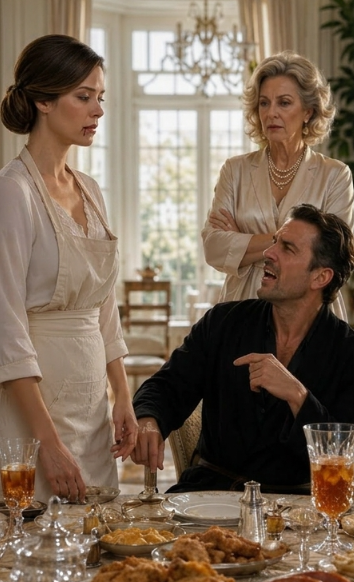
Behind him, his mother, Celeste, emerged from the hallway in her silk robe, face powdered, eyes cold. She had heard everything. She always heard everything.
“Some women don’t understand gratitude,” she said. “My son rescued you from nothing.”
I looked around the room I had paid for with money Marcus believed came from “family investments.” The imported tile. The copper pans. The antique sideboard. He had signed nothing, owned nothing, understood nothing.
That was his gift.
“Go clean yourself up,” Marcus snapped. “And tomorrow morning, I expect breakfast. A real one. None of your sulking.”
Celeste smiled. “A good wife knows when to be quiet.”
I nodded once.
That was all.
Because the cameras had recorded the slap. The microphones hidden beneath the kitchen island had captured every word. The private investigator I hired three months earlier had documented the affair, the forged loan papers, the offshore transfers, and the way Marcus had been handing my company’s contracts to his gambling creditors.
But the most important thing Marcus never discovered was this: I was not alone.
At 3:17 a.m., while Marcus slept upstairs with his phone under his pillow, I stood barefoot in the pantry and made one call.
My eldest brother answered before the first ring had even finished.
“Lena?”
I stared at my reflection in the dark window. Swollen lip. Dry eyes. Steady hands.
“He hit me,” I said.
Silence.
Then Rafael’s voice became flat as a blade.
“Are you safe?”
“Yes.”
“Do you want blood?”
I breathed in slowly.
“No,” I said. “I want breakfast.”….
Part 2
By dawn, the house smelled of butter, smoke, and judgment.
I fried chicken until the skin crackled golden. I baked biscuits that rose like soft white fists. I stirred shrimp and grits, glazed ham, collard greens, peach cobbler, red-eye gravy, sweet tea in crystal pitchers. A huge Southern feast, the kind Marcus thought proved a woman had learned her place.
My lip pulsed every time I smiled.
At six-thirty, Marcus came downstairs in a navy robe, freshly showered, smug enough to poison the air. Celeste followed behind him, diamonds at her throat though the sun had barely come up.
Marcus stopped at the dining-room entrance. His eyes widened at the spread.
“Well,” he said, pulling out the chair at the head of the table. “That’s a good wife.”
Celeste gave a pleased hum. “See? Discipline improves a household.”
I placed the silver cutlery down one piece at a time. The set had belonged to my grandmother. Marcus had once tried to sell it to cover a poker debt. He had told the buyer I was sentimental, weak, easy to manage.
“Sit,” I said.
He blinked. “Excuse me?”
“Food’s getting cold.”
His smile sharpened. “Careful, Lena.”
I poured his coffee. “Cream, no sugar. Like always.”
He leaned back, victorious. “Maybe there’s hope for you yet.”
His phone buzzed beside his plate. He ignored it. Then it buzzed again. And again. Celeste frowned.
“Popular this morning?” I asked.
Marcus glanced at the screen. For the first time, his face changed color.
Unknown number.
Then another.
Then his lawyer.
Then his bank.
He looked up slowly. “What did you do?”
I buttered a biscuit. “I cooked.”
The front gate intercom rang once. Marcus went rigid.
Before he could move, the house speakers clicked on. His own voice filled the room, lazy and drunk.
“Lena signs whatever I put in front of her. She doesn’t read contracts. She reads recipe books.”
Celeste dropped her fork.
Another voice followed. A woman laughing. Then Marcus again.
“Once her board votes her out, the company’s mine. Her brothers won’t touch me. They’re criminals. I’ll bury them with one phone call.”
Marcus jumped to his feet. “Turn it off.”
I did not move.
Because that recording had already been sent to my board, his attorney, three federal investigators, and the district attorney my second brother had put through law school years before Marcus ever knew my last name.
The kitchen doors swung open.
Rafael stepped out first, broad-shouldered in a charcoal suit, wiping his hands with one of my pristine white napkins.
Then Dante, calm and smiling, his gold watch flashing.
Then Nico, the youngest of my older brothers, carrying a sealed evidence box like a present.
Marcus stumbled backward.
The city called them syndicate captains. They called themselves logistics men. They owned docks, unions, clubs, debts, secrets.
But today, their true weapon was paperwork.
Rafael tossed the napkin onto Marcus’s empty plate.
“Morning, brother-in-law,” he said. “Hope you’re hungry.”
Part 3
Marcus pointed at them, trying to summon the voice that had frightened waiters, clerks, and me.
“You can’t come into my house.”
Dante laughed softly. “Your house?”
Nico opened the evidence box and laid the first folder beside the biscuits. Bank transfers. Forged signatures. Photographs. Emails. A copy of the prenup Marcus had mocked because he had never bothered to read paragraph fourteen.
I turned it toward him.
“Infidelity, financial fraud, domestic violence, and conspiracy against marital assets,” I said. “You trigger full forfeiture.”
Celeste snatched the paper. Her nails scraped the page.
“This is fake.”
“No,” I said. “Your son’s signature is fake on seven loan documents. Mine is real on every protection clause.”
Marcus lunged toward the folders.
Rafael caught his wrist with one hand. Not rough. Not theatrical. Just final.
“Touch her table again,” he said, “and I’ll let the officers outside misunderstand your intentions.”
Marcus froze.
Outside, blue lights flickered silently across the windows.
Celeste whispered, “Police?”
“Financial crimes unit,” Dante said. “Domestic violence liaison. Two federal agents. And, because Marcus used shell companies across state lines, people with very little patience.”
Marcus looked at me then. Really looked.
Not at the silent wife.
At the woman who had built the company he had tried to steal. The woman who had spent months letting him brag into hidden microphones. The woman who understood revenge worked best when it arrived wearing an apron and carrying receipts.
“You set me up,” he hissed.
I stepped close enough for him to see the cut on my lip.
“No, Marcus. I gave you room. You filled it.”
The doorbell rang.
Nico opened it.
The officers entered politely, almost gently, which made Marcus’s panic look even uglier. He shouted about corruption, family connections, fake evidence. Celeste screamed that I was unstable. Then Dante played last night’s video on the dining-room television.
The slap cracked through the room again.
This time, everyone saw it.
Marcus stopped talking.
When they cuffed him, he looked smaller than I remembered. Celeste clung to his sleeve until an officer told her to step back. Then Nico handed the agents a second envelope.
Celeste’s tax records.
Her face collapsed.
“Lena,” she breathed, suddenly sweet. “We’re family.”
I picked up the silver knife beside her plate and spread peach preserves over a biscuit.
“No,” I said. “You were guests who overstayed.”
Six months later, the house was quiet in a way that felt sacred.
Marcus accepted a plea after his mistress testified and his creditors became witnesses. Celeste lost the family estate paying restitution and legal fees. Both of them learned that arrogance is costly, and cruelty always leaves evidence.
I kept the company. I grew it.
On Sundays, my brothers came for dinner. Rafael still wiped his hands on the wrong napkins. Dante still flirted with my neighbors. Nico still checked every lock twice.
And me?
I healed.
One bright morning, I sat at the head of my own table, drank coffee from my grandmother’s china, and smiled at the sunlight spilling across the silver.
No fear.
No blood.
Just peace, served warm.
Part 4: The Inventory of Ruin
The silence that followed the snap of the front door latch was heavy, weighted with the grease of a hundred fried cutlets and the sharp, medicinal tang of the antiseptic I’d used to clean my mouth before the kitchen filled with men.
In the high-ceilinged dining room, the scent of the peaches—baked until the skins split and the brown sugar went dark as river silt—hung over the table like a funeral shroud for a ghost that hadn’t quite realized it was dead. The silver cutlery, laid out with geometric precision on the linen runner, caught the gray morning light filtering through the high casement windows.
“He didn’t even touch his coffee,” Nico said. He was leaning against the walnut sideboard, his sleeves rolled up to the elbows, revealing the faint, pale line of an old knife scar near his wrist. He was holding Marcus’s abandoned phone between two fingers as if it were a dead mouse. “Shame. You always get the foam right.”
“Leave it,” Rafael said from the window. His broad back was a dark wall against the pale blue glare of the police cruisers outside. He hadn’t taken his coat off. He never did in houses that didn’t belong to him by blood. “The investigators will want the call logs before the digital team scrubs the towers. He was texting the logistics manager at the terminal up until midnight.”
“He was texting a girl named Chloe,” Nico corrected, his thumb flicking across the glass. “Or rather, he was texting an empty account that Chloe used to dump her credit card statements into. He bought her a pair of Italian boots on Tuesday. Charged it to the corporate hospitality ledger under ‘Client Consultation: Regional Transport.’”
I didn’t look at the phone. I didn’t look at the chair Marcus had sat in, where the red velvet cushion still bore the faint, round impression of his weight. I took a clean white napkin—the linen heavy, stiff with starch from the laundry room downstairs—and carefully wiped a small bead of red-eye gravy from the rim of the silver tureen.
My lip was stiff. Every time I moved my jaw, the small, dry crust of blood near the corner of my mouth pulled tight, a tiny, hot reminder of the weight of a man’s hand when he thinks no one is looking.
“Where’s Celeste?” I asked. My voice sounded thin to my own ears, like paper that had been left in a damp drawer too long.
“In the back of the second sedan,” Dante said. He had entered from the hallway, his steps perfectly silent on the hardwood. He had Marcus’s leather briefcase under one arm and a stack of blue-bound folders under the other. “She asked the transport officer if the county facility had a separate wing for people with historic preservation society memberships. The officer told her everyone gets the same gray jumpsuit regardless of how many turn-of-the-century gardens they’ve restored.”
Dante sat down in the chair Celeste had occupied five minutes ago. He reached out, took a biscuit from the silver basket, tore it in half with one hand, and didn’t bother with the butter. “You used too much nutmeg in the greens, Lena.”
“It’s mace,” I said, sitting down at the opposite end of the table, far from the head where Marcus always insisted on sitting because he claimed the draft from the hallway cleared his sinuses. “Grandmother always used mace when the frost hit the collards early.”
“Whatever it is, it stays in the back of your throat,” Dante muttered, though he ate the second half of the biscuit anyway. “Lydia called from the office. The temporary injunction is already filed with the county clerk. As of eight-fifteen, Marcus Vance has no legal right to enter the zip code, let alone the driveway. The bank freezing order went through twenty minutes ago. His personal accounts are down to forty-two dollars and a recurring subscription to a car-detailing service in North Haven.”
I looked down at my hands. They were scrubbed clean of the lard and the flour, but the skin around my cuticles was pink from the lemon juice I’d used to get the smell of the onions out. For twenty-four months, those hands had signed checks, turned down corners of sheets, and ironed the small, stiff collars of Marcus’s shirts until they looked like the display models in the windows on Chapel Street.
“The company?” I asked.
“The board is meeting at noon,” Dante said, his eyes dropping to the folders. “They aren’t stupid, Lena. They saw the same ledger entries Nico found three weeks ago. When a man starts paying for container freight out of the employee healthcare fund, even the old men from the bank start looking for the exit doors. They’ll confirm your sole signature by one o’clock. The only thing they’re worried about is whether the state investigators are going to impound the cranes at the third pier.”
“The cranes are mine,” I said simply. “The titles are under the heritage trust. My name is on the bill of sale from ninety-eight, before Marcus even knew which side of the river the coal yards were on.”
“We know,” Rafael said, turning away from the window at last. The blue lights outside had stopped spinning, replaced by the steady, dull gray of a Connecticut Tuesday morning. “But the lawyers will still want to see the stamps. Go change your shirt, Lena. You’ve got flour on the sleeve, and you look like you’re about to go to work in a kitchen that isn’t yours anymore.”
Part 5: The Geography of the Boardroom
The offices of Vance Logistics—soon to be renamed, though the gold letters on the glass doors still bore the name of a grandfather Marcus had never met—sat on the fifth floor of an old brick malt house overlooking the harbor. The windows were wide and unwashed, thick with the salt-crust of the Atlantic and the soot from the diesel switchers that worked the rail spur down by the gravel pits.
When I walked into the conference room at twenty minutes to twelve, the air smelled exactly as it had when I was twelve years old, sitting on a high stool in the corner while my father argued with the tugboat captains: wet wool, stale tobacco, and the cold, flat grease of coffee that had been boiling since dawn.
There were seven men at the table. Four of them had known my father when he still wore work boots with steel toes; the other three were younger, men with sharp gray suits and small, rectangular spectacles who looked at the port receipts as if they were ancient hieroglyphs.
“Lena,” Harrison Vance said. He was Marcus’s uncle, an old man whose skin had the yellow, dried look of old parchment from forty years of salt air and scotch. He didn’t get up, but he shifted his cane from his right hand to his left. “We saw the tape.”
I sat at the foot of the table, near the water pitcher. I had put on a gray wool dress, the collar high enough to hide the faint yellowing bruise where Marcus’s thumb had dug into my throat when he shoved me against the pantry shelving. I hadn’t put anything on my lip but vaseline. It was split down the center, a small, dark line that looked like a pen stroke.
“The tape is secondary, Harrison,” I said. I laid my handbag on the table. It was an old leather thing, wide enough for a ledger and three rolls of quarters. “The state police have the receipts from the Westport box. Your nephew was billing the line-haul drivers for fuel they never took out of the pumps. He was using the difference to clear his ledger with the people who run the dogs down in Bridgeport.”
The three younger men looked at each other. One of them, a boy named Miller whose father owned the dry docks in Stonington, cleared his throat.
“Mrs. Vance—or Ms. Rossi, if we’re being precise about the filings—the corporate charter states that any transfer of the primary lease requires a two-thirds majority of the voting stock. Marcus signed a quitclaim to the third pier in October. We have the document here.” He slid a sheet of paper across the long oak table.
I didn’t touch it. I knew what it looked like before it even reached my side of the water pitcher.
“Marcus didn’t own the lease,” I said. “The lease belongs to the Rossi Estate Corporation. Paragraph fourteen of the pre-marital agreement—the one Marcus’s lawyer called ‘a standard domestic formality’ during the settlement discussions—explicitly states that any asset held by the Rossi trust prior to June of two thousand and twenty-four remains outside the marital pool, regardless of corporate titles or subsequent debt assignments.”
Old Harrison let out a sound that was half cough, half chuckle. It sounded like gravel shifting under a tire. “I told him. I told him when he bought that sports car with the corporate credit card that he wasn’t smart enough to steal from a family that had been counting fish since the nineteen-twenties.”
“He wasn’t stealing from the family,” I said, looking Harrison straight in the eye, where the cataracts made his pupils look like cloudy glass. “He was stealing from me. There’s a difference.”
“The feds are at the gate house,” Miller said, his voice dropping an octave. “They’re looking at the manifests for the timber haulers. If they find the numbers don’t match the weight receipts from the state scale, they’ll lock the fences before Friday. We have sixty thousand tons of Canadian birch sitting on the flats that needs to be on a ship by Tuesday.”
“The birch will move,” I said.
I stood up, took the blue-bound folder Dante had given me, and dropped it into the center of the table. It hit the oak with a loud, hollow thud that made the water pitcher rattle against its tray.
“Inside that folder are the certified weight slips from the private scale at the Rossi yard in New London,” I said. “The manifests Marcus filled out were for sixty tons; the actual weight was forty-eight. He was pocketing the freight difference from the paper mill and using the extra space on the flatbeds to run un-taxed scrap metal down from the yards in Worcester. The state police have the trucks now. The birch on the pier is clean. I bought the bill of lading back from the mill manager this morning at seven-thirty, while Marcus was still waiting for his arraignment.”
The room went completely quiet. One of the younger men, the one who hadn’t spoken, took off his spectacles and began wiping them with the tail of his tie.
“With what money?” Harrison asked.
“My grandmother’s money,” I said. “The money that didn’t go into the marble kitchen on Orchard Road. The money Marcus thought I spent on those dresses he used to tell me made my hips look wide.”
I walked toward the door, my heels clicking sharp and rhythmic against the old pine flooring. Before I touched the brass handle, I looked back at Harrison.
“The board vote is a formality, Harrison. You can sign the resolution or you can let Rafael come down here tomorrow morning with the lease cancellation notice for the building you’re sitting in. He’s got three crews from the local union waiting at the gate house, and they’re very particular about who owns the bricks under their boots.”
Part 6: The Inventory of Celeste’s Cedar Chest
By three o’clock that afternoon, the rain had started, a cold, gray drizzle that turned the gravel around the Orchard Road house into a soup of gray mud and crushed leaves.
The house was empty now, save for two men from the sheriff’s department who sat in the front hallway on folding chairs, eating egg salad sandwiches out of tin foil and listening to a basketball game on a small portable radio. They didn’t look up when I came down the stairs carrying a green canvas duffel bag.
“Mrs. Vance?” the older one asked, his mouth full of bread.
“Rossi,” I said. “The movers will be here at four for the sideboard.”
“We’re only here for the personal property listed in schedule B,” he said, pointing a greasy thumb toward the dining room. “The old lady’s stuff is still in the guest wing. Some lawyer called from Hartford said we weren’t supposed to let any of the silver leave the premises until the probate clerk verifies the signatures.”
“The silver is mine,” I said, walking past him into the west wing where Celeste had lived for eighteen months, complaining about the draft from the lake and the quality of the local cream.
Her rooms smelled like her: lavender water, mothballs, and the faint, sour odor of old wool that had been dried near an electric heater. Her cedar chest, the one with the brass corners she’d brought from her family’s old place in Litchfield, sat at the foot of the bed. The lock was simple—a small, three-lever tumbler that Marcus had probably bought at a hardware store when he thought he was protecting his inheritance from his mother’s cousins.
Nico was already there, sitting on the windowsill with a screwdriver in his hand and his boots resting on the white chenille bedspread.
“She’s got four savings books from seventy-four under the lining,” he said, not looking up as I entered. “Total balance is less than twelve grand, but the names on the accounts are interesting. One of them is under ‘Celeste Vance, Trustee for the Marcus Vance Gambling Trust.’ Filed in Rhode Island during the winter Marcus spent ‘studying maritime law’ in Providence.”
“He wasn’t studying law,” I said, opening the closet. Her dresses hung there like a row of long, gray crows—high collars, heavy silk, the kind of clothes women wear when they want people to believe they still own a pew at the church on the hill. “He was spending three nights a week at the dog track in Lincoln. His father used to send him five hundred dollars a week in postal money orders to keep him from being arrested by the state police.”
“The father was smart,” Nico muttered, tapping the side of the chest with the handle of the screwdriver. “He died before the money ran out. This old woman, though—she’s got ledger sheets from eighty-two that show she was buying stock in the old harbor company under three different names. She was using Marcus’s allowance to buy out the small shares from the widows of the derrick operators.”
I pulled a small, black tin box from the back of the closet shelf. It was heavy, the paint chipped away around the corners where a key had been forced into the latch more than once.
“What’s that?” Nico asked.
“Marcus’s school records,” I said, setting the box on the vanity table where Celeste used to spend an hour every morning painting her eyebrows on with a little grey pencil. “And the letters from the girl in Bridgeport. The one who had the baby in ninety-four, before Marcus met me at the charity regatta.”
Nico stopped tapping the screwdriver. He swung his legs off the bed and stood up, his face suddenly sharp in the dim light from the window. “He’s got a kid?”
“He’s got a son,” I said, turning the little brass latch on the tin box with my thumbnail until it popped open with a dry, metallic click. “A boy named Thomas who works the night shift at the wire mill in Shelton. Marcus has been paying thirty-four hundred dollars a month out of our office supply fund to a post office box in Derby for the last twelve years. He told the auditors it was for ‘specialized stationery and carbon forms.’”
Nico leaned over my shoulder, his breath smelling of the cinnamon toothpicks he chewed when he was trying to quit smoking. He looked down at the small bundle of yellowed receipts tied with a piece of blue grocery twine.
“He didn’t even use a different bank,” Nico said, his voice dropping into that low, flat rumble he used when he was calculating the cost of a freight run. “He was drawing the checks from the New Haven branch, the one where your father used to keep the payroll for the gravel pit crews.”
“Marcus didn’t think I looked at the New Haven statements,” I said. “He thought I only looked at the cookbooks. He told his mother that as long as the kitchen had copper pans and the pantry had three kinds of vinegar, I wouldn’t care who was signing the back of the checks.”
I picked up the letters—there were only five of them, written on cheap, lined tablet paper that had gone brown at the edges—and dropped them into my canvas duffel bag.
“Give the savings books to Lydia,” I told Nico. “The state investigators won’t care about the twelve thousand dollars, but they’ll care about the Rhode Island tax stamps on the back of the ledgers. Celeste hasn’t filed a non-resident return since the year the bridge went in at Jamestown.”
“And the kid in Shelton?” Nico asked.
“Leave him be,” I said, closing the duffel. “He works seventy hours a week for twenty-two dollars an hour, and his mother died of the cancer three years ago. He doesn’t look like Marcus. I checked. He looks like his grandfather—the one who worked the cranes before the strike in seventy-six.”
Part 7: The Litany of the Six-Month Winter
The trial didn’t happen in the big marble courthouse in Hartford where the corporate lawyers like to argue about patent rights and depreciation. It happened in a small, low-ceilinged room in the basement of the civic center in New Haven, where the walls were painted the color of old lard and the radiators clanked like a dying engine every time the wind came off the water.
Marcus sat between two public defenders who looked like they’d rather be anywhere else in the state—two young men with frayed cuffs and plastic briefcases who spent the three days of testimony looking at their watches and trying to find copies of the state transport codes under the piles of ledger sheets Nico had delivered to the district attorney.
Marcus had lost weight. His navy robe was gone, replaced by a gray wool suit that was too large for him around the neck, making him look like a boy who had put on his father’s funeral clothes. His hair, which he used to spend twenty minutes combing with that expensive grease from New York, was dry and long around the ears.
He didn’t look at me once during the three days. He looked at the floor, at the small brass heat register near his feet, at the water pitcher in the middle of the table that had a crack down the side mended with clear tape.
Celeste sat behind him in the second row, her head up, her silver hair held back with two small plastic combs she’d bought at the pharmacy down the street from her new apartment in Meriden. She didn’t have her diamonds on anymore. The state police had taken those in November when they verified that the receipts for the emerald pendant had been paid out of the Rossi corporate escrow account.
“The state calls Lena Rossi,” the prosecutor said. She was a woman named Vance—no relation to Marcus, though she had the same long, high nose that people from the Litchfield hills always seem to carry—who wore her hair in a grey braid that reached her shoulder.
I walked up to the box, my boots making a dull, flat sound on the linoleum. When I swore the oath, I looked at the judge, an old man named Corcoran who had known my father when they both played ball for the St. Patrick’s parish team in forty-eight.
“Ms. Rossi,” the prosecutor said, standing by the oak rail. “On the night of October the fourteenth, did you have a conversation with the defendant regarding the transfer of the wharf leases?”
“I did,” I said.
“And what did he tell you?”
“He told me I was sentimental,” I said, my voice steady, exactly as it had been when I poured his coffee that Tuesday morning while the bacon grease was still spitting on the iron. “He told me that women from the north side of the river didn’t understand how the city worked. He said that if I didn’t sign the assignment papers for the third pier, he’d see to it that the board voted me out of the chair by the first of the year.”
“And did he offer any justification for the transfer?”
“He said he had debts,” I said. “He said the people from the Bridgeport yard were tired of waiting for their money, and that if they didn’t get the timber leases, they’d come down to Orchard Road and look at the kitchen.”
From the second row, Celeste let out a sharp, wet gasp. “Liar,” she whispered, her hand going to her throat where the necklace used to be. “She’s a criminal’s daughter. She doesn’t know how to tell the truth to a judge.”
Judge Corcoran didn’t look at her. He tapped his pencil against the edge of his desk—three short, sharp clicks that sounded like a telegraph. “Quiet in the hall, Mrs. Vance, or I’ll have the deputy show you where the stairs are.”
Marcus didn’t move. He kept his hands flat on the oak table, his fingers slightly curved as if he were trying to find a coin that had rolled into a crack between the boards.
“Ms. Rossi,” the prosecutor continued, held up a small white envelope. “The defense has argued that the recordings taken from the kitchen island were unauthorized under the state privacy act of nineteen-ninety-two. Can you tell the court who installed the equipment?”
“I did,” I said. “The house belongs to the Rossi Trust. The security system was updated in twenty-two after the break-in at the coal yard. Marcus knew the cameras were there. He used to look at them when he came home from New York to see if the driveway had been plowed before he got out of his car.”
“And on the night he struck you?”
“He was standing directly under the lens,” I said. “He wanted me to see his face. He wanted me to understand that even with the cameras running, he could do what he liked because he thought my brothers were too loud to use the law.”
I looked down at Marcus then. His head shifted slightly, just enough for me to see the gray skin under his chin where he’d missed a spot while shaving with the cheap safety razor they give you at the county jail.
“He thought because we had secrets, we wouldn’t have receipts,” I said softly. “But my father always told us that a secret is just a bill you haven’t paid yet.”
Part 8: The Return of the Silver Cutlery
The spring came late that year, a long, cold series of rains that kept the daffodils from opening until the second week of May. The mud along the river spur stayed thick and black, and the trucks coming down from the paper mills had to use the old timber road to keep from getting bogged down near the gravel pits.
On the third Sunday in June, six months after the judge had signed the order that sent Marcus to the state facility at Cheshire for four years, the sun finally came through the fog, turning the harbor the color of old tin.
The dining room table at Orchard Road was set for five.
The velvet cushions Marcus had chosen—the ones that smelled like old dry-cleaning fluid—had been replaced with dark, split leather that didn’t hold the dust. The high casement windows were open, and the air coming off the salt flats smelled of sweet-fern and wet mud, the clean, cold smell of a river that had finally cleared its winter ice.
Rafael came in through the kitchen doors first, his coat off now, his linen shirt sleeves rolled up to reveal his thick, hairy forearms. He was carrying a big white ceramic platter with three whole shad, baked with wild onions and bacon fat until the tails were crisp as crackers.
“Nico’s late,” he said, setting the platter down on the linen runner. “He’s down at the third pier looking at the timber manifest for the Norwegian boat. The captain wants to unload before the tide turns at noon.”
“Let him look,” Dante said, entering from the porch with a pitcher of sweet tea that had lemon wheels floating in the top. He had a small pink spot on his cheek where the neighbor’s girl, the one who taught fourth grade at the parish school, had kissed him goodbye over the picket fence. “The Norwegians aren’t going anywhere. They’ve got twelve hundred tons of salt fish to leave on the dock, and they don’t know the way to the highway without a Rossi guide.”
Dante sat down in Marcus’s old chair at the head of the table. He didn’t ask if it was okay; he just took the silver ladle and began dipping the gravy onto his plate. “You got the salt right this time, Lena.”
“It’s kosher salt,” I said, sitting at the side near the window where the light hit the silver spoons. “The regular kind leaves a bitter taste if you boil it too long.”
The silver cutlery—Grandmother’s set, the one Marcus had tried to leave with the pawnbroker in New London—looked bright against the dark wood. I had polished every fork myself with a piece of old flannel and a tin of red cream that smelled like ammonia and old stoves. The small crest at the top of the handles—a simple, hand-stamped letter R that had been worn smooth by eighty years of fingers—caught the noon sun like a rows of small, clean mirrors.
“Nico found Celeste’s car,” Rafael said, taking his seat across from me and reaching for a hot roll. “The blue one. The one she used to drive down to the yacht club when she wanted to show the women from the parish that she still had the old money.”
“Where was it?” I asked.
“In a barn behind the old creamery in Wallingford,” Rafael said, chewing with his mouth half-open, his eyes fixed on the fish. “Her cousin had it under a tarp. He was trying to change the serial numbers on the block so he could sell the tires to a guy from the scrap yard in Waterbury. Nico took the keys back. He’s going to give the car to the boy in Shelton.”
I stopped with my fork halfway to my mouth. “Thomas?”
“He needs a ride to the wire mill,” Rafael said simply. “The bus doesn’t run past the river gates after ten o’clock, and his boots are split across the sole from the grease on the floor. He’s a good kid, Lena. He looks like his old man’s people—the ones who knew how to handle a shovel before they got the idea that money was something you found in an envelope.”
I looked down at the table, at the small, white scar on my lip that had gone pink from the hot tea. It didn’t hurt anymore. It was just a little ridge of tough skin, a small, quiet mark that reminded me of what happens when you let people believe you’re only listening to the recipes.
“Tell him to change the oil,” I said softly. “Celeste never checked the dipstick. She thought cars ran on the name of the dealer who sold them.”
Dante laughed, his gold watch catching the light as he reached for the sweet tea. “They all think that, Lena. Until the engine stops in the middle of the bridge and they have to look at the water below.”
The gate intercom didn’t ring. The house speakers stayed silent. There were no blue lights filtering through the maples, and the only sound from the hallway was the steady, rhythmic tick of the grandfather clock my father had bought from the harbor master’s estate when the old docks went under.
I broke a piece of biscuit and put it in my mouth. It was warm, soft, and tasted exactly like the ones I’d baked six months ago, but the kitchen behind me was empty of men who carried other women’s perfume on their shirts.
“Eat your fish, Rafael,” I said, leaning back in my chair and watching the sunlight turn the silver spoons to ice. “The tide’s coming in, and the docks don’t move themselves.”
Part 9: The Logistics of Recovery
By mid-summer, the name on the fifth-floor glass overlooking the New Haven harbor had been scraped away with a razor blade, leaving only a faint, rectangular shadow where the word Vance had been exposed to the sun for twenty years. The new gold leaf was smaller, thicker, and read simply: Rossi Transport & Freight.
The drivers didn’t complain about the change. They came into the gate house on Monday mornings with their trip logs in their pockets and their hats in their hands, looking at the new scale house I’d built near the coal pits with the money from the Westport bank settlement.
“Ms. Rossi,” Miller said, coming into my office on the first of August. He had a pair of new mud boots on and a roll of blueprints under his arm that looked like they’d been dragged through a puddle. “The state engineers approved the foundation for the new crane on pier four. They said as long as the pilings go down forty feet into the clay, we can load two ships at once without shifting the ballast on the timber haulers.”
I was sitting at the roll-top desk that had belonged to my father, my grandmother’s silver tea service sitting on a tray near the window where the tugboats were turning the big Canadian barge around.
“What’s the cost, Miller?” I asked.
“Eighty-four thousand for the concrete,” he said, laying the prints across the desk. “And another twelve for the steel ties from the foundry in Bridgeport.”
“Use the foundry in Ansonia,” I said, not looking up from the freight ledger. “The Bridgeport people are still talking to the federal grand jury about Marcus’s scrap metal invoices. I don’t want any steel on my pier that has a court order attached to the bill of lading.”
Miller cleared his throat, his eyes dropping to the small, white line on my lip. “We heard about Marcus. The lawyer said the appeal was denied on Thursday.”
“Marcus is where he belongs,” I said, turning a page in the ledger. “He’s got four years to think about paragraph fourteen, and the state facility has very strict rules about who signs the work orders in the laundry.”
“And the old lady?”
“Celeste is living in a boarding house near the tracks in Bristol,” I said. “She spends her mornings writing letters to the governor about her family’s connection to the historic preservation society. The governor’s secretary sends them to Lydia, and Lydia files them in the basement with the old tax liens.”
I stood up, walked to the window, and watched the big barge touch the pilings of pier three. The wood let out a long, groaning creak that reached all the way up to the fifth-floor glass—a sound I’d known since I was a child, the sound of five hundred tons of river oak holding its ground against the tide.
The house on Orchard Road was fully mine now, the title cleared of Marcus’s name by a special decree from the superior court that Lydia had framed and hung in the downstairs hall. The kitchen was quiet. The copper pans hung from their hooks like a row of small, bright suns, and the pantry smelled of nothing but dried bay leaves, white flour, and the clean, cold vinegar I used to scrub the counters after the baking was done.
On Sundays, the table was still set for five, even when Nico was down in Stonington or Rafael was sleeping off a double shift at the gravel pits. I used the grandmother’s china every day now—the thin, white plates with the small gold chain around the edge that Marcus used to say were too nice for regular use.
I didn’t use the hidden microphones anymore. The private investigator had been paid his final fee in January, and his folders were locked in the iron safe behind my father’s desk where the grease from the coal receipts had turned the paper gray.
I had learned what I needed to know: that a man’s voice when he thinks he’s invincible is the easiest thing in the world to catch if you just stay quiet enough and keep the kitchen doors closed.
One bright morning in late August, when the fog was so light it looked like wood smoke over the breakwater, I sat at the head of my table with a clean white napkin in my lap and a cup of strong coffee between my hands.
The cut on my lip had turned into a faint, pale line that only showed when the sun hit my face directly—a tiny, permanent receipt of the two years I’d spent waiting for the lard to melt and the biscuits to rise.
I didn’t look at the clock. I didn’t check the gate intercom. I just listened to the gulls screaming over the timber flats and the long, slow rumble of the first haul truck coming down the gravel road from the highway, its brakes squealing soft and rhythmic as it turned into the gate house.
No fear. No blood. Just peace, served warm.