The sharp scent of fear never truly leaves a person. It seeps into fabric, into memory, lingering like a ghost that resurfaces at the worst possible moments.
My name is Ethan Carter, a senior operations director at Vertex Dynamics in Boston, a man trained to predict disasters before they happen.
I build safeguards, manage crises, and keep everything under control. But nothing in my career, no emergency protocol or backup strategy, could have prepared me for the day my life cracked apart—or for the predator who entered my home pretending to help.
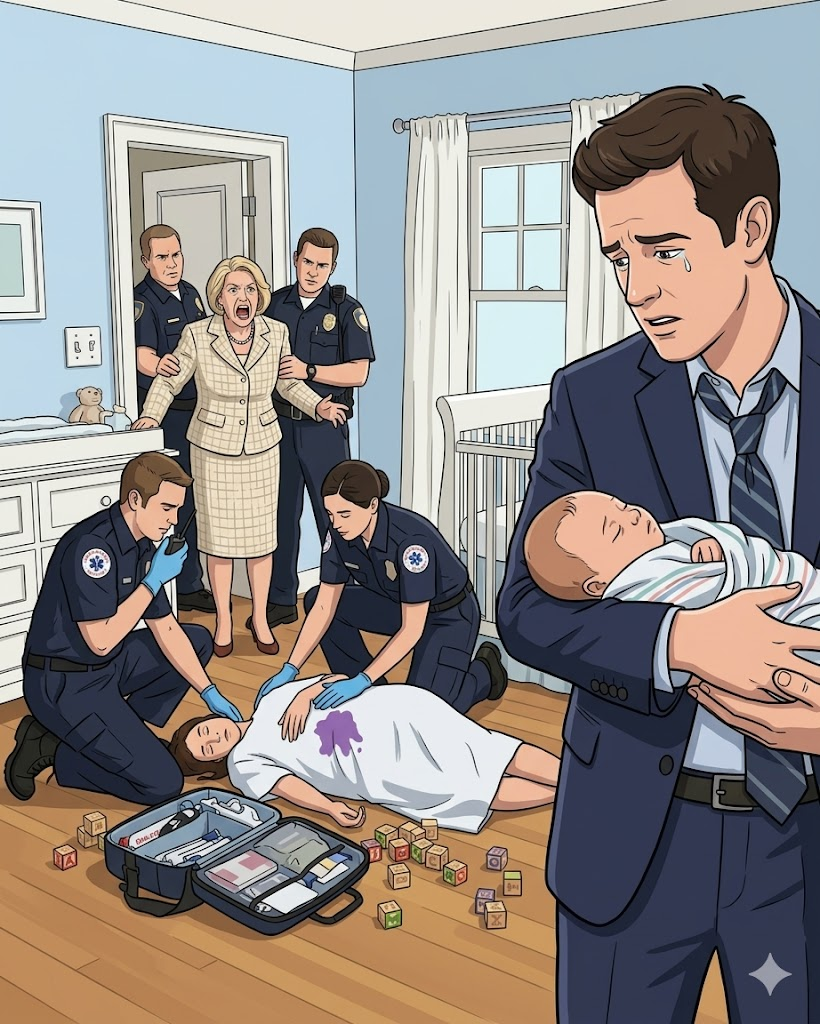
My wife, Emily, had always been the brightest part of my existence. Her laughter carried warmth strong enough to chase away the bitter cold of a Boston winter. But after the birth of our son, Noah, that light almost vanished beneath the cruel glare of hospital monitors and surgical lamps.
“Postpartum hemorrhage” sounded like sterile medical terminology, but in reality, it was chaos—sirens, shouting doctors, blood everywhere, and the horrifying moment her heart stopped for eleven endless seconds. Eleven seconds where my entire universe ceased to exist.
When she finally woke in recovery, pale and fragile as paper, the doctors gave strict instructions: absolute bed rest. Her internal stitches were delicate, and even the smallest strain could destroy the healing process.
Then my mother arrived.
Margaret Carter showed up three days after we brought Noah home, hauling expensive luggage behind her and carrying the suffocating perfume of designer roses. I had begged her to come because I was exhausted, desperate, and foolish enough to think a mother’s support could heal our shattered household.
I was wrong.
The criticism began instantly. She didn’t hug Emily when she walked through the door. She evaluated her.
“You look awful, sweetheart,” she remarked coolly. “Are you sure you’re taking care of yourself?”
The comments became constant, little cuts disguised as concern. She hovered over Noah’s bassinet, criticizing every swaddle, every feeding, every exhausted movement Emily made. Too loose. Too tight. Too careless. She ignored the fact that Emily’s hands trembled from severe blood loss.
The first real warning came the morning I returned to work. I stood in the nursery doorway watching Emily sleep beneath the dim glow of the nightlight. Her breathing was shallow, her face frighteningly pale against the pillow.
Margaret appeared beside me without a trace of gentleness. Instead of asking how Emily was feeling, she pointed at a nursing pad sitting on the dresser.
“In my day, Ethan, women didn’t let their homes look like emergency rooms just because they had a child,” she whispered sharply. “A husband deserves a clean house.”
I rubbed at my exhausted eyes. “Mom, please. She nearly died. None of that matters right now.”
Margaret turned toward me, and for a brief second her mask cracked. Her eyes hardened with something cold and merciless.
“She’s only helpless when it benefits her,” she muttered. “If you let her keep pretending to be weak, she’ll never stop.”
I should have forced her out that very moment. I should have recognized the poison underneath her words. Instead, I excused it as generational stubbornness. I kissed Emily’s forehead, picked up my briefcase, and left for work.
But while riding the elevator down to the garage, preparing for my first executive meeting since Noah’s birth, an uneasy feeling tightened in my chest. Without thinking, I opened the nursery camera app on my phone. I told myself I only wanted one last glance at my son.
Deep down, I already knew something was wrong.
The conference room on the fortieth floor overlooked the Boston harbor, gray waves crashing beneath heavy clouds. Around the polished table, executives argued over quarterly projections and revenue forecasts. Normally, I thrived in these meetings.
Today, every voice sounded distant.
Then my phone buzzed with a motion alert from the nursery camera.
I lowered the screen into my lap and tapped it open.
The sight froze my blood.
Emily was out of bed. Bent over in agony, she clutched the area around her C-section incision while trying to soothe Noah’s cries. Her face twisted with pain as she struggled to stay upright.
Then Margaret entered the frame.
She didn’t hurry to help. She didn’t ask if Emily was okay. She stormed across the room, grabbed the bassinet, and yanked it away so violently it nearly tipped over. Emily stumbled forward with a cry.
I turned up the volume just as my mother leaned closer.
“Get up,” Margaret snapped viciously. “I’m sick of looking at filthy floors.”
Emily whimpered weakly. “Margaret, please… my stitches. I’m bleeding again.”
My mother didn’t even blink. She scooped Noah into her arms and pointed toward the kitchen floor.
“Blood loss is no excuse for a disgusting house,” she hissed. “Get down there and scrub.”
On the screen, Emily’s knees buckled. She collapsed against the chair, clutching her abdomen while sobs wracked her body.
Something inside me shattered.
Not loudly. Quietly. Permanently.
I stood so abruptly my chair screeched across the hardwood floor. Every conversation in the boardroom stopped instantly.
My supervisor stared at me. “Ethan? What’s going on?”
I ignored him completely. My hands moved with terrifying calm as I shoved my laptop into my bag and walked out without explanation.
I ran through the stairwell, barely remembering the trip down to the garage. By the time I reached my car, rage was pulsing through every vein in my body. But I didn’t call my mother.
Instead, I contacted a locksmith.
Then I called a private security company.
“I need every lock changed immediately,” I said coldly.
Rain hammered against the windshield during the drive home while my wipers moved frantically back and forth. I called my older sister, Lauren, gripping the steering wheel so tightly my knuckles turned white.
“Ethan? Aren’t you at work?” she asked.
“Lauren,” I said flatly. “Did Mom ever force you to do chores after surgery?”
Silence.
Then a shaky breath.
“What did she do now?”
“Answer me.”
“Yes,” Lauren whispered. “After my appendix surgery, she made me clean the stairs because she said I was being dramatic. When I cried, she accused me of manipulation. Ethan… she’s always been like this. If attention isn’t focused on her, she punishes people. Who is she hurting?”
“Emily.”
Lauren’s voice sharpened instantly. “Get her out of that house now.”
Guilt crashed into me like a tidal wave. My entire life I had softened Margaret’s cruelty, translating abuse into “personality flaws.” And because of that, I had delivered my vulnerable wife directly into her hands.
That ended today.
When I reached home, I parked across the street instead of pulling into the driveway. Minutes later, the locksmith and security van arrived. Rain soaked through my coat as I instructed them to change every lock—front door, back entrance, garage.
While they worked, I stepped toward the kitchen window and quietly pulled out my phone to record.
Inside, the scene looked like something monstrous.
Margaret stood beside the kitchen island calmly drinking tea while holding Noah against her hip like an accessory. On the floor, Emily knelt beside a bucket of soapy water, shaking violently as she scrubbed the tiles.
Even through the rain-streaked glass, I could read my mother’s lips perfectly.
“You missed a spot. If you can’t be a proper wife, at least be useful as a maid.”
For a moment I thought I might vomit.
Then everything became crystal clear.
Marriage wasn’t only about loving Emily. It was about protecting her. And now I understood that sometimes the greatest danger came from your own blood.
The locksmith handed me a fresh set of silver keys. I stared at them briefly before unlocking the front door and stepping inside.
The house smelled like bleach and my mother’s perfume.
I walked straight into the kitchen.
Margaret looked up in shock. Emily gasped softly, dropping the sponge into the water.
I didn’t acknowledge my mother at all. I crossed the room, knelt beside Emily, and carefully lifted her into my arms. She felt heartbreakingly fragile. I carried her into the living room, wrapped a blanket around her shoulders, and settled her gently onto the couch.
Margaret hurried after us, immediately changing her tone into fake concern.
“Ethan, thank goodness you’re home. Emily insisted on cleaning, and I was only trying to—”
I turned around and silently held up my phone.
The nursery footage played across the screen.
Her face drained of color.
“The locks are changed,” I said quietly.
I took one slow step closer.
“While you were tormenting my wife, I packed your belongings. They’re waiting on the porch.”
“Ethan…” she stammered weakly. “You can’t mean this.”
“You have sixty seconds to hand me my son,” I replied. “Or I’ll call the police and report abuse of a recovering patient.”
Her expression twisted with fury.
“I’m your mother!” she screamed. “You owe me everything!”
I stared directly into her eyes.
“You were my mother,” I said coldly. “Now you’re trespassing. Give me Noah.”
For one terrifying moment, I thought she might refuse.
Then she shoved Noah toward me with trembling hands.
I held my son tightly against my chest and pointed toward the front door.
Margaret stumbled outside into the rain, her luggage already soaked on the porch. Before leaving, she spun around one final time, hatred burning across her face.
“She’ll leave you eventually!” she screamed. “You’ll come crawling back to me!”
I felt absolutely nothing.
I slammed the door shut.
The sound of the new deadbolt locking echoed through the house like the end of a war.
Everything changed after that.
Without Margaret’s presence poisoning the house, Emily began recovering quickly. Color returned to her face. Her strength slowly came back. Soon, laughter echoed through the halls again instead of silence and fear.
But Margaret didn’t disappear quietly.
Within days, relatives began calling nonstop. Aunts, cousins, old family friends—all repeating the lies she fed them about being “thrown out by her ungrateful son.”
I blocked every single number.
One evening, Emily sat beside me in the nursery while Noah slept peacefully nearby.
“I was terrified,” she admitted softly. “I thought if I upset her, you’d believe her instead of me. I thought you’d see me as a failure.”
Her words hit like a knife.
I knelt beside her chair and kissed her trembling hand.
“I failed you once by letting her into this house,” I whispered. “That will never happen again.”
In that tiny nursery, surrounded by bottles and blankets, our marriage became unbreakable.
Then came the lawsuit.
A courier delivered the documents early one morning. Margaret was suing us for grandparents’ visitation rights.
But a year later, standing in our backyard during Noah’s first birthday party, that lawsuit felt laughable.
Emily’s family had come in from Denver. Friends filled the yard beneath strings of warm lights while Noah waddled across the grass covered in frosting.
Margaret’s case collapsed instantly in court once our attorney presented the camera footage of her forcing a woman fresh from surgery to scrub floors while bleeding internally. The judge didn’t just reject her petition. He granted a permanent restraining order.
As I watched Emily laughing beside our son, healthy and radiant again, I realized something profound.
I had spent my entire life trying to be a “good son.”
But saving my family required me to stop being her son at all.
Weeks earlier, I had spotted Margaret downtown outside an expensive department store. She looked older, bitterer, hollowed out by her own resentment.
For a brief moment, our eyes met.
Once upon a time, guilt would have dragged me back toward her.
This time, I simply turned and walked away.
That evening, while photographing Emily and Noah laughing in the backyard, my phone buzzed in my pocket.
Unknown number.
I opened the message.
My blood instantly turned to ice.
It was a long-distance photo of Noah taken earlier that day from outside our fence. The image zoomed directly onto his face.
Underneath it was a single sentence.
He has my eyes. You’ll never keep him away from me forever.
I stared at the screen in silence.
Then I calmly slipped the phone back into my pocket, walked into my office, and locked the door behind me.
I picked up my secure line and dialed the director of our private security company.
He answered immediately.
“Mr. Carter?”
“Phase two,” I said coldly. “Our perimeter’s been breached. Move my family to the Chicago property.”
“When do you want the transfer?”
“Tonight.”
I looked out the office window at Emily and Noah laughing together beneath the fading sunset.
“We disappear now.”
The call ended.
And while the old version of me might have panicked, this version moved with absolute precision—the kind of calm only a man protecting his family can possess.
Because there is no force on earth more dangerous than a husband and father who finally understands exactly what he’s willing to destroy to keep the people he loves alive.


