“We’ve decided to cut you out of the inheritance. You’ve never deserved it.”
My father’s voice rang across the private dining room, and for a moment, everything stopped. The crystal chandelier above seemed to freeze mid-sparkle. The soft classical music playing in the background faded into nothing. Every face at that long, elegant table turned toward me with expressions ranging from smug satisfaction to poorly hidden amusement.
I sat there with my wine glass halfway to my mouth, staring at the man who had raised me.
Around us, my entire extended family had gathered. Aunts, uncles, cousins, even my grandmother. The restaurant my parents had chosen was one of those places where you needed a reservation months in advance, where the waiters wore white gloves and the menu had no prices. They had spared no expense for this moment.
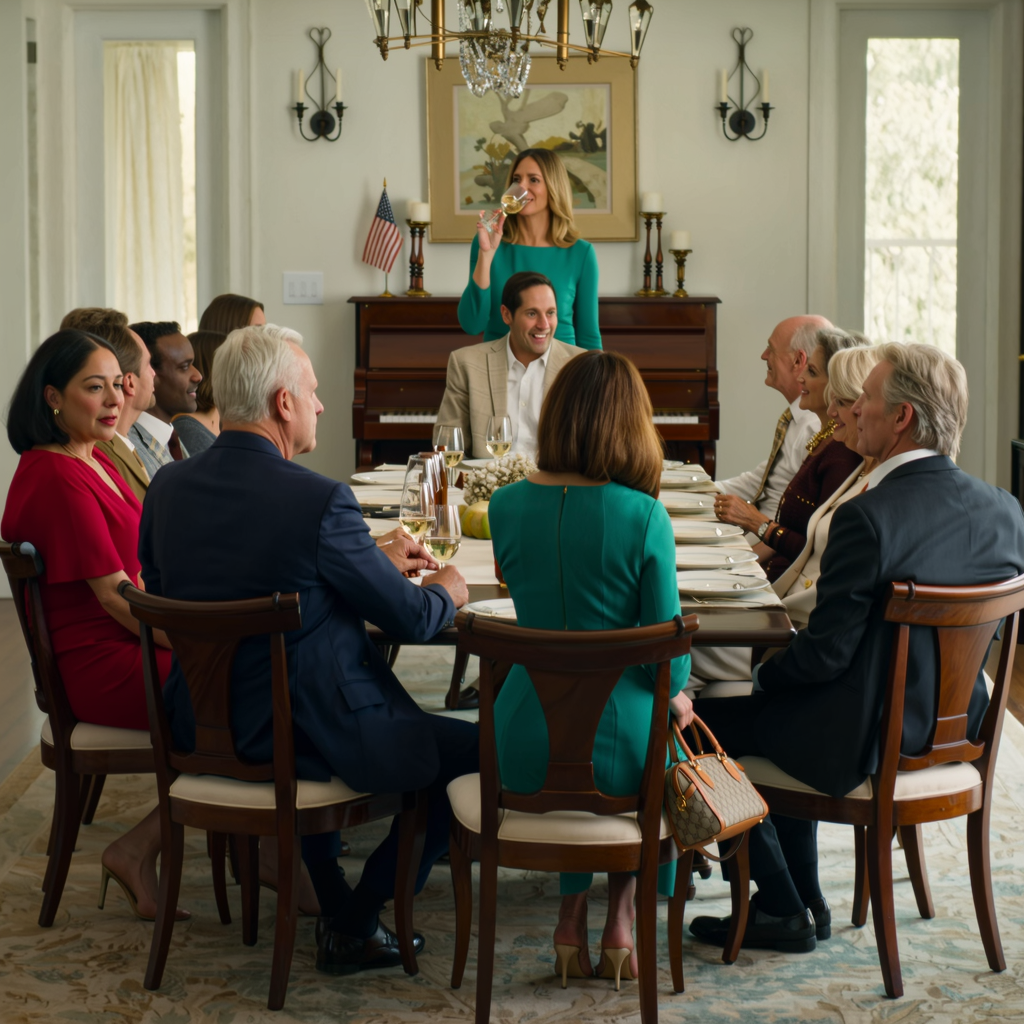
“Did you hear me, Tara?” my father asked.
He stood at the head of the table, his face flushed with wine and something darker. Triumph.
“You’re out. Completely out.”
My mother sat beside him, dabbing at the corners of her mouth with a linen napkin, trying to hide her smile. My younger brother Kevin lounged in his chair with a smirk that made my stomach turn. My sister Paige wouldn’t even look at me, but I could see her shoulders shaking with suppressed laughter.
“That’s what happens when you turn your back on family,” my aunt Carol chimed in, her voice dripping with false sympathy.
“We all saw it coming,” Uncle Gerald added, raising his wine glass. “To family loyalty.”
The table erupted in agreement. Glasses clinked. People laughed. My cousin Bethany actually clapped.
I set my fork down carefully, my hands steady despite the rage building in my chest.
Twenty-nine years of memories flashed through my mind in seconds. Every birthday where Kevin got the bigger present. Every Christmas where Paige got the better gifts. Every family dinner where my accomplishments were brushed aside while my siblings were praised for the smallest things.
But this was different.
My father had called me three days earlier, his voice warm and inviting for the first time in months.
“We’re having a family dinner on Saturday. Very important. Everyone will be there. We’d really like you to come, Tara. It’s been too long.”
I should have known better. I should have heard the trap in those words. But some stupid hopeful part of me thought maybe, just maybe, they finally wanted to make things right.
Instead, they wanted an audience for my humiliation.
I looked around the table, taking in every face. My grandmother, who used to sneak me cookies when I was little, wouldn’t meet my eyes. My cousin Jeffrey, who I helped through college by tutoring him every weekend for two years, stared at his plate. Even my uncle Thomas, who always said I was his favorite niece, raised his glass along with everyone else.
“Nothing to say, Tara?” my mother asked, her voice saccharine sweet. “No tears? No begging?”
I picked up my wine glass, a very expensive Bordeaux that my father had insisted on ordering for everyone. I took a slow sip, letting the silence stretch.
Then I smiled.
“Congratulations,” I said softly, setting the glass down. “I hope it was worth it.”
I stood, smoothed my dress, and picked up my purse.
The table had gone quiet again, but this time the silence was confused. They had expected tears, maybe shouting. Definitely some kind of scene that would give them even more to laugh about later.
“Wait, that’s it?” Kevin called out as I turned toward the door. “You’re just leaving?”
I paused and looked back over my shoulder.
My father’s face had gone from triumphant to uncertain. My mother’s smile had faltered.
“What else would you like me to do?” I asked, my voice pleasant, almost curious. “You’ve made your decision. I accept it.”
“But—” Paige started.
I was already walking away.
As I stepped out of the private dining room and into the restaurant’s main area, I heard the confused murmuring begin behind me. They didn’t understand. They had spent weeks planning this moment, imagining my breakdown, savoring the thought of my pain. My calm departure had stolen their satisfaction.
Let them wonder.
I handed my valet ticket to the attendant and waited in the cool Birmingham evening air. The restaurant sat in the heart of the city’s historic district, surrounded by old magnolia trees and wrought-iron lampposts. It was beautiful and peaceful, a strange contrast to the ugliness I had just left behind.
My phone buzzed in my purse.
I pulled it out and saw a text from Kevin.
Don’t think you can change Dad’s mind later. This is final.
I deleted it without responding.
Another text, this time from Paige.
You always were dramatic.
Deleted.
The valet brought my car around, a modest sedan I had bought myself and paid for with my own money from my own job. Everything I had, I had earned, and that had always been the problem.
I tipped the valet and slid behind the wheel.
As I pulled away from the restaurant, I caught one last glimpse of the building in my rearview mirror. Somewhere inside, my family was probably already celebrating, already spending the money they thought they had secured by cutting me out.
They had no idea what was coming.
Two days.
That was all it would take.
I drove home on autopilot, my mind already three steps ahead. The anger that had been simmering during dinner now burned with cold clarity. They wanted to humiliate me. They wanted to break me. They thought I was weak, that I would crumble under their rejection.
They had forgotten who had taught me to be ruthless.
My apartment was in a quiet neighborhood twenty minutes from downtown Birmingham. Nothing fancy, just a one-bedroom with enough space for me and my cat, Winston. I had moved there six years earlier when I started working at Bright Fen Wealth Management, one of the city’s most respected financial advisory firms.
I unlocked my door, and Winston immediately wound himself around my ankles, meowing for dinner.
“I know,” I told him. “You have no idea your grandfather just made the worst mistake of his life.”
I fed him, poured myself a real glass of wine—not the overpriced showoff bottle my father had ordered—and sat down at my kitchen table with my laptop.
The truth was, I had been expecting something like this for months.
My parents had been dropping hints, making comments about family values and loyalty and knowing your place. Kevin had been insufferable lately, constantly talking about his future, his plans, what he would do when the time came. Paige had started treating me like I was already a stranger.
But I had hoped I was wrong.
I had hoped that despite everything, despite the years of being overlooked and undervalued, they would see me as something more than a disappointment.
That hope died tonight.
I opened my laptop and pulled up a folder I had created three months earlier. I had called it Insurance, though that felt too generous. It was more like evidence—a detailed record of every financial transaction my parents had made in the last five years.
See, my father thought I was just a mediocre financial analyst at a medium-sized firm. He thought my job was boring, my salary modest, my career unremarkable.
He loved to compare me to Kevin, who worked in tech—whatever that meant. As far as I could tell, Kevin mostly played video games and called it user experience research.
He loved to praise Paige for her entrepreneurial spirit, even though her online boutique had been losing money for three years straight.
What my father didn’t know was that I wasn’t just any financial analyst.
I was a forensic accountant specializing in asset recovery and fraud detection.
My medium-sized firm handled some of the largest fraud cases in the Southeast.
And I was very, very good at my job.
Three months earlier, my mother had asked me for help with what she called a minor tax question. She had handed me a folder full of documents, trusting that I would do what she asked and nothing more.
What she hadn’t expected was that I would recognize the patterns immediately.
The shell companies. The offshore accounts. The creative bookkeeping that pushed right up against the edge of legality and sometimes crossed it.
I had spent the next two months quietly gathering information, not because I planned to use it, but because I believed in being prepared.
My father had built his small real estate empire through a combination of hard work, strategic investments, and, as it turned out, some very questionable financial practices.
Now I sat at my kitchen table looking at spreadsheets that told a story my family didn’t want anyone to know.
My father had been siphoning money from his business partners through complicated schemes that hid his profits and inflated his expenses. My mother had been using nonprofit organizations she claimed to support as personal piggy banks.
Together, they had built a house of cards that looked impressive from the outside but would collapse the moment anyone looked too closely.
And I was going to make sure someone looked very closely indeed.
My phone rang.
I glanced at the screen and saw my grandmother’s name.
For a moment, I hesitated.
She had been at that dinner. She had sat there and said nothing while they stripped away my inheritance, my dignity, my place in the family.
But she was calling now.
I answered.
“Hello, Grandma.”
“Tara, honey.” Her voice was thin and tired. “I wanted to apologize for tonight. That was cruel of your father. I should have spoken up.”
“But you didn’t.”
Silence.
“No,” she said finally. “I didn’t. I’m sorry.”
I closed my eyes. Part of me wanted to forgive her, wanted to believe she was different from the rest of them. But I had learned tonight that wanting something and getting it were very different things.
“Why did they do it?” I asked. “Why now? What did I do that was so terrible?”
My grandmother sighed.
“It wasn’t about what you did, sweetheart. It was about what you didn’t do. You didn’t need them. You didn’t come begging for money or help or approval. You built your own life, and that scared them.”
“Scared them?”
“Your father likes to be needed. He likes to be important. You made him feel irrelevant.”
She paused.
“Tara, there’s something you should know. Your father has been having financial troubles for the past year. Big troubles. The inheritance you think exists—most of it is already gone.”
My hand tightened around the phone.
“Are you sure?”
“I’m old, not foolish,” she said. “I know what I see.”
After we hung up, I sat in the dark kitchen, processing this new information.
My father was broke.
The great inheritance he had dangled over our heads our entire lives was a fiction, and he had gathered the whole family together to humiliate me before the truth came out.
I smiled in the darkness.
This was going to be even better than I thought.
Sunday morning dawned clear and bright, mocking the darkness of my mood.
I had spent most of the night reviewing files, making notes, planning my next moves. Winston had given up trying to lure me to bed around two in the morning and had simply curled up on a stack of papers beside my laptop.
Now, sitting at my favorite coffee shop with a triple-shot latte, I was ready.
I pulled out my phone and composed a message to someone I had worked with on a major fraud case six months earlier.
Timothy was an investigative journalist for the Birmingham Tribune who specialized in financial crimes and corruption. We had developed a good working relationship during that case. I provided the technical expertise. He wrote the stories that brought attention to the fraud.
Hey, Timothy. Remember when you said you owed me a favor? I might have a story for you. Interested?
His response came back in less than a minute.
Always. What are we talking about?
Local real estate developer. Possible fraud, embezzlement, tax evasion, multiple victims. Want to meet?
When and where?
We arranged to meet Tuesday morning at his office. That gave me one more day to organize everything and make sure my case was airtight.
I couldn’t afford any mistakes.
This had to be perfect.
I spent the rest of Sunday digging deeper into my father’s financial records. The more I looked, the worse it got. He had borrowed money from business partners and never paid it back. He had taken out loans using properties he didn’t fully own as collateral. He had created fake companies to hide income and inflate expenses.
Every transaction left a paper trail.
And every trail led back to my father.
My mother was complicit, of course. She had signed documents, opened accounts, moved money around. They had built this empire of deception together, and they would fall together too.
Monday morning, I went to work as usual.
My boss, Patricia, noticed I was more focused than usual.
“Big case?” she asked, stopping by my desk with her own coffee.
“Personal project,” I said. “But yes. Big.”
She studied me for a moment. Patricia was in her fifties, sharp as a blade, and better at reading people than anyone I knew.
“Does this personal project involve the family dinner you mentioned Friday?”
I had told her I was dreading a family event. I hadn’t told her why.
“It might,” I admitted.
She nodded slowly.
“If you need anything—resources, time, advice—you let me know. Family can be complicated.”
“Family can be toxic,” I corrected.
A corner of her mouth twitched.
“That too.”
I worked through lunch, barely noticing the hours passing. By the time five o’clock rolled around, I had compiled everything I needed for Timothy. Bank statements showing suspicious transfers. Property records revealing fraudulent deals. Email chains between my father and his business partners proving he knew exactly what he was doing. Contract agreements with forged signatures. Tax returns that didn’t match actual income.
It was enough to send someone to prison.
That evening, Kevin called.
I let it go to voicemail.
He called again.
I ignored it again.
On the third call, I finally answered.
“What do you want, Kevin?”
“Wow,” he said. “Took you long enough. Look, Dad wants to talk to you.”
“I have nothing to say to Dad.”
“Come on, Tara. Don’t be dramatic. He’s willing to reconsider if you apologize.”
I actually laughed.
“Apologize for what?”
“For embarrassing the family on Saturday. For leaving like that. For making a scene.”
“I didn’t make a scene. I left quietly.”
“Exactly. You left. You embarrassed Dad in front of everyone. He spent a lot of money on that dinner.”
“He spent a lot of money to humiliate me,” I said. “But I appreciate the call. Tell Dad I said no thanks on the reconsideration.”
“You’re making a mistake,” Kevin warned. “You don’t want to be on the wrong side of this family.”
“I’m pretty sure I’m on the only right side,” I said, and hung up.
Ten minutes later, Paige texted.
Kevin said you were rude to him. Why do you have to make everything so difficult?
I didn’t respond.
Another text, this time from my mother.
Your father is very disappointed. You always were ungrateful.
Delete.
Uncle Gerald.
Your parents only wanted what’s best for the family. I hope you’ll reconsider your attitude.
Delete.
Aunt Carol.
Such a shame to see you throw away your family like this. Pride comes before a fall, Tara.
I stared at that last message for a long moment.
Pride comes before a fall.
She had no idea how right she was—just wrong about who would be falling.
Tuesday morning, I met Timothy at his office downtown.
The Tribune’s building was an old converted warehouse with exposed brick and industrial windows. His office was on the third floor, a cluttered space filled with stacks of papers, coffee cups, and the faint smell of printer ink.
He looked tired as I sat down.
“Long weekend?”
“You could say that.”
I laid out everything I had brought. Documents, spreadsheets, timelines, evidence.
Timothy’s eyes grew wider with each page I showed him.
“Good Lord,” he breathed. “This is massive. How long has this been going on?”
“At least five years. Probably longer. I only have access to the last five years of records.”
“And the victims?”
“Multiple business partners who lost money. Nonprofit organizations that were promised donations they never received. Investors who bought into projects that don’t exist. The list goes on.”
Timothy leaned back in his chair and ran a hand through his hair.
“This could take down more than just your father. This could expose an entire network of corruption in Birmingham’s real estate sector.”
“I know.”
He looked at me carefully.
“These are your parents, Tara. Are you sure you want to do this?”
I thought about Saturday night. The laughter, the mocking, the way they had all looked at me like I was nothing, like I had never mattered.
“I’m sure.”
He nodded.
“Okay. Give me three days. I need to verify some of this independently, talk to sources, build the story properly. Can you wait three days?”
I smiled.
“I’ve waited twenty-nine years. Three more days won’t finish me off.”
Wednesday morning started like any other day, except for the nervous energy buzzing under my skin.
Timothy had my information. The investigation was underway. All I had to do was wait and act normal.
Acting normal proved harder than I expected.
At work, I kept checking my phone, expecting updates from Timothy. None came. He was being thorough, which I appreciated, but the waiting was torture. Every hour felt like a week.
Around ten o’clock, my desk phone rang.
Internal call.
I picked up.
“Tara, could you come to my office? We need to talk.”
Patricia’s voice was serious.
My stomach dropped. Had someone found out what I was doing? Had my family somehow gotten wind of my plans?
I walked to Patricia’s office, my mind racing through possibilities.
She was sitting behind her desk, her expression unreadable.
“Close the door and sit down.”
I did.
She folded her hands on the desk.
“I had an interesting conversation this morning with a potential client. He called asking about you specifically. Wanted to know if you were available for a private consultation on some financial matters.”
“Who was it?”
“He didn’t give his real name, but the number traced back to your father’s business.”
Cold rushed through my veins.
“He’s checking up on me.”
“That would be my guess. He asked about your qualifications, your specialty, your recent cases. I told him you were one of our best forensic accountants and that if he wanted to hire you, he’d need to go through proper channels and fill out our intake paperwork.”
“What did he say?”
“He hung up.”
Patricia leaned back in her chair.
“Tara, whatever you’re planning, be careful. If your father is sniffing around, he might suspect something.”
“He doesn’t suspect anything,” I said, more confidently than I felt. “He thinks I’m weak and insignificant. He’s probably just curious about what I actually do for a living.”
“Maybe,” Patricia said. “But frightened men can be dangerous. Watch your back.”
I returned to my desk, my earlier confidence shaken.
My father was making moves.
Why?
What had triggered his suspicion?
My phone buzzed. A text from Kevin.
Dad wants to have lunch with you. Just you two. He says it’s important.
I stared at the message.
This was a trap. It had to be.
My father didn’t do private lunches. He didn’t do one-on-one conversations unless he wanted something.
I texted back.
Busy all week. Maybe next month.
Kevin’s response was immediate.
He says it can’t wait. Tomorrow at noon. The Summit Club. He’ll be waiting.
The Summit Club was my father’s favorite restaurant, the place where he conducted business and impressed clients. It was expensive, exclusive, and exactly the kind of place where he felt powerful.
I didn’t respond.
Another text from Kevin.
He’s trying to make things right. Tara, don’t be stubborn.
Then one from my mother.
Your father is extending an olive branch. The least you could do is show up.
And Paige.
Seriously? You can’t even have lunch with Dad? You’re being petty.
They were coordinating, pushing, trying to force me into a corner.
I called Timothy.
“Hey,” he answered. “I was just about to call you. We have a problem.”
My heart sank.
“What kind of problem?”
“Someone contacted my editor this morning. Anonymous tip saying I was working on a story based on falsified documents provided by a disgruntled family member. My editor wants to see all my sources before we run anything.”
“They know,” I whispered. “My family knows I’m coming after them.”
“We don’t know that for sure,” Timothy said. “Could be coincidence.”
“My father called my office this morning pretending to be a client. Now he wants to meet me for lunch tomorrow, and you get an anonymous tip warning you off. That’s not coincidence.”
Timothy was quiet for a moment.
“Okay. So what do you want to do? We can still run the story, but it’ll take longer to verify everything if my editor is being cautious.”
“How much longer?”
“Maybe a week.”
“I don’t have a week,” I said. “They’re circling. Whatever they’re planning, they’re planning it now.”
“Then we need to be smarter,” Timothy said. “Go to the lunch. See what he wants. Maybe he’ll give us something we can use. Or maybe he’ll try to intimidate you into backing off.”
“Can he?”
I thought about Saturday night. The humiliation, the laughter, my entire family turning on me like I was nothing.
“No,” I said. “He can’t.”
That evening, I did something I rarely did.
I called my grandmother.
She answered on the third ring.
“Tara, sweetheart, I was hoping you’d call.”
“Grandma, has Dad said anything about me lately? Anything unusual?”
She hesitated.
“He’s been asking questions. About your job, your finances, whether you have any connections in the media.”
“Why?”
“I don’t know. He seems uneasy.”
“He suspects something,” I said.
“Tara… what are you doing?”
“What I should have done years ago,” I said. “Standing up for myself.”
“Be careful,” she warned. “Your father doesn’t like being challenged. He gets cruel when he feels cornered.”
“I know. I learned from the best.”
After we hung up, I sat in my apartment thinking.
My father was making moves. He was suspicious, but he didn’t know exactly what I was planning or he would have done more than request a lunch meeting. He was fishing, trying to figure out what I knew.
The smart thing would be to wait. Let Timothy finish his investigation. Build the case properly. Be patient.
But patience had never been my strong suit.
I texted Kevin back.
Fine. Noon tomorrow at the Summit Club. Tell Dad I’ll be there.
His response was immediate.
Good choice. He’ll be pleased.
I doubted that very much.
That night, I couldn’t sleep. I kept running through scenarios in my head. What would my father say? What would he offer? Would he try to buy me off, threaten me, manipulate me into thinking I had imagined everything?
Around two in the morning, I got up and made tea.
Winston followed me into the kitchen, meowing his disapproval at the late hour.
“I know, buddy,” I told him. “But I’m not being dramatic. I’m being careful.”
I pulled out my laptop and reviewed everything one more time.
The evidence was solid.
The paper trail was clear.
Even if my father suspected something, he couldn’t erase what he had already done. The transactions existed. The fraud was real. The victims were real.
Tomorrow, I would sit across from my father and listen to whatever story he wanted to tell. I would smile and nod and let him think he was winning.
And then I would watch his world burn.
Thursday morning arrived too fast.
I dressed carefully—professional but not intimidating, confident but not aggressive. I wanted my father to see me as the daughter he thought he knew, not the woman who was about to end him.
The Summit Club was in downtown Birmingham, on the top floor of one of the city’s oldest buildings. I arrived exactly at noon and gave my name to the hostess.
“Mr. Anderson is already here,” she said. “Right this way.”
My father sat at a corner table with a view of the city. He stood as I approached, smiling like nothing had happened on Saturday night.
“Tara, sweetheart. Thank you for coming.”
I sat down without hugging him.
“What do you want, Dad?”
His smile faltered slightly.
“Can’t a father want to have lunch with his daughter?”
“Not this father. Not this daughter. Not anymore.”
He sighed and sat down.
“I suppose I deserve that. Saturday night was harsh. Your mother and I have been talking, and we think we were too hasty.”
“Too hasty in cutting me out of the inheritance, or too hasty in humiliating me in front of the entire family?”
“Both,” he admitted. “We let emotion get the better of us.”
A waiter appeared with water and menus. My father ordered a scotch. I ordered nothing.
“You’re not eating?” he asked after the waiter left.
“I’m not staying long. Say what you need to say.”
He studied me across the table, and I saw something flicker in his eyes. Confusion. Maybe concern. This wasn’t going how he had planned.
“Tara, I want to make things right between us. The inheritance situation was a mistake. We’re willing to reconsider.”
“Willing to reconsider,” I repeated. “How generous.”
“Don’t be sarcastic. I’m trying to fix this.”
“Why now? What changed between Saturday and today?”
He shifted in his seat.
“Your mother feels guilty. She thinks we were too harsh.”
“Mom doesn’t feel guilty about anything she does,” I said. “Try again.”
The waiter brought his scotch. My father took a long sip before answering.
“Fine. You want the truth? We’re concerned about you. After Saturday, we expected you to call, to fight back, to do something. Instead, you just disappeared. That’s not like you.”
“You don’t know what’s like me. You never bothered to find out.”
“That’s not fair.”
“Saturday night wasn’t fair,” I said. “Spending twenty-nine years watching you worship Kevin and Paige while treating me like an inconvenience wasn’t fair. So forgive me if I don’t care about your definition of fairness.”
My father’s jaw tightened. There was the temper I remembered from childhood.
“Watch your tone. I’m still your father.”
“Biologically, yes. In every way that matters? Debatable.”
He set his glass down hard enough that nearby diners glanced over.
“I don’t know what’s gotten into you, but this attitude needs to stop. I’m offering you a chance to come back into the family, to restore your inheritance. Don’t throw that away because of pride.”
“It’s not about pride,” I said calmly. “It’s about self-respect. Something I should have developed years ago.”
I leaned back in my chair.
“Why did you call my office yesterday?”
The question caught him off guard.
“What?”
“You called Bright Fen Wealth Management yesterday morning, pretended to be a potential client, and asked questions about me. Why?”
He recovered quickly.
“I wanted to understand what you do. Your mother and I realized we don’t know much about your career.”
“Liar.”
The word hung between us like a match struck in a dark room.
“Excuse me?” His voice went dangerously quiet.
“You’re lying. You didn’t call because you care about my career. You called because you’re worried about something. What is it, Dad? What are you afraid I know?”
His face went carefully blank.
“I don’t know what you’re talking about.”
“Yes, you do.”
We stared at each other across the table.
This was the moment I could back down, pretend I was imagining things, accept his fake olive branch. Or I could push forward and show him I wasn’t the weak daughter he thought I was.
“How’s business, Dad?” I asked. “The real estate market must be challenging these days.”
“It’s fine.”
“Really? Because I heard you’ve been having some financial difficulties. Cash-flow problems. Partner disputes. That kind of thing.”
His eyes narrowed.
“Who told you that?”
“Nobody told me. I figured it out.”
“There’s nothing to figure out. My business is solid.”
“Is it?” I asked. “Because from what I’ve seen, your business is built on fraud, embezzlement, and tax evasion. But hey, what do I know? I’m just the disappointing daughter with the boring job.”
The color drained from his face.
“What did you just say?”
“You heard me.”
“Tara, I don’t know what kind of game you think you’re playing—”
“No game. Just facts. You’ve been stealing from your partners for years. Using fake companies to hide income. Taking money from nonprofits. I have documentation of everything.”
He leaned forward, his voice low and hard.
“You don’t know what you’re talking about. And if you spread lies like that, I’ll have lawyers on you so fast your head will spin.”
“It’s not a lie if it’s true. And it’s not gossip if I have bank statements, tax returns, and email chains proving everything.”
For the first time in my life, I saw fear in my father’s eyes.
Real fear.
“You’re bluffing.”
“Am I? Want to take that chance?”
He grabbed his scotch and downed the rest in one swallow.
“What do you want? Money? Fine. I’ll write you a check right now. Name your price.”
“I don’t want your money.”
“Then what?”
“I want you to face consequences for what you’ve done. To me, to your partners, to everyone you’ve used and discarded.”
“You ungrateful little—”
He caught himself, glancing around at the other diners.
When he spoke again, his voice was controlled, but I could hear the rage underneath.
“I gave you everything. A roof over your head. Food on the table. An education. This is how you repay me?”
“You gave me the bare minimum while giving Kevin and Paige the world. And now you want gratitude.”
“If you do this—if you try to destroy me—you’ll regret it. I promise you that.”
“Is that a threat?”
“It’s a warning. You think you’re clever, but you have no idea what you’re up against. I have lawyers, connections, friends in very high places. You’re a junior analyst at a mid-level firm. You can’t win this fight.”
I stood up, slinging my purse over my shoulder.
“We’ll see about that.”
“Tara, sit down. We’re not finished.”
“Yes, we are.”
I walked away.
My heart was pounding so hard I thought it might split my chest open. Behind me, I heard my father calling my name, then muttering something angry under his breath.
Good.
Let him be afraid.
Let him wonder what I was planning.
I made it to my car before my hands started shaking. I gripped the steering wheel and took deep breaths, trying to calm down.
That had been more intense than I expected.
My father was scared, which meant he would fight back.
This was about to get ugly.
My phone rang.
Timothy.
“Tell me you have good news.”
“Mixed news,” he said. “My editor approved the story, but he wants to hold it until we have comments from all parties involved. That means we need to contact your father for his side before we publish.”
“When?”
“Tomorrow morning. I’ll email him a list of questions and give him forty-eight hours to respond.”
“He’s not going to respond. He’s going to lawyer up and try to kill the story.”
“Probably. But ethically, I have to give him the chance.”
I closed my eyes.
“Okay. Do it. And Timothy? Be ready. When this breaks, it’s going to be ugly.”
“I know. Are you ready?”
I thought about the lunch I had just had. The look on my father’s face when I confronted him. The way he had tried to threaten me, buy me off, intimidate me.
“Yeah,” I said. “I’m ready.”
That afternoon, everything changed.
I was back at my desk trying to focus on work when Patricia appeared beside me.
“Conference room. Now. Bring your phone.”
Something in her voice made me move fast.
I followed her into the conference room, where three other senior partners were already waiting.
“Sit down, Tara,” Patricia said.
I sat.
She folded her hands.
“We received a call this afternoon from a law firm representing someone named Howard Anderson. They’re threatening to sue our firm for defamation, harassment, and corporate misconduct. They claim you’ve been spreading false allegations about their client and misusing professional knowledge.”
My father had made his first move.
The room suddenly felt smaller, the air thick with tension.
One of the founding partners, Gerald, frowned at me.
“Who is Howard Anderson?”
“My father,” I said quietly.
The room went still.
“Your father is threatening to sue us because of something you did?” Gerald asked. “Would you care to explain?”
I took a deep breath.
This was it. The moment where I either defended myself or let my father frighten me into silence.
“Three months ago, my mother asked me for help with what she called a tax question. She gave me documents from my father’s business. When I reviewed them, I noticed patterns consistent with financial fraud. I documented what I found.”
“And then what?” Patricia asked.
“I gave the information to an investigative journalist. He’s been verifying it independently. Tomorrow he’s going to contact my father for comment before publishing a story.”
Gerald looked like he might stop breathing for a second.
“You used company resources to investigate your own father?”
“No. I used my personal time and my own computer. The only professional resource I used was my expertise, which I’m entitled to apply to any situation.”
“That’s a technicality,” another partner, Susan, said sharply. “You’re employed by this firm. Anything you do reflects on us.”
“The work I did uncovered legitimate fraud affecting multiple people and organizations,” I said. “Isn’t that exactly what we do here?”
“Not when it involves an employee’s family,” Gerald snapped, slamming a hand on the table. “Do you have any idea what kind of liability you’ve exposed us to?”
Patricia held up a hand.
“Let’s all calm down. Tara, did you steal any documents?”
“No. Everything I have was either given to me directly by my mother or is publicly available information.”
“Did you misrepresent yourself or the firm in any way during this investigation?”
“No.”
“Did you use company time, equipment, or resources?”
“No.”
Patricia looked at Gerald.
“Then technically, she hasn’t violated any policies.”
“That doesn’t matter,” Gerald said, standing up and pacing. “Her father’s lawyers are going to drag us through court regardless. This is a disaster.”
My phone buzzed.
A text from Kevin.
Dad’s lawyer is going after your job. Hope you’re happy.
Another from Paige.
You’re destroying the family. I hope it was worth it.
Then my mother.
How could you do this to us after everything we’ve given you?
I turned my phone facedown on the table.
“There’s something you all should know,” I said. “My father doesn’t have a real case. He’s bluffing. This is intimidation, pure and simple. He’s hoping that by threatening the firm, you’ll force me to back down.”
“And will you?” Susan asked.
“Back down?” I met her eyes. “No.”
Gerald exhaled sharply.
“Then you’re suspended. Effective immediately. Until this situation is resolved, you are not to come into the office or have any contact with clients.”
“You can’t suspend me for something I did on my personal time.”
“We can, and we are, for the protection of the firm.”
I looked at Patricia. She gave me the slightest shake of her head.
Don’t fight it right now.
I stood.
“Fine. I’ll be at home if you need me.”
I walked out of the conference room with my head high, but inside I was shaking.
My father had moved faster than I expected.
He was going after my job, my reputation, my credibility. He wanted to destroy me before I could destroy him.
But he had made a mistake by showing his hand this early.
By threatening my firm, he had proven that he was frightened.
And frightened people make mistakes.
I drove home in a daze. This was escalating faster than I had planned. The story wasn’t even published yet, and already my father was launching attacks.
What would he do when the article actually came out?
My phone rang.
Timothy.
“I heard about your firm,” he said. “I’m sorry.”
“How did you—”
“Your father’s lawyer called my editor too. Threatened us with a lawsuit if we publish anything. Claimed you’re a disgruntled daughter spreading malicious lies.”
“Are you backing off?”
“Absolutely not. But my editor wants to move up the timeline. We’re publishing tomorrow morning instead of next week. We’re not giving your father time to bury this.”
“Tomorrow?”
“The article goes live at six.”
I gripped the steering wheel tighter.
“Okay. Do it.”
“Tara, are you sure? Once this is out there, there’s no taking it back.”
I thought about Saturday night. The humiliation. The laughter. My father’s smug face as he announced I was cut out of the inheritance. Then I thought about lunch. The threats. The intimidation. The way he had tried to destroy my career.
“I’m sure.”
“All right,” Timothy said. “I’ll send you the link when it’s up.”
After we hung up, I sat in my car in my apartment parking lot.
Tomorrow morning, my father’s world would start to crumble.
By noon, everyone in Birmingham would know what he had done.
By evening, his business partners would be calling their lawyers.
And I would be the one who made it happen.
My phone buzzed again.
Another text from Kevin.
Whatever you think you know, you’re wrong. Dad’s a good man.
I stared at the message for a long time.
Kevin honestly believed it.
They all did.
They had bought my father’s carefully constructed image of the successful businessman, the devoted family man, the pillar of the community. They had no idea who he really was.
I went inside, fed Winston, poured a glass of wine, and tried to eat something.
I couldn’t.
My stomach was tied in knots.
I kept checking my phone, watching the minutes tick by.
Twenty hours until the article published.
Twenty hours until everything changed.
Around eight o’clock, my grandmother called.
“Tara, what’s happening? Your father called me tonight. Very upset. He says you’ve been spreading lies about him.”
“They’re not lies, Grandma.”
“What do you mean?”
I told her everything. The fraud. The embezzlement. The fake companies. The stolen money. I told her about the article coming out tomorrow morning.
When I finished, she was quiet for a long time.
“Tara, sweetheart, you need to understand something. Your father comes from a family that values loyalty above everything. What you’re doing—exposing him publicly—that’s the worst kind of betrayal in his eyes.”
“He betrayed me first. He’s been betraying people for years.”
“I know. And he deserves consequences. But you need to be prepared for what comes next. Your father won’t go down quietly. He’ll fight back with everything he has.”
“I know.”
“And the rest of the family will take his side. They always do.”
“I know that too.”
“Then you also know that after tomorrow, you’ll be completely alone. No family. No support. Are you prepared for that?”
I looked around my small apartment. Winston was curled up on the couch, purring softly. My laptop sat on the kitchen table, full of evidence that would bring down my father’s empire. My phone was silent now, but tomorrow it would be flooded with messages. Some supportive, most accusing.
“Yes,” I said. “I’m prepared. Because the truth is, I’ve been alone for a long time. Saturday night just made it official.”
My grandmother let out a soft breath.
“Then I’ll pray for you. And Tara? For what it’s worth, I’m proud of you. What you’re doing takes courage.”
“Thank you, Grandma.”
After we hung up, I sat in the darkness of my apartment, waiting for morning, waiting for the article, waiting for everything to fall apart.
I didn’t sleep that night.
I just watched the hours pass with my laptop open, refreshing Timothy’s newspaper site every few minutes even though I knew the article wouldn’t post until six.
At five forty-five, I made coffee.
At five fifty, I opened my email.
At five fifty-five, I started refreshing the Tribune’s website every thirty seconds.
At exactly six o’clock, Timothy’s article went live.
The headline read:
Local Real Estate Developer Howard Anderson Accused of Fraud, Financial Misconduct, and Tax Irregularities
I clicked the link and started reading.
Timothy had done his job well. Every allegation was carefully documented. Every claim backed by evidence. He had interviewed several of my father’s former business partners, who confirmed the fraud. He had obtained independent verification of the fake companies and hidden accounts.
It was perfect.
Damning. Undeniable. Thorough.
My phone started ringing immediately.
I turned it off.
This was it. The point of no return.
By seven o’clock, my phone had accumulated forty-three missed calls and more than one hundred text messages.
I turned it back on just long enough to see who was trying to reach me.
Kevin: seventeen calls, twelve texts, all variations of how could you and you’ve destroyed everything.
Paige: nine calls, twenty-three texts, increasingly frantic. The last one read:
Dad’s crying. Are you happy now?
My mother: eight calls, no texts. She preferred to deliver her poison verbally.
Various aunts, uncles, and cousins: too many to count. All saying roughly the same thing. I was a traitor, a liar, a disgrace to the family name.
Only one message stood out.
From my grandmother.
The truth always comes out eventually. Stay strong.
I made myself breakfast—eggs and toast I barely tasted—and opened my laptop.
The Tribune’s website had exploded. Timothy’s article had been shared thousands of times. The comment section was a war zone, split between people defending my father and people demanding an investigation. Local news channels had picked up the story.
I watched one broadcast on my laptop, seeing my father’s business headquarters surrounded by reporters. The anchor spoke in serious tones about the allegations and the mounting questions around his finances.
My doorbell rang.
I looked through the peephole and saw Kevin standing outside, his face red with rage. Paige stood beside him, arms crossed.
I didn’t open the door.
Kevin pounded on it.
“Tara, open up! We know you’re in there!”
“Go away,” I called through the door.
“Not until you explain yourself!” Paige shouted. “How could you do this to Dad? To all of us?”
“Everything in that article is true,” I said. “You know it is.”
“It doesn’t matter if it’s true,” Kevin shouted back. “You don’t drag family business into public view. You don’t destroy your own father.”
“He destroyed himself. I just documented it.”
More pounding.
“Open this door right now, Tara, or I swear—”
“Or what?” I called back. “You’ll cut me out of the inheritance? Too late. You’ll humiliate me in front of the family? Already done. Face it, Kevin. You have no power over me anymore.”
The pounding stopped.
I heard low, furious voices outside, conferring.
Then Paige spoke, her voice dripping with false sweetness.
“Tara, please. Let’s talk about this like adults. Dad wants to work this out. He’s willing to forgive you if you’ll just publicly retract everything.”
I nearly laughed.
“Tell Dad that’s not happening.”
“You’re making a huge mistake,” Kevin warned. “Dad’s lawyer is already preparing a lawsuit. You’re going to lose everything—your job, your reputation, your credibility. Is this really worth it?”
“This isn’t revenge,” I said. “It’s accountability.”
“Call it whatever you want,” he snapped. “You’re still going to regret it.”
They left eventually, but not before Kevin kicked my door hard enough to leave a scuff mark.
I watched through the peephole as they climbed into Kevin’s car and drove away, probably heading straight to my parents’ house to report back.
My phone rang.
Patricia.
“Hello?”
“Have you seen the article?”
“Yes.”
“It’s causing quite a stir. I’ve had three calls this morning from reporters asking about you, about whether the firm knew about your investigation.”
“What did you tell them?”
“That you acted independently and that we can’t comment on ongoing matters.”
She paused.
“But, Tara, this changes things. The evidence you gathered—it’s legitimate. Gerald and the other partners are reviewing everything, and it looks like your father’s threats were empty. He can’t sue us over accurate reporting.”
“Does that mean I’m not suspended anymore?”
“The partners are meeting this afternoon. I’ll call you after. But between you and me, I think they’re going to reinstate you. What you uncovered is enormous. This is exactly the kind of case we built our reputation on.”
After we hung up, I let myself feel one small moment of relief.
My job was safe.
My career would survive.
But the real battle was just beginning.
At ten o’clock, my phone rang with a number I didn’t recognize.
Against my better judgment, I answered.
“Tara.”
My father’s voice sounded rough and tired.
“We need to talk.”
“We have nothing to talk about.”
“Please. Just five minutes. That’s all I’m asking.”
Something in his tone made me pause. He sounded defeated. Broken. Nothing like the confident, threatening man from yesterday’s lunch.
“Five minutes,” I said.
“Thank you. I want you to know I never meant for things to get this bad between us. Saturday night was a mistake. The lunch yesterday was a mistake. I was scared and angry, and I lashed out.”
“You’ve been lashing out at me for twenty-nine years.”
“I know. And I’m sorry. But this article—this public humiliation—it goes too far. You’re destroying more than just me. You’re destroying the whole family.”
“The family destroyed itself when everyone chose to laugh at me instead of standing up for me.”
“Tara, I’m begging you. Call the reporter. Tell him you were mistaken. Tell him you acted out of anger after Saturday night. We can say you misunderstood some documents, that you didn’t have the full picture. My lawyers can work with their lawyers, and we can make this go away.”
“No.”
“Why not? What do you gain from this? You’ve already made your point. You’ve shown everyone that you’re not someone to be pushed around. You’ve won. Now let it go.”
“I haven’t won anything yet. You’re still free. You still have your business. You haven’t faced any real consequences.”
“The article is consequence enough! My partners are abandoning me. My clients are demanding their money back. The bank is calling in my loans. I’m finished, Tara. You’ve destroyed me. Isn’t that enough?”
“Not even close.”
Silence.
Then, in a voice colder than I had ever heard from him, he said, “Then you’ve made your choice. Don’t expect mercy from me.”
He hung up.
I sat there staring at my phone, processing what had just happened.
My father had gone from begging to threatening in the span of one conversation.
He was desperate, which made him dangerous.
But I was done being afraid of him.
The afternoon brought more chaos. Local news vans appeared in my apartment complex parking lot. Reporters knocked on my door asking for interviews. I ignored them all.
Patricia called at three with good news.
“You’re reinstated effective immediately. The partners reviewed your evidence and agreed that you acted appropriately. In fact, we’re considering taking on some of your father’s victims as clients if they want to pursue civil cases.”
“Thank you, Patricia.”
“Don’t thank me. You did this yourself. Come back to work Monday. We’ll figure out the rest then.”
I spent the rest of Friday watching the story unfold online.
More victims came forward. Business partners who had lost money. Investors who had been deceived. Nonprofit organizations that never received promised donations. Each new revelation made the case against my father stronger.
By Saturday morning, the state attorney general’s office had announced an official investigation.
Federal investigators were looking into possible tax violations.
My father’s business was effectively frozen while authorities examined his records.
The family group chat—which I was somehow still part of—exploded with messages.
Kevin: This is a witch hunt. Dad did nothing wrong.
Paige: We need better lawyers. Does anyone know someone good?
Uncle Gerald: I always knew that business looked shaky. I told Howard to be more careful.
Aunt Carol: We should rally around him. Family sticks together.
My mother: Where’s Tara? Why isn’t she in this chat? Oh wait. She’s too busy destroying her own father to care about family.
I left the group chat.
Sunday afternoon, my grandmother called.
“I visited your father today,” she said. “He looks terrible. He’s not sleeping, barely eating. Your mother is a wreck. Kevin and Paige are running around trying to control the damage.”
“I’m sorry you had to see that.”
“Don’t be. This was inevitable. Your father built his empire on lies, and lies always collapse eventually.”
She paused.
“But Tara, you need to prepare yourself. This is going to get worse before it gets better.”
“What do you mean?”
“Your father is talking about bankruptcy. He’s trying to move assets around, hide money. He’s desperate. And desperate men do reckless things.”
“Like what?”
“Like trying to pin this on someone else. Like trying to make you look like the villain. He’s already telling people you fabricated evidence, that you’re unstable, that you’ve always been jealous of him. He’s building a story where he’s the victim and you’re the problem.”
“Let him,” I said. “The evidence speaks for itself.”
“I know. I just wanted you to be ready.”
Monday morning, I returned to work.
My colleagues greeted me with a mixture of curiosity and respect. Some congratulated me on the investigation. Others avoided eye contact, uncomfortable with the family drama.
Patricia called me into her office midmorning.
“We have three new clients,” she said. “All victims of your father’s schemes. They want you specifically to work on their cases.”
“Me?”
“You’re the expert on his financial practices. You know his methods better than anyone. Are you comfortable with that?”
I thought about it.
Taking on my father’s victims as clients meant I would be directly involved in his downfall. It meant more confrontations, more stress, more family fallout.
“Yes,” I said. “I’m comfortable with it.”
The first client was a man named Thomas who had invested two hundred thousand dollars in one of my father’s fake real estate developments. The second was a woman named Jennifer, whose nonprofit had lost fifty thousand dollars in promised donations that never arrived. The third was a couple, Robert and Clare, who had been business partners with my father for ten years before discovering he had been siphoning money from their joint ventures.
I met with each of them, documented their cases, and began building lawsuits.
Each conversation revealed more layers of my father’s deception.
Each story showed another life he had damaged in his pursuit of wealth and status.
By Wednesday, my father’s lawyer had filed motions to freeze all investigations, claiming bias and misconduct.
The motions were denied.
By Thursday, two of my father’s business partners had filed criminal complaints.
The state attorney general announced that formal charges were forthcoming.
By Friday, exactly one week after the article published, my father was arrested.
I was at work when I got the news.
Timothy sent me a text with a link to a video.
I clicked it and saw my father being led out of his office by federal agents. Reporters swarmed around him, shouting questions. His lawyer tried to shield him from the cameras. My father looked directly at one camera, his face twisted with fury and humiliation.
I felt nothing.
No satisfaction. No guilt. No triumph.
Just a cold, empty certainty that accountability had finally arrived.
My phone exploded with messages.
Kevin: I hope you’re proud of yourself.
Paige: You did this. This is your fault.
My mother: You’ve destroyed your father. I will never forgive you.
Various relatives: accusations, insults, disownments.
And then one message from my grandmother.
He made his choices. You made yours. I’m proud of you for standing up for what’s right.
That night, I went home and finally allowed myself to feel everything.
The anger. The hurt. The years of being overlooked and undervalued. The humiliation of Saturday night two weeks earlier. The fear during the confrontation at lunch. The stress of watching everything unfold.
I cried for an hour.
Winston curled up beside me, purring.
When I was done, I felt lighter. Cleaner. Free.
My father was facing justice. His victims would get their day in court.
And I had proven to myself that I was stronger than anyone—including me—had realized.
The trial began three months later.
By then, the case against my father had grown to include eighteen counts of fraud, twelve counts of embezzlement, and seven counts of tax evasion. His business had collapsed completely. His assets had been frozen. His reputation was ruined.
I attended every day of the trial, sitting in the back of the courtroom.
My father never looked at me.
My mother, Kevin, and Paige sat on the opposite side, their faces set in masks of anger and grief.
The prosecution called me as a witness on day four.
I walked to the stand, placed my hand on the Bible, and swore to tell the truth.
The prosecutor, a woman named Catherine, was sharp and meticulous.
“Miss Anderson, can you explain how you first discovered your father’s fraudulent activities?”
I walked the court through everything. The documents my mother had given me. The patterns I noticed. The investigation I conducted. I explained each piece of evidence calmly and professionally.
My father’s lawyer tried to discredit me during cross-examination.
“Isn’t it true that you were angry with your father?”
“Yes.”
“And isn’t it true that you wanted revenge?”
“I wanted accountability.”
“But you admit you were motivated by anger.”
“I was motivated by the truth,” I said. “My anger was justified, but it didn’t change the facts. The misconduct happened whether I was angry about it or not.”
He tried different angles, but I had prepared for this.
Every question, every attempt to paint me as a bitter daughter, I answered with facts and evidence.
When I stepped down from the stand, I felt my father’s eyes on me for the first time.
I looked directly at him.
He looked old. Diminished. All the power and confidence that had defined him were gone.
The trial lasted six weeks.
The jury deliberated for two days.
Guilty on all counts.
I was at work when the verdict came in. Patricia called me into her office, and we watched the news conference together.
The prosecutor stood outside the courthouse, flanked by several of my father’s victims.
“Justice has been served today,” Catherine said. “Howard Anderson used his position and reputation to deceive and exploit people over many years. Thanks to the courage of those who came forward, he will now face the consequences of his actions.”
Sentencing was scheduled for three weeks later.
In the meantime, my life continued to shift.
My clients—the people I had helped—expressed their gratitude. Some sent flowers. Others wrote letters. One couple invited me to dinner and spent the evening thanking me for giving them a path toward justice.
My firm promoted me to senior forensic accountant, with a significant raise and expanded responsibilities.
Patricia told me I had a bright future ahead.
“You did something extraordinary,” she said. “Not many people have the courage to stand up to family, especially when that family has power and influence. You should be proud.”
I was proud.
I was also exhausted.
The sentencing hearing was held on a Tuesday morning in November.
The courtroom was packed. My father’s victims filled the gallery along with reporters and curious onlookers. The judge, a stern woman in her sixties, listened as person after person stood and described how my father’s actions had impacted their lives.
Thomas, who lost his retirement savings.
Jennifer, whose nonprofit nearly folded because of missing funds.
Robert and Clare, whose business partnership and friendship with my father had been built on lies.
When it was my turn to speak, I walked to the front of the courtroom.
“Your Honor,” I said, “I’m not here only as someone harmed by the man at that table, though in many ways I was. I’m here as someone who once looked up to him. Someone who wanted nothing more than his approval and love.”
My father stared down at the table, refusing to meet my eyes.
“For years, I tried to earn that approval by being perfect, by succeeding, by making him proud. It never worked. And when I finally stood up for myself—when I refused to be silent about what he had done—he tried to destroy me.”
I paused.
“But he didn’t destroy me. Instead, I found my own strength. I learned that real family isn’t about blood or obligation. It’s about respect, support, and love. The people who matter most aren’t the ones who share your last name. They’re the ones who stand beside you when everything falls apart.”
I returned to my seat.
The judge thanked me and took a short recess to consider sentencing.
When she returned, her voice was firm.
“Mr. Anderson, you have been convicted of serious crimes that harmed numerous individuals and organizations. You used your position of trust to manipulate and deceive. You showed no remorse, even when confronted with overwhelming evidence. Therefore, I sentence you to fifteen years in federal prison, to be followed by five years of supervised release. You will also pay full restitution to all identified victims.”
My father’s shoulders sagged.
My mother cried softly.
Kevin and Paige looked stunned.
I felt nothing but relief.
In the months that followed, my family’s downfall continued.
My mother filed for divorce, trying to salvage what little money remained after restitution payments.
Kevin lost his job when his employer discovered his connection to the scandal and the public behavior surrounding it.
Paige’s boutique finally collapsed under the weight of debt she could no longer hide.
My father began serving his sentence at a federal prison in Alabama.
I received one letter from him asking for forgiveness and understanding.
I never responded.
Kevin and Paige both tried to reconnect with me at different times, claiming they understood now, claiming they could see I had been right.
I politely declined.
Some bridges, once burned, should stay that way.
My mother sent occasional messages through my grandmother, usually complaints about how difficult her life had become.
I felt no sympathy.
She had enabled my father for decades and had participated in humiliating me. She had made her choices.
Only my grandmother remained a steady presence in my life.
We met for lunch once a month, and she never mentioned my father unless I asked.
“You did what needed to be done,” she told me more than once. “The rest of them will have to live with the consequences of their own choices.”
A year later, I sat in my new apartment—a bigger place in a better neighborhood that I could finally afford after my promotion—watching the sunset through floor-to-ceiling windows.
Winston lounged on the couch beside me, purring contentedly.
My phone buzzed with a message from Timothy.
Anniversary dinner next week? One year since the article that changed everything.
I smiled and typed back.
I’ll be there.
One year.
It felt like a lifetime and a moment all at once.
I had lost a family, but gained something more valuable: self-respect, independence, and the knowledge that I could survive anything.
Standing up for what was right had cost me more than I could have imagined that night at the family dinner.
But it had also given me something priceless.
The freedom to build a life on my own terms, surrounded by people who actually valued me.
As I looked out at the Birmingham skyline, I thought about that moment two weeks after the article published when my father was led away in handcuffs. I had felt empty then, uncertain whether the price of accountability was too high.
Now, a year later, I knew the answer.
Some forms of reckoning aren’t about destruction.
They’re about liberation.
They’re about refusing to be silenced.
Refusing to accept injustice.
Refusing to let the people who hurt you continue hurting others.
My father had taught me to be ruthless.
He just never expected me to use those lessons against him.
And that was his biggest mistake.


